
Last updated: 22 November 2026 | Checked against the CSO Labour Force Survey Q3 2026 (tables updated 19 November 2026), Census 2022, CSO Earnings Analysis 2025 (updated 11 November 2026), DETE employment permit statistics for 2025 and January to October 2026, and the RTB Rent Index Q1 2026.
Drogheda is the largest town in Ireland, with 44,135 people at Census 2022 (CSO). It sits on the River Boyne where County Louth meets County Meath, on the M1 motorway and the Dublin to Belfast railway line, so many residents commute to work in Dublin.
This guide uses official figures to show which sectors employ the most people in the region, what people in County Louth earn, how many work permits go to employers in the county, what rent costs around Drogheda and which large employers to check first. It also covers what international applicants need to know before applying for jobs in Drogheda.
Quick answer
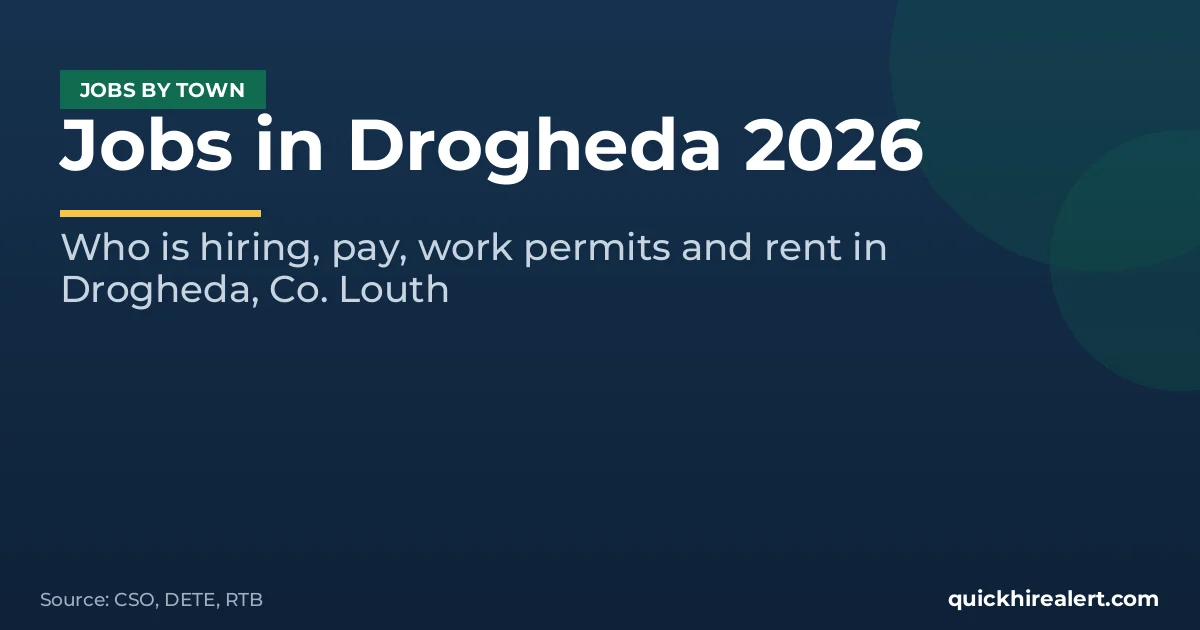
- Jobs: 402,800 people were employed in the Mid-East region (Kildare, Louth, Meath and Wicklow) in Q3 2026, and the unemployment rate was 6.0%, against 5.0% for the State (CSO).
- Pay: median weekly earnings among County Louth residents were EUR 728.06 in 2025, against EUR 759.21 for the State (CSO).
- Work permits: DETE issued 669 employment permits to employers in County Louth from January to October 2026, after 511 in the whole of 2025.
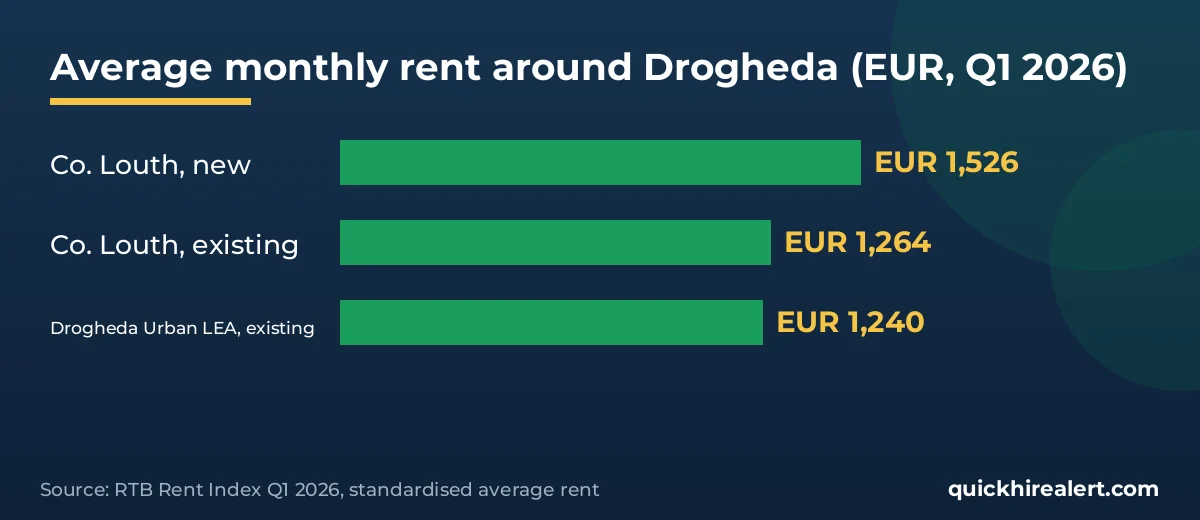
- Rent: the standardised average rent for new tenancies in County Louth was about EUR 1,526 a month in Q1 2026 (RTB).
- Foreign applicants: most non-EEA nationals need an employment permit before they start work, and the employer usually applies for it.
Live Jobs in Drogheda
We list a job only after reading it on the employer’s own vacancy page and confirming that it is open to all applicants. Always read the full specification for the contract, pay and requirements before you apply.
No live vacancy is listed for Drogheda today. Use the employer list below, the HSE jobs page and the employers’ own careers pages.
Who Is Hiring in Drogheda? Large Employers to Check
These large employers are based in or near Drogheda. We list them so you know where to look first; we do not claim that any of them is hiring today.
- Our Lady of Lourdes Hospital (HSE): a large acute hospital in the town, with nursing, healthcare assistant, medical and support roles on the HSE jobs site.
- Louth County Council: the council has offices in Drogheda; its headquarters are in Dundalk.
- Dublin employers: many Drogheda residents work in Dublin. See our Jobs in Dublin guide.
- Supermarkets and retail: Aldi and Lidl publish their pay. Aldi store assistants outside Dublin start at EUR 15.40 an hour and rise to EUR 17.90, and Lidl’s minimum rate is EUR 15.40 with a top rate of EUR 17.90 (company pages). Check each store’s own advert for hours.
Public sector jobs are advertised on each body’s own website or on publicjobs.ie. Our guides to public and civil service jobs and how to apply for HSE jobs explain each step. Private employers advertise on their own careers pages, so check those first rather than relying on reposted adverts.
Which Sectors Employ the Most People Around Drogheda?
The CSO reports employment for the Mid-East region, which covers Kildare, Louth, Meath and Wicklow, so the figures below include all of those counties and not Drogheda alone.
| Sector (CSO, Q3 2026) | People employed, Mid-East region |
|---|---|
| Human health and social work | 51,200 |
| Wholesale and retail trade | 46,900 |
| Industry (manufacturing, energy, water) | 45,000 |
| Education | 38,700 |
| Construction | 32,200 |
| Transport and storage | 25,700 |
| Finance, insurance and real estate | 24,000 |
| Professional, scientific and technical | 23,500 |
| All sectors | 402,800 |
In the Mid-East region, human health and social work is the biggest employer by number of people, followed by wholesale and retail trade and industry (manufacturing, energy, water). The regional unemployment rate was 6.0% in Q3 2026, compared with 5.2% in Q2 2026.
Pay in Drogheda and County Louth
The CSO publishes earnings by the county where employees live, using 2025 data. These figures cover residents of County Louth, wherever they work.
| 2025 (CSO) | Co. Louth | State |
|---|---|---|
| Median weekly earnings | EUR 728.06 | EUR 759.21 |
| Mean weekly earnings | EUR 884.21 | EUR 974.08 |
| Median annual earnings | EUR 42,148 | EUR 46,305 |
| Mean annual earnings | EUR 51,074 | EUR 58,127 |
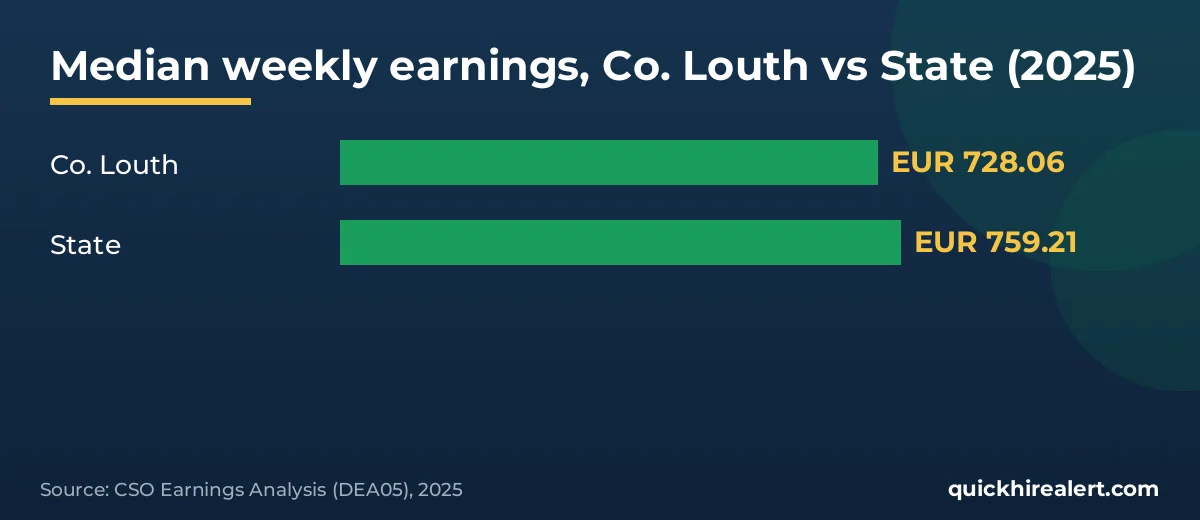
Median weekly earnings among County Louth residents were about EUR 31.15 below the State median in 2025 (our arithmetic).
Mean annual earnings by sector for County Louth residents in 2025 (CSO): industry EUR 58,992, human health and social work EUR 43,421, education EUR 58,529, construction EUR 51,355, wholesale and retail trade EUR 39,854 and accommodation and food service EUR 26,309.
The national minimum wage is EUR 14.15 an hour from 1 January 2026 for workers aged 20 and over, and the Government has announced EUR 14.94 from 1 January 2027. See our guides to the minimum wage and the salary calculator to work out take-home pay.
Work Permits in County Louth
| Employment permits (DETE) | Issued | Refused |
|---|---|---|
| Co. Louth, 2025 | 511 | 54 |
| Co. Louth, January to October 2026 | 669 | 53 |
| State, January to October 2026 | 33,362 | 3,758 |
County Louth accounted for about 2% of the permits issued in the State from January to October 2026, and about 1.6% in 2025 (our arithmetic). The tables show the county where the employer is based, so a permit counted here may be for a job anywhere in the county. See our Ireland work permit statistics 2026 page for nationality, sector and employer tables.
Rent in Drogheda
| Rent measure (RTB) | Monthly rent |
|---|---|
| Co. Louth, new tenancies, standardised average, Q1 2026 | EUR 1,526 |
| Co. Louth, existing tenancies, standardised average, Q1 2026 | EUR 1,264 |
| Drogheda Urban local electoral area, existing tenancies, Q1 2026 | EUR 1,240 |
| Drogheda, Co. Louth, average rent for new tenancies, Q4 2025 (RTB data published by the CSO) | EUR 1,462 |
| Drogheda, Co. Meath side, average rent for new tenancies, Q4 2025 (RTB data published by the CSO) | EUR 1,831 |
New tenancies are leases that began in the quarter, so they are the best guide if you are looking for a home now. Existing tenancies are leases that have run for at least a year. Rent is higher on the Meath side of the town: the RTB data published by the CSO shows about EUR 1,831 a month for new tenancies there in Q4 2025, against about EUR 1,462 on the Louth side. Our guide to the cost of living in Ireland shows how rent fits into a monthly budget.
How to Find a Job in Drogheda
- Start with the large employers listed above and the sectors that employ the most people in the region.
- Search the HSE jobs page for health service vacancies and read each specification in full.
- Get a PPS number before you start work.
- Ask for your terms in writing. Our guide to the employment contract in Ireland explains what must be in writing within 5 days and 1 month.
- Know your rights on working hours and breaks.
Part-Time and Student Work in Drogheda
Many part-time and seasonal jobs are in retail, accommodation and food service. If you are a non-EEA student, the Irish Immigration Service says you can work up to 20 hours a week during term time, and up to 40 hours a week during June, July, August and September and between 15 December and 15 January. Check your own immigration permission before you accept any job.
If you are under 18, special rules apply to hours and pay. Our guides to teen jobs in Ireland and the minimum wage for under 18s explain them. Check that your first payslip shows the correct tax, and read our guide to emergency tax if it does not.
Jobs in Drogheda for International Applicants
Most non-EEA nationals need an employment permit before they start work in Ireland, and the employer usually applies for it. Retail, security, cleaning and many hospitality roles are on the Ineligible List of Occupations, so a permit cannot be issued for them. Do not pay anyone who promises you a job or permit in Drogheda. A genuine employer does not ask you for money to hire you.
Check our guides to the Critical Skills Employment Permit, the General Employment Permit and jobs with visa sponsorship to see which route may apply to you.
Frequently Asked Questions
Is it easy to find a job in Drogheda?
The unemployment rate in the Mid-East region was 6.0% in Q3 2026, against 5.0% for the State (CSO). Human health and social work, wholesale and retail trade and industry (manufacturing, energy, water) are the largest sectors by number of people employed in the region.
What is the average salary in Drogheda?
The CSO reports pay by county. Median weekly earnings among County Louth residents were EUR 728.06 in 2025 and mean annual earnings were EUR 51,074, against EUR 58,127 for the State.
Who are the biggest employers in Drogheda?
Large employers in and around Drogheda include Our Lady of Lourdes Hospital (HSE) and Louth County Council, and many residents commute to jobs in Dublin. Check each employer's own careers page for current vacancies.
How many work permits are issued in County Louth?
DETE issued 669 employment permits to employers in County Louth from January to October 2026 and refused 53. In 2025 it issued 511 and refused 54.
Can foreigners get jobs in Drogheda?
Yes, but most non-EEA nationals need an employment permit before they start work, and the employer usually applies for it. EU and EEA citizens, and people with Stamp 4, do not need one.
How much is rent in Drogheda?
The RTB standardised average rent in County Louth was about EUR 1,526 a month for new tenancies and about EUR 1,264 for existing tenancies in Q1 2026. In the Drogheda Urban local electoral area, existing tenancies averaged about EUR 1,240.
How many people live in Drogheda?
Drogheda had 44,135 people at Census 2022, which makes it the largest town in Ireland (CSO).
What is the minimum wage in Ireland?
The national minimum wage is EUR 14.15 an hour from 1 January 2026 for workers aged 20 and over. The Government has announced an increase to EUR 14.94 from 1 January 2027.
Related Guides
- Jobs in Dublin
- Jobs in Navan
- Average Salary in Ireland 2026
- Minimum Wage Ireland 2026 and 2027
- Ireland Work Permit Statistics 2026
- Part-Time Jobs for Students in Ireland
- Employment Contract in Ireland
Sources
- CSO: Labour Force Survey, regional tables QLF07 and QLF08 (Q3 2026)
- CSO: Census 2022, population of towns (F1015)
- CSO: Distribution of Earnings by Gender and County 2025 (tables DEA05 and DEA08)
- DETE: Employment permit statistics (permits by county, 2025 and 2026)
- RTB: Rent Index Q1 2026 (county and local electoral area tables)
- CSO: RTB average monthly rent by town (RIQ02) (Q4 2025)
- Irish Immigration Service: FAQ for students (work hours)
Verification note: CSO figures were read from the CSO PxStat tables and RTB figures from the RTB Rent Index spreadsheets on 21 November 2026. Regional labour figures cover the whole Mid-East region. Percentages and differences marked as ours are our own arithmetic. Rents are rounded to the nearest euro.
Get an email when Ireland's permit rules change
Salary thresholds, occupation lists and visa rules change every year. Subscribe and we will tell you when they do, plus new job guides. Free, no spam.
Subscribe free