
Last updated: 17 November 2026 | Information verified: Revenue.ie pages on emergency tax (overview, rules, getting off emergency tax and refunds, all published 24 February 2026), Starting your first job (published 31 August 2026) and the Revenue tax relief charts (2026), checked on 17 November 2026.
Your first payslip in Ireland can be a shock. If it shows much more tax than you expected, you are probably on emergency tax. Emergency tax Ireland is not a fine and it is not permanent. It is the rate your employer uses when Revenue has not told them how much tax to take from you.
The good news is that you can fix it, and in most cases you get the extra tax back. This guide explains why it happens, what the 2026 emergency rates are, the steps to stop it and how the refund works.
Quick answer
- Why it happens: Your employer cannot get a Revenue Payroll Notification (RPN) because they have no PPSN for you, or your job is not registered with Revenue.
- No PPSN given: All your pay is taxed at 40%.
- PPSN given, job not registered: The single person rate band applies for 4 weeks, then all income is taxed at 40% from week 5.
- Emergency USC: A flat 8% in 2026.
- How to stop it: Give your employer your PPSN and register the job in Revenue myAccount (PAYE Services, Add Job or Pension Details).
- Refund: Paid by your employer on the next pay day after they get a cumulative RPN.
Emergency Tax Ireland: Key Facts
| Item | What Revenue says |
|---|---|
| What it is | Income Tax and USC deducted at emergency rates when the employer has no RPN |
| No PPSN given to employer | All pay taxed at 40% |
| PPSN given, job not registered | Single person rate band for weeks 1 to 4, then 40% on all income from week 5 |
| Emergency USC | Flat rate, 8% in 2026 |
| Where you fix it | Revenue myAccount, PAYE Services, Add Job or Pension Details |
| What you need | Your PPSN, your employer’s Tax Registration Number (TRN) and your start date |
| Refund (cumulative RPN) | Employer refunds overpaid tax and USC on the next pay day |
| Refund (Week 1 RPN) | No refund until a cumulative RPN is issued |
| Earlier years | File an Income Tax Return in myAccount (review the previous 4 years) |
What Is Emergency Tax in Ireland?
In Ireland your employer deducts Income Tax and Universal Social Charge (USC) from your pay before you receive it. To do that correctly they need information from Revenue: your tax credits, your rate band and your USC rate band. Revenue sends this to the employer in a document called a Revenue Payroll Notification, or RPN.
If the employer cannot get an RPN, they must deduct tax at the emergency rates. Revenue says this applies where you have not given your employer a PPSN, or where your job has not been registered with Revenue. Emergency rates are deliberately high, so most people who are on them are paying more than they will owe over the year.
Emergency tax is not a penalty for doing something wrong. It is the default when Revenue’s system has no information about you and your job yet. Once the information is in place, the emergency deductions stop.
When Do You Pay Emergency Tax in Ireland?
Revenue describes two situations. Which one applies to you decides how much is taken.
| Situation | How you are taxed |
|---|---|
| You did not give your employer a PPSN | All pay taxed at the higher rate of 40% |
| You gave a PPSN but the job is not registered with Revenue | Single person rate band for the first 4 weeks, then 40% on all income from week 5 |
In both cases, emergency USC also applies. Revenue says it is a flat rate, 8% in 2026, applied to all your income.
This catches new arrivals, school leavers, returning emigrants and anyone starting their first job in Ireland. If you are moving here for work, get your PPSN early. Our guide to getting a PPS number in Ireland covers the documents and the appointment.
How Much Emergency Tax Will You Pay?
Revenue gives worked examples on its emergency tax rules page. We use them here so you can see the scale.
No PPSN given
Revenue’s example is pay of €800 a week. At 40%, the tax is €320 a week.
PPSN given, job not registered
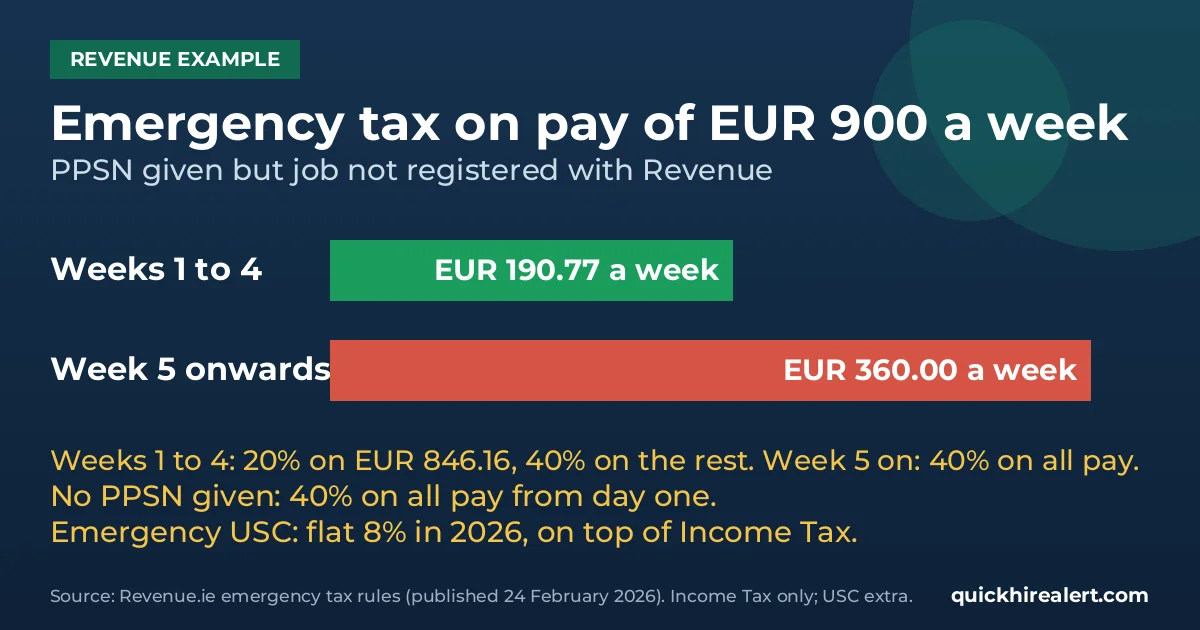
Revenue’s example is pay of €900 a week. The weekly single person rate band is €846.16, which is one 52nd of €44,000. In weeks 1 to 4 the tax is:
- 20% on €846.16 = €169.23
- 40% on the remaining €53.84 = €21.54
- Total Income Tax = €190.77 a week
From week 5, all income is taxed at 40%. On €900 a week that is €360 a week, according to Revenue’s example.
Our arithmetic on the €900 example
These two lines are our own calculation from Revenue’s figures, not Revenue’s numbers:
- Four weeks at €190.77 = €763.08 of Income Tax in weeks 1 to 4.
- Emergency USC at 8% of €900 = €72 a week on top of the Income Tax.
The longer your job stays unregistered, the more you overpay, so it pays to fix it in your first week. To see what you should normally take home, use our salary calculator for Ireland. Remember that normal deductions use your tax credits. The 2026 Revenue chart lists a Single Person tax credit of €2,000, an Employee (PAYE) tax credit of €2,000 and a standard rate band of €44,000 for a single person with no qualifying children. Revenue’s chart also notes changes announced in Budget 2027, so check Revenue for the figures that apply to you.
How to Stop Paying Emergency Tax
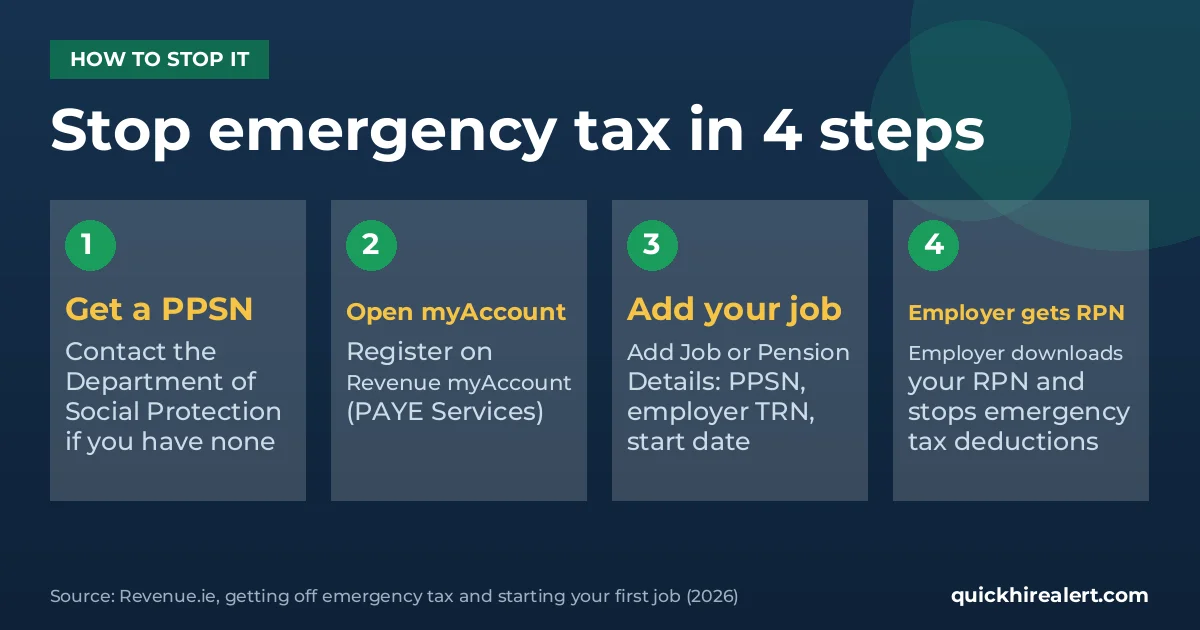
Emergency rates stop when three things are true: your employer has your PPSN, your job is registered with Revenue, and your employer can download an RPN. Revenue says to do this as soon as possible, ideally so the employer can request your RPN before your first pay day.
If it is your first job in Ireland
- Get a PPSN from the Department of Social Protection if you do not have one.
- Register for Revenue myAccount.
- Go to PAYE Services and choose Add Job or Pension Details.
- Enter your PPSN, your employer’s Tax Registration Number (TRN) and your start date.
- Once the job is registered, Revenue makes an RPN available to your employer.
Revenue’s page on starting your first job says to notify Revenue as soon as possible, or you may have to pay emergency tax. Your employer’s TRN is in the same format as a PPSN. Ask your employer or payroll team for it.
If it is not your first job
Your employer registers the job. Give your PPSN to the new employer as early as you can. If you have more than one job, check them in myAccount under Managing Tax for the current year and split your tax credits and rate bands between jobs if needed.
How to Get an Emergency Tax Refund
Once your employer receives your RPN, they stop deducting emergency tax. What happens to the extra tax already taken depends on the type of RPN.
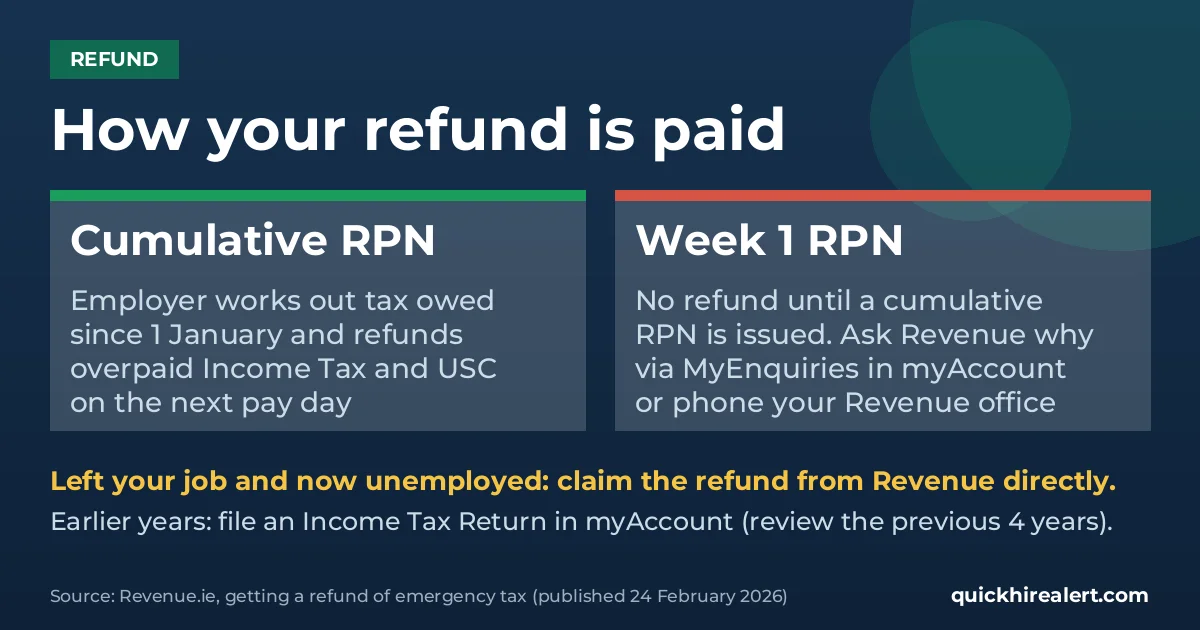
Cumulative RPN
Your employer works out the tax you owe from 1 January and refunds any overpaid Income Tax and USC on the next pay day. The date they receive the RPN decides which pay day that is.
Week 1 RPN (non-cumulative)
No refund can be made until a cumulative RPN is issued. Revenue says to ask why through MyEnquiries in myAccount, or by phoning your Revenue office.
If you changed job or left your job
If you moved to a new job in the same year, the new employer makes the refund when they get the cumulative RPN. If you left and are now unemployed, you claim the refund from Revenue directly.
Refund for a previous year
Revenue says you can file an Income Tax Return in myAccount. Under PAYE Services choose Review your tax for the previous 4 years, request a Statement of Liability, then choose Complete Income Tax Return. Delays can come from multiple active jobs, movement of allowances or residency issues. If that happens, use MyEnquiries.
Your First-Week Checklist
- Take your PPSN to your first day of work, or apply for one straight away.
- Ask your employer for their Tax Registration Number (TRN).
- Register for myAccount and add the job before your first pay day.
- Check your first payslip. Look for the tax and USC lines and compare them with our take-home pay calculator.
- If the deductions still look too high after two or three weeks, contact Revenue through MyEnquiries.
Knowing your pay rate also helps. See the current minimum wage in Ireland and the average salary in Ireland to check your gross pay is right before you look at tax.
Scam Warning: Refund Offers
This is our advice, not a Revenue rule. You can complete every step in this guide yourself in myAccount. Be careful with anyone who contacts you by text, email or social media offering a refund, or who asks for your myAccount password or your PPSN. Always go to revenue.ie directly.
Frequently Asked Questions
What is emergency tax in Ireland?
Emergency tax is the set of higher rates your employer uses to deduct Income Tax and USC when it cannot get a Revenue Payroll Notification (RPN) for you. Revenue says this happens where the employer does not have your PPSN or your job has not been registered with Revenue.
How much emergency tax will I pay in 2026?
It depends on your situation. If your employer has no PPSN, all your pay is taxed at 40%. If you gave your PPSN but the job is not registered, the single person rate band applies for the first four weeks (20% up to the band, 40% on the rest), then all your income is taxed at 40% from week 5. Emergency USC is a flat 8% in 2026.
How do I stop paying emergency tax?
Make sure your employer has your PPSN and that your job is registered with Revenue. For a first job in Ireland you register it yourself in myAccount under PAYE Services, using Add Job or Pension Details. Once your employer can download an RPN, they cease emergency tax and use your tax credits and rate bands.
Will I get my emergency tax back?
Usually yes, if you were overtaxed. When your employer receives a cumulative RPN they work out the tax owed since 1 January and refund any overpaid Income Tax and USC on the next pay day. If you only get a Week 1 RPN, no refund can be made until a cumulative RPN is issued.
Do I pay emergency tax if I do not have a PPSN?
Yes. Revenue says that if you do not give your employer a PPSN, all your pay is taxed at the higher rate of 40%. Get a PPSN from the Department of Social Protection, then register for myAccount and add your job.
Can I claim back emergency tax from a previous year?
Yes. Revenue says you can file an Income Tax Return in myAccount. Go to PAYE Services, choose Review your tax for the previous 4 years, request a Statement of Liability, then complete the Income Tax Return.
What if I left the job and I am now unemployed?
If you left the job and are unemployed, Revenue says you claim the refund from Revenue directly instead of through an employer.
What if I start a second job?
Give your PPSN to the new employer so they register the job with Revenue. In myAccount you can check your jobs under Managing Tax for the current year and split your tax credits and rate bands between jobs if needed.
Related Guides
- how to get a PPS number in Ireland
- salary calculator Ireland
- minimum wage in Ireland
- average salary in Ireland
- annual leave in Ireland
- sick leave in Ireland
- how to get a job in Ireland
Official Sources
- Revenue: Emergency Tax
- Revenue: Emergency Tax rules
- Revenue: How to stop paying Emergency Tax
- Revenue: Getting a refund of Emergency Tax
- Revenue: Starting your first job
- Revenue: Tax relief charts
Verification note: We read the Revenue pages above on 17 November 2026. Emergency rates and credits can change in each Budget, so check revenue.ie before you rely on a figure. We could not cross-check against Citizens Information for this page because it blocked automated reading, and we did not verify the 2026 USC bands or PRSI rate, so we do not quote them here.
Get an email when Ireland's permit rules change
Salary thresholds, occupation lists and visa rules change every year. Subscribe and we will tell you when they do, plus new job guides. Free, no spam.
Subscribe free