
Last updated: 13 November 2026 | Information verified: 13 November 2026 against Citizens Information (Jobseeker’s Allowance, edited 9 October 2026; Migrant workers and unemployment, edited 30 September 2026; the habitual residence condition, edited 24 July 2025) and gov.ie.
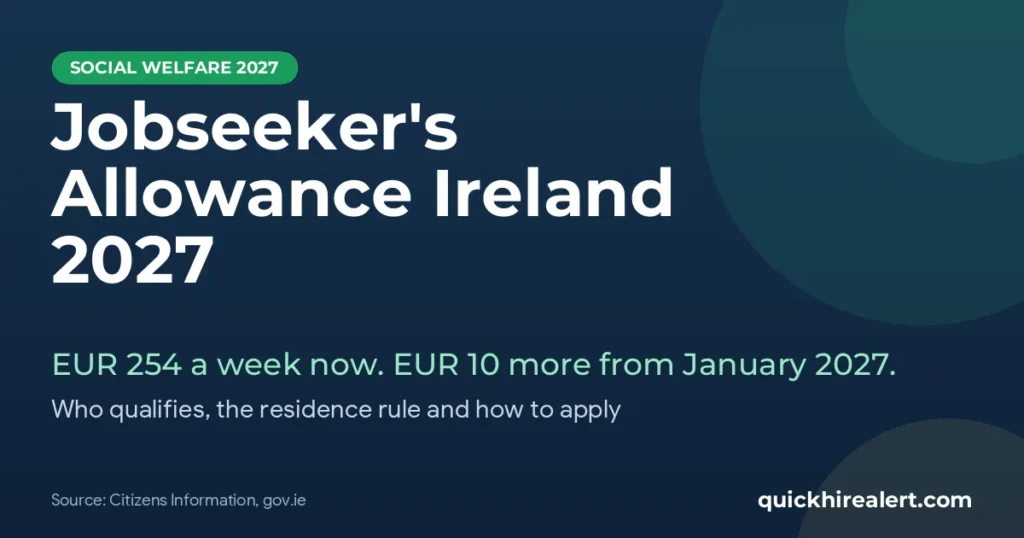
Jobseeker’s Allowance is a weekly payment for people in Ireland who are out of work and looking for a job. In 2026 the top rate is €254 a week, and it rises by €10 from January 2027. You have to pass a means test, and if you have come from abroad you also have to meet the habitual residence condition.
This guide covers who can claim, the 2026 and 2027 rates, how the residence rule works for people from outside Ireland, what to do if you lose your job on an employment permit, how much you can work while claiming, and how to apply. Everything below comes from Citizens Information and gov.ie.
Quick answer
- 2026 rate: up to €254 a week for most adults.
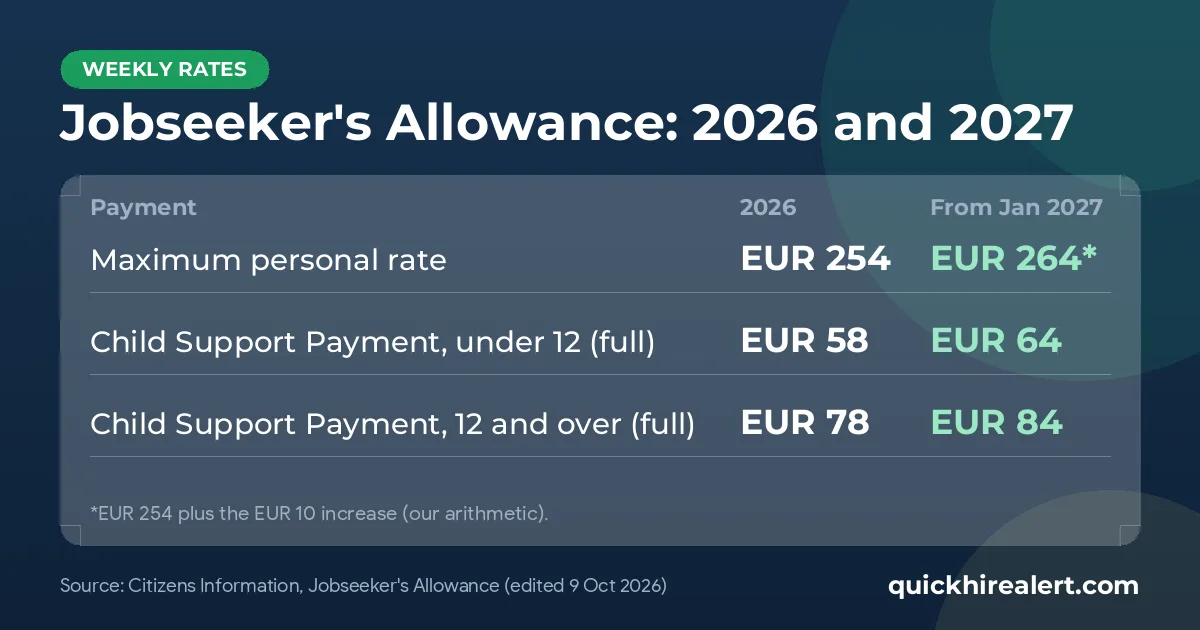
- 2027: the maximum rate rises by €10 from January, to €264 (our arithmetic).
- Who: aged 18 to 65, unemployed or working 3 days a week or less, available for and seeking full-time work.
- From abroad: you must pass the habitual residence condition, which includes having a right to reside.
- Apply: on your first day unemployed, at MyWelfare.ie or on a paper form.
Key Facts at a Glance
| Question | Answer | Source |
|---|---|---|
| Maximum weekly rate, 2026 | €254 | Citizens Information |
| Change from January 2027 | The maximum rate rises by €10 | Citizens Information |
| Age | 18 or over and under 66 | Citizens Information |
| Work limit | 3 days a week or less, still seeking full-time work | Citizens Information |
| Residence test | Habitual residence condition | Citizens Information, gov.ie |
| Where to apply | MyWelfare.ie or a paper form | Citizens Information |
| First 3 days of a claim | Not paid | Citizens Information |
Jobseeker’s Allowance Rates for 2026 and 2027
| Who you are | Weekly rate, 2026 |
|---|---|
| Aged 25 and over | €254 |
| Aged 18 to 24, living independently* | €254 |
| Aged 18 to 24, not living independently | €163.70 (€254 if you have children) |
| Increase for an adult dependant (25 and over) | €168.60 |
| Child Support Payment, under 12 | €58 full rate, €29 half rate |
| Child Support Payment, 12 and over | €78 full rate, €39 half rate |
*Citizens Information says you count as living independently if you get State housing support such as Rent Supplement, the Rental Accommodation Scheme or the Housing Assistance Payment.
From January 2027 the maximum rate of €254 increases by €10, so the top rate becomes €264 a week. Citizens Information says the qualified adult and reduced rates rise in proportion but does not yet give exact figures, so check its Jobseeker’s Allowance page in January for the new table. The Child Support Payment rises to €64 a week for a child under 12 and €84 for a child aged 12 and over.
Who Can Get Jobseeker’s Allowance
Citizens Information lists these conditions. You must:
- be aged 18 or over and under 66;
- be fully unemployed, or working 3 days a week or less;
- be available for full-time work and genuinely seeking it;
- be capable of work;
- pass the means test;
- meet the habitual residence condition.
Jobseeker’s Allowance is means tested. Citizens Information also describes an insurance-based jobseeker’s payment for people who have paid enough PRSI. If you do not qualify for that payment, you can apply for Jobseeker’s Allowance instead.
Non-EEA students are not entitled to social welfare payments, according to Citizens Information. If you are on a student permission, read our guide to part-time jobs for students in Ireland for what you can do.
The Habitual Residence Condition: What It Means If You Come From Abroad
The habitual residence condition applies to Jobseeker’s Allowance whatever your nationality. gov.ie says you only count as habitually resident if you meet both parts of the test.
- A right to reside. You need permission to live in the State. gov.ie lists Irish nationals, UK nationals under the Common Travel Area, EEA nationals who work in Ireland, and non-EEA nationals with permission to reside.
- A close link to Ireland. The term is not defined in Irish law. In practice it means you have lived here for some time and plan to stay for the foreseeable future.
The deciding officer looks at five factors:
- how long you have lived in Ireland;
- how long you have spent abroad and why;
- the nature and pattern of your employment;
- where your main centre of interest is;
- your future intentions to live in Ireland, shown by evidence.
Citizens Information does not set a minimum number of months or years. Having permission to reside is one step, not a guarantee, because the five factors are still examined. You must be habitually resident on the day you apply and stay that way, and a decision can be reviewed if your circumstances change. If you disagree with a decision, you can appeal to the Social Welfare Appeals Office within 60 days.
If You Lose Your Job on an Employment Permit
Citizens Information says non-EEA migrant workers who qualify for an insurance-based jobseeker’s payment can get it if they are legally resident. If you are not entitled to that payment, you can apply for Jobseeker’s Allowance, and you must be habitually resident.
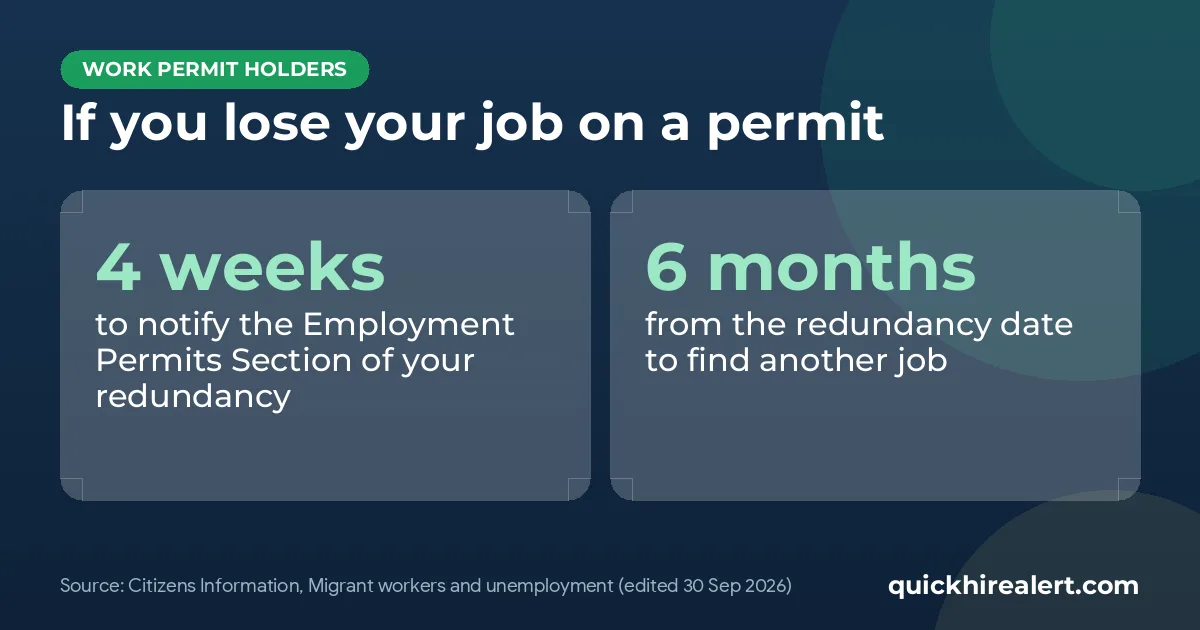
Your permit has its own deadlines. Citizens Information gives two:
- Notify the Employment Permits Section within 4 weeks of the redundancy, using the Redundancy Notification Form.
- You have up to 6 months from the date you were made redundant to find another job.
You may be eligible for a Reactivation Employment Permit if you fell out of the system through no fault of your own, or if you were badly treated or exploited at work. A redundancy payment may apply if you worked for your employer for at least 2 years. If you find a new employer, read our guide to changing employer on an Irish work permit, and see our work permit renewal guide for the next step.
Your immigration permission has its own conditions. Before you rely on a payment, check how it applies to you with the Department of Social Protection or the Irish Immigration Service.
EEA workers
Citizens Information says EEA workers can stay in Ireland while they are unemployed and looking for work, and can combine social insurance paid in another EU country to qualify for the insurance-based payment. If you do not qualify but are actively looking for work, you can meet the habitual residence requirement for Supplementary Welfare Allowance, which is means tested. If you worked in Ireland for less than 12 months, you can get it for 6 months from the date your employment ended.
Working While You Claim
- You can get Jobseeker’s Allowance for the days you do not work if you work 3 days a week or less and still look for full-time work.
- If your employer cuts your hours to 3 days a week or less, you may get the payment for the other days.
- Income from work affects your rate.
- After more than 15 months (390 days) on long-term Jobseeker’s Allowance, you may apply for the Part-time Job Incentive Scheme if you take part-time work of under 24 hours a week.
To see what a job pays, use our minimum wage guide and the salary calculator for Ireland. You also need a PPS number to work, so see how to get a PPS number.
How to Apply for Jobseeker’s Allowance
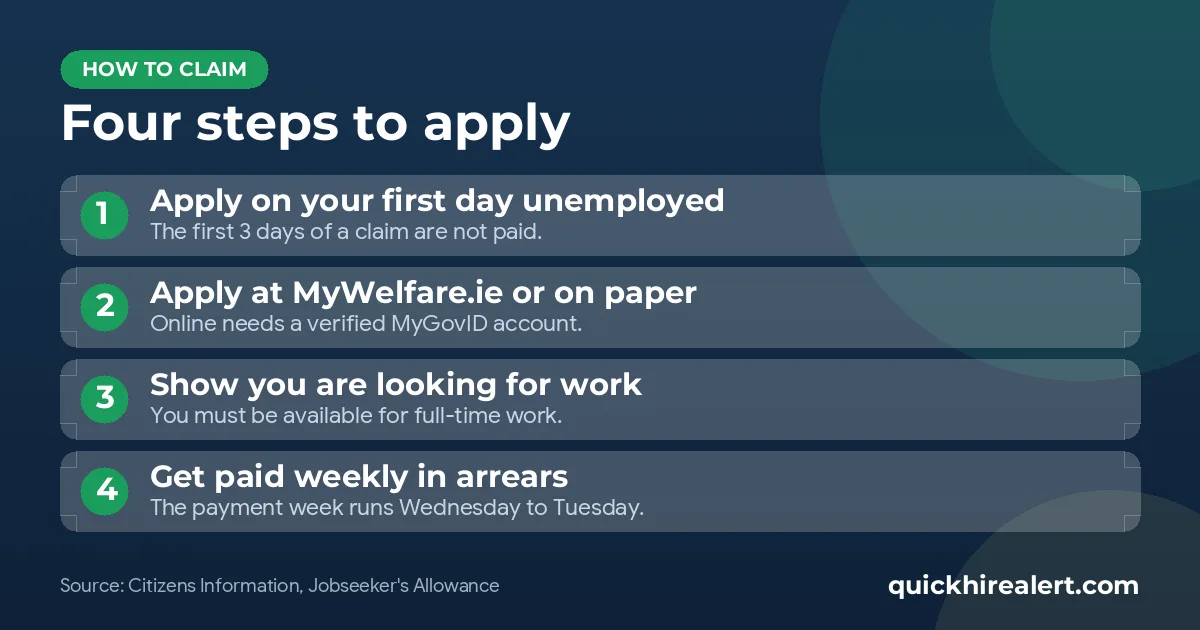
- Apply on your first day unemployed. The first 3 days of a claim are not paid.
- Apply online at MyWelfare.ie. You need a verified MyGovID account.
- Or use a paper form. Email Jobseekersforms@welfare.ie, or pick one up at an Intreo Centre or Social Welfare Branch Office.
- Repeat claims. If it has been less than 6 months since your last claim, use the separate repeat claim form.
- Show you are looking for work. You must be able to prove it to the Department of Social Protection.
How You Are Paid
Jobseeker’s Allowance is paid weekly in arrears. Most people collect it at a post office with a Public Services Card or Social Services Card. Part-time and casual workers, and people over 62, are paid into a financial institution or by cheque. The payment week runs from Wednesday to Tuesday.
Frequently Asked Questions
How much is Jobseeker’s Allowance in Ireland in 2026?
The maximum weekly rate is €254 for people aged 25 and over, and for people aged 18 to 24 who live independently. Citizens Information lists €163.70 for people aged 18 to 24 who do not live independently, unless they have children, when the rate is €254.
How much will Jobseeker’s Allowance be in 2027?
Citizens Information says the maximum rate of €254 will increase by €10 from January 2027. That makes €264 a week (our arithmetic). The Child Support Payment rises to €64 a week for a child under 12 and €84 for a child aged 12 and over.
Who can claim Jobseeker’s Allowance?
You must be aged 18 or over and under 66, fully unemployed or working 3 days a week or less, available for full-time work and genuinely seeking it, capable of work, pass the means test and meet the habitual residence condition.
Can a work permit holder claim Jobseeker’s Allowance?
Citizens Information says non-EEA migrant workers who qualify for an insurance-based jobseeker’s payment can get it if they are legally resident. If you are not entitled to that payment, you can apply for Jobseeker’s Allowance, which is means tested, and you must be habitually resident. Check how your own permission and permit conditions apply with the Department of Social Protection or the Irish Immigration Service before you rely on a payment.
What is the habitual residence condition?
It is a test for Jobseeker’s Allowance and several other payments. It has two parts: you need a right to reside in Ireland, and you need a proven close link to the country, judged on five factors. Citizens Information says no minimum length of stay is set.
Can I work and still get Jobseeker’s Allowance?
You can get it for the days you do not work if you work 3 days a week or less and you are still looking for full-time work. Income from work affects your rate. After more than 15 months (390 days) on long-term Jobseeker’s Allowance, you may be able to apply for the Part-time Job Incentive Scheme if you take part-time work of under 24 hours a week.
How do I apply for Jobseeker’s Allowance?
Apply online at MyWelfare.ie with a verified MyGovID account, or ask for a paper form by emailing Jobseekersforms@welfare.ie or collecting one from an Intreo Centre or Social Welfare Branch Office. Apply on the first day you become unemployed, because the first 3 days of a claim are not paid.
What happens if I lose my job on an employment permit?
Citizens Information says you must notify the Employment Permits Section within 4 weeks using the Redundancy Notification Form. You have up to 6 months from the date you were made redundant to find another job.
Related Guides
- Minimum wage in Ireland
- Salary calculator for Ireland
- Change employer on an Irish work permit
- Employment permit renewal in Ireland
- How to get a PPS number
- Part-time jobs for students in Ireland
- Main jobs in Ireland
- Bank holidays in Ireland
Official Sources
- Citizens Information: Jobseeker’s Allowance
- Citizens Information: The habitual residence condition
- Citizens Information: Migrant workers and unemployment
- gov.ie: Habitual Residence Condition
- MyWelfare.ie
Last verified: 13 November 2026. This guide explains published rules and is not legal or social welfare advice. The 2027 top rate of €264 is our own arithmetic (€254 plus the €10 increase Citizens Information announces). Rates and rules change, so check the Department of Social Protection or Citizens Information before you apply.
Get an email when Ireland's permit rules change
Salary thresholds, occupation lists and visa rules change every year. Subscribe and we will tell you when they do, plus new job guides. Free, no spam.
Subscribe free