
Disclaimer: General information, not immigration or legal advice. Renewal rules and thresholds change — renewal timing is set by the Employment Permits Act 2024 and salary thresholds rose on 1 March 2026. Confirm your position with DETE before acting.
Renewal is where people relax, and it is exactly where they should not. A first permit is granted on a promise; a renewal is judged on a record — what you were actually paid, whether the employer stayed compliant, and whether the salary still clears a threshold that may have risen since you started.
Two things make older renewal guidance dangerous: a defined filing window under the Employment Permits Act 2024, and a 2026 salary threshold increase with no grandfathering. Get either wrong and the renewal can be refused.
Quick Answer: How Do You Renew an Irish Work Permit?
You apply through Employment Permits Online before your current permit expires. DETE says the renewal must be submitted within the 4 months before the permit expires, or within 1 month after expiry; once it is submitted within that period, you can keep working while it is processed. The salary must meet the current threshold, not the one that applied when you first got the permit.
Key Facts at a Glance
| Item | Detail |
|---|---|
| First permit duration | Typically 2 years |
| Renewal duration | Typically up to 3 years on renewal |
| GEP filing window | Within 4 months before expiry, or within 1 month after expiry |
| Salary at renewal | Must meet the current threshold — no grandfathering of old figures |
| Renewal fee | GEP renewal: €1,500 for up to 36 months; €750 for 6 months or less |
| 50:50 rule | Must still be satisfied at renewal (GEP) |
| If refused | 28 days to submit a Review, decided by a different DETE officer |
| If the permit lapses | If no renewal is submitted within the prescribed period, the employee must stop working |
When to Apply: The Filing Window

The Employment Permits Act 2024, in force since 2 September 2024, sets out when a renewal can be made. DETE’s guidance is that the application must be submitted within the 4 months before the permit expires, or within 1 month after it expires.
If you apply within that period, DETE says you can continue to work while the renewal is processed. Treat the month after expiry as a safety net, not a plan: applying before the permit runs out keeps your position simplest, including for your immigration registration.
Practical approach: set a reminder for four months before expiry and treat that as the day to start gathering documents, aiming to file comfortably inside the window rather than at its edge.
The Salary Trap: No Grandfathering

This is the single most important thing on this page.
At renewal, your salary must meet the threshold in force now — not the threshold that applied when your first permit was granted. There is no grandfathering: DETE defines the minimum annual remuneration as the lowest salary for a permit “to be issued or renewed” (DETE, December 2025).
A concrete example: an employee on a 2024 General Employment Permit at €34,000 who has had no pay rise. The General Employment Permit threshold rose to €36,605 on 1 March 2026. That renewal would fail the threshold test, because €34,000 no longer qualifies.
If this could be you, there are only two options:
- The employer raises the salary to meet the current threshold before applying for renewal, or
- The permit lapses and the employment ends.
The current thresholds, from 1 March 2026:
| Permit | Current threshold |
|---|---|
| Critical Skills (listed role, relevant degree) | €40,904 |
| Critical Skills (unlisted occupation) | Above €68,911 |
| General Employment Permit (standard) | €36,605 |
| General Employment Permit (defined roles) | €32,691 |
These sit under the government’s Minimum Annual Remuneration roadmap, which is scheduled to keep raising thresholds. Anyone approaching renewal should check the current figure early enough to negotiate a pay rise if needed — that conversation is far easier four months out than four weeks out.
What a Renewal Application Requires
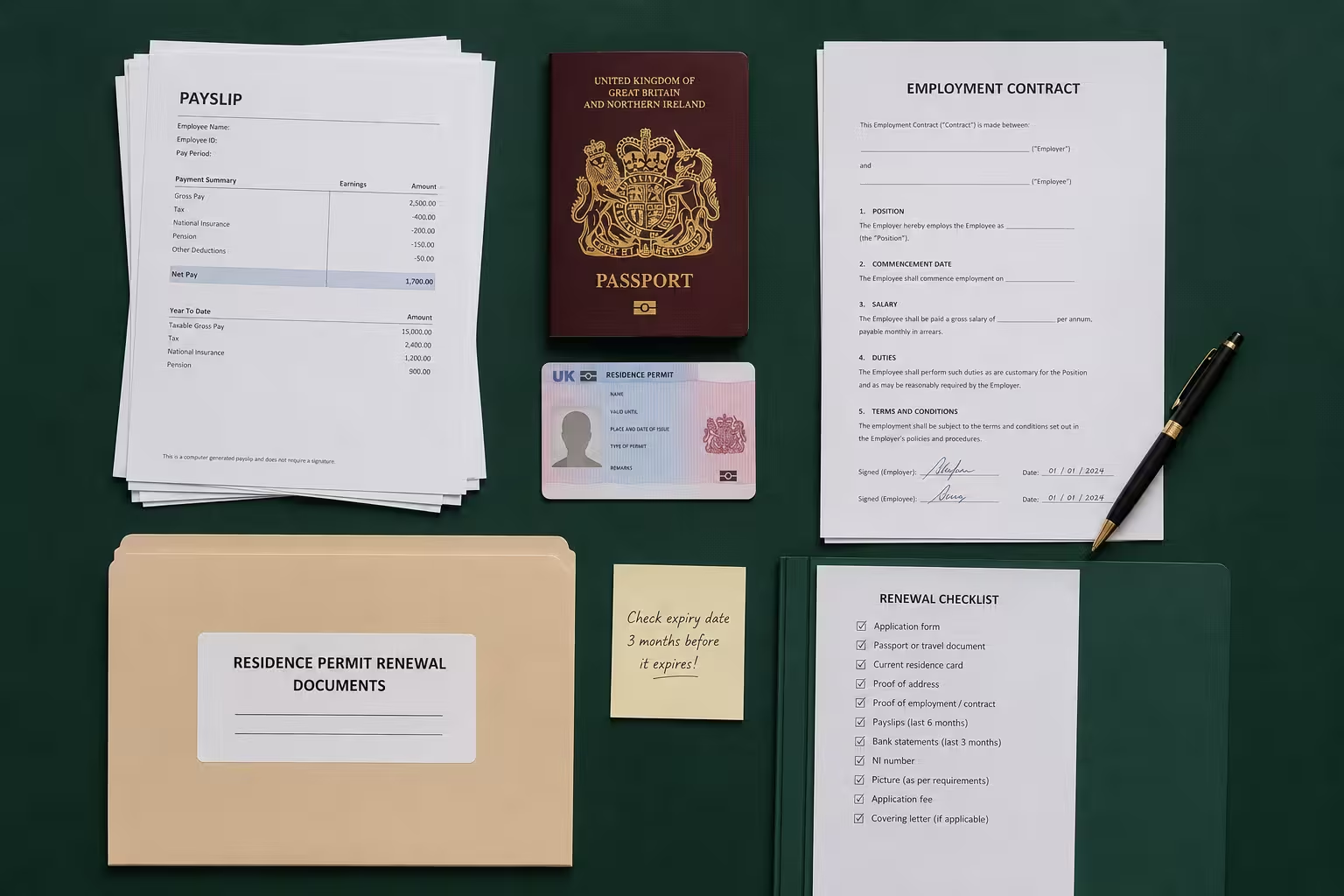
A renewal is a superset of the original application: everything you supplied first time, plus evidence of what happened during the first permit period. DETE is checking that the promises made at grant were kept.
- Current employment permit and IRP details
- Passport
- An up-to-date signed contract reflecting the post-March salary
- Payslips covering the permit period — proving you were actually paid at or above threshold throughout, not just on paper
- Confirmation the role still sits on the Critical Skills list, or that the Labour Market Needs Test exemption or position continues to apply
- Evidence the employer remains registered, trading and compliant
- For a GEP, evidence the 50:50 rule is still satisfied
The payslip requirement is where under-payment during the first term surfaces. If you were paid below threshold at any point — even briefly, even by accident — fix and document it before submitting rather than hoping DETE does not notice. Voluntary correction is far cheaper than a refusal.
Step by Step

- Four months before expiry: diarise it. Check the current salary threshold against your actual basic salary.
- If there is a shortfall, raise the salary conversation with your employer now, while there is time to act.
- Gather documents, especially payslips covering the whole permit period.
- Reconcile any discrepancies — underpayments, contract mismatches — before filing.
- File within the window through Employment Permits Online: within the 4 months before expiry, or at the latest within 1 month after.
- Pay the fee — for a General Employment Permit renewal, €1,500 for up to 36 months or €750 for 6 months or less.
- Keep working until a decision, provided you applied within the prescribed period.
- Renew your IRP separately once the permit renewal is granted, if your immigration registration also needs updating.
What Happens If the Permit Lapses

DETE says that once a renewal application has been submitted within the prescribed period, the employee can continue to work while it is processed. The real risk is missing that period altogether.
If no renewal is submitted within the 4 months before expiry or the month after it, the permit lapses and the employee must stop working. Do not rely on the month after expiry; apply before the permit runs out.
If Your Renewal Is Refused

A refusal is serious but not necessarily final. You have 28 days to submit a Review, which is decided by a different DETE officer from the one who refused it.
The Review works best where the refusal was for a fixable issue — a missing document, or an underpayment that has since been corrected. It is far weaker where the refusal was fundamental, such as an occupation that is no longer eligible or a salary the employer will not raise. Where the problem is fixable, fix it and evidence the fix clearly in the Review.
Do You Even Need to Keep Renewing?

Not necessarily — and this is the strategic point most renewal guides miss.
If you are on a Critical Skills Employment Permit, you can apply for Stamp 4 after 21 months. Stamp 4 removes the permit requirement entirely: no more renewals, no threshold checks, no 50:50 rule, and the freedom to change jobs at will. For most Critical Skills holders, the smarter path is to apply for Stamp 4 rather than renew the permit at all.
General Employment Permit holders face a longer road — Stamp 4 is available after 57 months — so they will typically renew at least once along the way. Our guide to Stamp 1 vs Stamp 4 explains which applies to you.
Common Mistakes
- Assuming the second term is automatic. It is not — the record is re-examined.
- Missing the renewal window: the 4 months before expiry, or 1 month after at the latest.
- Not checking the current salary threshold, and being refused on the March 2026 increase.
- Assuming old thresholds are grandfathered at renewal. They are not.
- Leaving the salary conversation until weeks before expiry, with no time to act.
- Ignoring under-payments during the first term that the payslip check will expose.
- Letting the permit lapse without a renewal application and continuing to work.
- Missing the 28-day Review deadline after a refusal.
- Renewing a Critical Skills permit when you were already eligible for Stamp 4.
- Forgetting that the 50:50 rule is re-tested at renewal for a GEP.
Frequently Asked Questions
How do I renew my work permit in Ireland?
You apply through Employment Permits Online before your current permit expires. The application must be submitted within the 4 months before the permit expires, or within 1 month after expiry, with a salary meeting the current threshold and evidence of compliance during the first permit period.
When should I apply to renew my Irish employment permit?
Within the 4 months before the permit expires. DETE also accepts renewals submitted within 1 month after expiry, but applying before expiry is the safer course.
Is the second work permit term automatic in Ireland?
No. It is a common misconception. At renewal the employer must again satisfy the requirements, including the 50:50 rule for a General Employment Permit and evidence that the correct salary was paid throughout the first term.
Do I have to meet the new salary threshold at renewal?
Yes. Your salary must meet the threshold in force at the time of renewal, not the one that applied when you first got the permit. There is no grandfathering. The General Employment Permit threshold rose to €36,605 on 1 March 2026.
What happens if my salary is below the new threshold at renewal?
The renewal will be refused on threshold grounds. Your options are for the employer to raise the salary to the current threshold before applying, or to let the permit lapse and end the employment. Old thresholds are not grandfathered.
How much does it cost to renew an Irish work permit?
For a General Employment Permit, the renewal fee is €1,500 for up to 36 months or €750 for 6 months or less, higher than a first application. If refused, 90 per cent of the fee is refunded.
What happens if my permit expires before renewal is decided?
If you submitted the renewal within the prescribed period, DETE says you can continue to work while it is processed. If no renewal was submitted within the 4 months before expiry or the month after, the employee must stop working.
Can I appeal a refused work permit renewal?
Yes. You have 28 days to submit a Review, which is decided by a different DETE officer. It works best where the refusal was for a fixable issue such as a missing document or a corrected underpayment.
How long is a renewed permit valid for?
A first permit is typically issued for two years, and a renewal is typically issued for up to three years, subject to the contract and the permit type.
Should I renew my permit or apply for Stamp 4?
If you hold a Critical Skills Employment Permit, you can apply for Stamp 4 after 21 months, which removes the need to renew a permit at all. General Employment Permit holders must wait 57 months for Stamp 4 and will usually renew at least once before then.
Conclusion
Two dates decide most renewals. The filing window — the 4 months before expiry, with a 1-month safety net after — and the day you check whether your salary still clears the current threshold, because old figures are not grandfathered.
Start four months out. Check the salary first. Gather payslips that prove you were actually paid at threshold throughout. And if you hold a Critical Skills permit and have passed 21 months, consider whether Stamp 4 is the better move than renewing at all.
See also our General Employment Permit guide, Critical Skills guide, and changing employer on a work permit.
Sources
- DETE — General Employment Permit
- DETE — Employment Permits
- DETE — Employment Permits FAQs (renewal window, working while a renewal is pending, fees)
- DETE — Minimum Annual Remuneration roadmap announcement, December 2025
- DETE — Current application processing dates
- Citizens Information — Employment permits