

Last updated: 13 October 2026 (salary thresholds, change-of-employer and end-of-employment rules checked against S.I. No. 643 of 2025, S.I. No. 444 of 2024 and the Employment Permits Act 2024). Other information in this guide was verified on 22 July 2026 against official Irish Government sources, including the Department of Enterprise, Tourism and Employment (DETE), Citizens Information and Immigration Service Delivery (ISD).
Disclaimer: This article is general information, not legal or immigration advice. Employment permit rules, salary thresholds and immigration procedures change. Always confirm the current rules on the official websites linked throughout this guide, or speak to a qualified immigration adviser, before making decisions about your application.
If you are a skilled professional from outside the European Economic Area (EEA), the UK or Switzerland, the Critical Skills Employment Permit is usually the most attractive route into the Irish workforce. Ireland created this permit to attract people whose skills are in significant shortage — software engineers, nurses, doctors, civil engineers, data scientists, accountants with specialist skills and many others — and to encourage them to settle in Ireland long term.
The permit comes with benefits that most other Irish work permits do not offer: no labour market test, immediate family reunification, the right for your spouse or partner to work without a permit, and a fast route to Stamp 4 residence after just 21 months of employment. Salary thresholds rose on 1 March 2026, and the Critical Skills Occupations List was updated in May 2026, so this guide reflects the rules that apply right now.
This article covers eligibility, the occupations list, 2026 salary requirements, the application process, fees, processing times, family rights, changing employer and what happens after approval. If you are earlier in your journey, start with our broader guides to jobs in Ireland for Americans and how to get a job in Ireland as an American, then come back here once you understand the permit landscape.
Quick Answer: What Is the Critical Skills Employment Permit?
The Critical Skills Employment Permit is Ireland’s work permit for highly skilled non-EEA professionals. You need a job offer of at least two years (for at least 20 hours a week) from an Irish-registered employer, in an occupation on the Critical Skills Occupations List paying at least €40,904, or any eligible occupation paying at least €68,911. It leads to Stamp 4 residence after 21 months.
Key Facts at a Glance

| Item | Detail (verified 22 July 2026) |
|---|---|
| Permit name | Critical Skills Employment Permit (CSEP) |
| Target applicant | Highly skilled non-EEA nationals with a two-year Irish job offer |
| Minimum salary (listed occupation) | €40,904 per year (from 1 March 2026) |
| Recent-graduate threshold | €36,848 per year (relevant degree, level 8 or higher, awarded within the 12 months before applying) |
| High-salary route | €68,911 or more per year for occupations not on the Ineligible Occupations List |
| Minimum contract duration | 2 years |
| Labour Market Needs Test | Not required |
| Application fee | €1,000 (90% refunded if refused or withdrawn) |
| Typical permit duration | 2 years |
| Family reunification | Immediate; spouse or partner receives Stamp 1G and can work without a permit (not self-employment) |
| Path to Stamp 4 | Apply to ISD after 21 months of employment in Ireland |
Sources: DETE — Critical Skills Employment Permit and Citizens Information.
What Is the Critical Skills Employment Permit?
The Critical Skills Employment Permit is issued by the Department of Enterprise, Tourism and Employment (DETE). It replaced the old Green Card permit and exists for one purpose: to fill occupations that are critically important to Ireland’s economy but in significant shortage in the domestic and EEA labour market. Eligible occupations are largely identified through analysis by the Expert Group on Future Skills Needs.
A non-EEA national is anyone who is not a citizen of an EU country, Norway, Iceland or Liechtenstein. UK and Swiss citizens also do not need employment permits. Everyone else — including citizens of the United States, India, Pakistan, Nigeria, Brazil, the Philippines and China — needs an employment permit to work legally in Ireland in most cases.
Three distinctions matter before you go any further:
- An employment permit is not a travel visa. The permit gives you the legal right to take up a specific job. If you are from a visa-required country, you must separately apply for an entry visa after your permit is approved. US citizens do not need an entry visa, but they still need the permit before starting work.
- An employment permit is not an immigration permission. After you arrive, you must register with Immigration Service Delivery and receive an Irish Residence Permit (IRP) card with the appropriate stamp. DETE states clearly that a permit alone does not make you lawfully resident.
- Approval does not complete the process. Border checks, immigration registration, a PPS number and Revenue registration all still lie ahead. This guide covers each step.
What makes the Critical Skills Employment Permit special is its design goal. DETE describes it as a permit intended to attract highly skilled people and encourage them to take up permanent residence. That is why it carries immediate family reunification, no labour market test and the 21-month route to Stamp 4 — benefits designed for people Ireland wants to keep.
Who Is Eligible for a Critical Skills Employment Permit?

Eligibility rests on four pillars: an eligible job offer, an eligible occupation, the correct salary, and the right qualifications. You must satisfy all four.
Eligible Job Offer
You must have a genuine job offer from a bona fide employer that is based and trading in Ireland and registered with the Revenue Commissioners and, where applicable, the Companies Registration Office. The offer must be:
- For a position lasting at least 2 years — shorter contracts can only be considered for a General Employment Permit
- At least 20 hours a week, with basic pay that meets both the annual threshold and the minimum hourly rate (for example €20.17 an hour at the €40,904 level)
- A direct employer–employee relationship — you work for the named employer, at the location(s) on the permit, not through disguised self-employment or informal outsourcing
Eligible Occupation
The standard route requires your job to appear on the Critical Skills Occupations List. The list is organised using Standard Occupational Classification (SOC 2010) codes, which group jobs by what people actually do rather than what the job is called.
This matters more than most applicants realise. Your job title alone does not determine eligibility. DETE assesses the duties, required qualifications, experience and specialism of the role against the SOC code and, in many cases, against the “Employments with Specific Skills” listed under a broader occupation category. A “Business Analyst” title, for example, could fall under an eligible ICT specialism or an ineligible administrative category depending on what the role actually involves. Read the duties in your contract and job description against the official list before anyone pays a fee.
Salary Requirements in 2026
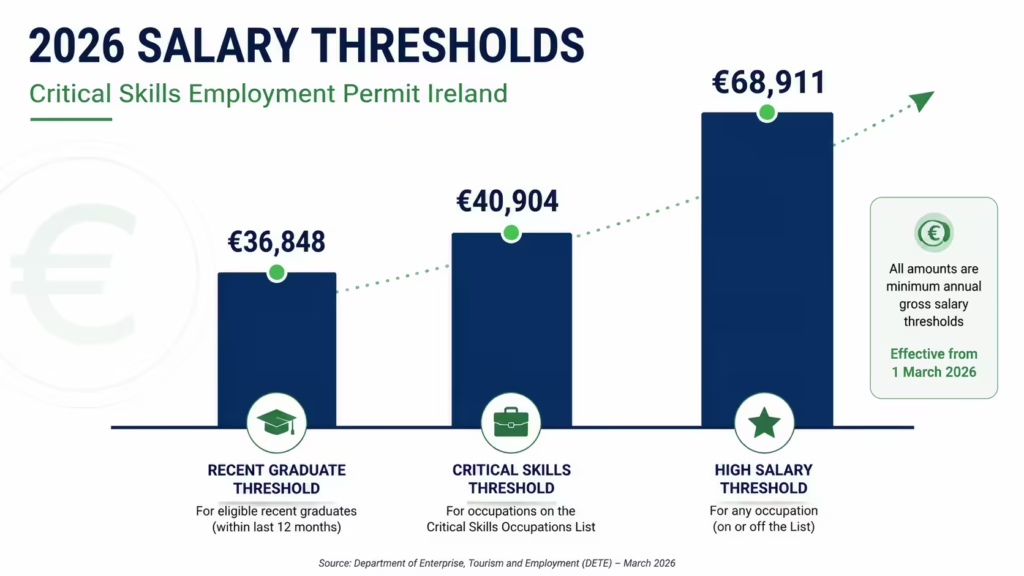
New minimum annual remuneration (MAR) thresholds took effect on 1 March 2026 under the Government’s MAR roadmap announced in December 2025, which plans further gradual increases through 2030. The current thresholds are:
| Route | Minimum annual salary (from 1 March 2026) | Key condition |
|---|---|---|
| Listed occupation (standard) | €40,904 | Job on the Critical Skills Occupations List; relevant degree or higher required |
| Recent graduate | €36,848 | Listed occupation; relevant degree (level 8 or higher) awarded within the 12 months before the application date |
| High-salary route | €68,911 or more | Any occupation not on the Ineligible Occupations List; degree or equivalent experience |
| Public sector roles under a pay agreement | Rate set by the public pay agreement | Includes Section 38 health employers |
These figures are set in Schedule 8 of the Employment Permits Regulations 2024, inserted by S.I. No. 643 of 2025 with effect from 1 March 2026. The regulations also set minimum hourly rates: €20.17 at the €40,904 level, €18.17 at the €36,848 level and €33.98 at the €68,911 level. The lower graduate rate applies only to a relevant degree; nurses, midwives and radiographers who qualify through NMBI or CORU registration use the €40,904 rate (or the public pay-agreement rate). DETE’s minimum annual remuneration page lists €40,909 and €36,849, but the figures in the regulations and on DETE’s Critical Skills permit page are €40,904 and €36,848. If you studied in Ireland, Stamp 1G is a separate graduate permission that lets you work while you look for a permit-eligible job: see our guide to jobs in Ireland after a master’s.
What counts as remuneration is defined narrowly. According to DETE, only two components count towards the threshold:
- Basic salary, which must itself be at least the National Minimum Wage or any statutory rate for the role, and
- Health insurance payments made to an insurer registered with the Health Insurance Authority (or an equivalent accepted by the Minister).
Bonuses, commission, share options, accommodation, meal allowances and other benefits do not count. The application form specifically asks for annual remuneration excluding bonuses. If your offer is structured as a low basic salary topped up with variable pay, it may fail the threshold even if your total package looks generous. Working hours matter too: the salary is assessed against the contracted hours, so unusually long stated hours can pull the effective rate down in the Department’s assessment.
Qualifications and Experience
- For listed occupations at the €40,904 threshold, you need a relevant degree qualification or higher.
- For nurses and midwives, the requirement is a third-level degree or diploma accepted by the Nursing and Midwifery Board of Ireland (NMBI) as sufficient for registration to practise in Ireland.
- For radiographers, the requirement is a degree or diploma accepted by the Radiographers Registration Board at CORU.
- For the €68,911 route, applicants without a degree must show the necessary level of relevant experience.
- Regulated professions — including doctors, nurses, pharmacists and teachers — require registration with the relevant Irish professional body (for example the Medical Council, NMBI, CORU or the Teaching Council). Start professional registration early; it is often the slowest part of the whole journey.
- Engineers: the title “Chartered Engineer” is protected in Irish law and awarded by Engineers Ireland, but that protects the title rather than making registration a general condition of engineering employment or of the Critical Skills permit. Some employers and specific roles do require chartered status or Engineers Ireland membership, so check the job description.
- If your qualification is from outside Ireland, you may need a comparability statement through the NARIC Ireland service on Quality and Qualifications Ireland (QQI).
Critical Skills Occupations List Ireland 2026

The current Critical Skills Occupations List is set out in S.I. No. 213 of 2026 (the Employment Permits (Amendment) Regulations 2026), which was signed on 13 May 2026 following the Department’s 2025 review of the occupations lists; notice of its making was published in Iris Oifigiúil on 22 May 2026, and the instrument does not state a separate commencement date. DETE’s notice of 29 May 2026 says the review confirmed 32 changes across the employment permit system, including six roles recommended for Critical Skills permits. The current list includes, for example, agronomists, construction planners and schedulers, geospatial surveyors, and optometrists and ophthalmic opticians in community eye care.
The list is organised by SOC 2010 code, and many entries only cover “Employments with Specific Skills” within a broader occupation. The categories below summarise the main groups — they are examples, not the full legal list. For a fuller breakdown by SOC code, and what the list does and does not establish, see our guide to Ireland’s Critical Skills and Ineligible Occupations Lists.
Information Technology and Telecommunications
Software developers and engineers, systems analysts, web and multimedia developers, database designers and administrators, ICT security specialists, network professionals, and IT project and programme roles with specific in-demand skills such as cloud, data engineering and AI/machine learning.
Engineering and Construction
Civil, structural, mechanical, electrical, electronics, chemical and process engineers; design and development engineers; quantity surveyors and construction project managers with the specialisms named on the list; and construction planners/schedulers.
Healthcare and Medical Professions
Medical practitioners, nurses and midwives, pharmacists, radiographers, physiotherapists, occupational therapists, medical scientists and other health professionals named on the list. Nearly all of these require professional registration in Ireland before a permit can issue.
Science, Pharmaceuticals and Life Sciences
Chemists, biological scientists, biochemists, physicists and R&D roles supporting Ireland’s large pharmaceutical and medtech sectors, where the listed specialist skills apply. Our guide to pharmaceutical and biotech jobs in Ireland explains which of these roles qualify.
Finance, Business and Analytics
Accountants with specific specialisms, actuaries, economists, statisticians, data analysts and certain business and financial specialists where the role matches the skills named on the list.
Education and Academic Roles
Certain third-level academic and research roles. Note that primary and secondary teaching posts are not on the Critical Skills list; the only teaching entry is for third-level academics who meet specific conditions, including a Level 10 qualification and at least one academic year of teaching experience. Our guide to teaching jobs in Ireland explains the conditions for academics and why schoolteachers usually need a General Employment Permit instead.
Other Newly Eligible or Specialist Occupations
The list also covers selected specialist roles in areas such as architecture, planning (town planners were added in March 2025), agricultural science (agronomists) and other shortage areas identified in the biennial reviews.
Always check your exact occupation, SOC code and listed specialist skills on the official DETE list before applying. Eligibility often turns on the duties and specialist skills of the role, not the general profession.
Jobs That May Qualify Through the High-Salary Route
Yes — a job that is not on the Critical Skills Occupations List can still qualify if the annual remuneration is €68,911 or more and the occupation is not on the Ineligible List of Occupations for Employment Permits or contrary to the public interest.
Three points to understand:
- The Ineligible Occupations List is absolute for this permit. A high salary cannot make an explicitly ineligible occupation qualify, no matter how much the role pays.
- You still need a relevant degree or, if you have no degree, the necessary level of professional experience for the role.
- All other conditions — the two-year contract, the bona fide employer, the 50:50 rule — still apply.
Example 1: A senior marketing director offered €85,000 by a Dublin multinational. “Marketing director” is not on the Critical Skills list, but if it is not an ineligible occupation and she holds a relevant degree with strong experience, she can apply through the high-salary route.
Example 2: A supply chain manager offered €72,000 with fifteen years of industry experience but no degree. He may still qualify under the high-salary route by demonstrating the necessary experience, provided the occupation is not ineligible and the employer meets all requirements.
Critical Skills Employment Permit Requirements Checklist
Before anyone submits an application, confirm every item below:
- ☐ Valid passport (with enough validity to cover the permit period comfortably)
- ☐ Signed employment contract for a role of at least 2 years’ duration
- ☐ Job title, detailed duties and location(s) matching an eligible occupation and SOC code
- ☐ Basic annual salary of at least €40,904 (listed occupation), €36,848 (recent graduate) or at least €68,911 (high-salary route)
- ☐ Confirmation that the employer is registered with Revenue and, where applicable, the CRO, and is trading in Ireland
- ☐ Employer passes the 50:50 rule (at least half the workforce are EEA nationals) or qualifies for the start-up waiver
- ☐ Degree certificate or evidence of equivalent experience
- ☐ Professional registration (or proof of application) for regulated professions
- ☐ Applicant’s contact details, immigration history and current immigration status if already in Ireland
- ☐ Employer’s registered details and contact person
- ☐ Occupation-specific supporting evidence (licences, certifications, registration decisions)
- ☐ Application submitted at least 12 weeks before the proposed start date
- ☐ €1,000 fee ready to pay through Employment Permits Online
How to Apply for a Critical Skills Employment Permit

Either the prospective employee or the employer can apply, and an authorised agent or solicitor can submit on behalf of either. The permit issues to the employee, with a certified copy to the employer. Whoever pays the fee should note DETE’s refund policy: refunds go to the applicant named on the application, so agree in advance who applies and who pays. Where the employer is the applicant, section 55 of the Employment Permits Act 2024 prohibits the employer from deducting or recovering the application costs from the employee.
Step 1: Confirm Your Occupation and SOC Code
Match the actual duties in your contract against the Critical Skills Occupations List and its SOC codes and listed specialist skills. If your role is not listed, check whether the €68,911 route applies and confirm the role is not on the Ineligible Occupations List.
Step 2: Check the Salary and Contract
Confirm the basic salary alone meets the relevant 2026 threshold, that the contract is for at least 20 hours a week and at least two years long, and that the stated hours support the required annual rate.
Step 3: Confirm Employer Eligibility
The employer must be Revenue-registered, trading in Ireland and compliant with the 50:50 rule (or hold the start-up waiver). Employers registered under DETE’s Trusted Partner Initiative use a faster processing queue and shorter forms.
Step 4: Collect Supporting Documents
Gather the passport copy, signed contract, job description, qualification evidence, professional registration and any occupation-specific documents. DETE publishes an official Critical Skills Employment Permit checklist (PDF) — use it.
Step 5: Create an Employment Permits Online Account
All applications go through Employment Permits Online, DETE’s digital application portal.
Step 6: Complete and Submit the Application
Enter the employment, employer and applicant details exactly as they appear in the supporting documents, upload everything requested, and review for consistency. Mismatched job titles, salaries or dates between the form and the contract are a common cause of delay and refusal.
Step 7: Pay the Application Fee
Pay the €1,000 fee online. The application only enters the processing queue once payment is recorded.
Step 8: Respond to Requests for Additional Information
A decision-maker may request further information during processing. You have 28 days to respond. Missing this window is an avoidable way to lose an application.
Step 9: Receive the Decision
The application is either granted or refused with specific reasons. If refused, you can submit a Submission of a Decision for Review within 28 days; a separate, more senior official considers the review. A 90% fee refund applies to unsuccessful applications.
Step 10: Complete Immigration and Arrival Requirements
After approval, visa-required nationals apply for an entry visa through Immigration Service Delivery. Everyone must carry the original permit and supporting documents for inspection at the border, then register for an Irish Residence Permit after arrival. The full post-approval sequence is covered later in this guide.
Documents Required for the Application
| Document | Provided By | Why It Is Needed |
|---|---|---|
| Passport copy (photo page) | Employee | Confirms identity, nationality and non-EEA status |
| Signed employment contract | Employer and employee | Proves a genuine job offer of at least 2 years at the required salary |
| Detailed job description | Employer | Allows DETE to match the duties to an eligible SOC code and specialism |
| Employer registration details (Revenue number, CRO number where applicable) | Employer | Confirms a bona fide employer trading in Ireland |
| Degree certificate or transcripts | Employee | Meets the qualification requirement for listed occupations |
| Professional registration (e.g. NMBI, Medical Council, CORU, Engineers Ireland) | Employee | Mandatory for regulated professions before a permit can issue |
| CV and previous employment evidence | Employee | Demonstrates relevant experience, especially on the high-salary route |
| Salary and working-hours details | Employer | Shows the basic pay meets the 2026 threshold for the contracted hours |
| Licences or certifications specific to the role | Employee | Required where the occupation or specialism depends on them |
| Immigration details (current IRP/stamp) if already in Ireland | Employee | Confirms eligibility to apply from within the State |
Exact requirements vary by occupation and applicant, so always follow the current version of DETE’s official application checklist rather than a generic list.
Critical Skills Employment Permit Fee
The application fee is €1,000, payable when the application is submitted through Employment Permits Online. Key rules from DETE’s fees page and the permit scheme rules:
- The employee, the employer or a third party may pay the fee.
- If the application is refused or withdrawn, 90% of the fee is refunded — but only to the applicant named on the application, even if someone else paid.
- Where the employer applied, the Employment Permits Act 2024 (section 55) prohibits the employer from deducting the fee, or any application-related expense, from the employee’s pay or recovering it from them later.
Budget separately for costs that are not part of the permit fee: the Irish Residence Permit registration fee of €300 per adult after arrival (see ISD’s registration page), entry-visa fees for visa-required nationals, professional registration fees, qualification recognition, document translation and general relocation expenses.
Critical Skills Employment Permit Processing Time

DETE does not guarantee processing times. Applications are processed strictly in date order within two queues — Trusted Partner employers and Standard employers — and the Trusted Partner queue generally moves faster. The only reliable source for current waiting times is DETE’s live current application processing dates page, which shows the submission date the Department is currently working on for each queue. Check it before and after you apply.
Why times fluctuate: application volumes rise and fall, occupation list changes trigger surges, and incomplete applications slow everything down. If a processor requests additional information, the clock effectively extends by however long the request and your 28-day response take.
Practical planning rules:
- Submit at least 12 weeks before the proposed start date — this is a DETE requirement, not just advice.
- Do not resign from your current job, book non-refundable travel or promise an employer a firm start date based only on an estimated timeline.
- Build slack into your plans for a possible request for additional information and for immigration steps after approval.
Employer Requirements
The employer’s side of the application fails as often as the employee’s. Current requirements include:
- Registration and trading: the employer must be registered with the Revenue Commissioners and, where applicable, the Companies Registration Office or Register of Friendly Societies, and must be actively trading in Ireland.
- Genuine employer–employee relationship: the vacancy must be real, and the permit holder must work directly for the named employer in the approved occupation and location(s).
- The 50:50 rule: a permit will not be granted if more than 50% of the company’s employees would be non-EEA nationals at the time of application. A waiver exists for start-ups within two years of registering as an employer with Revenue that are client companies supported by Enterprise Ireland or IDA Ireland.
- Employment law compliance: permit holders enjoy the full protection of Irish employment rights law — minimum wage, working time, leave, and protection against unfair treatment.
- No improper cost recovery: employers who apply cannot deduct or recover application charges, fees or expenses from the permit holder.
- Record-keeping and permit administration: employers must keep records connected to the permit. If the employment ends while the permit is in force, both the employer and the permit holder must notify DETE in writing within 4 weeks, and DETE then cancels the permit; failing to notify is an offence under section 43 of the Employment Permits Act 2024.
- Salary and contract compliance: the terms on the permit — occupation, salary, hours, location — must be honoured in practice.
Is a Labour Market Needs Test Required?
No. The Critical Skills Employment Permit does not require a Labour Market Needs Test. Because every eligible occupation is already recognised as being in significant shortage, the employer does not need to advertise the job to EEA workers first.
This is a major practical difference from the General Employment Permit, where employers must normally advertise the vacancy in line with the Labour Market Needs Test rules before applying, adding several weeks to the timeline.
Critical Skills vs General Employment Permit

| Feature | Critical Skills Employment Permit | General Employment Permit |
|---|---|---|
| Eligible occupations | Critical Skills Occupations List, or any non-ineligible occupation at €68,911 or more | Most occupations except those on the Ineligible Occupations List |
| Minimum salary (from 1 March 2026) | €40,904 (listed) / €36,848 (recent graduate) / €68,911 or more (non-listed) | €36,605 standard; €32,691 for certain listed lower-paid roles; graduate thresholds apply |
| Labour Market Needs Test | Not required | Normally required, with limited exemptions |
| Contract requirement | Minimum 2 years | Contracts shorter than 2 years possible |
| Family reunification | Immediate | Normally after 12 months of employment |
| Spouse/partner work rights | Stamp 1G — work without a separate permit | Stamp 1G once family reunification is granted (since May 2024) |
| Changing employer | After 9 months, within the same occupation or classification, without a fresh permit application | After 9 months, within the same type of employment |
| Route to Stamp 4 | After 21 months of employment | After 57 months of employment |
| Long-term residence | Fast track by design | Slower route |
| Typical applicant | Degree-qualified professionals in shortage occupations | Skilled workers across a broader range of occupations |
Which route suits you? If your occupation is on the Critical Skills list and the salary clears €40,904, the Critical Skills permit is almost always the better choice because of the family rights and the 21-month Stamp 4 route. The General Employment Permit is not an inferior product, though — it serves a much broader range of occupations, including many healthcare support, hospitality, construction and transport roles that the Critical Skills list does not cover, and for many workers it is the only available route. Compare both against your actual job offer using the official criteria for each permit.
Critical Skills Employment Permit for Americans
US citizens follow the same permit rules as other non-EEA nationals, with one significant simplification: Americans do not need an entry visa for Ireland. The practical sequence looks like this:
- Apply from the United States. You can be interviewed remotely, sign the contract electronically and let your employer (or you) submit the permit application while you remain in the US.
- Wait for the permit before moving. The permit must be granted before you start work in Ireland. Being visa-free does not create a right to work.
- Travel with your documents. Carry the original permit, contract and supporting documents; entry is always at the immigration officer’s discretion, even for visa-free nationals.
- Register after arrival. You must register your immigration permission with ISD and receive an Irish Residence Permit (Stamp 1), then obtain a PPS number and register your employment with Revenue so you are taxed correctly from your first payslip.
- Keep filing US taxes. The United States taxes citizens on worldwide income, so you will generally still file a US return while living in Ireland — most people use the Foreign Earned Income Exclusion or foreign tax credits, and many engage a cross-border tax preparer.
For the wider picture — job market, salaries, cost of living and daily life — see our complete guide to working and living in Ireland as an American. For the practical job-search sequence that leads to a permit-eligible offer, follow our step-by-step guide on how to get a job in Ireland as an American.
Can Your Family Move to Ireland With You?

Yes — and this is one of the permit’s strongest features. According to Citizens Information and ISD:
- Immediate family reunification. Your spouse, civil partner or de facto partner and your dependent children can join you in Ireland immediately — there is no waiting period, unlike most other permits.
- Spouse and partner work rights. When your spouse or de facto partner registers, they receive a Stamp 1G Irish Residence Permit, which lets them work for any employer, full-time or part-time, without needing their own employment permit. Stamp 1G does not allow self-employment or running a business.
- Children. Dependent children can live in Ireland and access education. Since 26 November 2025, eligible dependent children of Critical Skills permit holders receive Stamp 1G on reaching age 16, allowing them to work without a separate permit.
- Application procedures. Family members from visa-required countries apply for the relevant entry visa. De facto partners from countries that do not need a visa must apply for preclearance before travelling. All applications fall under the Non-EEA Family Reunification Policy.
- Documents. Expect to provide marriage or partnership evidence (for de facto partners, typically proof of a durable relationship including cohabitation), birth certificates for children, passports and evidence of your permit and employment.
Family rules are administered by the Department of Justice through ISD and can change, so confirm the current requirements on irishimmigration.ie before your family applies. Our guide to bringing your family to Ireland on a work permit compares the Critical Skills and General Employment Permit rules, including income thresholds and how to apply.
What Happens After the Permit Is Approved?
- Receive the permit. The original issues to you; your employer receives a certified copy. Check every detail — employer name, occupation, salary, dates — immediately.
- Complete visa or preclearance requirements if you are from a visa-required country (or if a family member needs preclearance).
- Travel to Ireland, timed against your contract start date. Under the Employment Permits Act 2024, employment should commence within six months of the permit being granted.
- Present documents at border control — original permit, contract and supporting evidence. The immigration officer grants your initial permission to enter.
- Register your immigration permission with ISD (online system for Dublin; registration offices/Garda stations elsewhere) as soon as possible after arrival.
- Receive your Irish Residence Permit (IRP) card with Stamp 1, the permission that corresponds to employment permit holders. The registration fee is €300.
- Apply for a PPS number — Ireland’s Personal Public Service number — through MyWelfare. You need it for tax, public services and often for banking.
- Register your employment with Revenue through myAccount so your employer can operate payroll tax correctly and you avoid emergency tax.
- Begin work under the approved terms. You must work for the named employer, in the approved occupation and location(s), unless the current rules allow an authorised change (covered below).
Stamp 1 and Stamp 4 Explained
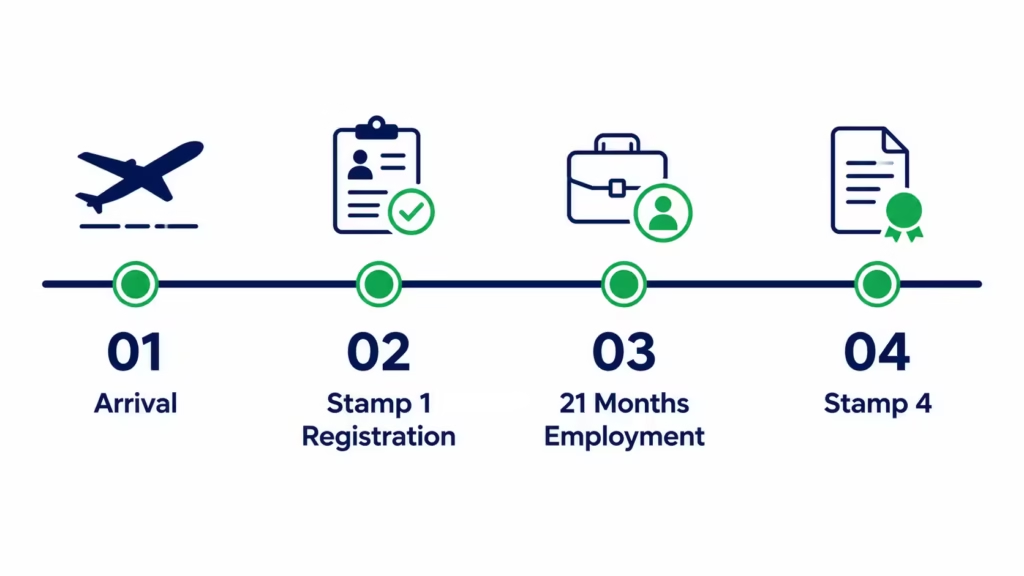
Stamp 1 is the immigration permission you register on when you arrive as an employment permit holder. It allows you to live in Ireland and work strictly in line with your permit.
Stamp 4 allows you to live in Ireland and work for any employer, in any role, without an employment permit. It is the closest thing in this system to settled status short of long-term residence or citizenship.
The current rules, per ISD’s Stamp 4 eligibility update and DETE:
- Critical Skills permit holders can apply for a Stamp 4 upgrade after completing 21 months from the commencement of employment in the State under the permit — measured from your Revenue Employment Detail Summary, not from the date your IRP card issued.
- Since 30 November 2023, you apply directly to ISD. The old Stamp 4 support letter from DETE is no longer required, and the permit itself does not need to be renewed through DETE first.
- Typical evidence includes your passport, current IRP, employment permit, recent payslips and your Employment Detail Summary from Revenue showing 21 months of employment.
- If granted, Stamp 4 issues for 2 years and is renewable if you continue to meet the criteria.
- Benefits: work for any employer without a permit, easier access to mortgages and services, and reckonable residence towards long-term residency (after 60 months) and citizenship by naturalisation (normally after 5 years of reckonable residence).
- If you do not qualify for Stamp 4, you remain on Stamp 1 and continue to need an employment permit to work.
Can You Change Employers?
Yes, within rules that were significantly reformed by the Employment Permits Act 2024, in force since 2 September 2024:
- Minimum period with the first employer: you are expected to stay with your original employer for 9 months from when you first started employment in Ireland on a permit (reduced from 12 months).
- Change of employer without a new permit: after 9 months, Critical Skills permit holders can apply to DETE for a change of employer instead of a full new permit application. The move must be within the same occupation or occupation classification — for example, moving between different engineering roles.
- Limits and mechanics: a maximum of three change-of-employer applications is allowed; the new employer’s written job offer must have been made in the 3 months before the application; your permit must be in force for at least 2 more months when you apply; and a new contract signed by both parties must be submitted. Approval does not extend your permit’s expiry date. The regulations require you to start with the new employer within 4 weeks of the change being approved (DETE’s guidance says within one month of the reissued permit), and you cannot start the new job before the permit is reissued.
- Different occupation? Moving to a genuinely different occupation still requires a new employment permit application that meets all criteria for that occupation.
- Promotions and internal moves: your permit covers only the employer, occupation and location(s) stated on it. Before a promotion, change of duties or move to another site, check with DETE whether a new permit or a notification is needed.
- Employer restructuring: where your employer changes name or ownership under a transfer of undertakings (TUPE), the employer notifies DETE on the prescribed form and a new permit issues with the updated name, provided the terms of employment stay the same.
- Before 9 months: DETE may permit an earlier change only in limited circumstances — redundancy, or unforeseen circumstances that fundamentally change the employment relationship.
If your situation involves anything unusual — part-completed periods, a contested exit, or a role that has shifted since the permit issued — get professional immigration advice before resigning.
What Happens If You Lose Your Job?
Redundancy does not automatically end your time in Ireland. The current protections:
- Notify DETE within 4 weeks of the dismissal date using the prescribed Notification of Redundancy form.
- You then have up to 6 months from the dismissal date to find another eligible job. This six-month window does not in itself give you permission to remain in Ireland (section 44(8) of the Employment Permits Act 2024), so contact ISD about your immigration permission straight away.
- New job found: apply for a new Critical Skills Employment Permit for the new role. Helpfully, if your job title has since dropped off the Critical Skills list, DETE will still consider an application if you secure a new 2-year offer with the same job title.
- Employer insolvency is treated as a redundancy situation — the same notification and six-month rules are your starting point.
- Keep your documents: permit, contract, payslips, Employment Detail Summary, redundancy notice and correspondence. You will need them for any new application and for Stamp 4 later.
- Family members: your family’s permissions are linked to yours, so resolve your own status quickly and check the impact with ISD.
- No job within 6 months: you must contact the immigration authorities to establish your status. If you leave Ireland and later receive a new offer, you can apply again under the rules in force at that time.
Act quickly at every stage. The notification deadline is short, and the six months pass faster than most people expect.
Common Reasons Applications Are Refused
- Incorrect occupation classification — the role is matched to the wrong SOC code, or the chosen code does not fit the actual duties.
- Salary below the required threshold — often because the application was prepared using pre-March 2026 figures.
- Duties not matching the listed specialism — the occupation category is eligible, but only for the “Employments with Specific Skills” listed, and the role does not demonstrate them.
- Ineligible occupation — the role appears on the Ineligible Occupations List, which no salary can cure.
- Contract shorter than 2 years — fixed-term offers of 18 or 23 months do not qualify.
- Missing or inadequate documents — unsigned contracts, missing qualification evidence, absent professional registration.
- Employer fails eligibility requirements — not properly registered, not trading, or breaching the 50:50 rule.
- Working hours undermining the salary — contracted hours that pull the effective rate below the required annual remuneration.
- Qualifications not relevant — a degree unrelated to the role, without compensating specialist evidence.
- Application submitted too close to the start date — inside the 12-week window.
- Inconsistent information — job titles, salaries or dates that differ between the form, the contract and the job description.
- Unanswered requests for additional information — the 28-day response window passes without a reply.
- Change-of-employer rules breached — applying for a new employer before 9 months without qualifying circumstances.
If refused: you receive the specific reasons in writing, and 90% of the fee is refunded. You may request a review within 28 days using the prescribed form; a separate, more senior DETE official decides the review. A confirmed refusal on review does not prevent you from fixing the problems and submitting a completely new application.
Common Mistakes Applicants Make
Before applying:
- Trusting the job title without checking the actual duties against the SOC code and listed specialist skills.
- Using outdated salary thresholds from articles written before 1 March 2026.
- Assuming every technology job qualifies — some tech-adjacent roles fall under ineligible or non-listed categories.
- Confusing the employment permit with a visa or residence permission — they are three separate things.
- Ignoring professional registration for regulated roles until after applying, when it should come first.
- Submitting incomplete or inconsistent documents to “get in the queue” quickly.
After approval:
- Booking non-refundable travel before the permit (and any visa) is actually in hand.
- Starting work before the permit start date or before completing entry formalities.
- Failing to register with ISD promptly — delays can affect later Stamp 4, long-term residence and citizenship applications.
- Forgetting the PPS number and Revenue registration, then losing weeks of pay to emergency tax.
- Relying on recruitment agents who demand improper fees — charging workers recruitment fees breaches Irish rules, and where the employer applied, application costs cannot lawfully be recovered from you.
Worked Examples

These are simplified fictional examples for illustration only, not official eligibility decisions.
Example 1: American Software Engineer
Job: Senior software developer at a Dublin SaaS company. Salary: €78,000 basic. Qualifications: BSc in Computer Science, eight years’ experience.
Likely eligibility: Strong. Software developers appear on the Critical Skills Occupations List, the salary comfortably exceeds €40,904, and the degree is relevant. Required checks: a two-year contract, the employer’s Revenue registration and 50:50 compliance, and consistency between the job description and the SOC code. Possible complications: if the contract were offered for 12 months “with renewal”, it would fail the two-year requirement; and as a US citizen he needs no entry visa but must still register with ISD after arrival.
Example 2: Internationally Trained Nurse
Job: Staff nurse at a hospital in Cork. Salary: per the public sector pay agreement. Qualifications: Nursing degree from the Philippines.
Likely eligibility: Good — nurses are on the Critical Skills list, and public-sector roles under a pay agreement use the agreement rate rather than the standard threshold. Required checks: NMBI registration is essential and must be resolved before the permit can issue; qualification recognition and any adaptation or assessment requirements come first. Possible complications: NMBI processing can take months, so the overall timeline is usually driven by professional registration rather than the permit itself.
Example 3: High-Salary Business Professional Outside the Occupations List
Job: Head of commercial operations at a Galway manufacturer. Salary: €82,000 basic. Qualifications: MBA plus twelve years’ experience.
Likely eligibility: Possible through the high-salary route — the role is not on the Critical Skills list, but the salary exceeds €68,911. Required checks: confirm the occupation is not on the Ineligible Occupations List, that the basic salary alone (not bonuses) exceeds the threshold, and that the two-year contract and employer requirements are met. Possible complications: if €15,000 of the package were a performance bonus, the basic salary would fall below €68,911 and the application would fail.
Critical Skills Employment Permit Timeline
| Stage | Main Action | Responsible Party | Timing Consideration |
|---|---|---|---|
| Job offer | Secure an offer of at least 2 years in an eligible occupation | Employee and employer | Salary and duties must meet 2026 rules before anything else |
| Eligibility check | Confirm SOC code, salary, employer status, qualifications | Both, ideally with the official checklist | Do this before paying any fee |
| Document preparation | Contract, qualifications, professional registration, employer details | Both | Professional registration can take months — start earliest |
| Application | Submit via Employment Permits Online and pay €1,000 | Employee, employer or agent | At least 12 weeks before the proposed start date |
| Processing | Application assessed in date order (Trusted Partner or Standard queue) | DETE | Check the live processing dates page; respond to queries within 28 days |
| Decision | Grant, or refusal with reasons (review possible within 28 days) | DETE | 90% fee refund if unsuccessful |
| Travel preparation | Entry visa if visa-required; book travel | Employee | Only book flexible travel until everything is granted |
| Arrival | Present permit and documents at border control | Employee | Entry is at the immigration officer’s discretion |
| Registration | Register with ISD; receive IRP with Stamp 1 (€300) | Employee | Register as soon as possible — delays affect Stamp 4 and citizenship timelines |
| PPS number | Apply through MyWelfare | Employee | Needed for tax and services |
| Employment start | Register job with Revenue; begin work under approved terms | Employee and employer | Employment should begin within 6 months of the permit being granted |
Frequently Asked Questions
1. What is the Critical Skills Employment Permit?
It is Ireland’s employment permit for highly skilled non-EEA nationals in shortage occupations, issued by DETE for two years against a job offer of at least two years, with a fast route to Stamp 4 residence.
2. Who qualifies for a Critical Skills Employment Permit in Ireland?
Non-EEA nationals with a job offer of at least two years (at least 20 hours a week) from an eligible Irish employer, in an occupation on the Critical Skills Occupations List at €40,904 or more, or in any non-ineligible occupation at €68,911 or more, with the relevant degree or experience.
3. What is the minimum salary in 2026?
From 1 March 2026, €40,904 for listed occupations. Only basic salary and qualifying health insurance payments count — bonuses and other benefits do not.
4. Do recent graduates have a lower salary threshold?
Yes. If you have a relevant degree (level 8 or higher) awarded within the 12 months before the application date and the job is on the Critical Skills list, the minimum is €36,848.
5. Does my job need to be on the Critical Skills Occupations List?
For the standard route, yes — and the duties must match the SOC code and any listed specialist skills, not just the job title.
6. Can a job outside the list qualify?
Yes, if the annual remuneration is €68,911 or more and the occupation is not on the Ineligible Occupations List or contrary to the public interest.
7. Which jobs are ineligible?
Occupations on DETE’s Ineligible List of Occupations for Employment Permits — generally roles where no shortage exists. Check the current list on enterprise.gov.ie, as it changes with each review.
8. Do I need a two-year job offer?
Yes. The Critical Skills permit is only issued for job offers of at least two years. Shorter offers may qualify for a General Employment Permit instead.
9. Is a Labour Market Needs Test required?
No. Critical Skills applications are exempt because the occupations are already recognised as being in shortage.
10. How much does the permit cost?
€1,000, paid on application. If the application is refused or withdrawn, 90% is refunded to the applicant.
11. How long does processing take?
It varies with demand and queue type. Applications are processed in date order for Trusted Partner and Standard employers; check DETE’s live current processing dates page for the submission date currently being processed, and apply at least 12 weeks before your start date.
12. Can I apply without a job offer?
No. A specific job offer from a specific Irish employer is a core requirement — there is no speculative or points-based route.
13. Can Americans apply?
Yes. US citizens follow the same permit process as other non-EEA nationals. They do not need an entry visa but must still hold the permit before starting work and register with ISD after arrival.
14. Can my spouse work in Ireland?
Yes. Spouses and de facto partners of Critical Skills permit holders receive Stamp 1G on registration, which allows them to work for any employer without their own employment permit.
15. Can my family join me immediately?
Yes. Critical Skills permit holders qualify for immediate family reunification for their spouse or partner and dependent children — no waiting period applies.
16. When can I apply for Stamp 4?
After completing 21 months of employment in Ireland under your permit, you can apply directly to Immigration Service Delivery. No DETE support letter is needed.
17. Can I change employers?
After 9 months with your first employer, you can apply for a change of employer within the same occupation or classification without a full new permit application, up to three times. Earlier changes are only allowed in limited circumstances such as redundancy.
18. What happens if I lose my job?
Notify DETE within 4 weeks using the redundancy notification form. You then have up to 6 months to find another eligible job and apply for a new permit, and you should contact ISD about your immigration permission for that period.
19. Can the application be refused?
Yes — common reasons include wrong occupation classification, salary below the threshold, contracts under two years, employer ineligibility and inconsistent documents. Refusals come with written reasons.
20. Can I appeal a refusal?
You can request a review within 28 days of the decision using the prescribed form; a more senior official reconsiders it. You can also fix the issues and submit a fresh application.
21. Do I need an Irish entry visa after permit approval?
Only if you are from a visa-required country — check the Department of Foreign Affairs list. US citizens and other visa-free nationals travel without a visa but must carry the permit and register after arrival.
22. Is a Critical Skills Employment Permit the same as permanent residency?
No. It is a two-year work permission tied to a named employer. It leads towards settlement — Stamp 4 after 21 months, long-term residence after 60 months of permission, and eligibility to apply for citizenship after five years of reckonable residence — but it is not itself permanent residency.
Get Ireland job alerts by email
Ireland’s permit rules and salary thresholds changed twice in the last eighteen months. Subscribe and we will email you when they change again, plus new job alerts and guides.
Conclusion
The Critical Skills Employment Permit is built for degree-qualified professionals in genuine shortage occupations — technology, engineering, healthcare, science, specialist finance — and for high earners on €68,911 or more in eligible roles. If that describes you, no other Irish permit matches its combination of immediate family rights, spousal work permission and a 21-month route to Stamp 4.
Three things decide most applications: whether your actual duties match an eligible occupation and specialism, whether your basic salary meets the current 1 March 2026 thresholds, and whether your qualifications and professional registration are in order. Verify each against the official DETE and ISD pages linked throughout this guide — thresholds, lists and procedures all changed within the last eighteen months, and they will change again under the roadmap running to 2030.
Your next action: check your exact occupation on the official Critical Skills Occupations List, then measure your job offer (or target roles) against the salary and contract rules above. If you are still hunting for that eligible offer, our guide to the complete Ireland job-search process shows how to find and win permit-sponsoring roles, and our overview of jobs in Ireland for Americans covers what working life actually looks like once you land.
Sources and References
- DETE — Critical Skills Employment Permits
- DETE — Critical Skills Occupations List — official Department of Enterprise, Tourism and Employment page
- DETE — Ineligible List of Occupations for Employment Permits
- DETE — Current Application Processing Dates
- DETE — Fees for Employment Permits
- DETE — Roadmap for gradual increase in employment permit salary thresholds (December 2025)
- Employment Permits Online
- Citizens Information — Critical Skills Employment Permit
- Citizens Information — Employment permits and family members
- Immigration Service Delivery — Stamp 4 upgrade eligibility
- Immigration Service Delivery — Registering your immigration permission
- Revenue Commissioners
- S.I. No. 643 of 2025 — Employment Permits (Amendment) (No. 5) Regulations 2025 (salary thresholds from 1 March 2026)
- S.I. No. 444 of 2024 — Employment Permits Regulations 2024
- Employment Permits Act 2024
- DETE — Changing employer
- Immigration Service Delivery — Right to work for minor children of employment permit holders