

Last updated: 22 July 2026. Salary thresholds and permit rules were verified against the Department of Enterprise, Tourism and Employment, Citizens Information and Immigration Service Delivery on that date.
This guide is for general information only and is not legal, immigration, or tax advice. Always confirm current rules with the Department of Enterprise, Tourism and Employment (DETE), Citizens Information, or a licensed immigration advisor before making decisions.
More Americans are looking at Ireland as a real place to build a career, not just visit. The reasons are practical, not romantic. Ireland has a small, open economy that’s home to the European headquarters of dozens of major U.S. companies. Workplaces run in English. The legal system, business culture, and even the humor will feel more familiar to an American than most of continental Europe.
That doesn’t mean getting a job in Ireland is simple. It’s a structured, permit-based process with specific documents, timelines, and rules — and most of the advice online is either too vague (“just apply on LinkedIn!”) or written for EU citizens who don’t need a visa at all.
This guide walks through the entire journey an American actually goes through: researching the market, building an Irish-style CV, applying for the right jobs, getting an offer, securing an employment permit, and landing in Dublin, Cork, or Galway ready to start work. If you want the broader picture first — visas, costs, and city comparisons — see our pillar guide, Jobs in Ireland for Americans, before diving into this step-by-step process.
Can Americans Get a Job in Ireland?
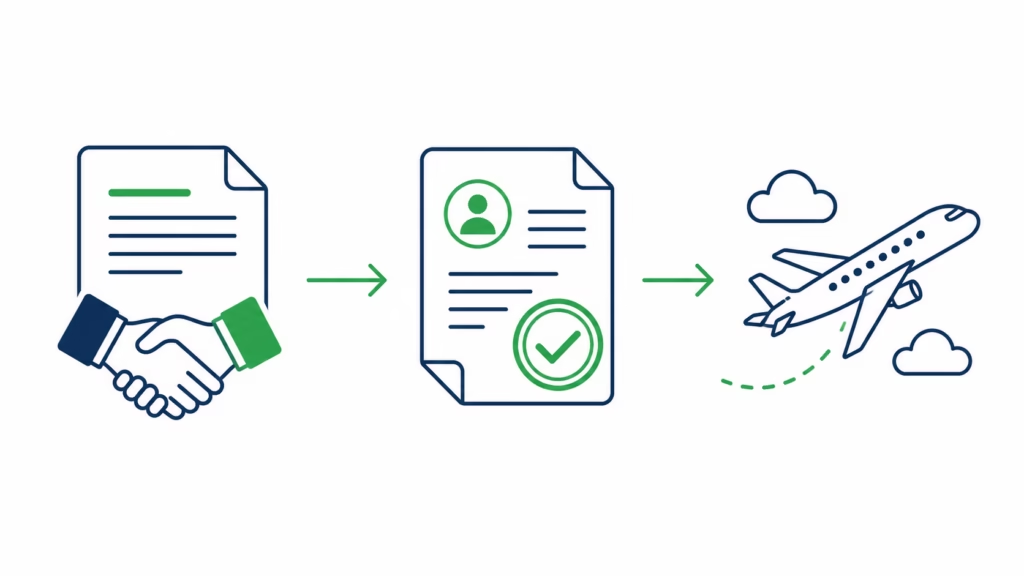
Quick Answer: Yes, but not the way EU citizens can. As a U.S. citizen, you are a “non-EEA national” under Irish law. You generally need a job offer from an Irish-registered employer and an employment permit before you can legally work in Ireland. There’s no independent “job seeker visa” that lets you show up and start interviewing in person indefinitely — most Americans secure the job first, then the permit, then the move. The most common route is the Critical Skills Employment Permit, aimed at roles in tech, engineering, finance, and healthcare.
Ireland doesn’t have a working holiday visa arrangement with the United States the way it does with countries like Canada and Australia, so casual “arrive and figure it out” plans don’t really work for employment purposes. Every legal path to working in Ireland as an American runs through one of two things: a sponsoring employer, or a separate immigration status (like an Irish or EU-citizen spouse, ancestry-based options, or a student visa with limited work rights).
The realistic expectation to set going in: you will likely apply for jobs from the U.S., interview remotely, receive a written offer, and only then start the employment permit process. Very few employers will fly you over for interviews first, and almost none will let you start work before your permit is approved.
Because Ireland runs a permit-based (not points-based) system, the deciding factor isn’t really your resume style or interview skills — it’s whether the job itself qualifies for sponsorship. Get that part right first, and the rest of this guide is your roadmap.
Step 1: Research the Irish Job Market
High-Demand Industries

Before you touch your CV, figure out where the actual demand is. Ireland’s employment permit system is built around labour and skills shortages, so your odds of getting sponsored rise dramatically if you’re targeting an in-demand field. The sectors that consistently need international talent include:
- Technology — software engineering, cybersecurity, cloud/DevOps, data science, and AI roles, largely driven by the European headquarters of major U.S. tech firms based in Dublin.
- Pharmaceuticals and life sciences — Ireland is one of the world’s largest exporters of pharmaceuticals, with major manufacturing and R&D operations concentrated around Cork, Dublin, and the midlands.
- Financial services and fintech — asset management, insurance, and payments companies with a significant presence in Dublin’s International Financial Services Centre (IFSC).
- Engineering — particularly for data centers, medtech manufacturing, and renewable energy projects.
- Healthcare — nursing, medicine, and allied health roles face persistent shortages and appear heavily on the Critical Skills Occupations List.
- Construction and skilled trades — electricians, welders, and site engineers, usually sponsored through the General Employment Permit rather than Critical Skills.
Jobs That Sponsor Americans
Sponsorship isn’t evenly distributed. Multinational employers with dedicated mobility or immigration teams — Google, Meta, Stripe, Workday, Pfizer, and similar — sponsor routinely because they already have the process down. Smaller Irish SMEs sponsor far less often, simply because running a Labour Market Needs Test and an employment permit application is a heavier lift for a company without an HR immigration specialist.
When you’re scanning job listings, look for phrases like “eligible to work in Ireland/EU required” — that’s a red flag the company won’t sponsor. Listings that don’t mention visa status at all are worth applying to regardless; many companies simply don’t advertise their sponsorship policy up front.
Average Salaries

Salary expectations matter for two reasons: cost of living, and permit eligibility. Employment permits in Ireland carry minimum salary thresholds, and those thresholds rose again on 1 March 2026 under the government’s phased Minimum Annual Remuneration roadmap.
| Role / Field | Typical Salary Range (EUR) | Permit Relevance |
|---|---|---|
| Software engineer (mid-level) | €55,000–€85,000 | Comfortably above Critical Skills threshold |
| Data scientist / AI specialist | €60,000–€95,000 | Usually Critical Skills Occupations List |
| Registered nurse | €38,000–€48,000 | Critical Skills List, degree-based |
| Financial analyst | €45,000–€70,000 | Often Critical Skills List |
| Mechanical/process engineer | €45,000–€75,000 | Critical Skills List |
| Electrician (skilled trade) | €38,000–€50,000 | General Employment Permit |
| Marketing / sales (multinational HQ) | €40,000–€65,000 | Case-by-case, often not on Critical Skills List |
| Hospitality management | €32,000–€42,000 | General Employment Permit, if not on Ineligible List |
These figures are general market ranges, not guarantees, and will vary by city, employer size, and experience. Dublin salaries typically run 10–20% above the national average, but so does the cost of living. For a full city-by-city cost breakdown, see Cost of Living in Ireland.
Step 2: Check Your Work Permit Options
This is the step most Americans skip — and it’s the one that actually determines whether your job search will succeed. Before you apply anywhere, understand which permit category your target roles fall under, because the permit type shapes salary requirements, processing time, and whether your employer needs to advertise the job locally first.
Critical Skills Employment Permit (CSEP). This is the flagship route for skilled non-EEA workers and the one most Americans in tech, engineering, finance, and healthcare will use. As of the 1 March 2026 threshold update, you qualify if your role is on the Critical Skills Occupations List and pays at least €40,904 a year (or €36,848 if you graduated within the past 12 months), or if the salary is at least €68,911 regardless of occupation. There’s no Labour Market Needs Test, the job offer must run at least two years, and after 21 months of continuous employment you can apply for Stamp 4 permission, which frees you from being tied to a single employer.
General Employment Permit (GEP). This is the broader, “everything not excluded” route. As of March 2026 the minimum salary is €36,605 a year (lower thresholds of roughly €32,691 apply to healthcare assistants, home carers, and a few other listed roles). Unlike the CSEP, most GEP applications require the employer to run a Labour Market Needs Test — advertising the vacancy for at least 28 days through JobsIreland/EURES and one additional platform — to prove no suitable EEA candidate was available. This adds real time to the process, so GEP hires typically take longer to get moving than CSEP hires.
Intra-Company Transfer Employment Permit (ICT). This route is only relevant if you already work for a U.S. company that has a linked entity (branch, subsidiary, or affiliate) in Ireland. It lets an employer transfer a senior manager, key employee, or trainee internally without going through the open job market at all. It’s the fastest path if it applies to you, but it only works if you’re already employed by a company with an Irish operation.
| Permit Type | Who It’s For | Salary Threshold (from 1 Mar 2026) | Labour Market Needs Test? | Typical Processing |
|---|---|---|---|---|
| Critical Skills Employment Permit | Degree-level roles on the Critical Skills Occupations List | €40,904 (€36,848 recent grads) or €68,911 any role | No | Roughly 2–8 weeks, varies by volume |
| General Employment Permit | Broader range of roles not on the Ineligible List | €36,605 (€32,691 for some care/agri roles) | Yes, usually | Roughly 6–12 weeks, plus 28-day advertising |
| Intra-Company Transfer Permit | Employees transferring within the same multinational | Set by ICT rules, typically higher for senior roles | No | Similar to CSEP timelines |
Processing times shift constantly depending on application volume, so always check DETE’s current processing dates page before you plan around a specific start date.
Step 3: Create an Irish-Style CV
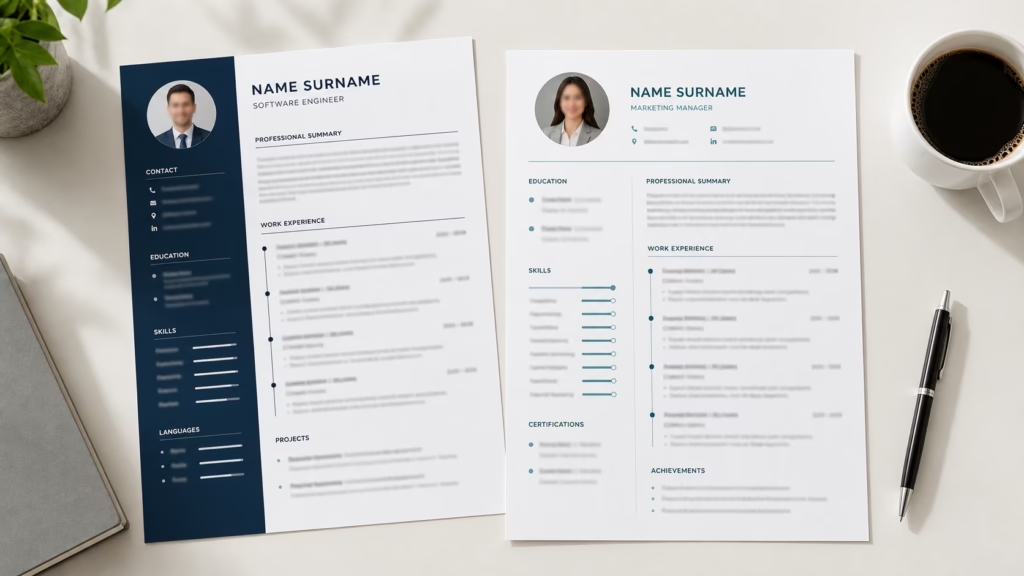
American resumes and Irish CVs look similar on the surface, but recruiters notice the differences immediately — and the wrong format can quietly signal “this person doesn’t know the market yet.” For a section-by-section walkthrough, see our guide to the Irish CV format and a complete CV example.
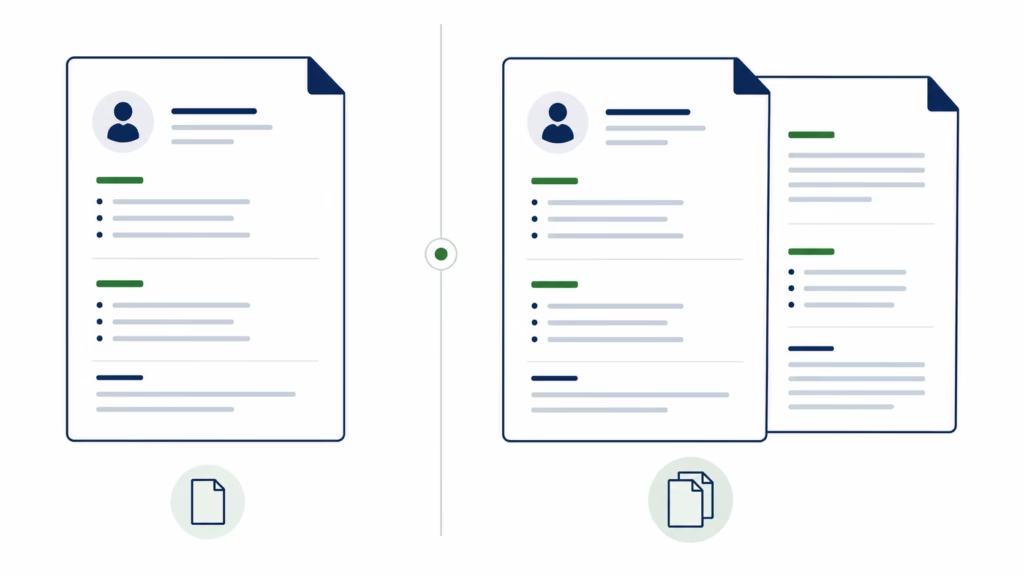
Length. American resumes are famously squeezed onto one page. The official JobsIreland guidance recommends one to two A4 pages for a CV; this is guidance rather than a universal legal rule, so follow any specific instructions in the job advert. Don’t force ten years of experience onto a single crowded page.
No photo, mostly. Unlike CVs in much of continental Europe, Irish CVs generally don’t include a photo. Adding one isn’t disqualifying, but it’s not expected and can look slightly out of place.
Personal details. Irish employers don’t need your date of birth, marital status or a photo, so leave them off. Irish equality law prohibits discrimination in recruitment on grounds including age and civil status, and the Irish Human Rights and Equality Commission gives asking a candidate’s date of birth, or whether they are single, at interview as examples of questions that can be discriminatory. Do include your visa/permit status in one line near the top — for example, “Non-EEA national, will require an employment permit” — since employers screening candidates want to know this immediately.
Spelling and terminology. Irish English uses British spelling conventions (organisation, not organization; programme, not program) and different job-title norms. “Résumé” is called a CV, “curriculum vitae.” Small details, but recruiters notice.
Structure. Irish CVs lead with a short personal profile/summary, then work experience in reverse chronological order, then education, then skills. You don’t need to list referees’ names and contact details on the CV itself; JobsIreland’s guidance says it is acceptable to write ‘References available on request’.
CV vs. Resume: Key Differences
| Feature | American Resume | Irish CV |
|---|---|---|
| Length | 1 page | 1–2 A4 pages |
| Photo | Never | Optional, uncommon |
| Personal info | Minimal | Visa/permit status often included |
| Spelling | American English | British/Irish English |
| Objective statement | Rare now | Short personal profile is standard |
| References | Rarely listed | Rarely listed, but “on request” is fine to omit |
Common Mistakes Americans Make on Irish CVs
- Submitting a one-page resume that looks thin by Irish standards.
- Using American spelling throughout (organization, color, program).
- Leaving out visa/permit status, forcing recruiters to guess.
- Including a headshot when it’s not expected.
- Using American date formats (MM/DD/YYYY instead of DD/MM/YYYY).
- Listing a U.S. phone number without the +1 country code or without mentioning availability for time-zone-friendly interviews.
Irish CV Checklist
- One to two A4 pages, clean and uncluttered
- Personal profile summary at the top (3–4 sentences)
- Visa/permit status stated clearly
- British/Irish spelling throughout
- Reverse chronological work history with quantified achievements
- Education section with recognized qualification level (see Qualifications Recognition Ireland if your degree needs comparison)
- Skills section tailored to the job posting
- No date-of-birth, marital status, or unnecessary personal data
Step 4: Optimize Your LinkedIn Profile

A large share of Irish recruitment — especially for tech, finance, and multinational roles — happens through LinkedIn, so your profile needs to work as hard as your CV.
Headline. Don’t just list your job title. Include your target role and location intent, e.g., “Senior Software Engineer | Relocating to Ireland | Cloud & DevOps.” This helps you surface in recruiter searches for Ireland-based roles even before you’ve formally relocated.
Keywords. Mirror the language used in Irish job postings, not just American ones. If Irish listings say “graduate programme” instead of “graduate program,” or “Level 8 degree” instead of “bachelor’s degree,” reflect that terminology where it’s accurate to your background.
Open to Work. Turn on the “Open to Work” setting and specifically add Ireland (and, if relevant, specific cities like Dublin, Cork, or Galway) as target locations. You can set this visible to recruiters only, which is the more discreet option if you’re currently employed.
Recruiter settings. Irish and European recruiters often filter searches by location and visa requirements. Make sure your location is set to reflect your actual availability — if you list your current U.S. city, some recruiters will filter you out automatically, assuming relocation isn’t possible.
Recommendations. A couple of specific, role-relevant recommendations from former managers carry more weight with Irish recruiters than a long list of generic ones. Quality over quantity.
Location settings. If you’re serious about relocating, consider setting your LinkedIn location to the Irish city you’re targeting once you have a firm moving timeline — but only do this once you can credibly explain your situation in interviews, since recruiters will ask.
Step 5: Where to Find Jobs in Ireland

| Platform | Best For | Notes |
|---|---|---|
| IrishJobs.ie | Broadest range of Irish-specific listings | One of the largest local job boards, strong for SMEs and Irish companies |
| Jobs.ie | General listings across sectors | Good secondary board to cross-check postings |
| Indeed Ireland | High volume, wide sector coverage | Useful for casting a wide net and filtering by “visa sponsorship” |
| LinkedIn Jobs | Multinational and professional roles | Best for tech, finance, and corporate roles; also key for networking |
| Recruitment agencies | Specialist and senior roles | Agencies often have exclusive access to unadvertised roles |
| Company career pages | Direct multinational hiring | Google, Stripe, Meta, and similar list Ireland-specific roles directly |
| Networking (events, alumni, LinkedIn groups) | Warm introductions | Referrals significantly increase response rates in the Irish market |
| Specialist recruiters | Tech, pharma, finance | Recruiters focused on regulated or technical sectors know which employers sponsor |
A few practical notes: Irish recruitment agencies are more central to hiring than in much of the U.S. — many mid-to-senior roles are filled primarily through agency relationships rather than direct applications. It’s worth reaching out to two or three agencies that specialize in your field even before you start applying broadly.
Networking matters more than most Americans expect. Ireland’s professional community, especially outside Dublin, is small and relationship-driven. If you have any Irish or Ireland-based contacts — former colleagues, alumni networks, industry associations — a warm introduction will outperform a cold application nearly every time.
Step 6: Apply for Jobs Effectively
Tailor every application. Irish hiring managers can spot a generic, mass-sent application quickly. Reference the specific company, team, and role in your cover letter, and adjust your CV’s skills section to match the posting’s language.
Cover letters. Unlike in much of the U.S. market where cover letters are increasingly optional, Irish employers — particularly for corporate and professional roles — still expect one. Keep it to three to four short paragraphs: why this company, why this role, why you’re a fit, and a brief note on your visa/permit situation so it’s not a surprise later in the process.
ATS optimization. Many multinational employers in Ireland use the same applicant tracking systems (Workday, Greenhouse, Taleo) as their U.S. offices. Use standard section headers (Experience, Education, Skills) and avoid tables or graphics in the CV file you upload, since these often don’t parse correctly.
Common mistakes. The biggest one is applying to roles that clearly won’t sponsor — wasting time on postings explicitly requiring existing EU work authorization. The second is failing to mention your visa situation until an interview, which can feel like it was hidden. Address it briefly and matter-of-factly in your cover letter or application form instead.
Application tracking. Keep a simple spreadsheet logging the company, role, date applied, permit type the role likely qualifies for, and follow-up dates. Given how permit-dependent this process is, tracking which roles are realistically sponsorable saves significant time.
Step 7: Prepare for Interviews

Irish interview culture. Irish interviews tend to be less aggressively assertive than typical American interview style — expect a more conversational tone, with less emphasis on rapid-fire “sell yourself” answers and more emphasis on how you’ll fit the team. That said, competency-based questions (“Tell me about a time when…”) are just as common as in the U.S.
Video interviews. Given the distance, most or all of your early-stage interviews will happen over video. Confirm the time zone explicitly in every scheduling email — Ireland is on GMT/IST, and daylight saving transitions don’t always align with the U.S., so double-check the date, not just the time.
Salary expectations. Irish employers are generally comfortable discussing salary ranges earlier in the process than is typical in parts of the U.S. Be ready with a number in euros, not dollars, and make sure it clears the relevant permit’s minimum salary threshold — offering below the threshold means the permit application simply won’t be approved.
Questions employers ask. Beyond standard competency questions, expect Irish employers to ask directly about your relocation timeline, your visa/permit situation, and whether you understand what moving to Ireland involves. They want to know you’ve done your homework, not just that you want an adventure.
Questions candidates should ask. Ask directly whether the company has sponsored Critical Skills or General Employment Permits before, whether they cover permit application fees, and what relocation support (flights, temporary housing, moving costs) is typically included. These questions signal that you understand the process, which tends to build employer confidence.
Step 8: Get a Job Offer

Offer letters. Irish job offers are typically issued first as a written offer letter outlining salary, start date, and key terms, followed by a formal contract of employment. Read both carefully — the salary figure needs to clear the permit threshold on its base pay alone, since bonuses and allowances generally don’t count toward that minimum.
Negotiation. There’s more room to negotiate salary, start date, and relocation support than many Americans expect, especially for in-demand technical roles. Negotiate respectfully and remember that a slightly higher salary can also matter for permit eligibility.
Contracts. Irish employment contracts must include specific statutory details under Irish employment law — job title, salary, hours, and notice periods. If anything in the contract looks vague on these points, ask for clarification before signing.
Notice periods. If you’re leaving a U.S. job, factor in Irish notice period norms once you start — but for your move itself, factor in permit processing time, not just your notice period at your old job.
Relocation packages. Larger multinationals frequently offer relocation packages covering flights, temporary accommodation, and sometimes a lump-sum allowance. Smaller employers may offer little or nothing — always ask directly rather than assuming it’s included.
Step 9: Apply for Your Employment Permit
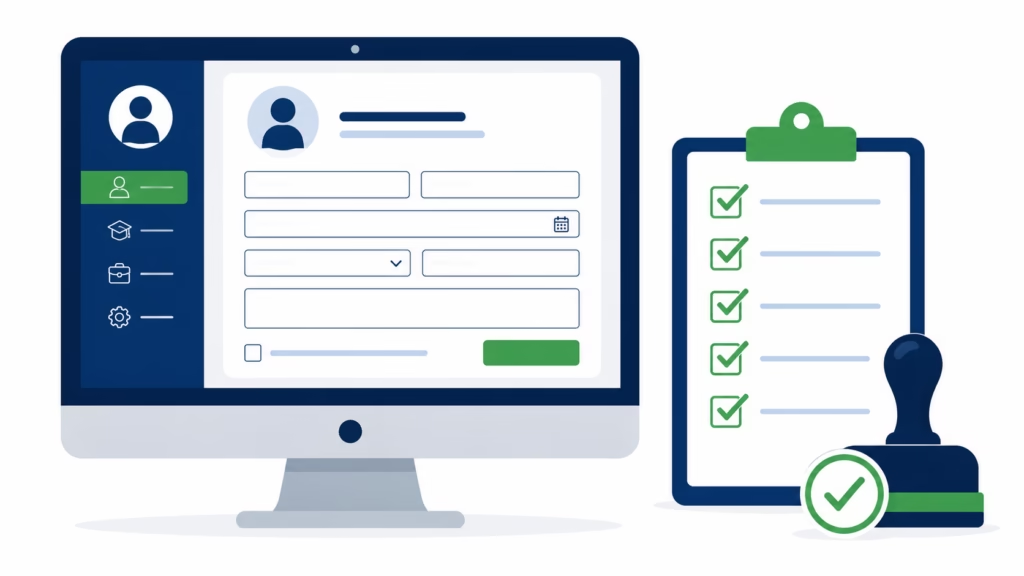
Once you have a signed offer, the employment permit application becomes the critical path. Either you or your employer can submit it through the Employment Permits Online System (EPOS), run by the Department of Enterprise, Tourism and Employment.
Step-by-step process:
- Confirm which permit type applies (Critical Skills, General, or ICT) based on the role and salary.
- Gather required documents (see below).
- If applying for a General Employment Permit, your employer completes the Labour Market Needs Test — advertising the role for at least 28 days.
- Submit the application through EPOS, along with the fee.
- Respond promptly to any request for additional information (you typically get 28 days to reply).
- Receive a decision. If approved, and you’re a citizen of a visa-required country, apply separately for a long-stay (“D”) employment visa through Immigration Service Delivery.
- Travel to Ireland and, within your first month, register for your Irish Residence Permit (IRP).
Required documents typically include:
- A valid passport
- Signed contract of employment or detailed offer letter
- Evidence of relevant qualifications (degree certificates, professional certifications)
- CV/employment history
- Proof the employer is registered and trading in Ireland
- Labour Market Needs Test evidence (General Employment Permit only)
Fees. As of the current schedule, the Critical Skills and General Employment Permit application fee is €1,000, and 90% is refunded if the application is refused. The IRP registration that follows arrival costs a separate €300 per adult.
Processing times. These fluctuate significantly with volume — DETE publishes live processing dates online, and it’s worth checking them regularly rather than assuming a fixed number of weeks. As a general rule, submit at least 12 weeks before your intended start date to leave room for processing, a possible information request, and visa processing if required.
Employer responsibilities. Your employer must be registered with Revenue and the Companies Registration Office, must generally maintain at least 50% EEA nationals among its workforce (with some startup exemptions), and cannot deduct recruitment costs from your salary or hold your personal documents.
Employment Permit Checklist
- Confirmed correct permit type for the role
- Signed offer letter/contract with compliant salary
- Qualifications documentation gathered (translated if needed)
- Labour Market Needs Test completed, if applicable
- Application submitted through EPOS with fee paid
- Visa application submitted (if from a visa-required category)
- Travel and IRP registration planned for arrival
Step 10: Prepare for Your Move

Housing. Start your search early — rental supply in Dublin and other major cities is tight, and many landlords ask for references and proof of income. Short-term accommodation for your first few weeks gives breathing room while you search for a longer lease.
Bank account. Most Irish banks require proof of address and immigration status to open a full account, though several digital banks allow you to open an account with just a passport before you have an Irish address, which can smooth the first few weeks.
PPS Number. Your Personal Public Service (PPS) number is essential — you need it to be paid, pay tax correctly, and access public services. Applications go through MyWelfare.ie using a MyGovID account, and you’ll need to attend an in-person appointment with your passport, proof of address, and a letter from your employer confirming your job. The number itself is free, though appointment availability can take a few weeks depending on demand.
Healthcare. Ireland has a public healthcare system (HSE), but many employees also get private health insurance as part of their benefits package. Register with a local GP once you’ve settled, and understand your specific coverage before you need it.
Taxes. Ireland taxes residents on a Pay As You Earn (PAYE) basis, deducted directly from your paycheck. As a U.S. citizen, you’ll also need to continue filing U.S. taxes annually regardless of where you live, though foreign tax credits and exclusions may reduce double taxation — this is genuinely worth a conversation with a cross-border tax professional rather than guesswork, and Revenue’s own guidance is a good starting reference.
SIM cards. Pick up a prepaid Irish SIM as soon as you land — you’ll need an Irish number for banking, job onboarding, and general daily life almost immediately.
Transportation. Dublin, Cork, and Galway all have workable public transport, and a Leap Card (the contactless transit card) is worth getting in your first week. If you’re moving outside a major city, factor in whether you’ll need a car and how your U.S. driving license transfers (Ireland has reciprocal arrangements with some, not all, U.S. states).
Common Mistakes Americans Make
- Applying to jobs that clearly won’t sponsor a work permit, wasting weeks of effort.
- Not checking whether the role and salary meet a permit’s minimum threshold before applying.
- Cramming years of experience onto a crowded one-page resume instead of a clear, relevant CV of one to two A4 pages.
- Ignoring British/Irish spelling and terminology on application materials.
- Assuming a working holiday visa exists for U.S. citizens — it doesn’t.
- Waiting to mention visa/permit status until late in the interview process.
- Underestimating employment permit processing times and planning too tight a start date.
- Not confirming whether the employer has sponsored international staff before.
- Negotiating salary without checking it still clears the relevant permit threshold.
- Assuming remote-from-the-U.S. arrangements satisfy Irish work authorization — they don’t; you need to be physically present under valid permission to work for an Irish employer based there.
- Booking permanent housing before arriving, without seeing it in person or through a trusted local contact.
- Forgetting continued U.S. tax filing obligations after relocating.
- Not budgeting for the gap between arrival and first paycheck, since PPS number and payroll setup take time.
- Skipping the Qualifications Recognition Ireland comparison for non-U.S.-standard degrees, which can slow employer or permit processing.
- Overlooking that offer letters alone aren’t enough — permits require a properly signed contract with compliant salary terms.
- Failing to plan for the IRP registration and its separate €300 fee after arrival.
Best American Companies Hiring in Ireland
Ireland’s economy has been shaped for decades by American multinational investment, largely coordinated through IDA Ireland, the state agency responsible for attracting foreign direct investment. Companies with significant Irish operations that regularly hire international talent include:
- Google — European headquarters in Dublin, hiring across engineering, sales, and operations.
- Apple — major operations base in Cork since the 1980s, covering manufacturing, support, and corporate functions.
- Meta — international headquarters in Dublin, with roles across engineering, policy, and trust & safety.
- Microsoft — long-established Irish base covering engineering, cloud services, and regional operations.
- Amazon — significant Dublin presence spanning AWS, retail operations, and logistics.
- Intel — major manufacturing campus in Leixlip, County Kildare, one of the largest employers in the tech-manufacturing sector.
- Pfizer — multiple Irish manufacturing sites, part of the country’s large pharmaceutical export base.
- Salesforce — European headquarters in Dublin.
- Dell Technologies — long-standing manufacturing and operations presence.
- ServiceNow — growing engineering and operations base in Dublin.
These companies hire international talent because Ireland’s domestic labour market alone can’t fill the specialized roles their Irish operations need — which is exactly why the employment permit system exists, and why sectors like tech, pharma, and finance dominate the Critical Skills Occupations List. For more on this landscape, see our dedicated guide to American Companies in Ireland.
Realistic Timeline
| Timeframe | What Happens |
|---|---|
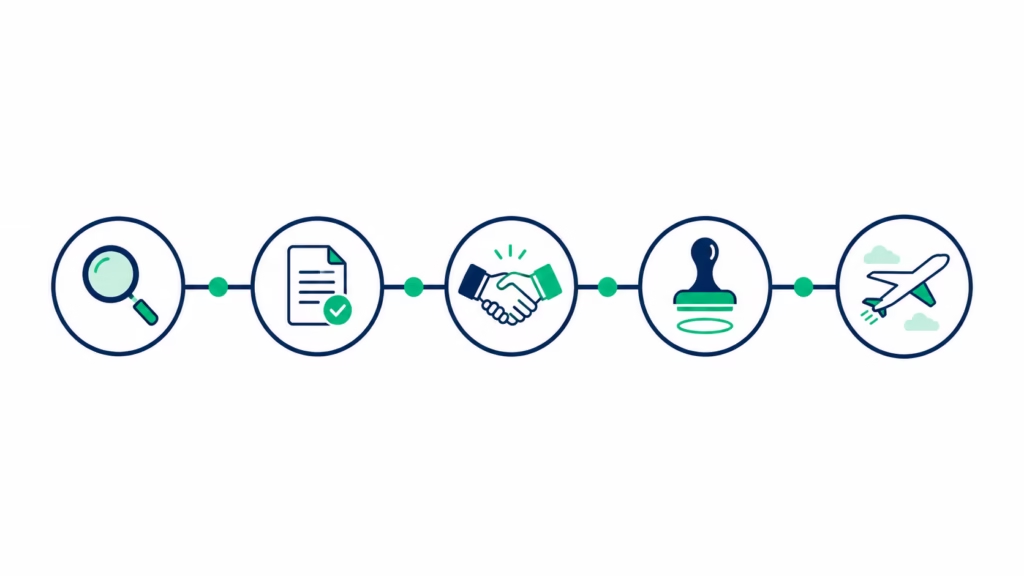
| Week 1–2 | Research target industries, build Irish-style CV, optimize LinkedIn |
| Week 3–4 | Begin applying, reach out to recruiters and agencies |
| Month 1–2 | Interviews, follow-ups, salary discussions |
| Month 2 | Receive and negotiate job offer, sign contract |
| Month 2–3 | Employer/employee submits employment permit application |
| Month 3 | Permit decision; visa application if required |
| Month 3–4 | Book travel, arrange short-term housing, prepare documents |
| Arrival | Register IRP within your first month, apply for PPS number, open bank account, start work |
Every case moves at a different pace depending on permit type and processing volume, but three to four months from first application to arrival is a reasonable planning baseline for most Americans.
Frequently Asked Questions
1. Can Americans work in Ireland without a visa? No. As a non-EEA national, you need a valid employment permit and, depending on your visa-required status, a long-stay visa, before working legally in Ireland.
2. Is there a working holiday visa for U.S. citizens in Ireland? No, Ireland does not currently offer a working holiday scheme for U.S. citizens the way it does for countries like Canada or Australia.
3. How long does it take to get an Irish work permit? It varies significantly by permit type and current application volume — check DETE’s live processing dates, and plan for roughly 12 weeks from application to decision as a general guideline.
4. Do I need a job offer before applying for a work permit? Yes. Employment permits are tied to a specific job offer from a specific Irish employer; you cannot apply speculatively without one.
5. What is the easiest work permit for Americans to get? There’s no “easiest” permit universally — it depends on your role. If your job is on the Critical Skills Occupations List and meets the salary threshold, the Critical Skills Employment Permit is generally faster since it skips the Labour Market Needs Test.
6. Can my employer sponsor me if they’ve never done it before? Yes, but it adds administrative overhead for them. Employers who’ve sponsored permits before tend to move faster through the process.
7. What’s the minimum salary to qualify for a work permit? As of 1 March 2026, it’s generally €40,904 for Critical Skills roles (or €68,911 for any occupation) and €36,605 for General Employment Permits, though some categories have different thresholds.
8. Do I need a college degree to work in Ireland? Not always — General Employment Permits can be based on relevant skills, training, or experience rather than a degree, though many Critical Skills roles require one.
9. How do I know if my U.S. degree is recognized in Ireland? Qualifications Recognition Ireland (through NARIC Ireland) allows you to compare your qualification against the Irish National Framework of Qualifications.
10. Can I bring my spouse or family with me? Critical Skills Employment Permit holders can generally apply for immediate family reunification, while General Employment Permit holders typically need to wait about a year of employment first.
11. Can my spouse work in Ireland too? Spouses of Critical Skills Employment Permit holders typically receive a Stamp 1G, allowing them to work for any employer without needing their own permit.
12. How much does an employment permit cost? The standard application fee for Critical Skills and General Employment Permits is €1,000, with 90% refunded if the application is refused.
13. What is a Labour Market Needs Test? It’s a requirement for most General Employment Permit applications where the employer must advertise the role for at least 28 days to show no suitable EEA candidate is available before hiring internationally.
14. Do I need to be in Ireland to apply for a job? No, most Americans apply and interview remotely from the U.S. before relocating.
15. What’s an Irish Residence Permit (IRP), and do I need one? Yes — nearly all non-EEA nationals staying in Ireland longer than 90 days must register for an IRP after arrival, which costs €300 per adult.
16. Do I need a PPS number to get a job? No, you don’t need one to apply or interview, but you’ll need one shortly after starting work to be paid correctly.
17. Will I still need to file U.S. taxes while working in Ireland? Yes. U.S. citizens are taxed on worldwide income regardless of residence, though credits and exclusions may reduce double taxation — a cross-border tax professional can advise on your specific situation.
18. Can I switch employers once I have a work permit? It depends on the permit type. Under the Employment Permits Act 2024, both Critical Skills and General Employment Permit holders can normally apply to change employer after 9 months with their first employer, provided the move is within the same occupation or occupation classification. Moving into a genuinely different occupation still requires a new permit application, and once you hold Stamp 4 you can work for any employer without a permit.
19. What happens if my employment permit application is refused? You’ll receive a letter explaining the specific reasons, and you can request a review within 28 days of that decision.
20. Do recruitment agencies charge job seekers in Ireland? No — legitimate Irish recruitment agencies are paid by the hiring employer, not the candidate. Be cautious of any agency asking you for fees.
21. Is Dublin the only place with jobs for Americans? No, though it has the highest concentration. Cork, Galway, and Limerick all have significant multinational and tech-sector employment too. See our Best Cities in Ireland guide for a full comparison.
Get Ireland job alerts by email
Ireland’s permit rules and salary thresholds changed twice in the last eighteen months. Subscribe and we will email you when they change again, plus new job alerts and guides.
Conclusion
Getting a job in Ireland as an American is absolutely achievable, but it rewards preparation over spontaneity. The process runs in a fairly predictable order: research where the real demand is, build a CV and LinkedIn presence that actually reads as Irish rather than American, apply to roles that can realistically sponsor you, and once you have an offer, move methodically through the employment permit and relocation process.
The single biggest lever you control is targeting the right roles from the start — jobs on the Critical Skills Occupations List, at multinational employers with established sponsorship experience, paying above the current salary thresholds. Get that part right, and the rest of the journey, while still paperwork-heavy, becomes far more predictable.
For the wider picture on visas, budgeting, and life after you land, continue with our related guides: Jobs in Ireland With Visa Sponsorship, Critical Skills Employment Permit Guide, High-Demand Jobs in Ireland, Moving to Ireland From the US, and Living in Ireland as an American.