The most common jobs in Ireland are the ones that employ the most people. They are not always the jobs employers struggle to fill, or the ones a foreign worker can get a permit for. This guide uses official Central Statistics Office (CSO) figures to show where people in Ireland actually work: by occupation group and by economic sector.
If you are looking for shortage roles, see our guide to jobs in demand in Ireland. If you need to know whether an occupation can be sponsored, see Ireland’s official occupation lists.

Quick Answer: What Are the Most Common Jobs in Ireland?
In Q2 2026, 2,839,300 people were in employment in Ireland, according to the CSO Labour Force Survey.
- By occupation group, the largest is professional occupations, with 762,400 people. This group includes health professionals such as doctors and nurses, teachers and lecturers, engineers, IT professionals, and business professionals such as accountants.
- By economic sector, the largest employer is human health and social work, with 395,200 people, followed by industry (356,000), wholesale and retail trade (289,800) and education (256,900).
The CSO Labour Force Survey does not publish a single “most common job title,” so the honest answer is given by occupation group and sector, as below.
Common Jobs, Jobs in Demand and Permit-Eligible Jobs Are Not the Same
These three ideas are often mixed up online. They answer different questions:
| Question | What it measures | Where to read more |
|---|---|---|
| Which jobs are most common? | How many people currently work in an occupation or sector (CSO data) | This page |
| Which jobs are in demand? | Where employers report shortages or are actively recruiting | Jobs in demand in Ireland |
| Which jobs can get an employment permit? | Whether an occupation is eligible under the official lists, salary rules and quotas | Critical Skills and Ineligible Occupations Lists |
A job can be very common and still be ineligible for a permit. Sales and retail assistants are a good example: retail is one of Ireland’s largest employers, but sales and retail assistants are on the Ineligible Occupations List. Equally, even an eligible occupation does not mean a particular employer will sponsor you — see our guide to jobs with visa sponsorship.

Most Common Jobs by Occupation Group
The CSO classifies jobs using the UK Standard Occupational Classification (SOC 2010). This table shows how many people worked in each major occupation group in Q2 2026, with Q2 2025 for comparison.
| Occupation group (SOC 2010) | Q2 2026 (people) | Q2 2025 (people) | Typical jobs in this group |
|---|---|---|---|
| Professional occupations | 762,400 | 700,200 | Doctors, nurses, teachers, engineers, software developers, accountants |
| Associate professional and technical occupations | 347,700 | 356,000 | Technicians, paramedics, IT support, sales and finance associates |
| Skilled trades occupations | 321,700 | 344,100 | Electricians, plumbers, carpenters, mechanics, chefs, farmers |
| Administrative and secretarial occupations | 270,100 | 283,800 | Administrators, office managers, secretaries, records and finance clerks |
| Elementary occupations | 263,500 | 266,100 | Cleaners, kitchen and catering assistants, warehouse and labouring roles |
| Managers, directors and senior officials | 259,200 | 248,000 | Managers and directors across all sectors, including retail and hospitality managers |
| Caring, leisure and other service occupations | 234,200 | 234,700 | Care workers and home carers, healthcare assistants, childcare workers |
| Process, plant and machine operatives | 200,800 | 195,500 | Production operatives, assemblers, drivers |
| Sales and customer service occupations | 169,600 | 176,400 | Sales and retail assistants, cashiers, call and contact centre staff |
| All occupation groups | 2,839,300 | 2,818,100 | Includes 10,000 “other / not stated” in Q2 2026 |
Source: CSO PxStat table QLF29, persons aged 15–89 in employment by UK SOC 2010 major group. “Typical jobs” are illustrative examples of each classification group, not CSO figures.
Where People Work: Employment by Sector
The CSO also counts employment by economic sector. It now publishes these figures using the updated NACE Rev 2.1 classification, so sector names and letters differ from older tables.
| Economic sector (NACE Rev 2.1) | Q2 2026 (people) | Q2 2025 (people) |
|---|---|---|
| Human health and social work activities (R) | 395,200 | 391,000 |
| Industry (B–E) | 356,000 | 346,800 |
| Wholesale and retail trade (G) | 289,800 | 299,100 |
| Education (Q) | 256,900 | 242,700 |
| Professional, scientific and technical activities (N) | 189,800 | 206,800 |
| Construction (F) | 189,300 | 187,900 |
| Accommodation and food service activities (I) | 188,100 | 181,300 |
| Information and communication (J, K) | 176,600 | 179,200 |
| Public administration and defence; compulsory social security (P) | 150,100 | 146,300 |
| Financial, insurance and real estate activities (L, M) | 148,400 | 144,000 |
| Other NACE activities (S to V) | 142,400 | 138,500 |
| Transportation and storage (H) | 134,000 | 124,200 |
| Administrative and support service activities (O) | 109,500 | 112,300 |
| Agriculture, forestry and fishing (A) | 105,800 | 109,700 |
| All sectors | 2,839,300 | 2,818,100 |
Source: CSO PxStat table QLF56, persons aged 15–89 in employment by NACE Rev 2.1 sector, State. “All sectors” also includes 7,500 people whose sector was unknown in Q2 2026.
Figures are rounded to the nearest 100, so changes calculated from this table may differ slightly from those in the CSO release.
Size is not the same as growth. In its Q2 2026 release, the CSO reported that the largest annual increases in employment were in education (up 14,200) and transportation and storage (up 9,800). The largest decrease was in professional, scientific and technical activities (down 17,100). Education grew fastest, but health and social work remains the largest sector.

Common Jobs, Sector by Sector
The sections below follow the sectors in order of size, with the kinds of jobs most people in each sector do.
Healthcare and Social Care
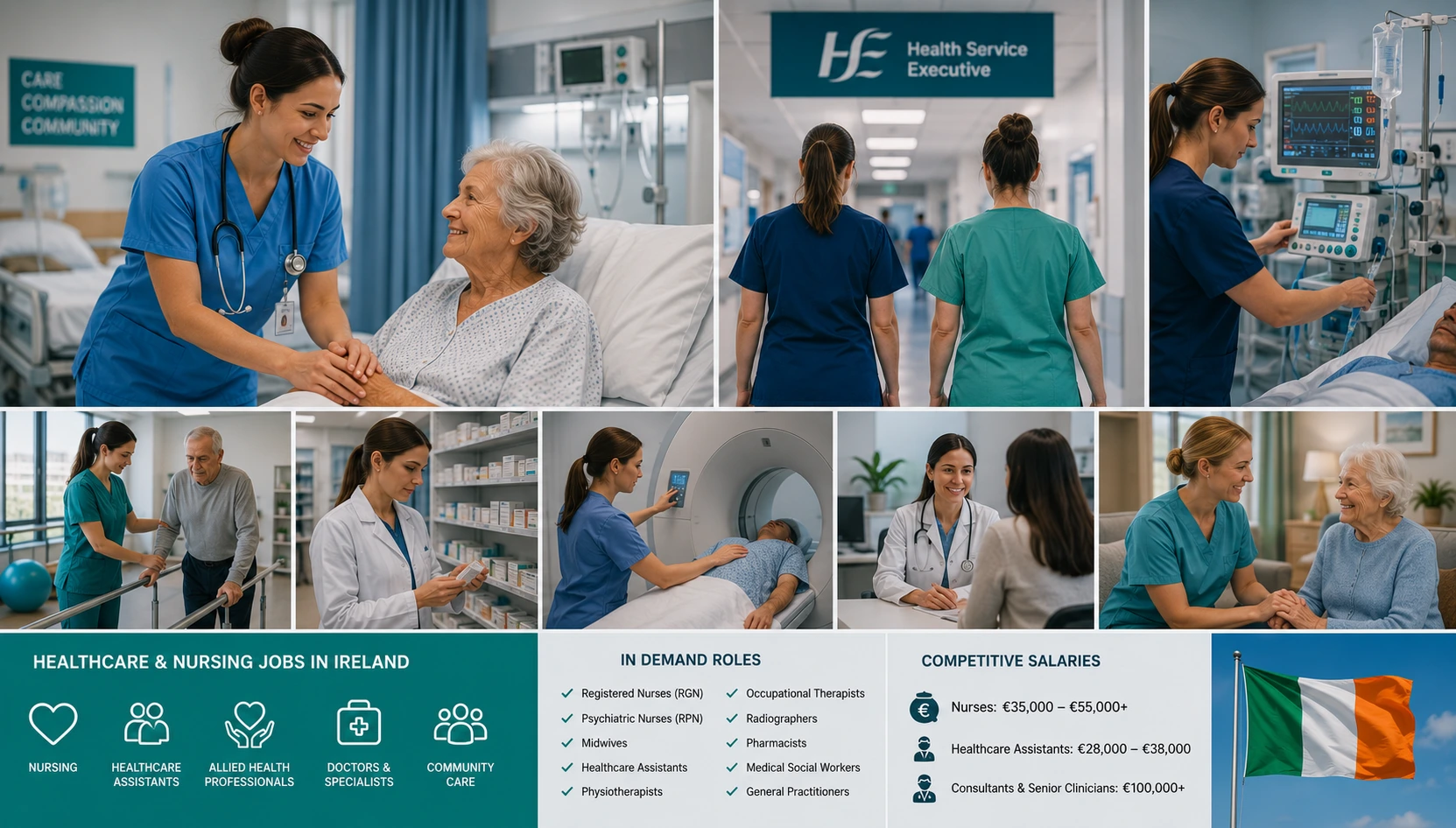
Human health and social work is Ireland’s largest employer, at 395,200 people in Q2 2026. Common roles include nurses and midwives, healthcare assistants, care workers and home carers, doctors, pharmacists, and allied health professionals such as physiotherapists and radiographers. Employers include the HSE, private hospitals, nursing homes and community care providers. For permit rules in this sector, see our guides to nursing jobs and healthcare assistant jobs.
Industry, Manufacturing and Pharmaceuticals
Industry (sectors B to E) employed 356,000 people. Common roles include production and process operatives, engineers, quality and validation specialists, laboratory scientists and technicians, and maintenance technicians, particularly in pharmaceuticals, medical devices, food processing and electronics.
Retail and Wholesale
Wholesale and retail trade employed 289,800 people. Common roles include sales and retail assistants, cashiers, store supervisors and managers, stock and warehouse staff, and buyers. Part-time and shift work is widespread. Note that sales and retail assistants are on the Ineligible Occupations List, so these roles are generally open only to people who already have the right to work in Ireland.
Education
Education employed 256,900 people and recorded the largest annual increase of any sector. Common roles include primary and secondary teachers, special needs assistants, lecturers and researchers, and school and college administrators. Teaching in Irish schools requires registration with the Teaching Council.

Construction and Engineering
Construction employed 189,300 people. Common roles include electricians, plumbers, carpenters, plasterers, general operatives, site managers, quantity surveyors and civil engineers. Engineering professionals also work across industry and professional services.

Hospitality and Food Service
Accommodation and food service employed 188,100 people. Common roles include waiters, bar staff, kitchen and catering assistants, chefs, receptionists and hotel and restaurant managers. Many of these roles are accessible without formal qualifications, but waiters, bar staff and kitchen and catering assistants are on the Ineligible Occupations List. See our guide to hotel jobs in Ireland for the roles that can be sponsored.

IT and Communications
Information and communication employed 176,600 people. Common roles include software developers, IT support and systems administrators, data and cloud specialists, cybersecurity professionals, and telecoms engineers, with large clusters in Dublin and Cork. See our guide to IT jobs in Ireland.
Finance, Insurance and Real Estate
This sector employed 148,400 people. Common roles include accountants, auditors, fund administrators, financial analysts, insurance and claims staff, compliance officers and property professionals, concentrated in Dublin. See our guide to finance and accounting jobs.

Transport, Logistics and Warehousing
Transportation and storage employed 134,000 people, up 9,800 on a year earlier. Common roles include HGV, van and bus drivers, warehouse operatives, forklift operators, logistics coordinators and airline and airport staff. The CSO attributes much of the annual increase to air transport.
Common Jobs for Foreign Workers: What Is Realistic
EU, EEA and Swiss citizens do not need an employment permit to work in Ireland, and UK citizens can work here under the Common Travel Area. For them, any of the common jobs above is open in the same way as for Irish citizens.
Non-EEA nationals usually need an employment permit, and that changes the picture. Some of the highest-volume jobs in Ireland are on the Ineligible Occupations List, including sales and retail assistants, waiters, bar staff, kitchen and catering assistants, cleaners, and most administrative and call-centre roles. Permits are not granted for these, apart from specific listed exceptions.
Common jobs that can be considered for a permit include many professional roles, such as nurses, doctors, engineers, software developers and accountants. Several of these are on the Critical Skills Occupations List. Some roles under quota, such as care workers and home carers, can also be considered. Chefs are on the Ineligible list except for specified grades with minimum experience, working outside fast-food outlets.
Even where an occupation is eligible, you still need a job offer from an employer willing to apply for the permit, at a salary that meets the threshold. Our guides to jobs with visa sponsorship and jobs in Ireland for foreigners explain the routes.

Entry-Level Common Jobs
Many common jobs in Ireland can be started with little or no experience, especially for people who already have the right to work here:
- Retail sales assistant — training is usually given on the job.
- Hospitality and catering staff — front-of-house, kitchen porter and catering assistant roles.
- Healthcare assistant or care worker — many providers train new starters.
- Warehouse operative — shift-based work in distribution and logistics.
- Cleaning and facilities staff — across offices, healthcare and hospitality.
- Customer service and call-centre agent — communication skills are usually the main requirement.
For which of these roles international applicants can actually get a permit, see our guide to entry-level and no-experience jobs in Ireland. For school-age teenagers the rules are different again — see what jobs a 14, 15 or 16-year-old can get in Ireland.
Related Guides: Demand, Pay, Job Search and Permits
This page focuses on how many people work in each kind of job. For the related questions, use these guides:
- Jobs in demand — shortage occupations and where employers are recruiting: what jobs are in demand in Ireland.
- Pay — the best-paid roles and salary ranges: highest-paying jobs in Ireland.
- Finding work — CVs, job sites, recruiters and interviews: how to get a job in Ireland.
- Visas and permits — permit types, requirements and fees: Ireland work visa requirements.
- Sponsorship — which employers sponsor and how to find them: jobs in Ireland with visa sponsorship.
Get Ireland job alerts by email
Ireland’s permit rules and salary thresholds changed twice in the last eighteen months. Subscribe and we will email you when they change again, plus new job alerts and guides.
Frequently Asked Questions
What is the most common job in Ireland?
The CSO Labour Force Survey does not rank individual job titles. By occupation group, professional occupations are the largest, with 762,400 people in Q2 2026. By sector, human health and social work employs the most people, at 395,200.
What are the most popular jobs in Ireland?
Measured by how many people do them, the largest occupation groups in Q2 2026 were professional occupations (762,400), associate professional and technical occupations (347,700) and skilled trades (321,700). Typical jobs in these groups include nurses, teachers, engineers, software developers, accountants, technicians and electricians.
What jobs are in high demand in Ireland?
Demand is different from how common a job is. For shortage occupations and where employers are recruiting, see our guide to jobs in demand in Ireland.
What are the main industries in Ireland by employment?
In Q2 2026 the largest sectors by employment were human health and social work (395,200), industry (356,000), wholesale and retail trade (289,800) and education (256,900), according to the CSO.
Can foreigners get jobs in Ireland?
Yes. EU, EEA and Swiss citizens need no employment permit, and UK citizens can work under the Common Travel Area. Non-EEA nationals usually need a permit, and some of the most common jobs, such as sales and retail assistants and waiters, are on the Ineligible Occupations List.
Are there jobs in Ireland with visa sponsorship?
Yes, but sponsorship depends on the employer. An occupation being eligible for a permit does not mean an employer will apply for one. Our visa sponsorship guide explains how to find employers that do.
What are the highest-paying jobs in Ireland?
The most common jobs are not usually the best paid. See our guide to the highest-paying jobs in Ireland for salary ranges by role.
How can I get a job in Ireland as a foreigner?
Check whether your occupation is eligible for a permit using the official lists, target employers that recruit internationally, and follow our step-by-step guide to getting a job in Ireland.
What is the main employment sector in Ireland?
Human health and social work activities, with 395,200 people in employment in Q2 2026, is the largest sector by headcount, according to the CSO.
Sources
- CSO — Labour Force Survey Quarter 2 2026: Employment
- CSO — Labour Force Survey Quarter 2 2026: Key Findings
- CSO PxStat — QLF56, Persons in employment by NACE Rev 2.1 economic sector
- CSO PxStat — QLF29, Persons in employment by UK SOC 2010 occupation group
- DETE — Ineligible Occupations List
- DETE — Critical Skills Occupations List
- Irish Statute Book — S.I. No. 213 of 2026 (current occupation lists and quotas)