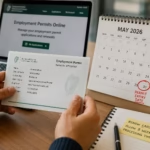

Disclaimer: This guide is general information, not immigration or legal advice. Employment permit rules, salary thresholds and occupation lists change frequently — thresholds rose on 1 March 2026 and the occupations lists changed again on 13 May 2026. Always confirm your position against the official DETE guidance linked throughout, or take advice from a qualified immigration professional, before acting.
Every week, thousands of people search for jobs in Ireland with visa sponsorship. They are usually looking for the same thing: an Irish employer willing to support a non-EEA candidate through the paperwork that makes legal employment possible.
Those opportunities are real. Ireland’s economy runs on international talent, and the state operates a formal system specifically designed to bring skilled non-EEA workers into roles that cannot be filled locally. Software engineers, nurses, process engineers, quality specialists and construction professionals move to Ireland on this basis every month.
But the search term itself is slightly misleading, and that misunderstanding costs applicants a great deal of wasted effort. Ireland does not really operate a “visa sponsorship” system in the way the United States or the United Kingdom does. It operates an employment permit system, and the distinction changes how you should search, how you should apply, and what you should ask an employer.
This guide covers what sponsorship actually means in the Irish context, which occupations and sectors realistically attract permit support in 2026, which employers recruit international professionals, how to recognise a genuinely sponsorship-friendly job advert, what the process costs and how long it takes — and how to spot the scams that target people in exactly this position.
Quick Answer: Can You Get a Job in Ireland With Visa Sponsorship?
Yes. Non-EEA nationals can work in Ireland, but you need an eligible job offer first. Your employer supports an employment permit application rather than a visa. The occupation, the salary and the employer must all meet current rules. Sponsorship is never guaranteed. The Critical Skills and General Employment Permits are the two most common routes.
Key Facts at a Glance
| Item | Position in 2026 |
|---|---|
| Main routes | Critical Skills Employment Permit (CSEP) and General Employment Permit (GEP). Intra-Company Transfer and several niche permits also exist. |
| Job offer required? | Yes. There is no general job-seeker permit. You must hold a written offer from a trading Irish employer before applying. |
| What “sponsorship” means | The employer confirms a genuine vacancy, supplies company and payroll details, and supports (or submits) the permit application. It is not a visa guarantee. |
| Salary thresholds | From 1 March 2026: CSEP €40,904 with a relevant degree, or €68,911 without one. GEP €36,605. Reduced rate of €32,691 for defined roles. |
| Labour Market Needs Test | Required for most GEP applications. Not required for CSEP. |
| Application fee | €1,000 for permits of two years or more; €500 for shorter permits. 90% is refunded if the application is refused. |
| Employer duties | Registered with the CRO and Revenue, actively trading, compliant with the 50:50 rule where it applies, and prohibited from recovering recruitment costs from you. |
| Family | CSEP: family may join immediately; spouse or partner gets Stamp 1G and can work without a permit. GEP: family may join after your first year. |
| Long-term residency | CSEP: Stamp 4 after 21 months. GEP: Stamp 4 after 57 months. |
| Processing | Varies by permit type and demand. DETE publishes current processing dates, which should be checked rather than assumed. |
What Does Visa Sponsorship Mean in Ireland?
“Visa sponsorship” is search terminology, not Irish legal terminology. No Irish government form uses the phrase. When people search for it, they generally mean: will an employer do the paperwork and cover the process so I can legally work there?
In Ireland, that support breaks into distinct components that are often confused. Understanding them is genuinely useful, because it tells you exactly what to ask an employer for.
Employer support
The employer confirms the job is real, provides company registration and Revenue details, states the salary and hours, issues a contract, and either submits the permit application or supplies the documents you need to submit it yourself. Many employers also pay the fee, though they are not obliged to.
Employment permit
This is the core authorisation. It is issued by DETE and it permits you to do a specific job, for a specific employer, in Ireland. Either you or your employer can apply, through the Employment Permits Online system.
Entry visa
A separate document, issued by the Department of Justice, that allows you to travel to Ireland and present yourself at the border. Only nationals of visa-required countries need one. Indian, Pakistani, Nigerian and Filipino nationals typically do; American, Canadian, Australian and Brazilian nationals typically do not. Holding a permit does not automatically grant you a visa.
Immigration permission
Permission to remain in the State, granted by an immigration officer when you arrive. This is distinct from both the permit and the visa.
Irish Residence Permit (IRP)
The physical card evidencing your immigration permission, issued after you register with Immigration Service Delivery following arrival. Your stamp number — Stamp 1, 1G or 4 — is recorded on it.
PPS number
Your Personal Public Service number, needed for payroll, tax and public services. You apply for it after arriving, through the Department of Social Protection.
What sponsorship does not guarantee
An employer’s willingness to support you does not guarantee a permit. DETE assesses the occupation, the salary, the contract and the employer independently. A supportive employer with an ineligible role or a below-threshold salary will still see the application refused.
In short, the sequence is:
- Receive an eligible job offer from a trading Irish employer, in an occupation that qualifies, at or above the applicable salary threshold.
- Obtain the correct employment permit from DETE.
- Complete entry and immigration registration — entry visa if required, arrival, IRP registration and PPS number.
Can Foreigners Get Sponsored Jobs in Ireland?
Yes, but the answer depends heavily on who you are and what you do.
EEA versus non-EEA status
Citizens of the EU, the wider EEA (which adds Iceland, Norway and Liechtenstein), Switzerland and the UK can work in Ireland without any permit. If you fall into that group, sponsorship is irrelevant to you. Everyone else is non-EEA and needs an employment permit unless they hold residence permission that already allows work.
This matters because Irish permit policy is explicitly built around it. DETE states that policy prioritises sourcing skills from within Ireland, the EU and the EEA first, and treats permits as a response to shortages that cannot be met locally. Every rule below flows from that principle.
Labour shortages drive everything
Your realistic chance of sponsorship is close to a direct function of how scarce your skill is in Ireland. Where shortages are documented and severe — certain healthcare roles, specialist engineering, regulated pharmaceutical functions, senior software work — employers routinely recruit internationally and know the permit process well. Where local supply is adequate, they have no reason to take on the cost, delay and administrative risk.
Qualifications and registration
The Critical Skills route generally requires a relevant third-level qualification, though some occupations accept a lower qualification plus relevant practical experience. Regulated professions add a second gate: a nurse needs NMBI registration, a doctor needs Medical Council registration, an engineer may need Engineers Ireland recognition. Foreign qualifications frequently need formal comparison through Quality and Qualifications Ireland. These processes take months and should be started early.
Salary thresholds are absolute
Only basic annual salary counts toward the threshold. Bonuses, overtime, commission, allowances, shift premiums and benefits in kind do not. A role advertised at €38,000 basic plus a €5,000 bonus does not meet the €40,904 Critical Skills threshold, however the total is described.
Why specialist roles do better
Specialist roles clear all three hurdles at once: they tend to appear on the Critical Skills Occupations List, they tend to pay above threshold naturally, and the employers hiring for them tend to have existing permit experience. Generalist roles usually fail at least one.
Realistic expectations for entry-level applicants
This deserves plain speaking. If you are seeking your first job, have no specialist qualification, and are targeting general roles in retail, hospitality, administration or customer service, sponsorship is very unlikely. Those occupations are largely on the Ineligible List, salaries sit below threshold, and there is ample EEA labour supply. The honest routes into Ireland for people in that position are study (with the graduate Stamp 1G that follows), an intra-company transfer within an existing employer, or building specialist experience elsewhere first. One narrow exception exists: recent graduates of recognised third-level institutions can access a reduced Critical Skills threshold of €36,848 within twelve months of graduating, provided the role is on the Critical Skills Occupations List.
Types of Employment Permits Used for Sponsored Jobs
Ireland operates nine employment permit types plus several related schemes. Four matter for most people searching for sponsored work.
Critical Skills Employment Permit
The Critical Skills Employment Permit is the premium route, designed for occupations in documented shortage and intended to encourage permanent settlement. There are two ways in:
- Listed route: the role appears on the Critical Skills Occupations List and pays at least €40,904.
- High-salary route: the role pays at least €68,911 and does not appear on the Ineligible List. This opens the Critical Skills route to occupations that are not specifically listed.
- Recent graduate route: a reduced threshold of €36,848 applies to graduates of recognised third-level institutions at Level 8 or above who apply within twelve months of graduating, where the role is on the list and relevant to the qualification.
The advantages are substantial. No Labour Market Needs Test is required, so the employer avoids 28 days of advertising. The contract must run for at least two years. Your family can join you immediately, and your spouse or de facto partner receives a Stamp 1G, which allows them to work in Ireland without needing their own permit. After 21 months of employment on the permit you can apply directly to Immigration Service Delivery for Stamp 4, which lets you work without any permit at all. Note that the old requirement for a DETE support letter was abolished in November 2023 — the application now goes straight to ISD.
Our complete guide to the Critical Skills Employment Permit covers eligibility, documents and the application process in detail.
General Employment Permit
The General Employment Permit is the broader route. It covers occupations that are not on the Critical Skills list but are also not on the Ineligible List — a much wider span of work, including many roles in manufacturing, care, transport, food production and skilled trades.
The minimum salary is €36,605 from 1 March 2026. A reduced threshold of €32,691 applies to four defined roles: meat processing operatives, horticultural operatives, healthcare assistants and home carers. The latter two require a QQI Level 5 qualification, or a commitment to obtain one within two years of starting.
Three additional conditions apply that do not apply to Critical Skills:
- The employer must complete a Labour Market Needs Test in most cases.
- The 50:50 rule applies — at least half the employer’s workforce must be EEA nationals at the time of application.
- Family reunification is only available after your first year of employment, rather than immediately.
Stamp 4 becomes available after 57 months. One notable exception: doctors employed by the HSE or a HSE-funded agency holding Stamp 1H can apply for Stamp 4 after 21 months.
Our full General Employment Permit guide walks through eligibility, the Labour Market Needs Test and the application in detail.
Intra-Company Transfer Employment Permit
If you already work for a multinational with an Irish entity, this is frequently the fastest and most reliable route — and it is badly underused by job seekers, who tend to look outward rather than inward.
There are three categories:
- Senior managers: minimum €49,523, with at least six months’ prior service in the group.
- Key personnel holding specialist knowledge: minimum €49,523, also six months’ prior service.
- Trainees: minimum €36,605, with at least one month’s prior service.
The practical implication is worth stating clearly: if your current employer has an office in Dublin, Cork or Galway, an internal transfer conversation may be far more productive than any external job search.
Other relevant permit routes
- Dependant, Partner, Spouse Employment Permit — for dependants of Critical Skills holders and Hosting Agreement researchers. Note that a spouse or de facto partner of a CSEP holder does not need this, since they can work on Stamp 1G without a permit.
- Contract for Service Employment Permit — where a foreign contractor is delivering a contract for an Irish business. Minimum €49,523, six months’ prior service, maximum five years.
- Hosting Agreement — a fast-track route for non-EU researchers at accredited research organisations, processed by EURAXESS Ireland rather than DETE. Academics and postdoctoral researchers should look here first.
- Seasonal Employment Permit — introduced by the Employment Permits Act 2024 and currently running as a pilot. Allows three to seven months’ work in a twelve-month period, after which the holder must leave Ireland for five months. Employers must be pre-approved as Approved Seasonal Employers.
- Internship, Exchange Agreement, Sport and Cultural, and Reactivation permits — each narrow and purpose-specific.
- Atypical Working Scheme — for short assignments of under three months.
Critical Skills vs General Employment Permit
This comparison determines most of what happens in your application, so it is worth studying closely.
| Factor | Critical Skills Employment Permit | General Employment Permit |
|---|---|---|
| Eligible occupations | Must be on the Critical Skills Occupations List, or pay €68,911+ and not be on the Ineligible List | Any occupation not on the Ineligible List |
| Minimum salary | €40,904 (listed, with relevant degree); €68,911 (unlisted high-salary); €36,848 (recent graduates) | €36,605 standard; €32,691 for meat processing, horticulture, healthcare assistants and home carers |
| Labour Market Needs Test | Not required | Required in most cases — 28 days of advertising |
| Contract requirement | Minimum two years | Minimum twelve months |
| 50:50 rule | Applies, with limited exemptions | Applies |
| Family reunification | Immediate | After twelve months of employment |
| Partner work rights | Spouse or de facto partner gets Stamp 1G and works without a permit | Spouse or partner may obtain Stamp 1G once family reunification is granted |
| Changing employer | Permitted after 9 months, within the same profession; permit must be reissued first | Permitted after 9 months, within the same profession; permit must be reissued first |
| Stamp 4 pathway | After 21 months, applied for directly to ISD | After 57 months (21 months for HSE doctors on Stamp 1H) |
| Typical applicant | Software engineer, registered nurse, process engineer, quality specialist, actuary, medical scientist | Healthcare assistant, chef, HGV driver, meat processing operative, care worker, some skilled trades |
One change worth flagging for anyone who read older guidance: since 2 September 2024, the Employment Permits Act 2024 has allowed permit holders on both routes to change employer after nine months without applying for an entirely new permit, provided the move stays within the same profession. You cannot start with the new employer until the permit has been reissued, and you must begin within one month of issue. The Act also expressly permits promotion and internal transfer within the same company where the same skills are used — something that previously created unnecessary difficulty.
Jobs Most Likely to Offer Sponsorship in Ireland
The occupations below are drawn from the Critical Skills Occupations List as it stands after SI 213 of 2026, which took effect on 13 May 2026, together with roles that commonly qualify under the General Employment Permit. Being on a list does not guarantee sponsorship for any individual vacancy — salary, employer and qualifications still have to align.
IT and Technology Jobs
Technology remains the largest single source of sponsored roles in Ireland, and the Critical Skills list covers the field broadly through SOC categories 2133 to 2139.
Software engineering sits under SOC 2136 (programmers and software development professionals) and is the single most common sponsored occupation in the country. Backend, full-stack, mobile and platform roles all qualify. Cloud engineering and DevOps generally fall under 2139 or 2135 depending on how the employer classifies the work. Cybersecurity specialists, data engineers and AI and machine learning engineers are covered under the ICT professional categories, and demand across all three has grown sharply.
Enterprise architecture and systems design fall under 2135 (IT business analysts, architects and systems designers). IT project and programme managers have their own category at 2134, and IT specialist managers at 2133 — which now also explicitly includes BIM Managers, reflecting construction technology demand.
A practical note: Irish employers in this sector are generally experienced with permits, and many have dedicated mobility teams. This makes technology one of the smoother sectors to navigate as an applicant.
Healthcare and Nursing Jobs
Healthcare is the sector with the most acute and best-documented shortages, and the permit system reflects that.
Registered nurses (SOC 2231) and registered midwives (2232) are on the Critical Skills list. The HSE and private hospital groups run structured international recruitment campaigns, frequently including relocation support and adaptation programmes. Medical practitioners (2211) are listed, as are psychologists (2212), pharmacists and industrial pharmacists (2213), radiographers and radiation therapists (2217), podiatrists and chiropodists (2218), and a cluster at 2219 covering audiologists, perfusionists, dieticians and medical scientists.
The May 2026 regulations added optometrists and ophthalmic opticians in community eye care (2214) to the Critical Skills list — a direct response to community eye care shortages.
Therapy professions are covered at 222: physiotherapists, occupational therapists, speech and language therapists and orthoptists. Health associate professionals include PHECC-registered paramedics and advanced paramedic practitioners (3213) and prosthetists and orthotists (3218).
The critical caveat for all of these: professional registration is a separate and often slower process than the permit itself. A nurse needs registration with the Nursing and Midwifery Board of Ireland; a doctor with the Medical Council; health and social care professionals with CORU. Start registration before, not after, you start applying for jobs.
At the other end of the scale, healthcare assistants and home carers qualify under the General Employment Permit at the reduced €32,691 threshold, subject to holding or obtaining a QQI Level 5 qualification within two years.
Engineering Jobs
Engineering is comprehensively covered under SOC category 212, and the list is unusually specific about specialisms.
Civil engineers (2121) are listed, along with structural engineers and site engineers. Mechanical engineers (2122) and electrical engineers (2123) are listed outright. Electronics engineers (2124) qualify where they specialise in chip design, test or application engineering, process automation, or power generation, transmission and distribution — the semiconductor and grid specialisms in particular.
Design and development engineers (2126) and production and process engineers (2127) qualify through named specialisms including quality control, validation and regulation engineering, chemical process engineering and process automation. Chemical engineers are explicitly named. Materials scientists, setting out engineers, façade designers and project engineers appear at 2129.
Renewable energy deserves specific mention. Ireland’s offshore wind and grid programmes have created sustained demand, and power generation, transmission and distribution specialisms are named repeatedly across the engineering categories.
Pharmaceuticals and Life Sciences Jobs
Ireland hosts a dense concentration of pharmaceutical and medical device manufacturing, and the permit lists follow that industrial base closely.
Chemical scientists (2111) and biological scientists and biochemists (2112) qualify where they work in manufacturing, product development, analytical development, clinical co-vigilance or biotechnology. Medical laboratory scientists are named at 2112, and physical scientists at 2113 on the same specialism basis.
Quality assurance and regulatory professionals (2462) and quality control and planning engineers (2461) are listed in their own right — and in practice these are among the most reliably sponsored roles in the country, because regulated manufacturing cannot operate without them. Environmental health professionals (2463) are also covered.
Validation, bioprocessing and manufacturing science roles typically qualify through the process and validation engineering specialisms at 2126 and 2127. Supply chain roles are more variable and depend heavily on seniority and salary.
Finance and Fintech Jobs
Dublin’s international financial services sector generates steady sponsored demand, though the Critical Skills list is noticeably specialism-dependent here.
Chartered and certified accountants and taxation experts (2421) qualify where they specialise in tax, compliance, regulation, solvency or financial management. The list also carves out a specific route for qualified accountants with at least three years’ auditing experience who are full members of the AICPA, PICPA or ICAP, with US GAAP and global audit experience, working in multinational global audit services.
Management consultants and business analysts (2423) qualify where specialising in big data analytics. Business and financial project management professionals (2424) qualify in finance and investment analytics, risk analytics, credit and fraud analytics. Actuaries, economists and statisticians (2425) qualify in big data analytics specialisms.
The pattern is clear: generic finance roles rarely qualify, but quantitative, risk, actuarial and regulatory specialisms frequently do. Funds administration roles typically fall outside Critical Skills but may qualify under the General Employment Permit if the salary clears €36,605.
Construction and Skilled Trades
This sector needs careful distinction, because the two permit routes lead to very different outcomes.
On the Critical Skills list: site managers (1122), architects (2431), town planning officers (2432), quantity surveyors (2433), architectural technologists (2435), and construction project managers (2436). The May 2026 regulations added construction planners and schedulers to 2436 and geospatial, land and geomatics surveyors at 2434. Commercial managers, estimators (3531) and BIM coordinators and technicians (3122) also appear.
Not on the Critical Skills list: most site trades — general labourers, and many craft roles. Some of these may qualify under the General Employment Permit if they are not on the Ineligible List and the salary reaches €36,605, which is a meaningful hurdle for trade rates. The May 2026 regulations did carve out new exceptions for specific construction roles, so current eligibility should be checked directly against the DETE lists rather than assumed.
The practical summary: professional and managerial construction roles sponsor well; site trades generally do not.
Academic and Research Roles
Academics qualify at SOC 2311 under tightly defined conditions: a qualification equivalent to Level 10 on the National Framework of Qualifications, awarded at least two calendar years before application, plus at least one academic year of relevant teaching experience, and employment either in an institution governed by the Universities Act 1997, the Institutes of Technology Act 2006 or the Technological Universities Act 2018, or delivering an ICT programme leading to a QQI Level 8 or 9 award.
Postdoctoral researchers and research scientists should look first at the Hosting Agreement route through EURAXESS Ireland rather than the standard permit system — it is designed for exactly this purpose and is generally faster.
Care, Transport, Hospitality and Agriculture
These sectors sponsor selectively, and only where 2026 rules currently allow.
Care: healthcare assistants and home carers qualify under the General Employment Permit at €32,691 with the QQI Level 5 condition. Social workers (2442) are on the Critical Skills list.
Agriculture: agronomists were added to the Critical Skills list in May 2026 at SOC 2112. Professional foresters and resource modelling, earth observation and data analyst roles appear at 1213. Horticultural operatives qualify under the General Employment Permit at the reduced threshold. Seasonal agricultural work falls under the Seasonal Employment Permit pilot.
Transport: HGV drivers have been permit-eligible under quota arrangements in recent years, but quotas open and close, so current status must be checked directly with DETE.
Hospitality: chefs have historically been eligible under quota. Most other hospitality roles are not. Quota-based eligibility is the most volatile part of the entire system and changes without much notice — the May 2026 regulations updated several quotas, with a first submission date of 10 June 2026 for the newly opened categories.
Jobs That Rarely Offer Sponsorship
It is more useful to be direct about this than to leave people hoping.
- Retail — sales assistants, shop supervisors and most retail management. Overwhelmingly on the Ineligible List.
- General administration — administrators, receptionists, office managers, data entry. Ample EEA supply and salaries below threshold.
- Basic customer service — contact centre roles, unless they require a genuinely scarce non-EEA language combined with a specialist function.
- Casual and temporary work — the permit system requires a substantial contract, twelve months minimum for a GEP and two years for a CSEP.
- Low-paid hospitality — waiting staff, bar staff, kitchen porters, housekeeping.
- Roles with sufficient EEA applicants — even where technically eligible, an employer facing a strong local shortlist has no reason to sponsor.
- Anything below the salary threshold — an absolute bar, regardless of how much the employer wants you.
- Ineligible List occupations — a refusal, with the fee only 90% refundable.
If your target role appears here, the productive move is not to keep applying. It is to change the target: retrain into a listed occupation, pursue study in Ireland with the graduate permission that follows, or seek an intra-company transfer.
Companies in Ireland Hiring International Professionals
This is not a list of companies that guarantee sponsorship, and no such list exists. These are established employers with substantial Irish operations that recruit international professionals. Whether any individual vacancy attracts permit support depends on the specific role, the salary, your qualifications and the company’s policy at that moment. Always confirm permit support for the individual role before investing time in an application.
Technology
Ireland’s technology cluster is concentrated in Dublin, with significant operations in Cork and Galway. These companies employ international professionals in Ireland, and some suitable vacancies may qualify for employment permits.
- Google — Dublin (EMEA headquarters). Engineering, sales, operations, trust and safety. Careers
- Microsoft — Dublin. Engineering, cloud, finance operations. Careers
- Amazon — Dublin and Cork. AWS engineering, operations, corporate functions. Careers
- Apple — Cork (Hollyhill campus), one of the largest single-site employers in the region. Careers
- Meta — Dublin (international headquarters). Careers
- Salesforce — Dublin. Engineering, sales, customer success. Careers
- Stripe — Dublin. Engineering and operations. Careers
- HubSpot — Dublin. Engineering, sales, marketing. Careers
- Workday — Dublin. Engineering and corporate functions. Careers
- ServiceNow — Dublin. Careers
Pharmaceuticals and Medical Technology
This sector is distributed across Cork, Limerick, Galway, Dublin, Waterford and Sligo, and is the most reliable source of sponsored roles outside technology — particularly in quality, validation and regulatory functions.
- Pfizer — Cork (Ringaskiddy), Dublin, Kildare. Manufacturing, quality, process engineering. Careers
- Johnson & Johnson — Cork, Limerick, Galway. Medical devices and pharmaceuticals. Careers
- MSD — Carlow, Cork, Dublin, Tipperary. Biotech manufacturing. Careers
- Boston Scientific — Galway, Clonmel, Cork. Medical devices. Careers
- Medtronic — Galway, Dublin. Medical devices. Careers
- Abbott — Sligo, Longford, Donegal, Dublin, Clonmel. Diagnostics and devices. Careers
- Eli Lilly — Cork (Kinsale), Limerick. Careers
- Stryker — Cork, Limerick, Carrigtwohill. Careers
Finance and Professional Services
- Citi — Dublin. Technology, risk, compliance, funds. Careers
- JPMorgan Chase — Dublin. Technology, operations, funds. Careers
- Bank of America — Dublin. Careers
- State Street — Dublin, Kilkenny, Naas. Fund administration and technology. Careers
- Deloitte Ireland — Dublin, Cork, Galway, Limerick. Careers
- PwC Ireland — Dublin, Cork, Galway, Waterford, Limerick. Careers
- EY Ireland — Dublin, Cork, Galway, Limerick, Waterford. Careers
- KPMG Ireland — Dublin, Cork, Galway. Careers
Note the pattern within this sector: the professional services firms sponsor most readily into specialist functions — tax with a named specialism, actuarial, risk analytics, regulatory — because those map onto Critical Skills categories. General audit and advisory roles are harder.
Healthcare Employers
- Health Service Executive (HSE) — the largest healthcare employer in the State, running structured international recruitment for nursing and other shortage professions. Careers
- Public hospitals — including the major Dublin academic teaching hospitals, and regional university hospitals in Cork, Galway and Limerick. Many recruit through the HSE portal; some run their own campaigns.
- Private hospital groups — the Blackrock Health, Bon Secours and Mater Private networks all employ international clinical staff and advertise directly.
Healthcare is unusual in that international recruitment is often explicit and organised, with named campaigns, adaptation programmes and relocation support. It is one of the few sectors where searching for the recruitment programme rather than the individual vacancy is the better strategy.
Engineering, Construction and Energy
Rather than naming individual contractors, whose hiring fluctuates sharply with project pipelines, the more reliable approach in this sector is to work from the demand side. Ireland’s data centre construction, offshore wind programme, grid reinforcement work and pharmaceutical plant expansion all generate sustained specialist demand. Target the large Irish engineering consultancies and main contractors, the semi-state utilities responsible for grid and generation, and the engineering procurement and construction firms delivering pharmaceutical and semiconductor facilities. IDA Ireland publishes information on major investment projects, which is a useful early indicator of where hiring will follow.
How to Recognise a Sponsorship-Friendly Job Listing
Learning to read job adverts accurately will save you more time than any other single skill in this process.
| Listing phrase | Likely meaning | Recommended action |
|---|---|---|
| “Visa sponsorship available” | The employer has permit experience and is open to non-EEA candidates. Loosely worded, but a strong positive signal. | Apply. Confirm the permit type and salary early. |
| “Work permit support provided” | More precise and more reliable — the employer understands the Irish system. | Apply with confidence. Ask which permit they anticipate. |
| “Relocation support available” | Refers to moving costs, not necessarily permit support. The two are separate. | Apply, but ask explicitly about permit support. Do not assume. |
| “Applicants requiring sponsorship will be considered” | Open but non-committal, usually decided case by case on the candidate’s strength. | Apply. Lead with why you clear the eligibility bar. |
| “International applicants welcome” | Ambiguous. May mean permit support, or merely that they accept overseas applications from people who already have work rights. | Apply, but clarify before investing heavily. |
| “Critical Skills eligible” / “CSEP eligible” | The strongest possible signal. The employer has checked the occupation against the list. | Prioritise these applications above all others. |
| “Must already have the right to work in Ireland” | No sponsorship. A clear exclusion. | Do not apply unless you already hold work rights. |
| “EU work authorisation required” | No sponsorship. | Do not apply. |
| “Stamp 4 or EU passport holders only” | No sponsorship, stated in Irish immigration terms. | Do not apply. |
| No mention of work authorisation at all | Genuinely neutral. Common in shortage occupations where employers assume international hiring. | Apply and ask. In shortage sectors, silence is often not a barrier. |
Best Websites for Finding Sponsored Jobs
- IrishJobs — one of the largest Irish-specific boards, strong across professional and technical roles. Good sector filtering; no dedicated sponsorship filter.
- Jobs.ie — broad Irish coverage, heavier on general and volume roles.
- LinkedIn Jobs — the most useful single tool, because it lets you search advert text for phrases like “visa sponsorship” or “work permit” and because you can approach recruiters directly. Also the easiest place to research whether a company already employs international staff in Ireland.
- Indeed Ireland — very large volume, aggregated from many sources. Free-text search works well; duplicate and stale listings are the main drawback.
- JobsIreland — the Department of Social Protection’s official service. Strategically important for a reason most applicants miss: employers must advertise here to satisfy the Labour Market Needs Test, so roles appearing here are often roles an employer is preparing to fill from outside the EEA.
- EURES — the European employment portal, and the other mandatory Labour Market Needs Test platform. Same logic applies.
- Official company career pages — consistently the highest-quality route. Listings are current, the employer is verified, and there is no agency intermediary.
- Recruitment agencies — Irish agencies specialising in engineering, life sciences, healthcare and technology often know precisely which clients sponsor. Legitimate agencies are paid by the employer and never charge candidates.
- Healthcare portals — the HSE careers site and individual hospital group sites, which carry roles that never reach general boards.
- University job portals — each Irish university advertises academic and research posts directly; researchers should also check EURAXESS Ireland.
Best Search Terms
Search the advert text, not just job titles. These phrasings surface listings that generic searches miss:
- visa sponsorship jobs Ireland
- employment permit support Ireland
- work permit sponsorship Ireland
- Critical Skills eligible jobs
- CSEP eligible Ireland
- international applicants Ireland
- non-EEA applicants welcome
- relocation support Ireland
- nurse sponsorship Ireland
- software engineer work permit Ireland
Combine these three ways for far better results:
- Job title + permit phrase — “validation engineer” + “work permit”, or “registered nurse” + “sponsorship”.
- Sector + permit phrase — “medical devices” + “visa sponsorship”, or “fintech” + “relocation”.
- City + job title — “quality assurance Cork”, “process engineer Limerick”, “data engineer Galway”. City-level searching matters in Ireland because the pharmaceutical and device sector is regional rather than Dublin-centred.
On LinkedIn, use quotation marks around exact phrases and set the location filter to Ireland rather than a city, then filter down — many employers list roles against a national location.
How to Apply for Visa Sponsorship Jobs in Ireland
- Check occupation eligibility first. Before anything else, find your job title on the Critical Skills Occupations List or confirm it is absent from the Ineligible List. Everything else depends on this. Note the SOC code — you will want it later.
- Confirm the salary threshold applies to you. Work out which figure governs your case: €40,904, €68,911, €36,848, €36,605 or €32,691. Remember that only basic salary counts.
- Prepare an Irish-style CV. Two pages, reverse chronological, no photograph, no date of birth, no marital status. See the detailed guidance below.
- State your work-authorisation position clearly. Do not hide it and do not bury it. A single clear line prevents wasted time for everyone.
- Target employers with international experience. Multinationals, regulated manufacturers, healthcare providers and technology companies have permit-experienced HR functions. Small domestic firms frequently do not, and the administrative burden alone deters them.
- Apply through official channels. Company careers pages and established job boards. Never through a personal email address, a messaging app, or anyone charging a fee.
- Raise permit support at the right moment. Mention it in your application, then discuss it properly once genuine interest is established — typically at first interview.
- Secure a compliant written contract. It must state the job title, salary, hours, location and duration — at least two years for a Critical Skills permit, twelve months for a General Employment Permit.
- Submit the permit application. Through Employment Permits Online. Either you or your employer can submit. Applications can be made up to twelve weeks before the intended start date, and there is a 28-day window to respond if DETE requests a review or further information.
- Complete immigration and relocation steps. Entry visa if your nationality requires one, travel, immigration permission at the border, IRP registration, PPS number, bank account and accommodation.
How to Ask an Employer About Sponsorship
Be direct. Employers who sponsor are not put off by the question; employers who do not sponsor will tell you quickly, which saves you weeks. Never conceal your position — discovering it late is the fastest way to lose an offer, and it damages your credibility.
In a cover letter:
“I am a non-EEA national and would require an employment permit to take up this role. My occupation appears on the Critical Skills Occupations List, and the advertised salary meets the current threshold, so I believe the position would qualify.”
On an application form, where a field asks about work authorisation:
“Not currently authorised to work in Ireland. Would require an employment permit. Believe the role is Critical Skills eligible.”
In a message to a recruiter:
“Before we go further — I would need an employment permit to work in Ireland. Is that something the client supports for this role? Happy to share details of why I think it qualifies.”
At interview, if it has not come up:
“Could I ask about the practical side? I would need an employment permit. Has the company supported permit applications for this kind of role before?”
At offer stage:
“Thank you — I am delighted to accept. Could we confirm the permit arrangements: which permit type you intend to apply under, who submits the application, who covers the fee, and the expected start date given processing times?”
CV Tips for International Applicants
- Structure: two pages maximum. Personal details, a short professional profile, work experience in reverse chronological order, education, professional registration, technical skills.
- Leave out: photograph, date of birth, marital status, religion, nationality-as-identity, and national identity numbers. Irish convention omits all of these, and including them looks unfamiliar.
- Permit-status line: place one clear line near your contact details, for example: “Non-EEA national — requires employment permit. Role believed eligible under the Critical Skills Occupations List (SOC 2136).” Citing the SOC code signals that you have done your homework and immediately reassures an HR team.
- Qualifications: give the awarding institution, the country and the year. Where you have obtained a QQI comparability statement, say so — it removes a significant unknown.
- Professional registration: state your current status plainly. “NMBI registration in progress, application submitted March 2026” is far more useful than silence.
- Relocation availability: a brief, realistic line. “Available to relocate within eight to twelve weeks of permit issue.”
- Phone number: full international format, +92 or +91 or +234 as applicable. Recruiters will not guess.
- Quantify achievements: “reduced batch release time by 30%” rather than “responsible for batch release”. This matters more in Irish and UK hiring culture than in many others.
- Spelling: use Irish or British conventions — organisation, specialise, programme, licence as a noun.
- File format: PDF, named clearly, for example Firstname-Lastname-CV.pdf.
Sample Cover Letter
Adapt this to your own background. Do not copy it verbatim, and do not claim experience you do not have.
Dear [Hiring Manager’s name],
I am writing to apply for the [job title] position at [company], advertised on [source].
I am a [profession] with [number] years of experience in [specialism], currently based in [country]. In my present role at [employer] I am responsible for [two or three core responsibilities that match the advert]. Recently I [one specific, quantified achievement relevant to the role].
I hold [qualification] from [institution], and [state professional registration status — held, in progress, or being applied for].
I should be transparent about my position: I am a non-EEA national and would require an employment permit to take up this role. I have checked the requirements carefully. My occupation appears on the Critical Skills Occupations List under SOC [code], and the salary indicated for this position meets the current threshold of €40,904. On that basis I believe the role would qualify, and I would be glad to provide any documentation your team needs to support an application.
I am drawn to [company] because [one specific, researched reason — a facility, a product line, a recent investment, a technical area]. I am available to relocate within [realistic timeframe] of a permit being issued.
Thank you for considering my application. I would welcome the opportunity to discuss how my experience in [specialism] could contribute to your team.
Yours sincerely,
[Your name]
Three things make this letter work: it is specific about the role, it addresses the permit question openly and factually rather than apologetically, and it demonstrates that you already understand the system the employer would have to navigate.
Interview Questions About Sponsorship
Questions employers may ask
- “Are you authorised to work in Ireland?” — Answer directly. “Not currently. I would need an employment permit, and I have confirmed the role appears eligible under the Critical Skills Occupations List.”
- “Have you been through this process before?” — If yes, describe it briefly. If no, show you have researched it: naming the permit type and threshold does the same reassuring work as experience.
- “How long would it take you to start?” — Give a realistic range covering permit processing, entry visa if applicable, notice period and relocation. Do not understate this to seem more available; it will surface later.
- “Do you have your qualifications recognised in Ireland?” — State the current position honestly, including anything in progress with dates.
- “Would you need the company to pay the fee?” — Have a considered answer. Many employers pay; being flexible here is reasonable, but note that employers are legally prohibited from recovering recruitment costs from you.
Questions you should ask them
- “Has the company supported employment permit applications before?”
- “Which permit type would you expect to apply under for this role?”
- “Who would submit the application — the company or me?”
- “Is the confirmed basic salary at or above the applicable threshold?”
- “Would the contract run for at least two years?” (essential for Critical Skills)
- “Is any relocation support available, and is it separate from the permit process?”
- “What start date are you working towards, given processing times?”
These questions are not presumptuous. They are the questions a well-prepared candidate asks, and asking them tends to increase rather than decrease employer confidence.
Employer Responsibilities
Understanding what the employer must do helps you assess whether a prospective employer is actually able to sponsor you.
- A genuine vacancy. The role must be real, full-time and substantive. DETE refuses applications where the vacancy appears constructed to secure a permit.
- Proper registration. The employer must be registered with the Companies Registration Office and with Revenue, and must be actively trading in Ireland.
- Revenue compliance. Payroll and tax affairs must be in order.
- The 50:50 rule. At least half the workforce must be EEA nationals at the time of application. This catches out small and early-stage companies in particular, and it is assessed at the point of application, not afterwards. The Government has proposed removing this requirement for the health and social care sector, but that change would require legislation and had not been enacted as at the date of this article.
- Labour Market Needs Test where required. For most General Employment Permit applications, the employer must advertise with EURES and the Department of Social Protection for at least 28 days, plus in a national newspaper for three days and in a local paper or online recruitment platform for three days. Since 2 September 2024 these publications may be online. Records must be retained, and inadequate documentation is one of the most common causes of refusal.
- Salary and hours compliance. The stated basic salary must meet the threshold, and working conditions must comply with Irish employment law.
- A written contract covering title, salary, hours, location and duration.
- Record keeping for inspection purposes.
- No recovery of recruitment costs. An employer may not deduct recruitment expenses from your pay, and may not retain your personal documents such as your passport. Both are prohibited, and both are red flags if proposed.
Sponsorship Costs and Fees
| Cost | Approximate amount | Mandatory or negotiable | Usually paid by |
|---|---|---|---|
| Employment permit fee (2 years or more) | €1,000 | Mandatory | Employer or applicant — negotiable |
| Employment permit fee (under 2 years) | €500 | Mandatory | Employer or applicant |
| Long Stay (D) entry visa | Around €100 single entry | Mandatory for visa-required nationals | Applicant |
| IRP registration on arrival | €300 | Mandatory | Applicant |
| Document translation | Varies by volume | Mandatory where documents are not in English or Irish | Applicant |
| Qualification recognition (QQI comparability) | Modest fee | Often required | Applicant |
| Professional registration (NMBI, Medical Council, CORU) | Varies significantly by body | Mandatory for regulated professions | Applicant, sometimes reimbursed |
| Flights | Varies by origin | Practical necessity | Negotiable — often covered in healthcare |
| Temporary accommodation | Significant in Dublin | Practical necessity | Negotiable |
| Relocation allowance | Varies widely | Entirely negotiable | Employer where offered |
Two points deserve emphasis. First, 90% of the permit fee is refunded if the application is refused — but the refund goes to whoever paid it, and the remaining 10% plus all the time invested is lost. Second, mandatory state costs are relatively modest; the real financial pressure is relocation, and above all Dublin accommodation. Budget realistically for the first two months, and negotiate relocation support as a distinct item from permit support.
Processing Time and Realistic Timeline
DETE publishes current application processing dates, which move with demand. Check them rather than relying on any figure quoted in an article, including this one. Trusted Partner applications are processed faster than standard applications.
| Stage | Typical duration | Notes |
|---|---|---|
| Job search and applications | 1–6 months | Highly variable by occupation and shortage level |
| Interview process | 2–6 weeks | Often two or three rounds, usually remote for overseas candidates |
| Offer and contract | 1–3 weeks | Contract must satisfy permit requirements |
| Labour Market Needs Test | 28 days minimum | General Employment Permit only; runs before submission |
| Permit application preparation | 1–3 weeks | Document gathering is usually the bottleneck |
| DETE processing | Check current published dates | Varies by permit type and Trusted Partner status |
| Entry visa (if required) | Several weeks | Only after the permit is issued |
| Travel and arrival | 1–4 weeks | Include notice period with your current employer |
| IRP registration | Within 90 days of arrival | Appointment availability varies |
| PPS number | 1–4 weeks | Needed for payroll |
| Employment start | — | Many employers allow starting before the PPS number issues |
A realistic end-to-end expectation for most applicants is four to nine months from starting the search to starting the job. Critical Skills applicants from non-visa-required countries sit at the faster end; General Employment Permit applicants from visa-required countries at the slower end. These are planning estimates, not guarantees.
Two useful details: permit applications can be submitted up to twelve weeks before the intended start date, so this stage can be run in parallel with your notice period. And if you are made redundant while holding a permit, you must notify DETE, and a job-search period applies during which you may seek a new eligible role — confirm the current rules with DETE immediately if this happens, as timelines are strict.
Visa Sponsorship Scams and Warning Signs
People searching for sponsored work are among the most heavily targeted groups online. The scams are sophisticated, they use real company names and logos, and they work because they exploit genuine hope. Learn these signals.
- Any request for payment in exchange for a job offer. This is the defining marker. Legitimate Irish employers do not sell jobs. There is no circumstance in which paying for an offer is normal.
- Payment requested in cryptocurrency, gift cards, or via money transfer services. No legitimate recruitment process uses these.
- Guaranteed visa or permit claims. Nobody can guarantee a DETE decision — not an employer, not an agency, not a lawyer. Anyone promising a guaranteed outcome is either lying or does not understand the system.
- A job offer without any interview. Real employers interview. An unsolicited offer for a role you never applied to is a scam.
- Contracts riddled with errors — wrong currency, incorrect Irish legal terminology, no company registration number, misspelled company name, mismatched addresses.
- Personal email addresses. Correspondence from a free webmail account rather than a company domain. Also check for near-miss domains that imitate a real company by a character or two.
- A company you cannot independently verify. Every legitimate Irish employer appears in the Companies Registration Office register. If it is not there, it is not trading in Ireland.
- Salary below permit rules. An offer of €28,000 described as Critical Skills eligible is definitionally impossible. Scammers frequently get the numbers wrong.
- Pressure to pay or decide immediately. Artificial urgency — “the quota closes tomorrow” — is a manipulation technique, not a feature of Irish immigration.
- Requests to send your passport or to hand over original documents. Employers may not retain your personal documents; this is prohibited under Irish law.
- Accommodation arranged in advance for a fee, particularly where payment must be made before you travel and the property cannot be independently verified.
- Fake government letters. Documents purporting to be from DETE, ISD or the Department of Justice, often with subtly wrong logos, invented reference formats or a non-government email domain.
- Recruitment fees charged to you. In Ireland, agencies are paid by employers. A recruiter asking you for a placement fee is operating unlawfully.
- “Visa processing agents” offering to submit your permit application for a large fee while discouraging you from contacting DETE directly.
How to verify an employer or recruiter
- Search the company on the CRO register and confirm the registered name, number and address.
- Go to the company’s own website by typing the address yourself, not by clicking a link in an email, and check whether the vacancy actually appears on their careers page.
- Phone the company’s publicly listed main switchboard and ask to confirm the recruiter’s identity.
- Check the recruiter has a real, established professional profile with a consistent history.
- Confirm any employment agency is licensed by the Workplace Relations Commission, which maintains a public register of licensed agencies.
- Verify permit facts against DETE directly. Any claim that contradicts the official guidance is false, however confidently it is presented.
If you have been targeted, report it to An Garda Síochána and to the Workplace Relations Commission. If you have already sent money, contact your bank immediately.
Common Reasons Employers Decline Sponsorship
Understanding the refusal reasons helps you target better and read employer hesitancy accurately.
- The occupation is ineligible. The role appears on the Ineligible List, and no amount of enthusiasm changes that.
- The salary is below threshold. Often the employer simply cannot raise the budget to €36,605 or €40,904 for that role.
- Suitable local or EEA applicants exist. The most common reason of all, and rarely stated openly.
- The Labour Market Needs Test is too burdensome. Twenty-eight days of advertising plus documentation, before the application even starts, deters employers who need someone quickly.
- No prior permit experience. Smaller employers often decline purely because the process is unfamiliar and they fear getting it wrong.
- The 50:50 rule is not met. Common in start-ups and in businesses with already-international workforces. This is a hard bar at the point of application.
- The contract is too short. A twelve-month contract cannot support a Critical Skills permit, which requires two years.
- Qualification mismatch. The degree does not clearly correspond to the occupation claimed, which is a frequent problem where job titles differ across countries.
- Incomplete professional registration. A nurse without NMBI registration cannot practise, whatever the permit says.
- The relocation timeline is too long. If the employer needs someone in six weeks, a five-month process ends the conversation.
Common Applicant Mistakes
- Applying for roles on the Ineligible List without ever checking the list.
- Assuming any job in Ireland can be sponsored if the employer likes you enough.
- Counting bonuses, overtime or allowances toward the salary threshold.
- Using outdated salary figures — €38,000 and €34,000 are still widely republished but were superseded on 1 March 2026.
- Hiding work-authorisation status until offer stage, then losing the offer.
- Sending a CV in the format of their home country, complete with photograph and date of birth.
- Applying to hundreds of roles indiscriminately instead of targeting eligible occupations.
- Ignoring the Intra-Company Transfer route while already working for a company with an Irish office.
- Leaving professional registration until after arrival, then being unable to work for months.
- Failing to have foreign qualifications assessed for comparability.
- Paying a “recruitment agent” for a job offer.
- Believing that a tourist visa can be converted into a work permission from inside Ireland.
- Underestimating Dublin accommodation costs and arriving without a financial buffer.
- Accepting a twelve-month contract while expecting Critical Skills treatment.
- Assuming “relocation support” in an advert means permit support.
- Not asking who submits the permit application, and losing weeks to mutual assumption.
- Applying only to Dublin, and missing the pharmaceutical and medical device employers concentrated in Cork, Galway, Limerick and Sligo.
- Trusting immigration information from forums and social media rather than DETE.
Sponsored Jobs by City
Dublin
The largest concentration of sponsored roles by a wide margin. Technology, international financial services, professional services, pharmaceuticals and healthcare all cluster here, and most multinational EMEA headquarters are Dublin-based. The trade-off is severe: accommodation costs and availability are the single biggest practical obstacle for arriving workers, and rents consume a substantial share of even a good salary. Our guide to jobs in Dublin covers the market in more detail.
Cork
Ireland’s second city and arguably the best value proposition for sponsored workers. Cork hosts Apple’s largest European campus, a dense pharmaceutical and biopharma cluster around Ringaskiddy and Carrigtwohill, and a growing technology sector. Salaries approach Dublin levels in specialist manufacturing roles while living costs are meaningfully lower. For quality, validation, process engineering and chemical science roles, Cork is often the strongest market in the country.
Galway
The centre of Ireland’s medical device industry, with major operations including Boston Scientific and Medtronic, alongside a substantial university research base. Strong for device engineering, quality, regulatory affairs and research roles. A smaller city with a lower cost of living than Dublin, though the housing market is tighter than its size suggests.
Limerick
A mixed base of pharmaceutical manufacturing, engineering, aviation services and a growing technology presence, anchored partly by the University of Limerick. The lowest accommodation costs among the four cities, and a good option for engineering and manufacturing professionals who do not need a Dublin address.
| City | Strongest sectors | Opportunity volume | Cost considerations |
|---|---|---|---|
| Dublin | Technology, financial services, professional services, pharma, healthcare | Highest | Highest accommodation costs; significant availability pressure |
| Cork | Pharmaceuticals, biopharma, medical devices, technology | High | Notably lower than Dublin; good salary-to-cost ratio |
| Galway | Medical devices, research, quality and regulatory | Moderate, highly specialised | Moderate; tight housing supply for city size |
| Limerick | Pharmaceuticals, engineering, aviation, technology | Moderate | Lowest of the four cities |
A strategic point that many applicants miss: competition is materially lower outside Dublin, while the roles are frequently more permit-eligible, because regional employment is weighted toward regulated manufacturing — precisely the sector where Critical Skills occupations concentrate.
Jobs in Ireland With Visa Sponsorship for Americans
US citizens occupy an unusual middle position: better off than most non-EEA nationals in some respects, but not as well off as many assume.
You still need an employment permit. There is no special arrangement for Americans, and no treaty route comparable to the US E-visa system. The occupation, salary and employer rules apply exactly as they do to everyone else.
You do not need an entry visa. This is the meaningful advantage. US citizens are not visa-required for Ireland, which removes an entire stage — typically several weeks — from the timeline. Once your permit is issued you can travel and seek immigration permission on arrival.
Applying from the US works well in practice. Irish employers in shortage sectors are used to remote hiring, and interviews are routinely conducted by video across a five-hour time difference. Schedule for Irish business hours where you can; it signals seriousness.
After arrival you must register with Immigration Service Delivery and obtain an Irish Residence Permit within 90 days, and apply for a PPS number for payroll and tax.
US tax filing continues. American citizens must file US returns on worldwide income regardless of residence. The Foreign Earned Income Exclusion and the US–Ireland tax treaty generally prevent double taxation, but the filing obligation itself does not disappear. This is worth professional advice in your first year.
We cover this in much greater depth in our complete guide to jobs in Ireland for Americans and our step-by-step guide for American applicants.
Worked Examples
These are simplified illustrations created for this guide. They are not real cases, and outcomes in reality depend on individual circumstances and current rules.
Example 1: Software engineer
Background: Indian national, seven years’ backend development experience, BTech in Computer Science. Offer: Senior Software Engineer, Dublin, €72,000 basic. Likely permit: Critical Skills — SOC 2136 is on the list and the salary comfortably exceeds €40,904. Sponsorship potential: Strong. Checks required: degree relevance to the occupation, two-year contract, employer’s 50:50 position. Likely obstacles: entry visa needed as an Indian national, adding several weeks; Dublin accommodation.
Example 2: Registered nurse
Background: Filipino national, five years’ medical-surgical experience, BSc Nursing. Offer: Staff Nurse with a public hospital, €42,000 basic. Likely permit: Critical Skills — SOC 2231, above threshold. Sponsorship potential: Strong; structured international recruitment exists for this role. Checks required: NMBI registration, which is the critical path and can take several months; qualification comparability; English language evidence. Likely obstacles: registration timing rather than the permit itself; possible adaptation programme requirement.
Example 3: Civil engineer
Background: Nigerian national, six years’ structural design experience, BEng Civil Engineering. Offer: Structural Engineer with a consultancy, Cork, €48,000 basic. Likely permit: Critical Skills — SOC 2121 covers civil and structural engineers, and the salary clears the threshold. Sponsorship potential: Good, though smaller consultancies may lack permit experience. Checks required: Engineers Ireland recognition where relevant, degree accreditation, two-year contract. Likely obstacles: entry visa required; employer’s familiarity with the process; document authentication.
Example 4: Entry-level applicant targeting an ineligible role
Background: Pakistani national, recent business graduate, no specialist experience. Target: Retail Supervisor, Dublin, €29,000. Likely permit: None available. Retail supervision falls on the Ineligible List, and €29,000 is below every applicable threshold. Sponsorship potential: Effectively nil, regardless of employer willingness. Realistic alternatives: study in Ireland with the graduate Stamp 1G that follows, which can then lead to a Critical Skills permit; or build two to three years of specialist experience in an eligible occupation first. Likely obstacles: the fundamental one is occupation choice, not application quality — and no amount of persistence will change the eligibility rules.
Our guide for Pakistani applicants covers this scenario in more detail.
Application Checklist
Before you apply
- Located your job title on the Critical Skills Occupations List, or confirmed it is absent from the Ineligible List
- Noted the relevant SOC code
- Identified which salary threshold applies to your case
- Confirmed your qualification is relevant to the occupation
- Started qualification comparability with QQI if needed
- Started professional registration if your profession is regulated
- Prepared a two-page Irish-format CV with a clear permit-status line
- Prepared a cover letter template that addresses sponsorship openly
While applying
- Targeting employers with international recruitment experience
- Applying only through official channels
- Stating your work-authorisation position in every application
- Verifying every employer independently before engaging
- Keeping a record of applications, contacts and dates
- Never paying anyone for a job offer
At offer stage
- Confirmed the basic salary meets the threshold
- Confirmed contract duration — two years for Critical Skills
- Confirmed which permit type will be used
- Confirmed who submits the application and who pays the fee
- Received a written contract with title, salary, hours, location and duration
- Checked the employer’s 50:50 position where relevant
After the permit is issued
- Applied for an entry visa if your nationality requires one
- Booked travel allowing for notice period and permit validity
- Arranged initial accommodation with a realistic budget
- Planned IRP registration within 90 days of arrival
- Planned your PPS number application
- Understood your Stamp type and its conditions
- Understood the rules on changing employer — nine months, same profession, permit reissued first
Frequently Asked Questions
Can I get a job in Ireland with visa sponsorship?
Yes, but you need an eligible job offer first. Ireland uses an employment permit system rather than employer visa sponsorship. Your occupation must be permit-eligible, the salary must meet the current threshold, and the employer must be trading in Ireland and compliant with permit rules.
What is the difference between a visa and an employment permit in Ireland?
An employment permit is issued by the Department of Enterprise, Tourism and Employment and allows you to work in a specific job for a specific employer. An entry visa is issued by the Department of Justice and allows you to travel to Ireland. Many nationalities need both; some need only the permit.
Which companies sponsor work visas in Ireland?
No company guarantees sponsorship. Large multinationals in technology, pharmaceuticals, medical devices and financial services routinely employ international professionals, as does the HSE for shortage healthcare roles. Whether a particular vacancy attracts permit support depends on the role, salary and company policy at that time.
What is the minimum salary for a Critical Skills Employment Permit in 2026?
From 1 March 2026 the minimum is €40,904 per year where you hold a relevant degree and the occupation is on the Critical Skills Occupations List. Where the occupation is not listed, the threshold is €68,911. Recent graduates may qualify at €36,848 within twelve months of graduating.
What is the minimum salary for a General Employment Permit in 2026?
The standard minimum is €36,605 per year from 1 March 2026. A reduced threshold of €32,691 applies to meat processing operatives, horticultural operatives, healthcare assistants and home carers, with qualification conditions for the latter two.
Do bonuses count toward the salary threshold?
No. Only basic annual salary counts. Bonuses, overtime, commission, shift premiums, allowances and benefits in kind are excluded. A role paying €38,000 basic plus a bonus does not meet the €40,904 Critical Skills threshold.
How much does an Irish employment permit cost?
The fee is €1,000 for permits of two years or more and €500 for shorter permits. If the application is refused, 90 per cent of the fee is refunded to whoever paid it. Employers commonly pay the fee, but they are not legally required to.
How long does the employment permit process take?
Processing times vary by permit type and current demand. DETE publishes current processing dates, which should be checked rather than assumed. A realistic end-to-end expectation from starting your job search to starting work is four to nine months.
Do I need a job offer before applying for an Irish work permit?
Yes. Ireland has no general job-seeker permit. You must hold a written offer from a trading Irish employer before any employment permit application can be made. Applications can be submitted up to twelve weeks before your intended start date.
Can my family come with me to Ireland?
On a Critical Skills Employment Permit your family can join you immediately. On a General Employment Permit they can join after your first twelve months of employment. Dependent children can access the Irish education system.
Can my spouse work in Ireland?
The spouse or de facto partner of a Critical Skills permit holder receives a Stamp 1G, which allows them to work in Ireland without needing their own employment permit. Partners of General Employment Permit holders can obtain Stamp 1G once family reunification has been granted.
Can I change employer on an Irish employment permit?
Yes. Since 2 September 2024 you can change employer after nine months with your first employer, without applying for an entirely new permit, provided you move within the same profession. You cannot start the new job until the permit has been reissued, and you must start within one month of issue.
When can I apply for Stamp 4 in Ireland?
Critical Skills Employment Permit holders can apply after 21 months of employment, directly to Immigration Service Delivery. General Employment Permit holders must wait 57 months. Doctors employed by the HSE on Stamp 1H can apply after 21 months.
What is the 50:50 rule?
At least half of an employer’s workforce must be EEA nationals at the time an employment permit application is made. It is assessed at the point of application. Start-ups and small companies with international teams are most likely to fall foul of it.
What is the Labour Market Needs Test?
It is the employer’s demonstration that they tried to fill the role locally first. The vacancy must be advertised with EURES and the Department of Social Protection for at least 28 days, plus a national newspaper for three days and a local paper or online platform for three days. It is not required for Critical Skills permits.
Are there sponsored jobs in Ireland for Americans?
Yes. US citizens need an employment permit like any other non-EEA national, but they do not need an entry visa, which removes several weeks from the process. There is no special treaty route for Americans comparable to the US E-visa system.
Can nurses get visa sponsorship in Ireland?
Yes. Registered nurses and midwives are on the Critical Skills Occupations List, and the HSE and private hospital groups run structured international recruitment. The main obstacle is usually registration with the Nursing and Midwifery Board of Ireland rather than the permit itself, so start registration early.
Can IT professionals get sponsorship in Ireland?
Yes. Software developers, IT architects, project managers, cybersecurity specialists and data professionals are covered on the Critical Skills Occupations List. Technology is the largest single source of sponsored roles in Ireland, and employers in the sector generally have permit experience.
Can construction workers get sponsorship in Ireland?
It depends on the role. Professional and managerial construction roles such as site managers, quantity surveyors, architects, construction project managers and construction planners are on the Critical Skills list. Most general site trades are not, and may struggle to reach the €36,605 General Employment Permit threshold.
Can I get sponsorship for an entry-level job in Ireland?
Very rarely. Entry-level roles in retail, administration, hospitality and customer service are largely on the Ineligible List, pay below threshold, and have sufficient EEA supply. The main exception is the recent graduate route, which allows Critical Skills applications at €36,848 for listed occupations within twelve months of graduating.
Does relocation support mean the employer will sponsor my permit?
No. Relocation support refers to help with moving costs such as flights or temporary accommodation. Permit support is a separate matter. An advert can offer one without the other, so always ask about permit support explicitly.
How do I know if a job offer from Ireland is a scam?
The clearest sign is any request for payment in exchange for a job offer or a guaranteed visa. Legitimate Irish employers never sell jobs, recruitment agencies are paid by employers rather than candidates, and nobody can guarantee a permit decision. Verify every company on the Companies Registration Office register.
Can I convert a tourist visa into a work permit in Ireland?
No. You cannot switch from visitor permission to an employment permit from inside Ireland. In most cases you must obtain the employment permit before travelling, and enter on the correct basis.
What happens if I lose my job while on an employment permit?
You must notify the Department of Enterprise, Tourism and Employment, and a limited job-search period applies during which you may look for another eligible role. The timelines are strict, so contact DETE immediately rather than waiting, and check the current rules as they apply to your permit type.
Conclusion
Sponsored work in Ireland is real, and thousands of people secure it every year — but it is not evenly available, and the honest summary is worth stating plainly.
Sponsorship exists, but it is never guaranteed. No employer, agency or adviser can promise a permit, because the decision belongs to DETE and rests on criteria no private party controls.
Four things decide your prospects: your occupation, your salary, your employer and your qualifications. Get all four right and the process is navigable. Get one wrong — an ineligible occupation, a salary €2,000 short, an employer failing the 50:50 rule, a degree that does not match the role — and no amount of persistence will rescue it.
Skilled shortage roles have far and away the strongest prospects. Software engineering, nursing and the therapy professions, process and validation engineering, quality and regulatory work, actuarial and risk analytics, and professional construction roles are where Irish employers actively recruit internationally and know the system.
Verify everything. Verify the employer on the CRO register. Verify the occupation against the current DETE lists. Verify the salary against the current threshold. Verify that any recruiter is licensed and paid by the employer, not by you.
Official guidance always takes priority over any article, including this one. Thresholds changed on 1 March 2026 and the occupation lists changed on 13 May 2026; both will change again. Treat DETE and Citizens Information as the source of truth and everything else as commentary.
If your occupation is on the Critical Skills list, start with our Critical Skills Employment Permit guide. If it is not, our General Employment Permit guide covers the broader route. If you are still deciding what to target, our overview of jobs in demand in Ireland and how to get a job in Ireland as a foreigner are the best places to begin.
Sources and References
All information in this article was verified on 23 July 2026 against the following official sources.
- Department of Enterprise, Tourism and Employment — Employment Permits — permit types, employer obligations, policy framework
- DETE — Critical Skills Occupations List — current list effective 13 May 2026 under SI 213 of 2026, including all SOC codes cited
- DETE — Ineligible List of Occupations
- DETE — Current Application Processing Dates
- DETE — Roadmap for gradual increase in employment permit salary thresholds — source of the 1 March 2026 threshold changes
- Citizens Information — Types of employment permits — thresholds, family reunification, Stamp 4 timelines, change of employer rules
- Citizens Information — General Employment Permit — Labour Market Needs Test and 50:50 rule detail
- Immigration Service Delivery — entry visas, immigration permission, IRP registration, Stamp categories
- Employment Permits Online — the official application system
- JobsIreland and EURES — the platforms used for the Labour Market Needs Test
- Quality and Qualifications Ireland — foreign qualification comparability
- Nursing and Midwifery Board of Ireland, Medical Council and CORU — professional registration
- Companies Registration Office — employer verification
- IDA Ireland — inward investment and major employer information