
Last updated: 1 November 2026 | Checked against Citizens Information’s minimum wage page (edited 9 October 2026), the Low Pay Commission’s 2026 recommendations (July 2026) and Citizens Information’s tax and PRSI pages.
Ireland’s national minimum wage is €14.15 an hour in 2026 and rises to €14.94 an hour from 1 January 2027. This guide sets out the current and 2027 rates, the lower rates for workers under 20, what an employer can and cannot count towards the minimum wage, and what a minimum wage job pays after tax.
Quick answer
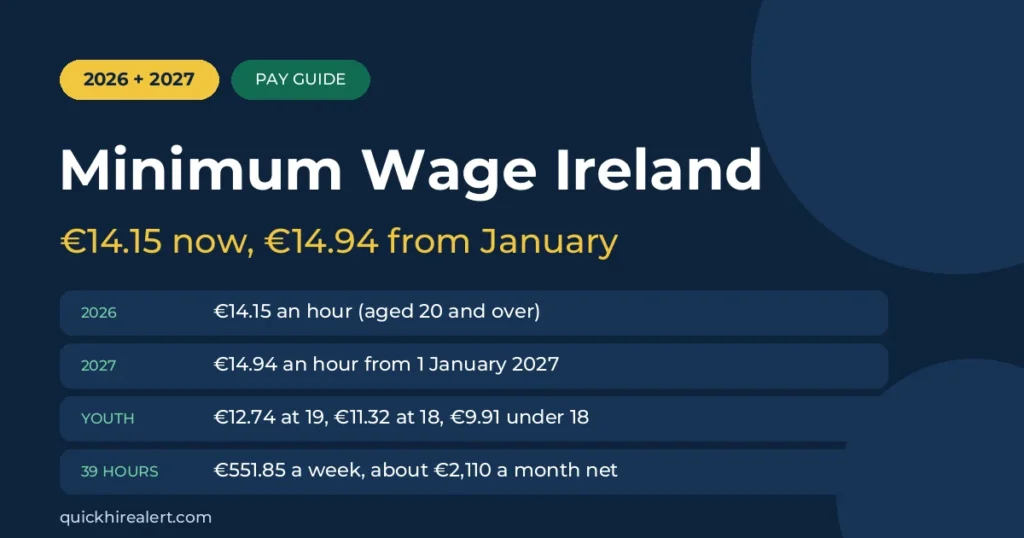
The national minimum wage in Ireland is €14.15 per hour for workers aged 20 and over, since 1 January 2026. Budget 2027 announced an increase of 79 cents to €14.94 per hour from 1 January 2027 (this requires legislation). Lower rates apply under 20: €12.74 at 19, €11.32 at 18 and €9.91 under 18 in 2026. On a 39-hour week, €14.15 is €551.85 a week, or about €28,696 a year, which is roughly €2,110 a month after tax for a single person.
Minimum Wage in Ireland: 2026 and 2027 Rates
| Age | % of full rate | From 1 January 2026 |
|---|---|---|
| 20 and over | 100% | €14.15 an hour |
| 19 | 90% | €12.74 an hour |
| 18 | 80% | €11.32 an hour |
| Under 18 | 70% | €9.91 an hour |
From 1 January 2027, the rate for workers aged 20 and over rises to €14.94 an hour. Citizens Information notes that this change requires legislation. The Low Pay Commission recommended this exact increase on 21 July 2026. The 2027 youth rates had not been published when we checked, and the government has deferred a decision on the Commission’s recommendation to abolish the lower youth rates.
Minimum Wage Per Week, Month and Year
| Hours a week | 2026 (€14.15) | 2027 (€14.94) |
|---|---|---|
| 20 hours | €283.00 a week | €298.80 a week |
| 30 hours | €424.50 a week | €448.20 a week |
| 39 hours | €551.85 a week / €28,696 a year | €582.66 a week / €30,298 a year |
| 40 hours | €566.00 a week / €29,432 a year | €597.60 a week / €31,075 a year |
Annual figures are the weekly pay multiplied by 52, before tax.
Minimum Wage After Tax
| Single person, 39-hour week | 2026 | 2027 |
|---|---|---|
| Gross pay a year | €28,696 | €30,298 |
| Income tax | €1,739 | €1,810 |
| USC | €394 | €426 |
| PRSI | €1,248 | €1,318 |
| Take-home a year | €25,315 | €26,745 |
| Take-home a month | €2,110 | €2,229 |
| Take-home a week | €487 | €514 |
These are estimates using Citizens Information’s 2026 rates and the Budget 2027 changes (20% band of €46,500 and personal and employee credits of €2,125 each in 2027), with PRSI at 4.35%. Try your own hours and pay in our Ireland salary and take-home pay calculator.
Part-time workers earning €352 or less a week pay no PRSI, and anyone whose income for the year is €13,000 or less pays no USC.
What Counts Towards the Minimum Wage
| Counts | Does not count |
|---|---|
| Basic pay Shift premium Fees, bonuses or commission Service charges paid through payroll Payments under zero-hours rules | Overtime premium Call-out premium Unsocial hours premium Premiums for public holidays, Saturdays or Sundays Sick pay, holiday pay and redundancy pay Benefit-in-kind other than board or lodgings |
If your employer provides food or accommodation, they can count a set amount towards the minimum wage: €1.27 an hour for board, and €33.42 a week or €4.77 a day for lodgings. This matters for jobs with accommodation in hotels, farms and care homes.
What If You Are Paid Less Than the Minimum Wage?
- Ask your employer for a written statement of your average hourly pay for the period in question.
- If the problem is not fixed, use the online complaint form on workplacerelations.ie. You can ask for an investigation by a Workplace Relations Commission (WRC) inspector, or refer a dispute to a WRC adjudicator, but not both.
- A dispute must be referred within 6 months of getting the statement, which can be extended to 12 months.
From Minimum Wage to a Living Wage
The government plans to replace the national minimum wage with a national living wage from 2029, set at 60% of median hourly wages. In April 2025 the government moved the timeline from 2026 to 2029. The Low Pay Commission estimates the current minimum wage is about 57.4% of median hourly wages, and says the 79-cent rise for 2027 keeps progress on track for 2029.
Minimum Wage and Work Permits
If you are coming to Ireland from outside the EU on an employment permit, your salary has to be well above the minimum wage. Most General Employment Permits need at least €36,605 a year (€32,691 for healthcare assistants and some other roles), and Critical Skills permits at least €40,904. A full-time minimum wage job of about €28,700 a year would not qualify, so check the salary before you accept an offer that depends on a permit.
For better-paid options, see the highest-paying jobs in Ireland, healthcare assistant jobs and the jobs in demand in Ireland. Teenagers can check the rules in our guide to jobs for 14, 15 and 16-year-olds.
Frequently Asked Questions
What is the minimum wage in Ireland in 2026?
€14.15 per hour for workers aged 20 and over, since 1 January 2026.
What is the minimum wage in Ireland in 2027?
Budget 2027 announced that the minimum wage for workers aged 20 and over will rise by 79 cents to €14.94 per hour from 1 January 2027. The change requires legislation.
What is the minimum wage for under 18s in Ireland?
In 2026 it is €9.91 an hour (70% of the full rate). It is €11.32 at 18 and €12.74 at 19.
How much is minimum wage a month in Ireland?
On a 39-hour week, €14.15 an hour is about €2,391 a month before tax and about €2,110 a month after tax for a single person in 2026.
How much is minimum wage a year in Ireland?
For a 39-hour week, about €28,696 a year in 2026 and €30,298 a year in 2027, before tax.
Does overtime count towards the minimum wage?
Basic pay for overtime hours counts, but the overtime premium does not. Unsocial hours, Sunday and public holiday premiums also do not count.
Can my employer deduct accommodation from my minimum wage?
Your employer can count board at €1.27 an hour and lodgings at €33.42 a week (€4.77 a day) towards the minimum wage.
When will Ireland have a living wage?
The government plans to replace the minimum wage with a living wage, set at 60% of median hourly wages, from 2029.
Sources
- Citizens Information: minimum wage and paying social insurance
- Low Pay Commission: recommendations for the national minimum wage 2027
This guide is general information, not legal or tax advice. QuickHireAlert is an independent publisher. Check the current rates with Citizens Information or the Workplace Relations Commission.
Get an email when Ireland's permit rules change
Salary thresholds, occupation lists and visa rules change every year. Subscribe and we will tell you when they do, plus new job guides. Free, no spam.
Subscribe free