
Last updated: 1 November 2026 | Uses the 2026 income tax, USC and PRSI rates published by Citizens Information, and the Budget 2027 changes announced for 1 January 2027.
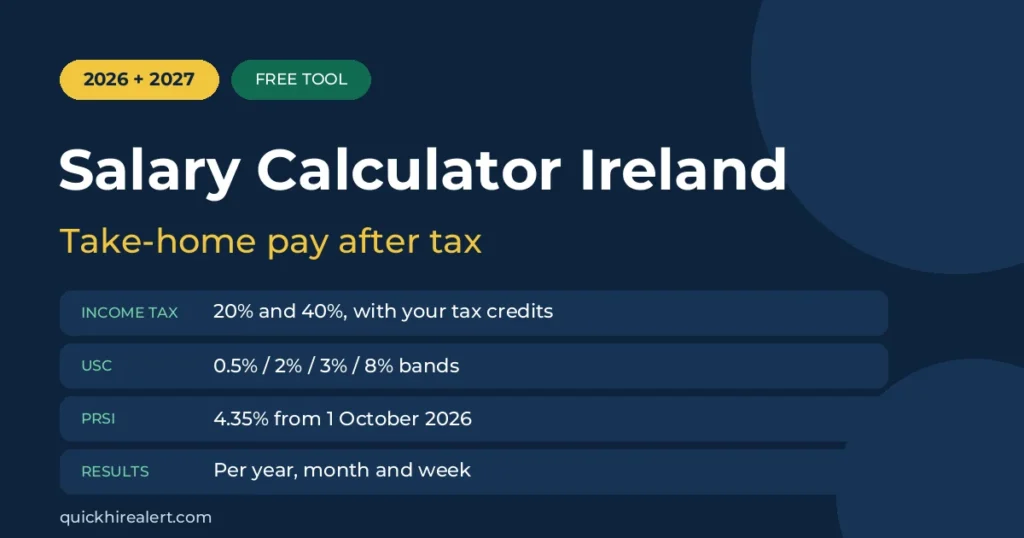
Enter your salary to see your take-home pay in Ireland after income tax, USC and PRSI, by year, month and week. The calculator covers single people, lone parents and married couples, and shows 2027 figures for single people using the Budget 2027 changes.
💰 Paid by the hour? Choose “Hour” and enter your hours. On the national minimum wage of €14.15 an hour for a 39-hour week, a single person takes home about €2,110 a month. See our minimum wage Ireland guide.
Take-Home Pay in Ireland: Quick Table (2026, single person)
| Gross salary | Income tax | USC | PRSI | Take-home a year | A month |
|---|---|---|---|---|---|
| €20,000 | €0 | €220 | €529 | €19,252 | €1,604 |
| €30,000 | €2,000 | €433 | €1,305 | €26,262 | €2,189 |
| €40,000 | €4,000 | €733 | €1,740 | €33,527 | €2,794 |
| €50,000 | €7,200 | €1,033 | €2,175 | €39,592 | €3,299 |
| €60,000 | €11,200 | €1,333 | €2,610 | €44,857 | €3,738 |
| €80,000 | €19,200 | €2,431 | €3,480 | €54,889 | €4,574 |
| €100,000 | €27,200 | €4,031 | €4,350 | €64,419 | €5,368 |
In 2027, the same single person keeps a little more. For example, on €50,000 take-home rises to about €40,358 (€3,363 a month), because of the higher standard rate band, higher tax credits and the wider 2% USC band.
How Your Take-Home Pay Is Worked Out
Three deductions come off an employee’s pay in Ireland: income tax, the Universal Social Charge (USC) and Pay Related Social Insurance (PRSI).
1. Income tax
Income up to your standard rate cut-off point is taxed at 20%; income above it is taxed at 40%. Your tax credits are then subtracted from the tax.
| 2026 | 20% band up to | Main tax credits |
|---|---|---|
| Single person | €44,000 | €2,000 personal + €2,000 employee |
| Lone parent | €48,000 | €2,000 personal + €1,900 single person child carer + €2,000 employee |
| Married couple, one income | €53,000 | €4,000 married + €2,000 employee |
| Married couple, two incomes | €53,000 plus the lower earner’s income, up to €35,000 more (maximum €88,000) | €4,000 married + €2,000 employee each |
2027 (Budget 2027): the single person’s 20% band rises by €2,500 to €46,500, with proportionate increases for married couples. The personal, employee and earned income tax credits each rise by €125 to €2,125, and the home carer credit by €100 to €2,050.
2. Universal Social Charge (USC)
You pay no USC if your income is €13,000 or less. Above that, each band is charged at its own rate:
| Income (2026) | USC rate |
|---|---|
| Up to €12,012 | 0.5% |
| €12,012.01 to €28,700 | 2% |
| €28,700.01 to €70,044 | 3% |
| Over €70,044 | 8% |
In 2027, the 2% band will extend to €30,300. Full medical card holders, and people aged 70 or over, with income of €60,000 or less pay a reduced rate: 0.5% up to €12,012 and 2% above.
3. PRSI
Employees on Class A PRSI pay 4.35% of their earnings from 1 October 2026 (it was 4.2% up to 30 September 2026). If you earn €352 or less a week you pay no PRSI. Between €352.01 and €424 a week, a PRSI credit of up to €12 a week reduces what you pay.
What This Calculator Does Not Include
- Pension contributions, including public service pension deductions, and the auto-enrolment pension scheme.
- Other tax credits, such as the home carer credit, rent credit or medical expenses relief, and any credits your employer’s payroll has not yet applied.
- Benefit-in-kind, overtime at different rates, bonuses and second jobs.
- For the 2026 figures, PRSI is calculated at 4.35% for the whole year. Employees paid before 1 October 2026 paid 4.2% on those earnings, so your real 2026 PRSI is slightly lower.
Your payslip may differ because your employer uses the tax credits and rate band on your Revenue tax credit certificate. Check yours in Revenue’s myAccount.
Salaries That Matter for Work Permits
If you are coming to Ireland on an employment permit, your salary must meet a minimum: €40,904 for most Critical Skills permits and €36,605 for most General Employment Permits (€32,691 for healthcare assistants and some other roles). Use the calculator to see what those salaries mean in take-home pay, and compare with the highest-paying jobs in Ireland and nurse pay on the HSE scale.
Frequently Asked Questions
How much is €40,000 after tax in Ireland?
A single person earning €40,000 in 2026 takes home about €33,527 a year, or €2,794 a month, after €4,000 income tax, €733 USC and €1,740 PRSI.
How much is €50,000 after tax in Ireland?
A single person on €50,000 takes home about €39,592 a year (€3,299 a month) in 2026, and about €40,358 (€3,363 a month) in 2027 under Budget 2027.
What are the tax rates in Ireland in 2026?
Income tax is 20% up to the standard rate cut-off point (€44,000 for a single person) and 40% above it. USC is 0.5%, 2%, 3% and 8% across its bands, and employee PRSI is 4.35% from 1 October 2026.
What tax credits do employees get?
In 2026, a single employee gets a €2,000 personal tax credit and a €2,000 employee tax credit. Both rise to €2,125 in 2027.
Do I pay PRSI if I earn under €352 a week?
No. Citizens Information says employees earning €352 or less a week before tax do not pay PRSI, although their employer still pays it. A tapered PRSI credit applies between €352.01 and €424 a week.
When do I not pay USC?
If your total income for the year is €13,000 or less, you pay no USC.
What changes in 2027?
Budget 2027 raises the single person’s 20% band to €46,500, increases the personal, employee and earned income credits to €2,125, widens the 2% USC band to €30,300 and raises the national minimum wage to €14.94 an hour from 1 January 2027.
Sources
- Citizens Information: how your tax is calculated, tax credits, Universal Social Charge, paying social insurance and PRSI classes
This calculator gives estimates for general information only. It is not tax advice. QuickHireAlert is an independent publisher. Your actual deductions depend on your tax credit certificate and personal circumstances; check with Revenue.
Get an email when Ireland's permit rules change
Salary thresholds, occupation lists and visa rules change every year. Subscribe and we will tell you when they do, plus new job guides. Free, no spam.
Subscribe free