
Last updated: 10 November 2026 | Checked against Citizens Information (annual leave and public holidays) on 10 November 2026.
Almost every employee in Ireland has a legal right to paid annual leave. The questions that come up most are how many weeks you get, how part-time and casual workers are counted, how holiday pay works and what happens to unused leave when you change job.
This guide answers those questions with the rules set by the Organisation of Working Time Act 1997, as explained by Citizens Information. It also covers public holiday pay, which is a separate entitlement. Every rule comes from the official sources listed at the bottom of the page.
Quick answer
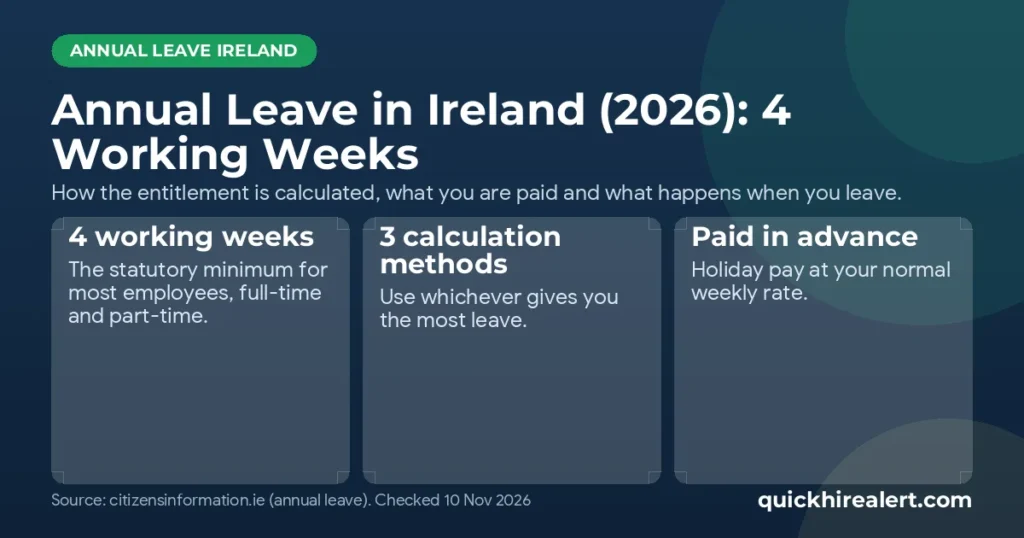
- Entitlement: 4 working weeks a year for most employees, including part-time, temporary and casual workers. Your contract can give you more.
- How it is worked out: Three methods. You get whichever gives you the most leave.
- Pay: Holiday pay is paid in advance at your normal weekly rate.
- Leave year: The statutory leave year runs from 1 April to 31 March. Many employers use the calendar year instead.
- Public holidays: A separate entitlement. Your employer picks one of four options.
- Leaving a job: Your employer must pay you for any leave you have not taken.
Annual Leave in Ireland: Key Facts
| Item | What the official source says |
|---|---|
| Statutory entitlement | 4 working weeks a year for most employees |
| Who is covered | Full-time, part-time, temporary and casual employees |
| Method 1 | At least 1,365 hours worked in the leave year gives the full 4 weeks (not if you changed employment in the leave year) |
| Method 2 | 1/3 of a working week for each month in which you worked at least 117 hours |
| Method 3 | 8% of the hours you worked in the leave year, up to 4 working weeks |
| Leave year | 1 April to 31 March (statutory) |
| Holiday pay | Paid in advance at your normal weekly rate |
| Employer discussion | At least one month before your leave |
| Complaint deadline (WRC) | 6 months, extendable by up to 6 more with reasonable cause |
How Many Weeks of Annual Leave Do You Get?
Most employees get 4 working weeks of annual leave a year. Employers can give you more, and if they do, it is set out in your contract of employment.
A working week means the number of days you usually work each week. Citizens Information gives this example: if you work 3 days of 10 hours (30 hours) a week, your leave week is 3 days. By our arithmetic, a 5-day week gives 20 working days of leave and a 3-day week gives 12.
After at least 8 months of work, you are entitled to an unbroken block of 2 weeks of leave.
Who Is Entitled to Annual Leave?
All employees are entitled to annual leave, including full-time, part-time, temporary and casual workers. For agency workers, whoever pays the wages (the agency or the client company) is treated as the employer for the Act and must provide the leave.
Citizens Information also says foreign nationals working legally in Ireland are entitled to the same range of statutory employment protections as Irish employees. That includes people on employment permits.
How Annual Leave Is Calculated: The Three Methods
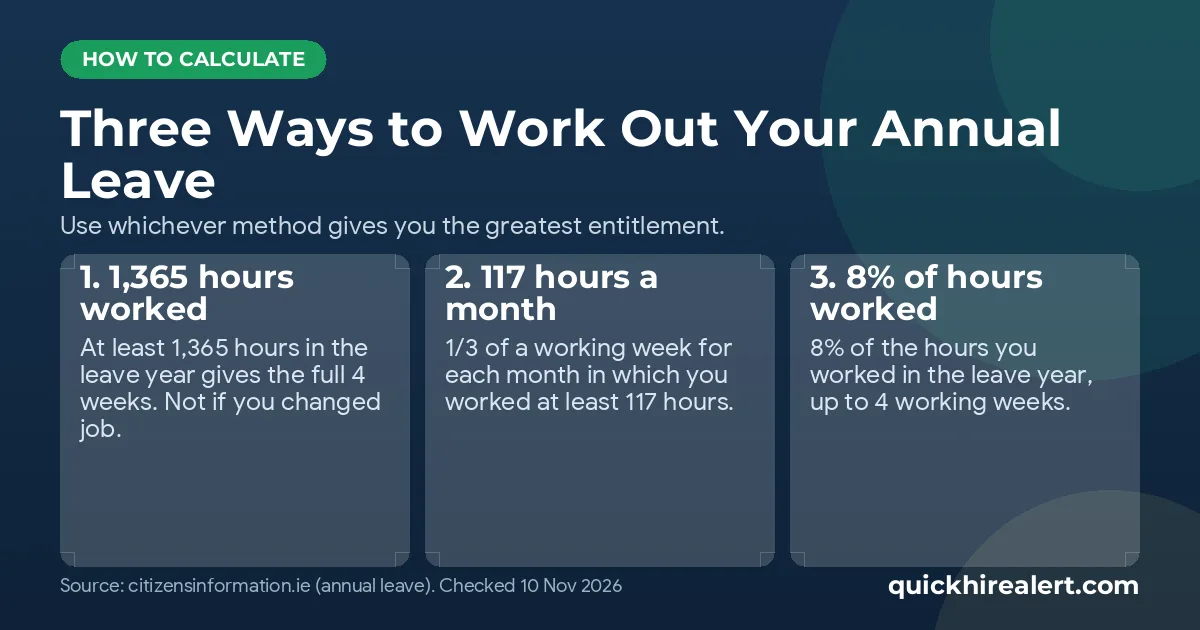
The Act gives three ways to work out your leave. You are entitled to whichever one gives you the greatest amount.
- Method 1: If you worked at least 1,365 hours in the leave year, you get the full 4 working weeks. You cannot use this method if you changed employment during the leave year. By our arithmetic, 1,365 hours is roughly 26 hours a week across a full year.
- Method 2: Take 1/3 of a working week for each calendar month in which you worked at least 117 hours.
- Method 3: Take 8% of the hours you worked in the leave year, up to a maximum of 4 working weeks.
The hours that count include time on annual leave, certified sick leave, maternity leave, adoptive leave, parental leave, force majeure leave and the first 13 weeks of carer’s leave.
Annual Leave for Part-Time Workers
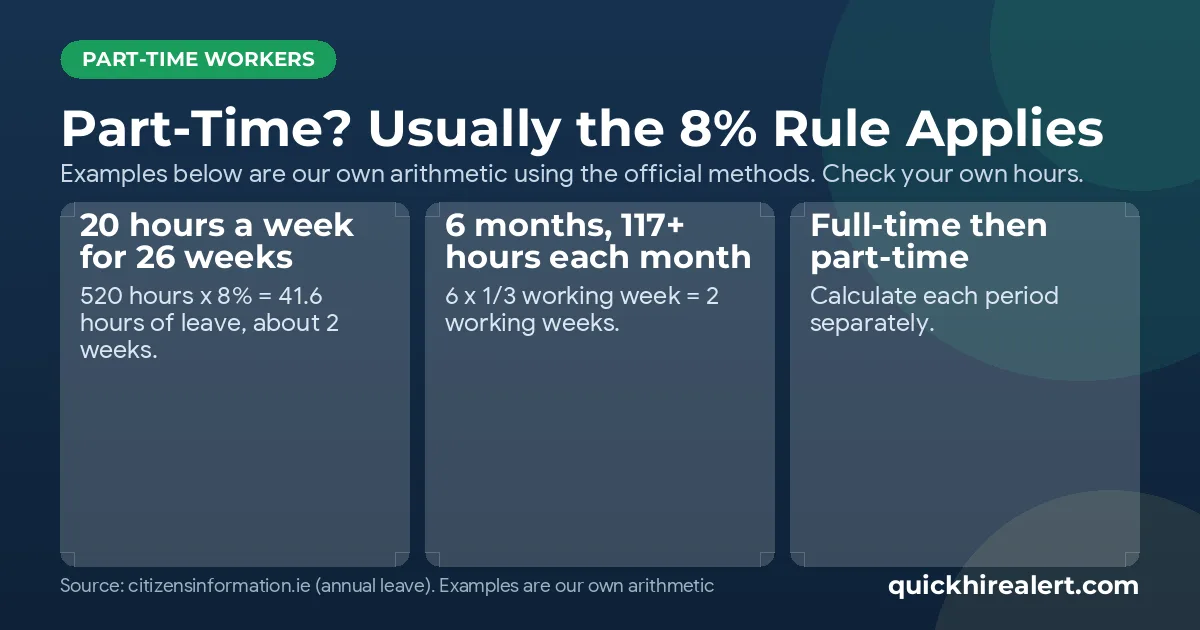
Part-time workers generally use Method 3, which is 8% of the hours worked. If you work full-time for part of the year and part-time for another part, calculate each period separately.
Two worked examples, using our own arithmetic with the official methods:
- 20 hours a week for 26 weeks: 520 hours worked. 8% of 520 is 41.6 hours of leave, which is about 2 weeks of 20-hour weeks.
- 6 months, at least 117 hours in each month: 6 months at 1/3 of a working week each gives 2 working weeks.
Check your own hours against the three methods. If your employer gives you less than the method that suits you best, ask them to show how they calculated it.
The Leave Year
The statutory leave year runs from 1 April to 31 March. Many employers use the calendar year (1 January to 31 December) instead. Citizens Information says this does not affect your statutory entitlements.
Holiday Pay
Your holiday pay must be paid in advance at your normal weekly rate. If your pay varies, for example because of commission or bonuses, your holiday pay is the average of your pay over the 13 weeks before the leave.
For the legal minimum hourly rate, including youth rates, see our guide to the minimum wage in Ireland.
Who Decides When You Take Your Leave?
You can ask for leave at specific times, and your employer can accept or refuse the request. Your employer decides when leave is taken, but must consider your family responsibilities and your opportunities for rest and recreation. Your employer must also discuss your leave with you (or your union) at least one month before the leave.
Public Holidays and Annual Leave
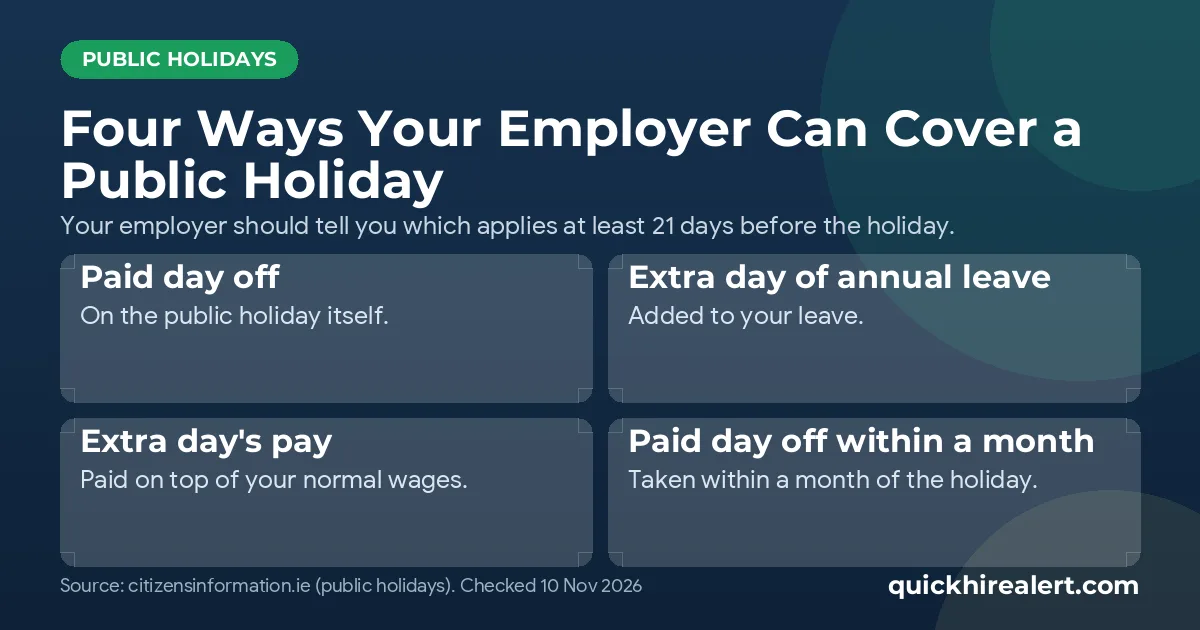
Public holidays are a separate entitlement from your 4 weeks. If you qualify, you get one of these four options instead of the public holiday itself:
- A paid day off on the public holiday
- An additional day of annual leave
- An additional day’s pay
- A paid day off within a month of the public holiday
Your employer should tell you which option applies at least 21 days before the public holiday. If they have not responded at least 14 days before, you are entitled to the actual public holiday off, paid.
Part-time workers: To qualify, you must have worked at least 40 hours in the 5 weeks before the public holiday, and annual leave counts as time worked. If the holiday falls on a day you normally work, you are paid for the day even if you do not work, and you get an extra day’s pay if you do work. If it falls on a day you do not normally work, you are paid one-fifth of your weekly pay.
For all the dates, see our guide to bank holidays in Ireland.
Sick Leave and Annual Leave
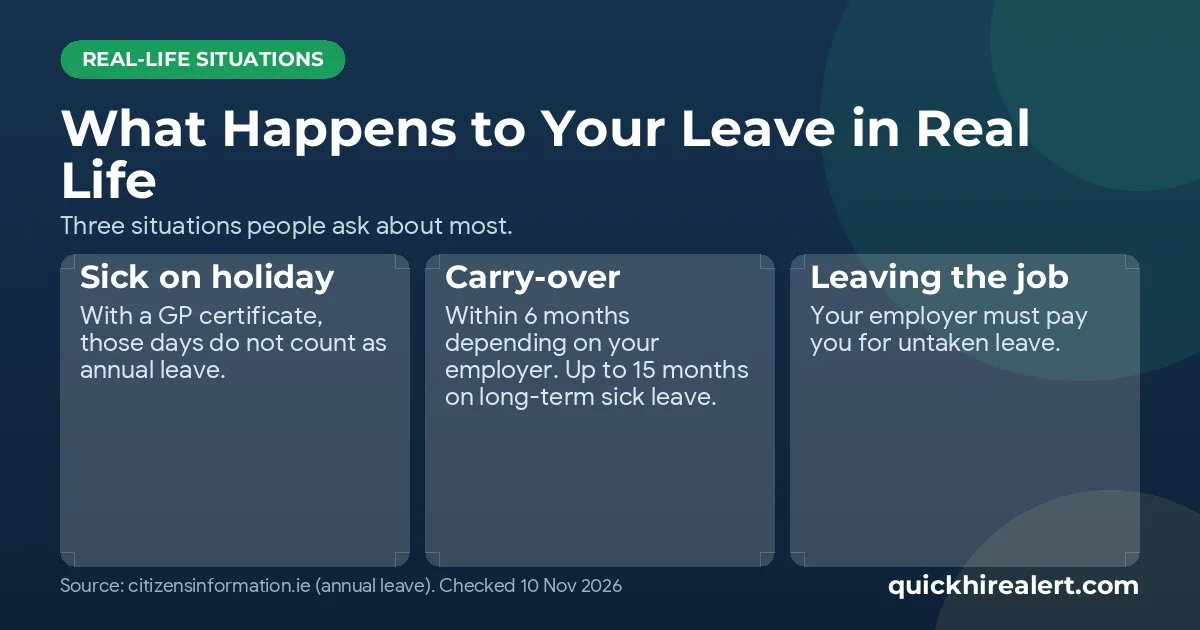
If you get sick during annual leave, get a medical certificate from your GP and give it to your employer when you return. Those days do not count as annual leave, and you can take the leave later. Your employer cannot make you take annual leave for certified sick days.
Your statutory entitlement keeps building up during certified sick leave.
For how many sick days you get, how much sick pay is and when Illness Benefit starts, see our guide to sick leave in Ireland.
Can You Carry Annual Leave Over?
Leave should be taken within the leave year. Depending on your employer, you can agree to take it within 6 months of the relevant leave year, and any further carry-over needs agreement between you and your employer.
If you are on long-term sick leave and cannot take your leave, you can carry it over for up to 15 months after the end of the year it was earned. If you leave your job within that period, you should be paid instead.
What Happens to Your Leave When You Leave a Job?
If you leave without taking all the leave you are entitled to, your employer must pay you for the untaken days. This matters if you are moving employer on an employment permit, so read our guide to changing employer on a work permit before you hand in notice.
During a lay-off or short-time working you remain an employee, but you do not build up annual leave. You can still take leave you accrued before the lay-off.
Other Leave That Still Counts
These types of leave still build up your annual leave: certified sick leave, maternity and additional maternity leave, adoptive and additional adoptive leave, paternity leave, parental leave, parent’s leave, health and safety leave, force majeure leave and the first 13 weeks of carer’s leave. See our guides to maternity leave in Ireland and paternity leave in Ireland.
If Your Employer Does Not Give You Your Leave
- Try to resolve it informally with your employer first. Ask for your leave balance and how it was calculated, in writing.
- If that fails, make a complaint to the Workplace Relations Commission (WRC) using its online complaint form.
- You must complain within 6 months of the dispute. The WRC can extend this by a further 6 months only if you had reasonable cause for not complaining in time.
The WRC Information and Customer Service line is (059) 917 8990, Monday to Friday. The Citizens Information Phone Service is 0818 07 4000, Monday to Friday, 9am to 8pm.
Frequently Asked Questions
How many days of annual leave do you get in Ireland?
Most employees get 4 working weeks a year. By our arithmetic that is 20 working days for a 5-day week. Your contract can give you more.
How is annual leave calculated for part-time workers?
Part-time workers generally use the 8% method: 8% of the hours you worked in the leave year, up to a maximum of 4 working weeks.
Do you get paid for annual leave in Ireland?
Yes. Holiday pay must be paid in advance at your normal weekly rate. If your pay varies, it is the average over the 13 weeks before the leave.
Can my employer refuse my annual leave request?
Your employer can accept or refuse a request, because the employer decides when leave is taken. They must consider your family responsibilities and your opportunities for rest and recreation, and discuss your leave with you at least one month before.
Can I carry over annual leave to next year?
Leave should be taken within the leave year. Depending on your employer, you can agree to take it within 6 months of the leave year. If you are on long-term sick leave you can carry it over for up to 15 months.
What happens to unused annual leave when I leave my job?
Your employer must pay you for the days you are entitled to but have not taken.
Does sick leave affect my annual leave?
If you are sick during annual leave and have a GP certificate, those days do not count as annual leave. Your entitlement also keeps building up during certified sick leave.
Do public holidays count as annual leave?
No. Public holidays are a separate entitlement. If your employer gives you an additional day of annual leave for a public holiday, it is added to your leave.
Do workers from outside the EU get annual leave?
Yes. Citizens Information says foreign nationals working legally in Ireland are entitled to the same range of statutory employment protections as Irish employees.
Related Guides
- bank holidays in Ireland
- minimum wage in Ireland
- maternity leave in Ireland
- paternity leave in Ireland
- changing employer on a work permit
- jobs in Ireland for foreigners
Sources
- Citizens Information: Annual leave
- Citizens Information: Public holidays in Ireland
- Citizens Information: Employees’ rights and entitlements
Get an email when Ireland's permit rules change
Salary thresholds, occupation lists and visa rules change every year. Subscribe and we will tell you when they do, plus new job guides. Free, no spam.
Subscribe free