
Last updated: 10 November 2026 | Checked against Citizens Information (sick leave and sick pay, Illness Benefit, Budget 2027 rates), gov.ie and the Workplace Relations Commission on 10 November 2026.
Since 2023, employees in Ireland have had a legal right to paid sick leave from their employer. The scheme is called statutory sick leave or statutory sick pay, and it is set by the Sick Leave Act 2022. Many people still do not know how many days they get, how much they are paid or what happens once those days run out.
This guide covers the number of days, the pay rate, who qualifies, medical certificates and Illness Benefit from the Department of Social Protection. Every rule comes from the official sources listed at the bottom of the page.
Quick answer
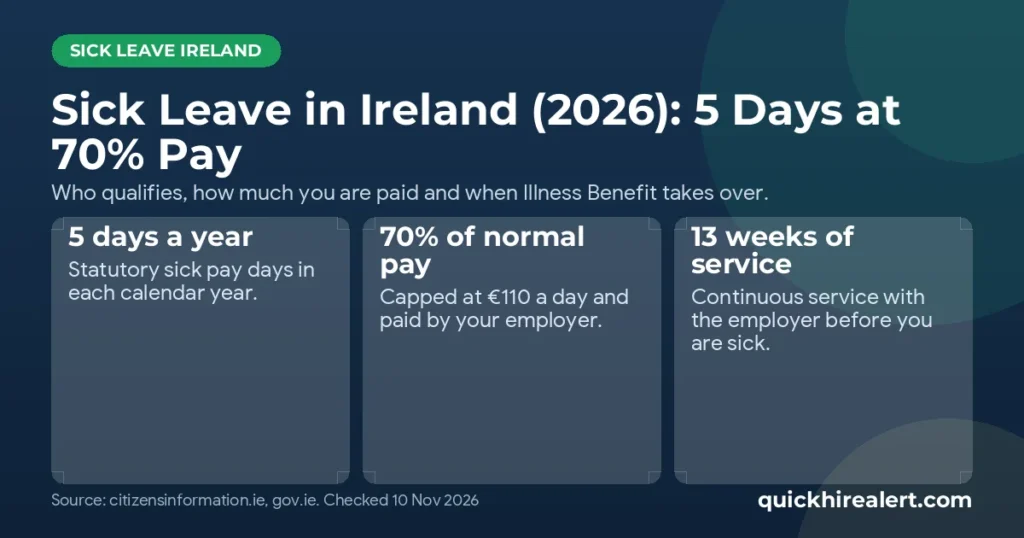
- Days: 5 days of statutory sick pay a year (the calendar year, 1 January to 31 December).
- Pay: 70% of your normal pay, capped at €110 a day, paid by your employer.
- Who qualifies: Employees with at least 13 weeks of continuous service with that employer, certified by a medical practitioner as unable to work.
- No waiting days: Your employer cannot make you wait before sick pay starts.
- After 5 days: If you have enough PRSI, you can claim Illness Benefit from the Department of Social Protection.
- 2027: The Minister confirmed in April 2025 that the entitlement stays at 5 days. We found no announced change for 2027 in the sources we checked.
Sick Leave in Ireland: Key Facts
| Item | What the official source says |
|---|---|
| Days a year | 5 (3 in 2023, 5 from 1 January 2024) |
| Pay rate | 70% of normal daily pay, up to €110 a day |
| Who pays | Your employer |
| Service needed | 13 weeks of continuous service with your employer |
| Medical certificate | Needed from day 1, from a medical practitioner |
| Year used | Calendar year, no carry-over to the next year |
| Illness Benefit | From day 6 (day 4 if you have already used your 5 days), if you have enough PRSI |
| Illness Benefit maximum rate | €254 a week in 2026, €264 a week in 2027 |
| Complaint deadline (WRC) | 6 months, extendable by up to 6 more with reasonable cause |
How Many Days of Sick Leave Do You Get?
You are entitled to 5 days of paid sick leave a year. The scheme started on 1 January 2023 with 3 days and rose to 5 days from 1 January 2024. In April 2025 the Minister for Enterprise confirmed that it would stay at 5 days.
The days can be taken together or separately. If you are off for fewer than 5 days, the unused days can cover later sick periods in the same calendar year, up to 5 days in total. You cannot carry unused days into the next year, and a period of statutory sick leave cannot run on into the next calendar year. If you are still sick in January, you get a fresh entitlement for the new year.
Who Qualifies for Statutory Sick Pay?
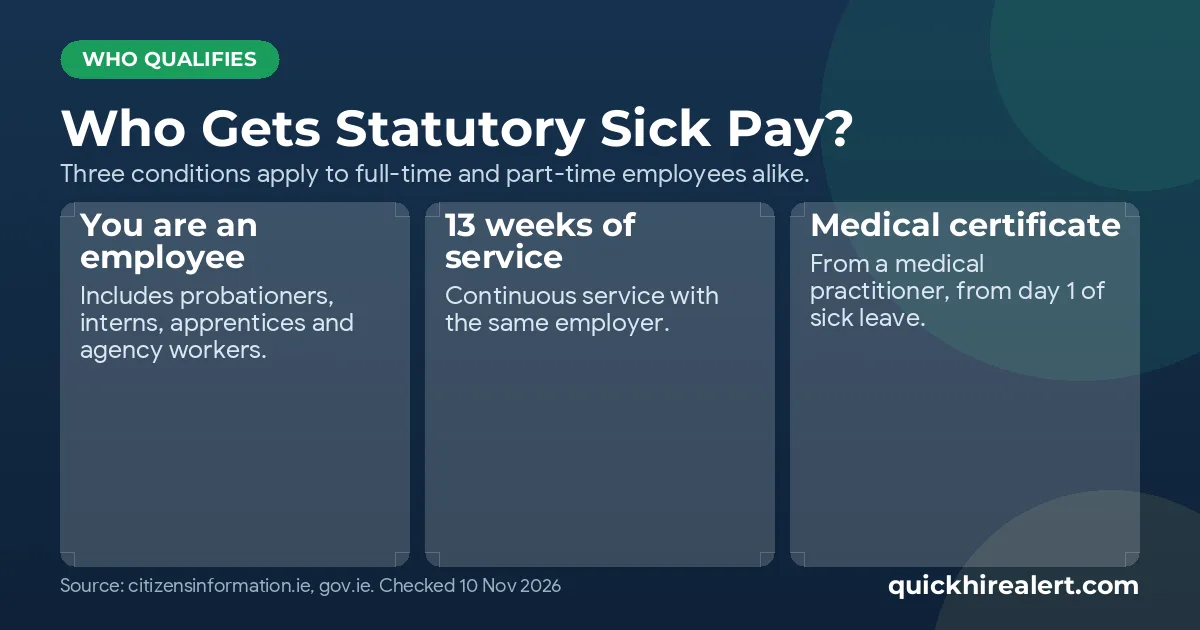
- You must be an employee, full-time or part-time. Probationers, interns, apprentices, agency workers and people over State Pension age can qualify.
- You must have worked continuously for your employer for at least 13 weeks before you are sick.
- You must be certified by a medical practitioner as unable to work.
Each employer counts separately. If you have two jobs, you can get 5 days from each employer once you have 13 weeks of service with that employer. A gap of up to 26 weeks before you return to the same employer does not break your continuity.
Sick days in your first 13 weeks are not covered by statutory sick pay, but you may still qualify for Illness Benefit.
How Much Sick Pay Do You Get?
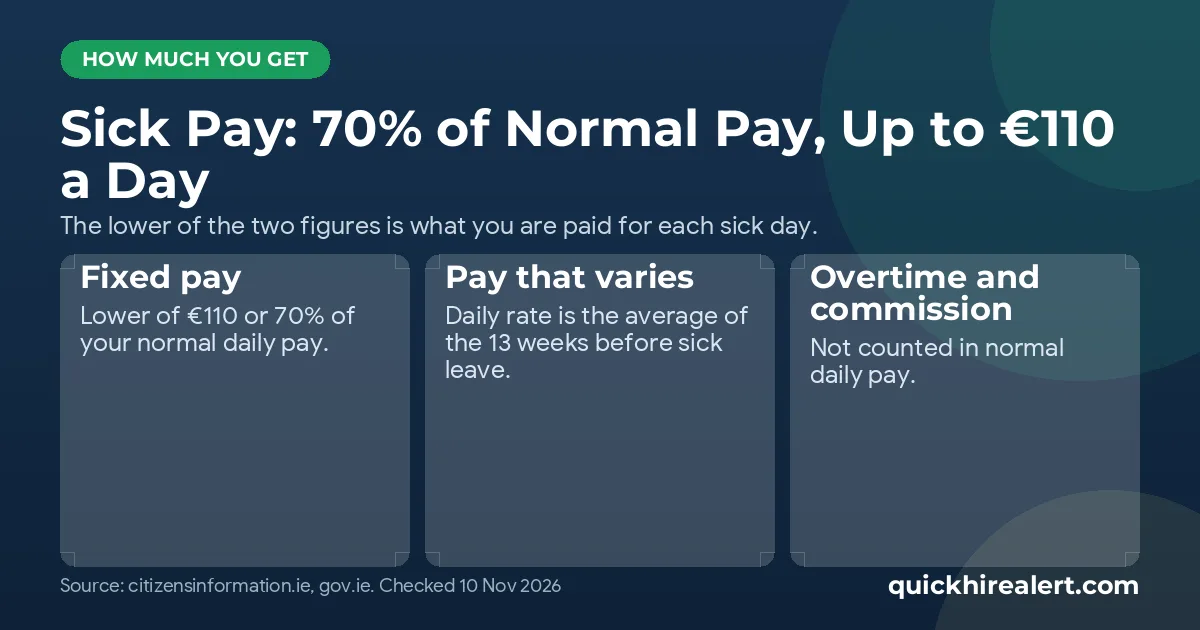
Statutory sick pay is 70% of your normal pay, capped at €110 a day. Your employer pays it, and the cap means higher earners get no more than €110 for each sick day.
- Normal daily pay includes regular bonuses and allowances that do not change from week to week. It does not include overtime or commission.
- If your pay varies, your daily rate is the average over the 13 weeks before your sick leave.
- Part-time with fixed hours and a fixed rate: you get the lower of €110 or 70% of your normal daily pay.
- Part-time with variable hours at a fixed rate: you get the lower of €110 or 70% of what you would have earned that day.
Medical Certificates
You need to be certified by a medical practitioner as unable to work, and this applies from the first day of sick leave. Your employer cannot apply waiting days before sick pay starts. The Citizens Information page does not set out what the certificate must contain, so check with your employer and your doctor.
Employer Sick Pay Schemes
If your employer has its own sick pay scheme that is more favourable overall, it can apply instead of statutory sick pay. You cannot get statutory sick pay on top of a more generous employer scheme. Some sectors also have their own schemes. In construction, for example, the Construction Workers Sick Pay Trust replaces statutory sick pay.
An employer in severe financial difficulty can apply to the Labour Court for an exemption from paying statutory sick pay. An exemption lasts between 3 and 12 months.
Illness Benefit After Your Sick Days
Illness Benefit is paid by the Department of Social Protection. It is separate from statutory sick pay, and you cannot get both for the same day.
- Waiting period: No payment for the first 3 days (Sundays are not counted).
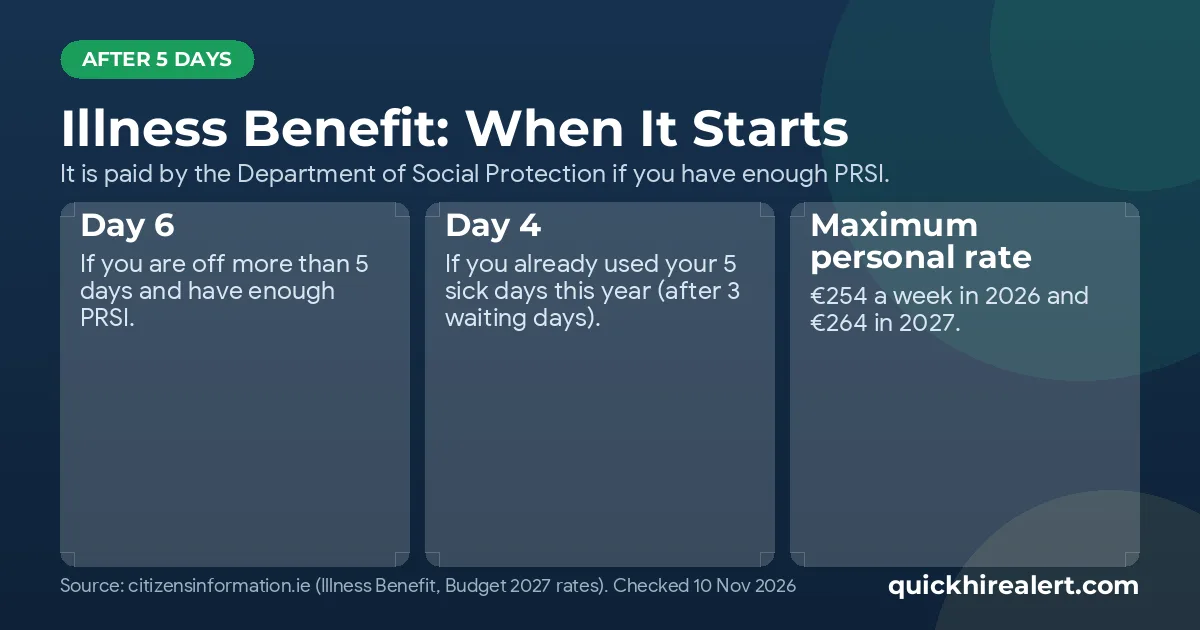
- From day 6: If you are off sick for more than 5 days, Illness Benefit starts from day 6.
- From day 4: If you have already used your 5 statutory days in the year and become sick again, it starts from day 4, after the 3 waiting days.
- Rate: The maximum personal rate is €254 a week in 2026 and €264 a week in 2027. Lower rates apply if your average weekly earnings are below €300.
PRSI conditions: You need at least 104 weeks of PRSI contributions since you first started work, and either 39 weeks paid or credited in the relevant tax year (at least 13 of them paid) or 26 weeks paid in the relevant tax year and 26 weeks in the previous one. Only Class A, E, H and P count. Contributions from an EU or EEA country or the UK can help you qualify, but your last contribution must have been paid in Ireland.
How to claim: Apply within 6 weeks of becoming ill. You need a medical certificate from your GP. You can apply online at MyWelfare.ie with a verified MyGovID account, or post an IB1 form with a certificate of incapacity for work. Illness Benefit lasts up to 624 days (2 years) if you have at least 260 weeks of contributions, or 312 days (1 year) if you have between 104 and 259 weeks.
Sick Leave, Annual Leave and Public Holidays
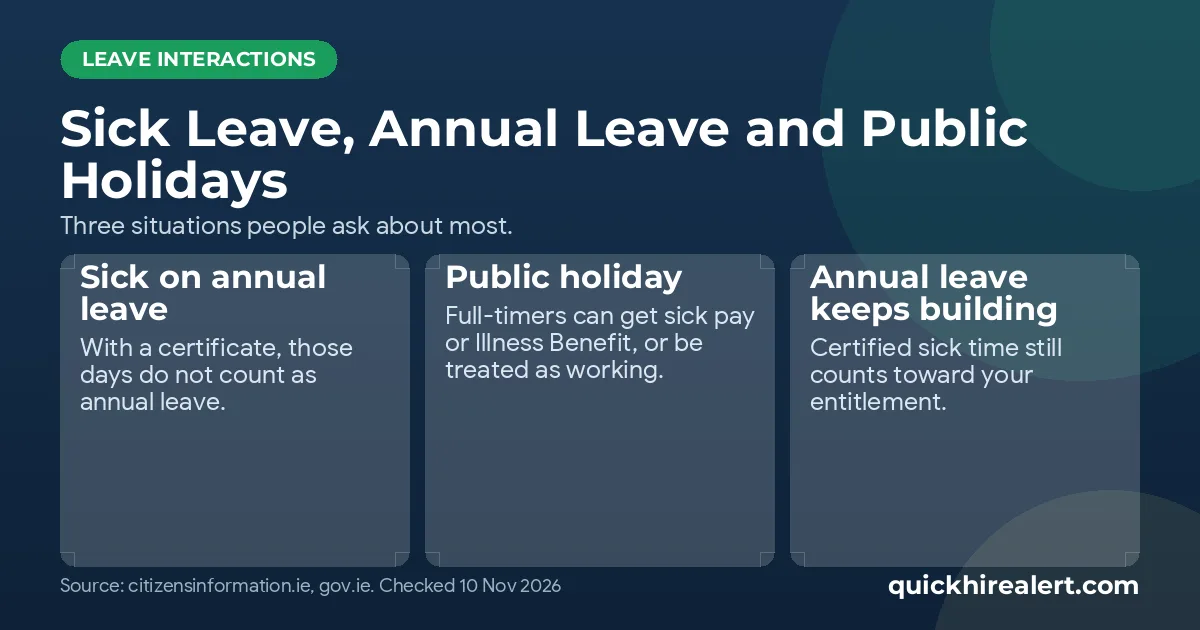
If you get sick during annual leave and have a medical certificate, those days do not count as annual leave, and your employer cannot make you take annual leave for certified sick days. You also keep building up annual leave while certified sick. See our guide to annual leave in Ireland for how entitlement is worked out.
For public holidays, full-time workers who are on sick leave can get sick pay or Illness Benefit for that day, or the employer can treat them as working and pay them normally. Part-time workers on sick leave are entitled to time off if they worked at least 40 hours in the previous 5 weeks. See our guide to bank holidays in Ireland for the dates.
Probation, Training and Apprenticeships
An employer can suspend probation, training or an apprenticeship during sick leave, and can add the suspended days to the end of the period.
Protection From Penalties
You are protected from being penalised for claiming your sick leave rights. Penalties include dismissal, unfair treatment or an unfavourable change to your conditions. Complaints go to the Workplace Relations Commission (WRC).
Workers on an Employment Permit
Citizens Information says foreign nationals working legally in Ireland are entitled to the same range of statutory employment protections as Irish employees. That includes statutory sick leave. If you are on an employment permit and thinking of moving job, read our guide to changing employer on a work permit. A new employer counts separately, so you need 13 weeks of service with them before statutory sick pay applies.
If Your Employer Does Not Pay Your Sick Leave
- Try to resolve it with your employer first. Ask in writing how your sick pay was calculated.
- If that fails, make a complaint to the WRC using its online complaint form.
- You must complain within 6 months of the dispute. The WRC can extend this by a further 6 months if you had reasonable cause for not complaining in time.
The Citizens Information Phone Service is 0818 07 4000, Monday to Friday, 9am to 8pm.
Frequently Asked Questions
How many days of sick leave do you get in Ireland?
You get 5 days of statutory sick pay a year, paid by your employer. The entitlement was 3 days in 2023 and has been 5 days since 1 January 2024.
How much is sick pay in Ireland?
Statutory sick pay is 70% of your normal pay, capped at €110 a day.
Who is entitled to statutory sick pay?
Employees who have worked continuously for their employer for at least 13 weeks and who are certified by a medical practitioner as unable to work. Full-time and part-time employees both qualify.
Do you need a medical certificate for sick leave in Ireland?
Yes. You must be certified by a medical practitioner as unable to work, and this is needed from day 1 of sick leave.
Can my employer make me wait before sick pay starts?
No. Employers cannot apply waiting days before statutory sick pay starts.
What happens when I use up my 5 sick days?
If you have enough PRSI contributions you can claim Illness Benefit from the Department of Social Protection. It starts from day 4 if you have already used your 5 statutory days, after 3 waiting days.
How much is Illness Benefit in 2026 and 2027?
The maximum personal rate is €254 a week in 2026 and €264 a week in 2027. Lower rates apply if your average weekly earnings are below €300.
Can I carry unused sick days into next year?
No. Unused days cannot be carried forward, and a period of statutory sick leave cannot run into the next calendar year.
Does sick leave count as annual leave?
Not if you have a medical certificate. Certified sick days during annual leave do not count as annual leave, and you keep building up annual leave while certified sick.
Is sick leave going to increase to 7 or 10 days in 2027?
The Minister for Enterprise confirmed in April 2025 that the entitlement stays at 5 days. We found no announced change for 2027 in the official sources we checked.
Related Guides
- annual leave in Ireland
- bank holidays in Ireland
- minimum wage in Ireland
- maternity leave in Ireland
- paternity leave in Ireland
- changing employer on a work permit
- jobs in Ireland for foreigners
Sources
- Citizens Information: Sick leave and sick pay
- Citizens Information: Illness Benefit
- Citizens Information: Social welfare rates announced in Budget 2027
- gov.ie: Entitlement to statutory sick leave to remain unchanged at 5 days
- Workplace Relations Commission: Sick leave
Get an email when Ireland's permit rules change
Salary thresholds, occupation lists and visa rules change every year. Subscribe and we will tell you when they do, plus new job guides. Free, no spam.
Subscribe free