
Last updated: 10 November 2026 | Checked against the CSO (Labour Force Survey Q2 2026 and Earnings Analysis 2025), DETE employment permit statistics 2025, the RTB Rent Index Q1 2026 and the HSE jobs site on 10 November 2026.
Cork is Ireland’s second city and its second-biggest hub for employment permits. The jobs market is smaller than Dublin’s but unemployment is lower, pay is above the national median and rents are well below Dublin’s.
This guide uses official figures to show which sectors employ the most people in Cork, what people earn, how many work permits are issued, what rent costs and where to find live vacancies. It also covers what international applicants need to know.
Quick answer
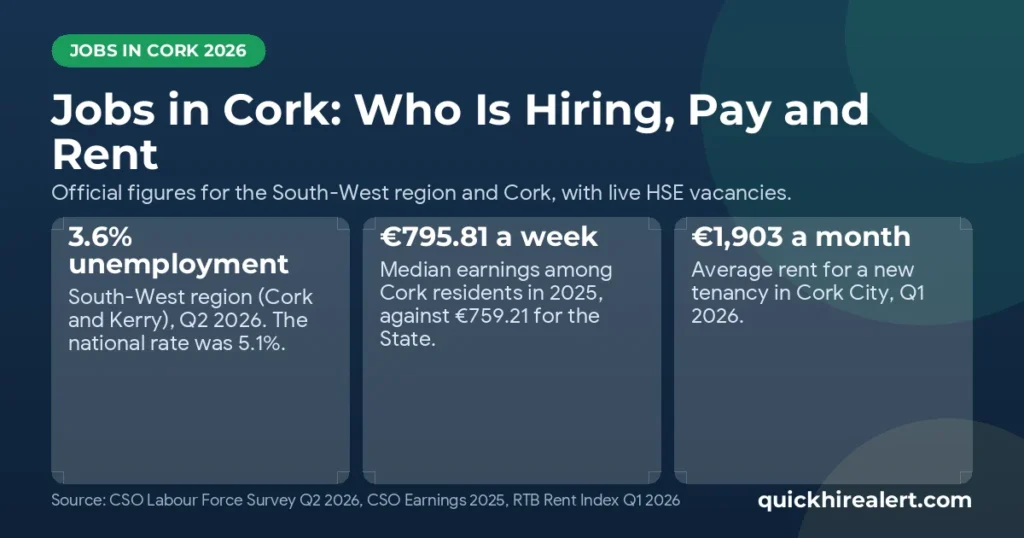
- Jobs: 417,800 people were employed in the South-West region (Cork and Kerry) in Q2 2026, and the unemployment rate was 3.6%, against 5.1% nationally (CSO).
- Pay: median weekly earnings among Cork residents were €795.81 in 2025, above the State median of €759.21 but below Dublin’s €848.06 (CSO).
- Work permits: DETE issued 2,973 employment permits for Cork in 2025, the second-highest county after Dublin.
- Rent: the average new tenancy in Cork City was €1,903 a month in Q1 2026 (RTB), against €2,335 in County Dublin.
- Foreign applicants: most non-EEA nationals need an employment permit. A General Employment Permit generally needs at least €36,605 a year.
Live Jobs in Cork
These Cork vacancies were open when we checked. We list a job only after reading it on the employer’s own vacancy page. They are HSE or HSE-funded posts that need professional registration, so read each specification for the contract, pay and requirements before you apply.
3 open vacancies · checked on 10 November 2026. Closed jobs are removed automatically.
Nurses (NMBI registration needed)
- Clinical Nurse Manager 3, Disability Services, St Raphael's Centre, Youghal, Co. Cork (HSE South West). Permanent, whole-time; open to all applicants; closes 27 November 2026, 12:00 Irish time. View the vacancy.
Healthcare assistants
- Staff Bank Healthcare Assistant, HSE South West, Cork and Kerry (HSE). Permanent, whole-time (staff bank); open to all applicants; closes 16 September 2027, 12:00 Irish time. Staff bank: shifts are offered across Cork and Kerry sites. View the vacancy.
Other roles
- Staff Grade Physiotherapist, Children's Disability Network, Corlann, Carrigaline and Bandon, Co. Cork (HSE-funded). Permanent, whole-time (35 hours per week); open to all applicants; closes 22 November 2026, 23:45 Irish time. Advertised by the HSE on behalf of a publicly funded organisation; not an HSE job. View the vacancy.
For more vacancies, search the HSE jobs page and the careers pages of the employers you want to work for. Our guide to how to apply for HSE jobs explains each step of the HSE process.
Which Sectors Employ the Most People in Cork?
The CSO reports employment for the South-West region, which covers Cork and Kerry, so the figures below include both counties. Cork is by far the larger of the two.
| Sector (CSO, Q2 2026) | People employed, South-West region |
|---|---|
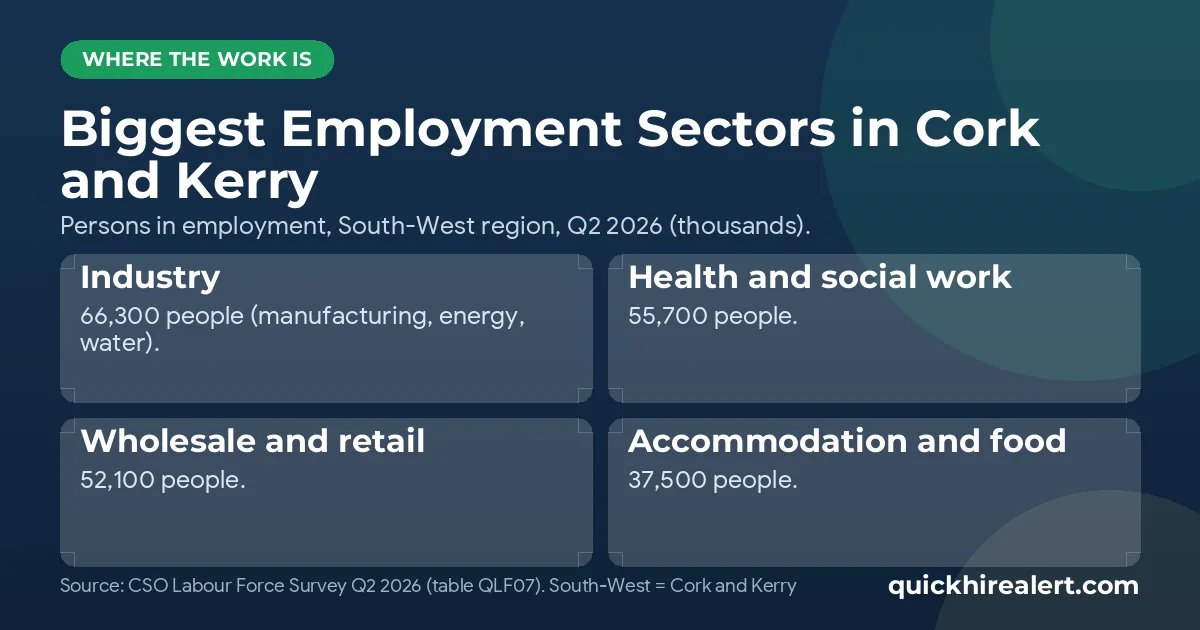
| Industry (manufacturing, energy, water) | 66,300 |
| Human health and social work | 55,700 |
| Wholesale and retail trade | 52,100 |
| Accommodation and food service | 37,500 |
| Education | 34,300 |
| Professional, scientific and technical | 26,600 |
| Construction | 25,000 |
| Agriculture, forestry and fishing | 23,000 |
| Public administration and defence | 19,400 |
| Information and communication | 18,200 |
| All sectors | 417,800 |
Industry is the biggest employer in the region, with more people than in Dublin’s industry sector (66,300 against 60,200). Health and social work comes second, so nursing, healthcare assistant and allied health roles are the main route for many applicants. See our guides to nursing jobs in Ireland and nurse salary in Ireland.
Pay in Cork
The CSO publishes earnings by county in its Earnings Analysis using Administrative Data Sources 2025. Median weekly earnings among Cork residents were €795.81, up 3.9% on 2024. That is about 4.8% above the State median (our arithmetic) and 6.6% below Dublin’s. The figures are based on where employees live, not where they work, and they include part-time work.
| CSO, 2025 | Median weekly | Mean weekly |
|---|---|---|
| Cork | €795.81 | €999.47 |
| Dublin | €848.06 | €1,149.74 |
| State | €759.21 | €974.08 |
The CSO notes a large gap between men and women in Cork: median weekly earnings were €902.79 for men and €687.95 for women, so men’s median was 31.2% higher.
For pay by sector and role, see our guides to the average salary in Ireland and the highest-paying jobs in Ireland. The legal pay floor is in our minimum wage guide, and our salary calculator shows take-home pay.
Work Permits and Employers in Cork
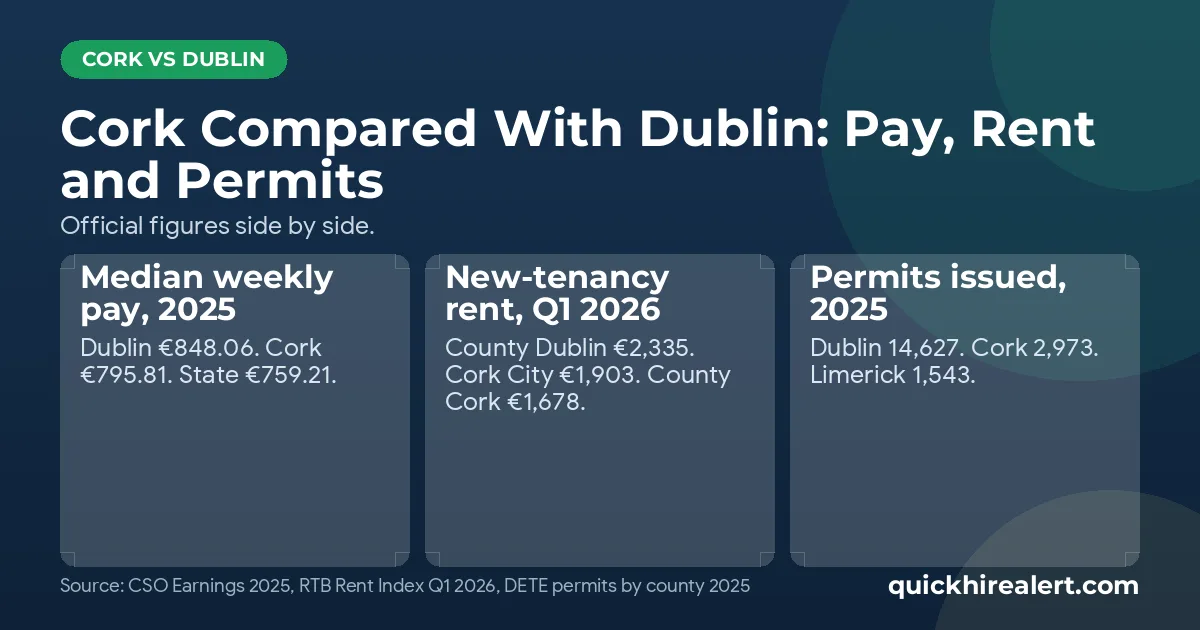
DETE publishes employment permits by county. In 2025 it issued 31,044 permits in total. Dublin received 14,627 and Cork 2,973 (9.6% of the total), followed by Limerick with 1,543. DETE refused 322 permit applications in Cork that year.
DETE’s list of employers does not show the county of each job, so we cannot rank Cork employers on its own. One employer on the 2025 top 50 list is named for Cork: Cork University Hospital, with 146 permits in 2025 and 165 in January to September 2026. The full list is in our guide to companies that receive employment permits. A company on that list is not necessarily hiring now, so always check its own vacancies.
If you need a permit, read our guides to the General Employment Permit and the Critical Skills Employment Permit, and to jobs in Ireland with visa sponsorship.
Rent in Cork
The RTB Rent Index reports average rents by area. Cork is cheaper than Dublin but rents there are rising quickly: the Cork City figure for new tenancies was up 16.3% on a year earlier.
| RTB Rent Index, Q1 2026 | New tenancies (monthly) | Sitting tenants (monthly) |
|---|---|---|
| Cork City | €1,903 (+16.3%) | €1,422 |
| County Cork | €1,678 (+12.9%) | €1,259 |
| County Cork excluding Cork City | €1,442 (+12.1%) | €1,071 |
| National average | €1,839 (+9.1%) | €1,513 |
| County Dublin | €2,335 (+7.8%) | €1,960 |
A new tenancy in Cork City costs €432 a month less than in County Dublin (our arithmetic), although the two figures cover different areas. See our guides to rent in Dublin and the cost of living in Ireland.
How to Find a Job in Cork
- Start with the HSE if you are a health professional. HSE South West recruits in Cork and Kerry. Check your registration (NMBI for nurses, the Medical Council for doctors) first.
- Use the employers’ own careers pages and the main Irish job boards, and apply to roles that match your qualifications rather than sending generic applications.
- Tailor your CV to each vacancy and read the job specification closely.
- Beware of fees. A genuine employer or recruiter will not ask you to pay to apply or to be considered.
Part-Time and Student Work in Cork
- The minimum wage is €14.15 an hour for workers aged 20 and over in 2026, with lower youth rates below that age. See the minimum wage guide.
- Part-time workers need at least 40 hours in the previous 5 weeks to get public holiday benefit. See bank holidays in Ireland.
- Annual leave builds up with the hours you work. See annual leave in Ireland, and sick leave in Ireland for statutory sick pay.
- Students on a Stamp 2 permission can work up to 20 hours a week during term and 40 hours a week in the holiday periods (June to September and 15 December to 15 January), according to the Irish Immigration Service. They must not engage in any other business or trade.
Jobs in Cork for International Applicants
EEA, UK and Swiss citizens can work in Ireland without a permit. Most other nationals need an employment permit or an immigration permission that allows work, and the employer must apply for the permit. Many entry-level roles are on the Ineligible Occupations List and cannot be supported with a permit. Our guide to jobs in Ireland for foreigners sets out the options, and our guide to jobs in Dublin compares the capital.
Frequently Asked Questions
Is it easy to find a job in Cork?
The unemployment rate in the South-West region (Cork and Kerry) was 3.6% in Q2 2026, below the national rate of 5.1% (CSO). Competition still varies by sector, so apply to roles that match your qualifications and registration.
What is the average pay in Cork?
CSO figures for 2025 put median weekly earnings among Cork residents at €795.81 and mean weekly earnings at €999.47. The State median was €759.21. These figures include part-time work.
Which industries employ the most people in Cork?
In the South-West region (Cork and Kerry), industry employed 66,300 people in Q2 2026, health and social work 55,700, wholesale and retail 52,100, and accommodation and food service 37,500 (CSO).
How many work permits are issued for Cork?
DETE issued 2,973 employment permits for Cork in 2025, about 9.6% of the 31,044 total. Only Dublin, with 14,627, received more.
Can foreigners get jobs in Cork?
Yes, but most non-EEA nationals need an employment permit or another permission that allows work. The employer applies for the permit, and a General Employment Permit generally needs a salary of at least €36,605. Many entry-level roles are on the Ineligible Occupations List.
How much is rent in Cork?
The RTB Rent Index for Q1 2026 gives an average of €1,903 a month for a new tenancy in Cork City and €1,678 in County Cork. The national average was €1,839.
Is Cork cheaper than Dublin?
Rent is lower: €1,903 for a new tenancy in Cork City against €2,335 in County Dublin (RTB, Q1 2026). Median weekly earnings are also lower, at €795.81 in Cork against €848.06 in Dublin (CSO, 2025).
Where can I find the latest jobs in Cork?
Check the HSE jobs site, the careers pages of employers in Cork, and the main Irish job boards. Read each vacancy on the employer’s own page before you apply, and never pay a fee to apply.
Related Guides
- jobs in Dublin
- rent in Dublin
- cost of living in Ireland
- average salary in Ireland
- highest-paying jobs in Ireland
- jobs in Ireland with visa sponsorship
- HSE jobs
Sources
- CSO: Labour Force Survey Quarter 2 2026 (tables QLF07 and QLF08, South-West and Dublin regions)
- CSO: Earnings Analysis using Administrative Data Sources 2025, County
- DETE: Employment permit statistics 2025 (permits by county and company listing)
- ESRI and RTB: The RTB Rent Index, Q1 2026
- HSE jobs: job search
- Irish Immigration Service (Stamp 2 conditions)
Last verified: 10 November 2026. The South-West region covers Cork and Kerry. Earnings figures are by place of residence. Rents are RTB averages for new tenancies and vary by property type and area. Confirm permit rules on enterprise.gov.ie.
Get an email when Ireland's permit rules change
Salary thresholds, occupation lists and visa rules change every year. Subscribe and we will tell you when they do, plus new job guides. Free, no spam.
Subscribe free