
Last updated: 6 November 2026. Rent figures are taken from the Residential Tenancies Board (RTB) Rent Index for Q1 2026; energy costs from Selectra Ireland (updated November 2026); transport fares from Transport for Ireland. Other figures are typical 2026 market ranges and should be treated as a guide, not a quote.
The cost of living is the first real question most people ask before moving to Ireland — and for good reason. Ireland offers high salaries, a strong job market and one of the easiest routes to the EU for skilled workers, but it is not a cheap country, and housing in particular can swallow a large part of your income if you don’t plan for it.
This guide breaks down what it actually costs to live in Ireland in 2026 — rent, energy, groceries, transport, healthcare and more — with real figures from official sources, sample monthly budgets for a single person and a family, and a direct comparison for anyone moving to Ireland from the US. If you are weighing up a job offer, read this alongside our guide to the highest-paying jobs in Ireland so you can judge whether the salary clears the real cost of living.
Quick Answer: How Much Does It Cost to Live in Ireland?
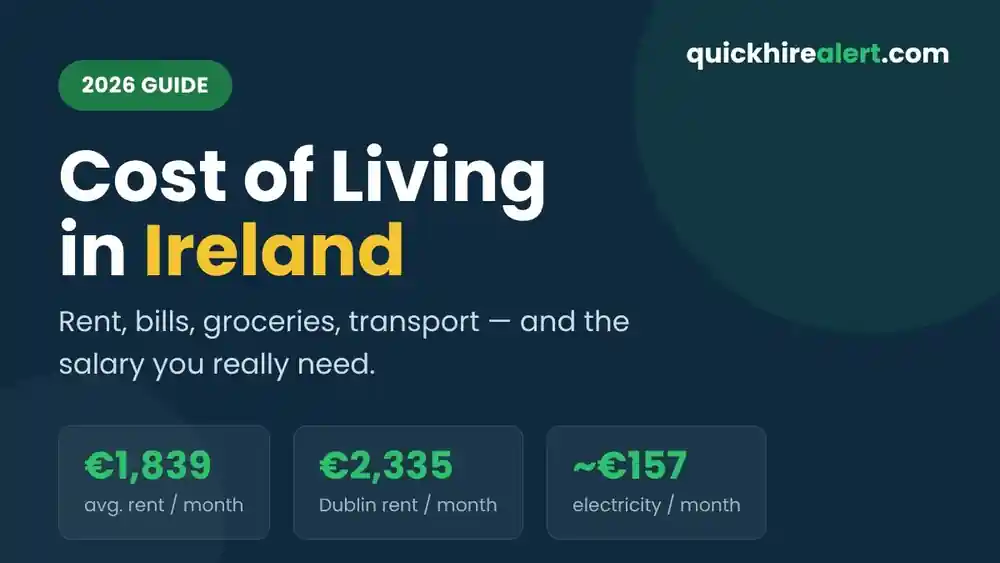
How much money do you need to live in Ireland? A single person renting a one-bedroom home outside the city centre needs roughly €2,500–€3,000 a month to live comfortably in 2026, and a family of four needs roughly €4,500–€6,000 a month, depending heavily on where they live. Rent is by far the biggest cost: the national average for a new tenancy was €1,839 a month in early 2026, rising to €2,335 in Dublin.
Cost of Living in Ireland at a Glance (2026)
| Expense | Typical monthly cost (single person) | Source |
|---|---|---|
| Rent (1-bed, outside city centre) | €1,500–€1,900 | RTB Rent Index Q1 2026 |
| Electricity | ~€157 | Selectra Ireland |
| Gas / heating | ~€129 | Selectra Ireland |
| Groceries | €300–€400 | Typical 2026 range |
| Public transport (Leap Card) | €80–€120 | Transport for Ireland |
| Mobile & broadband | €55–€75 | Typical 2026 range |
| Health insurance (optional) | €120–€200 | Typical 2026 range |
| Social, dining & misc. | €250–€400 | Typical 2026 range |
The single most important thing to understand about the cost of living in Ireland is that your rent decides almost everything. Someone renting in Dublin and someone renting in a smaller town can have the same salary and a completely different quality of life, purely because of housing. So that is where we start.
Rent and Housing Costs in Ireland (2026)
Housing is the defining cost of living in Ireland, and it has risen sharply. According to the Residential Tenancies Board (RTB) Rent Index for the first quarter of 2026, the standardised average rent for a new tenancy was €1,839 per month nationally — up 9.1% in a year. Rents for existing tenancies (where you are already a sitting tenant, protected by Rent Pressure Zone rules) averaged a lower €1,513 per month.
That gap matters enormously: new arrivals almost always pay the higher “new tenancy” rate, because they are signing a fresh lease.
Average Rent in Ireland by Area (New Tenancies, Q1 2026)
| Area | Average monthly rent (new tenancy) | Year-on-year change |
|---|---|---|
| National | €1,839 | +9.1% |
| Dublin (county) | €2,335 | +7.8% |
| Cork City | €1,903 | +16.3% |
| Galway City | €2,004 | +13.3% |
| Limerick City | €1,921 | +20.9% |
| Cork (county) | €1,678 | +12.9% |
| Galway (county) | €1,718 | +10.7% |
| Limerick (county) | €1,744 | +16.3% |
Source: RTB Rent Index, Q1 2026. Figures are standardised averages that adjust for the mix of property types.

Two things stand out. First, Dublin is in a league of its own — at €2,335 for a new tenancy, it is around 27% above the national average. Second, the “cheaper” cities are catching up fast: Limerick City rents rose nearly 21% in a year, and Galway City is now above €2,000. The idea that you can escape high rents simply by avoiding Dublin is becoming less true each year.
How to Cut Your Housing Costs
- House-share. Renting a room in a shared house, rather than a whole apartment, is how most new arrivals and younger workers manage. A room in a shared house typically costs far less than a self-contained one-bed.
- Look beyond the big cities. Commuter towns and smaller counties can be meaningfully cheaper, though you then pay more in transport and time.
- Start with short-term accommodation. Rental supply is tight and competitive, so many people book a few weeks of short-term accommodation on arrival and search for a longer lease once they are on the ground.
- Know your rights. Most of the country is covered by Rent Pressure Zone rules that cap how much rent can rise. Citizens Information explains your rights as a tenant.
Utility Bills in Ireland (2026)
Energy is Ireland’s second painful cost. The country has some of the higher electricity prices in Europe, and winters, while mild, are long and damp, so heating runs for much of the year.
Based on typical household consumption, Selectra Ireland (updated November 2026) estimates:
- Electricity: about €1,887 per year, or roughly €157 per month, for a standard urban home.
- Gas (heating): about €1,554 per year, or roughly €129 per month, for a typical gas-heated home.
Not every home uses gas — many rural properties heat with oil or electricity instead — but between electricity and heating, budget €200–€300 a month for energy across the year, higher in winter and lower in summer. On top of that, expect:
- Broadband: roughly €30–€60 a month for home internet.
- Mobile: roughly €15–€30 a month for a decent plan.
- TV licence: a flat annual fee is payable for any household with a television.
- Bins / waste: waste collection is privatised and charged per household, often €150–€300 a year depending on the provider and usage.
Water charges do not apply to ordinary domestic use in Ireland, which is one genuine saving compared with many other countries.
Grocery and Food Costs in Ireland
Groceries in Ireland are moderately priced by Western European standards, helped by the strong presence of discount supermarkets. A single person who cooks at home typically spends €300–€400 a month on groceries; a family of four spends closer to €700–€900 a month.
Where you shop makes a real difference:
- Aldi and Lidl are the budget options and extremely popular — most households do their main shop here.
- Tesco, Dunnes Stores and SuperValu sit in the mid-range, with wider choice and higher prices.
- Convenience shops (Centra, Spar) are the most expensive and best avoided for a weekly shop.
Eating out adds up quickly. A casual restaurant meal for one runs around €18–€25, a pint of beer around €6–€7 in most of the country (more in central Dublin), and a takeaway coffee around €3.50–€4. Cooking at home is where most people control their food budget.
Transport Costs in Ireland
If you live in a city, you may not need a car at all. Ireland’s public transport is anchored by the TFI Leap Card, a contactless card that works across bus, Luas (Dublin’s tram), DART and commuter rail, and is far cheaper than paying cash fares.
Leap Card fares are capped daily and weekly, so there is a ceiling on what you can spend in a week no matter how many journeys you take. In practice, a city commuter who relies on public transport spends roughly €80–€120 a month. If your employer offers the TaxSaver commuter-ticket scheme, you can buy monthly or annual tickets out of pre-tax salary and save further.
Running a car is much more expensive. Beyond the purchase price, budget for:
- Motor insurance, which is notably high in Ireland, especially for newly arrived drivers without an Irish or recognised no-claims history.
- Motor tax, charged annually based on emissions.
- Fuel, among the higher prices in Europe due to tax.
- NCT (the national car test) for older vehicles.
For anyone relocating from the US, check whether your home state has a licence-exchange agreement with Ireland — some do, some don’t, and it affects whether you can swap your licence or must re-test.
Healthcare Costs in Ireland
Ireland has a public health system run by the HSE, but it is not free at the point of use for everyone the way some public systems are. Most working residents pay for GP visits (typically €50–€70 per visit) unless they qualify for a medical card or GP visit card based on income.
Because of public waiting lists, a large share of employees take private health insurance, often partly or fully covered as a job benefit. If you pay for it yourself, expect roughly €120–€200 a month for an individual plan, more for family cover. Prescription medicines are subsidised but still cost money, with a monthly cap on what any household pays.
When comparing a job offer, always ask whether health insurance is included — it is one of the most valuable benefits an Irish employer can offer, and it materially changes your real cost of living.
Sample Monthly Budgets for Ireland (2026)
Figures below combine the official rent and energy data above with typical 2026 market ranges for everything else. They assume a new tenancy at current market rents, which is what new arrivals pay.
Single Person, Dublin
| Expense | Monthly cost |
|---|---|
| Rent (1-bed or large room share) | €1,400–€2,000 |
| Electricity & gas | €220 |
| Groceries | €350 |
| Transport (Leap Card) | €110 |
| Mobile & broadband | €65 |
| Health insurance | €150 |
| Social & misc. | €350 |
| Total | €2,645–€3,245 |
Single Person, Smaller City or Town
| Expense | Monthly cost |
|---|---|
| Rent (1-bed or room share) | €900–€1,400 |
| Electricity & gas | €220 |
| Groceries | €320 |
| Transport | €90 |
| Mobile & broadband | €65 |
| Health insurance | €150 |
| Social & misc. | €300 |
| Total | €2,045–€2,545 |
Family of Four, Commuter Town near Dublin
| Expense | Monthly cost |
|---|---|
| Rent (3-bed house) | €2,000–€2,600 |
| Electricity & gas | €300 |
| Groceries | €800 |
| Transport (two commuters) | €220 |
| Mobile & broadband | €90 |
| Health insurance (family) | €350 |
| Childcare | varies widely — often €800+ per child |
| Social & misc. | €500 |
| Total (excl. childcare) | €4,260–€4,860 |
Childcare is the hidden budget-breaker for families. Full-time crèche or childminding is one of the largest single costs a young family faces in Ireland, frequently rivalling rent. Government subsidies through the National Childcare Scheme reduce the bill, but families moving with young children should research this carefully before accepting an offer.
Cost of Living in Ireland vs the US
For Americans weighing a move, the headline is this: Ireland generally has lower healthcare and university costs, but higher housing, energy, petrol and car costs, and salaries that are often lower in headline terms than US equivalents — though what you keep after healthcare and education can tell a different story.
- Housing: Dublin rents are comparable to a mid-tier US city, below the likes of New York or San Francisco but well above most of middle America.
- Healthcare: far cheaper than the US. There is no risk of a catastrophic medical bill, and private insurance that would cost a fortune in the US runs €120–€200 a month here.
- Cars and fuel: markedly more expensive than the US — higher purchase prices, higher insurance, and petrol taxed at European levels.
- Groceries and dining: broadly similar, with alcohol and eating out on the pricier side.
- Taxes: income tax is higher than in most US states, but it funds healthcare and heavily subsidised third-level education.
One practical point Americans often overlook: as a US citizen you continue filing US taxes on worldwide income even while living in Ireland, though foreign tax credits and exclusions usually prevent genuine double taxation. This is worth a conversation with a cross-border tax professional. For the full relocation picture, see our guide to moving to Ireland from the US and our overview of jobs in Ireland for Americans.
Which Irish Cities Are Cheapest to Live In?
On current RTB data, Dublin is the most expensive place to live by a wide margin, driven almost entirely by rent. After Dublin, the other cities cluster closer together than many expect: Galway City (€2,004) and Limerick City (€1,921) are now nearly as expensive as Cork City (€1,903) for new tenancies.
The cheaper options tend to be county areas and smaller towns rather than the cities themselves — Cork county (€1,678) and Galway county (€1,718) sit well below their city centres. The trade-off is transport: living further out saves on rent but adds commuting cost and time. For most newcomers, the sweet spot is a commuter town with a direct rail or bus link to where the jobs are.
How Much Salary Do You Need to Live Comfortably in Ireland?
As a rough guide for 2026:
- A single person can live reasonably on a gross salary of around €40,000–€45,000, and comfortably on €50,000+, especially outside Dublin.
- A couple with no children manage well on a combined €70,000–€80,000.
- A family of four realistically wants a combined household income of €80,000–€100,000+ once childcare is factored in, particularly near Dublin.
These are guides, not guarantees — your rent, your city and whether your employer covers health insurance can shift the picture by hundreds of euro a month. The reassuring part is that most of Ireland’s higher-paying roles and Critical Skills Employment Permit jobs pay comfortably above these thresholds.
Tips to Reduce Your Cost of Living in Ireland
- Share housing, at least at first. Rent is the single biggest lever on your budget. A room in a shared house instead of a solo apartment can cut your largest bill in half.
- Shop at Aldi and Lidl. The discount supermarkets are genuinely cheaper and widely used — there is no stigma attached.
- Use the TaxSaver scheme. If your employer offers it, buying your commuter ticket from pre-tax salary is a straightforward saving.
- Switch energy providers. Ireland’s energy market is competitive, and new-customer discounts are significant. Don’t stay on a standard rate out of inertia.
- Negotiate health insurance into your package. Employer-paid cover is worth €1,500–€2,400 a year to you.
- Consider a commuter town. The rent saving often outweighs the extra transport cost, especially with a TaxSaver rail ticket.
Frequently Asked Questions
1. How much does it cost to live in Ireland per month?
A single person renting outside the city centre typically needs €2,500–€3,000 a month in 2026, and a family of four €4,500–€6,000, depending heavily on location. Rent is the biggest variable.
2. What is the average rent in Ireland in 2026?
The national average for a new tenancy was €1,839 a month in Q1 2026, rising to €2,335 in Dublin, according to the RTB Rent Index.
3. Is Ireland expensive to live in?
Yes, relative to much of Europe — mainly because of housing and energy. Rent, electricity, petrol and car costs are high, while healthcare is far cheaper than in the US and water is not charged for ordinary domestic use.
4. How much money do I need to move to Ireland?
Beyond your first month’s rent and a deposit (usually one month), budget for several weeks of short-term accommodation, initial living costs before your first pay, and setup costs. A buffer of a few thousand euro is sensible, as rental supply is competitive and the gap between arrival and first salary can be weeks.
5. What is the cheapest city to live in Ireland?
Among the cities, Cork, Limerick and Galway are cheaper than Dublin, though the gap is narrowing. County areas and smaller towns are cheaper still, at the cost of longer commutes.
6. How much are utility bills in Ireland?
Electricity averages about €157 a month and gas about €129 a month for a typical home (Selectra, 2026). Budget €200–€300 a month across the year for energy combined, higher in winter.
7. Do you need a car to live in Ireland?
Not in the cities — public transport with a Leap Card is cheaper and sufficient for most. In rural areas a car is usually necessary, and running one is expensive due to high insurance, fuel and tax.
8. How much do groceries cost in Ireland?
A single person spends roughly €300–€400 a month, a family of four €700–€900, with Aldi and Lidl being the cheapest places to shop.
9. Is healthcare free in Ireland?
No. Public healthcare through the HSE is subsidised but not free at the point of use for most workers — GP visits cost €50–€70 unless you qualify for a medical card. Many employees hold private health insurance, often as a job benefit.
10. What salary do you need to live comfortably in Ireland?
Roughly €40,000–€50,000 gross for a single person (more in Dublin), and €80,000–€100,000+ combined for a family of four once childcare is included.
Conclusion
Ireland is not a cheap country, but it is a well-paid one, and for most skilled workers the maths works out — provided you go in with your eyes open about housing. Rent is the cost that decides your quality of life, so the smartest move you can make is to choose your location and housing type deliberately rather than defaulting to central Dublin.
Once you know your likely costs, the next question is income. Use our guides to the highest-paying jobs in Ireland and the Critical Skills Employment Permit to check that the salary on offer clears the real cost of living, and if you are relocating from America, read our full guide to moving to Ireland from the US next.
Sources
- Residential Tenancies Board (RTB) — Rent Index Q1 2026
- Selectra Ireland — average energy bills (2026)
- Transport for Ireland — Leap Card fares
- Citizens Information — tenancy rights and childcare schemes
- HSE — healthcare and medical cards
Get an email when Ireland's permit rules change
Salary thresholds, occupation lists and visa rules change every year. Subscribe and we will tell you when they do, plus new job guides. Free, no spam.
Subscribe free