
Last updated: 6 November 2026. Immigration routes and salary thresholds are based on the Irish Department of Enterprise employment-permit rules effective 1 March 2026 and current Department of Foreign Affairs guidance. Rules change — always confirm the specifics for your situation on the official gov.ie and Irish Immigration Service sites before you commit.
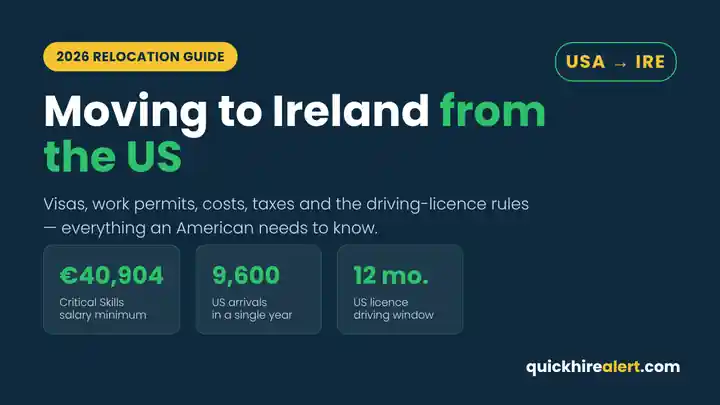
Moving to Ireland from the US has gone from a niche idea to a genuine trend. Irish government migration figures show arrivals from the United States nearly doubled in a single year — from around 4,900 in the twelve months to April 2024 to roughly 9,600 to April 2025. Americans are drawn by the strong job market, the EU gateway, the shared language, and for many, ancestral ties.
But Ireland is not a place you can simply show up and settle in. As a US citizen you can enter easily, yet living and working there legally means securing the right permission in advance. This guide walks through every realistic route, the 2026 salary thresholds, the full step-by-step process, and the practical realities — housing, taxes, healthcare and the driving-licence headache that catches almost every American by surprise.
Quick Answer: Can an American Move to Ireland?
Yes — but you need the right permission, not just a plane ticket. US citizens can enter Ireland visa-free for up to 90 days as a visitor, but to live and work you need a basis to stay: usually an employment permit tied to a job offer, a working-holiday authorisation, Irish citizenship by descent, or proof of independent means. You arrange that permission before you move, then register for residence after you arrive.
Do Americans Need a Visa to Move to Ireland?
This is where most people get confused, so it is worth being precise. There are two separate things: entry and permission to live and work.
- Entry: US passport holders do not need a visa to land in Ireland. You can enter visa-free and stay as a tourist for up to 90 days.
- Living and working: That visitor entry gives you no right to work, rent long-term, or settle. For that you need an underlying permission — most commonly an employment permit — and then an Irish Residence Permit (IRP) once you are in the country.
In other words, Americans are “visa-exempt” for entry but still need an immigration permission to actually move. The permit or authorisation is the thing that matters, and it is arranged before you fly.
The Main Routes for Americans to Move to Ireland
There are several legal pathways. The right one depends on your job, your age, your ancestry and your finances.
| Route | Best for | Leads to |
|---|---|---|
| Critical Skills Employment Permit | Skilled workers with a job offer in an in-demand field (tech, engineering, healthcare, finance) | Stamp 1 → Stamp 4 after 2 years → citizenship after 5 |
| General Employment Permit | Job offers in a wider range of occupations | Stamp 1, renewable; longer path to Stamp 4 |
| Working Holiday Authorisation | Younger Americans wanting up to 12 months to live and work | Temporary stay only |
| Citizenship by descent | Anyone with an Irish parent or grandparent | Full Irish (EU) citizenship and passport |
| Stamp 0 / independent means | Retirees or the financially independent | Residence without the right to work |
| Study (Stamp 2) | Students enrolled in an Irish course | Temporary stay with limited work rights |
Critical Skills Employment Permit
This is the premium route and the one Ireland actively wants skilled Americans to use. The Critical Skills Employment Permit is for roles on the Critical Skills Occupations List — software, engineering, data, healthcare, finance and similar high-demand fields. Its big advantages: no labour-market test, immediate family reunification, and a fast track to long-term residence. After two years you can apply for a Stamp 4, which lets you live and work without a permit at all, and Irish citizenship becomes possible after five years of legal residence.
General Employment Permit
The General Employment Permit covers a far broader set of occupations, including many not on the critical list. It is the workhorse permit, but it comes with a labour-market needs test (the employer usually has to advertise the role first) and a slower route to permanent residence. It is still a completely viable way to move if your occupation does not qualify for a Critical Skills permit.
Working Holiday Authorisation
Under the long-standing US–Ireland Working Holiday Agreement, eligible Americans — typically post-secondary students and recent graduates — can get a Working Holiday Authorisation to live and work in Ireland for up to 12 months. Places are limited and issued through the Irish consular network in the US. It is the simplest way to test life in Ireland before committing to a permit-based move, though it does not by itself lead to permanent residence.
Irish Citizenship by Descent
If you have an Irish parent, or an Irish-born grandparent, you may already be entitled to Irish citizenship — which means an EU passport and the right to live and work in Ireland (and across the EU) with no permit at all. This is the single best route if you qualify. We cover the process in detail in our guide to Irish citizenship by descent; it is worth checking your family tree before you look at any permit.
Stamp 0 and the Independent Means Route
Retirees and financially independent Americans who do not intend to work can apply to live in Ireland under a Stamp 0 or “persons of independent means” arrangement. This requires demonstrating a substantial, stable annual income and comprehensive private health insurance, and it does not grant the right to take up employment.
Employment Permit Salary Thresholds (2026)
Ireland raised its employment-permit salary thresholds on 1 March 2026, the first step in a roadmap of gradual increases running toward 2030. If you are moving on a permit, your job offer must meet or exceed the relevant minimum:
| Permit type | Minimum annual salary (from 1 March 2026) |
|---|---|
| General Employment Permit | €36,605 |
| Critical Skills — with a relevant degree | €40,904 |
| Critical Skills — without a relevant degree | €68,911 |
| Critical Skills — recent graduate route | €36,848 |
Source: Irish Department of Enterprise, Tourism and Employment. These are minimums — actual salaries in critical-skills fields are typically well above them. The thresholds are scheduled to rise again in 2027 and beyond, so always check the current figure when you receive an offer. For a sense of what roles clear these thresholds comfortably, see our guide to the highest-paying jobs in Ireland.
Step-by-Step: How to Move to Ireland from the US
Assuming the employment-permit route (the most common), the process looks like this:
- Secure a job offer. Almost every work route starts with an Irish employer willing to hire you. Target companies that routinely sponsor permits — large multinationals, tech firms and hospitals are the usual sponsors.
- Apply for the employment permit. Either you or your employer applies to the Department of Enterprise. Processing times vary, so apply as early as possible once the offer is signed.
- Arrange the practicalities. Book flights, sort initial accommodation, and gather documents (passport, job contract, qualifications, birth certificate, proof of funds).
- Enter Ireland. You can travel once the permit is approved. US citizens enter without a visa; carry your permit approval and job contract.
- Get a PPS number. This is your personal public service number — essential for working, paying tax and accessing services (see below).
- Register for your IRP. Within 90 days, register with immigration to receive your Irish Residence Permit card, which confirms your legal right to stay.
- Open a bank account, set up utilities, and settle in. With a PPS number, proof of address and your IRP, you can open an Irish bank account and get everything else running.
Getting Your PPS Number and Registering for Residence
Two pieces of admin trip up new arrivals more than anything else: the PPS number and the IRP registration.
The PPS (Personal Public Service) number is Ireland’s equivalent of a Social Security number. You cannot be paid properly, pay the right tax, or access public services without one. You apply through the Department of Social Protection once you have an address and a reason (your job) for needing it. Expect to provide your passport, proof of address and evidence of employment.
The Irish Residence Permit (IRP) is the card that proves your permission to live in Ireland. Non-EEA nationals staying longer than 90 days must register and hold one. You book an appointment with immigration, pay the registration fee, and receive the card by post. Keep it current — you renew it in line with your permit.
Cost of Moving to Ireland from the US
The move itself has real upfront costs, separate from your ongoing living expenses. Budget for:
- Flights: one-way transatlantic fares, more if you are moving a family.
- Shipping your belongings: a full container shipment from the US runs into the thousands of dollars and takes weeks. Many movers sell up and arrive light, buying afresh in Ireland.
- Initial accommodation: rental supply is tight, so most people book several weeks of short-term accommodation on arrival and search for a lease on the ground.
- Deposits and first rent: typically a month’s deposit plus a month up front.
- A financial buffer: there can be weeks between arriving and your first Irish pay cheque, so arrive with a cushion.
Once you are settled, your month-to-month budget is a different question entirely — rent, energy, groceries and transport. We break those numbers down in full, with official 2026 figures and sample budgets, in our guide to the cost of living in Ireland. Read it before you accept any offer, so you know the salary clears the real cost.
Driving in Ireland: The Licence Problem Americans Don’t Expect
This is the single most frustrating surprise for Americans moving to Ireland, so plan for it now. Ireland has no licence-exchange agreement with any US state. That means you cannot simply swap your American licence for an Irish one.
Here is how it actually works in 2026:
- As a visitor or new resident, you can drive on your valid US licence for up to 12 months after arriving.
- After that, because no exchange agreement exists, you must go through the full Irish learner process — pass the theory test, get a learner permit, complete the mandatory Essential Driver Training lessons, and pass the practical driving test.
- Once you hold an Irish learner permit, it takes precedence over your US licence, so experienced American drivers can find themselves classed as learners.
By contrast, EU licences are recognised without any exchange, which is one more reason the citizenship-by-descent route is so valuable. The good news: the Irish government is under real pressure to fix this. With US migration surging, officials confirmed in 2026 that they are in active talks with New York, New Jersey and Massachusetts on reciprocal licence-exchange agreements, and a campaign report urging faster action is under review by the Department of Transport. Nothing has been signed yet, so for now assume you will face the full learner process if you stay beyond a year.
Practical tip: if you plan to drive, start the theory test and lessons early in your first year rather than waiting for the 12 months to run out.
Taxes for Americans Living in Ireland
Taxes are the other area where Americans need to plan carefully, because the US is one of the very few countries that taxes its citizens on worldwide income regardless of where they live.
- You keep filing US taxes. As a US citizen you must file a US federal return every year even while living in Ireland, reporting worldwide income.
- Double taxation is usually avoided. The Foreign Earned Income Exclusion, foreign tax credits, and the US–Ireland tax treaty generally prevent you from being taxed twice on the same income — but you still have to file to claim them.
- You pay Irish tax too. Once resident, you pay Irish income tax through the PAYE system, plus USC (Universal Social Charge) and PRSI. Irish income-tax rates are higher than most US states, but they fund healthcare and heavily subsidised third-level education.
- Report foreign accounts. US citizens with foreign bank accounts above certain thresholds must file FBAR and may have FATCA obligations.
Because cross-border tax is genuinely complex, most Americans in Ireland use an accountant who handles both US and Irish returns, at least for the first year. This guide is general information, not tax advice.
Healthcare for Americans in Ireland
Ireland’s public health system, run by the HSE, is a major draw for Americans used to US healthcare costs. It is not entirely free at the point of use — most workers pay for GP visits and prescriptions — but there is no risk of a catastrophic medical bill, and private insurance that would cost a fortune in the US runs roughly €120–€200 a month here.
Once you are legally resident and have a PPS number, you access the public system. Because of public waiting lists, many employees also take private health insurance, frequently provided as a job benefit — always ask whether it is included in an offer. We cover healthcare costs in more detail in the cost of living guide.
Banking, Phone and Other Practicalities
- Bank account: open an Irish account once you have a PPS number, proof of address and your IRP. Irish banks and app-based banks like Revolut are both widely used.
- Mobile: get an Irish SIM on arrival — prepaid plans are cheap and easy, and you can switch to a contract once you have a bank account.
- Address: securing a long-term address is the hardest single step given rental competition, so expect to start with short-term accommodation.
- Bringing pets: Ireland allows pets from the US to enter under its pet-travel rules, which require microchipping, rabies vaccination, and documentation arranged well in advance — start this months before you move.
Finding a Job in Ireland as an American
Since most routes start with a job offer, your search strategy matters. Focus on employers that regularly sponsor permits: the big US multinationals with Irish/EMEA headquarters (tech, pharma, finance), hospitals and the health service, and engineering firms. Tailor applications to roles on the Critical Skills list for the smoothest permit path. Our guides to jobs in Ireland for Americans and the highest-paying jobs in Ireland are the best places to start building a target list.
Frequently Asked Questions
1. Can a US citizen move to Ireland permanently?
Yes. The usual path is an employment permit leading to a Stamp 1, then a Stamp 4 after about two years, and eligibility for Irish citizenship after five years of legal residence. Those with Irish parents or grandparents can move permanently straight away through citizenship by descent.
2. Do Americans need a visa to move to Ireland?
Not for entry — US passport holders can enter visa-free for up to 90 days. But to live and work you need an underlying permission, usually an employment permit, plus an Irish Residence Permit (IRP) once you arrive.
3. How much money do I need to move to Ireland from the US?
Beyond flights and shipping, budget for several weeks of short-term accommodation, a rental deposit plus first month’s rent, and a buffer to cover the gap before your first Irish pay. A cushion of several thousand dollars is sensible given competitive rental supply.
4. What is the easiest way for an American to move to Ireland?
If you qualify, citizenship by descent is by far the easiest — it gives you an EU passport and needs no permit. Otherwise, a Critical Skills Employment Permit tied to an in-demand job offer is the smoothest work route.
5. Can I use my US driver’s licence in Ireland?
Only for up to 12 months. Ireland has no licence-exchange agreement with any US state, so if you stay longer you must pass the Irish theory test, get a learner permit, take mandatory lessons and pass the driving test. Talks with some US states are ongoing but nothing is finalised.
6. Do I still have to pay US taxes if I live in Ireland?
Yes. US citizens file a US federal return on worldwide income every year regardless of where they live. The Foreign Earned Income Exclusion, foreign tax credits and the US–Ireland tax treaty usually prevent genuine double taxation, but you must file to claim them, and you also pay Irish tax once resident.
7. What salary do I need to move to Ireland on a work permit?
From 1 March 2026, the minimum is €36,605 for a General Employment Permit and €40,904 for a Critical Skills permit with a relevant degree (€68,911 without one). Actual salaries in skilled fields are usually well above these minimums.
8. How long does it take to move to Ireland from the US?
Once you have a job offer, the employment-permit application and relocation logistics typically take a few months. Processing times vary, so apply as soon as your offer is signed.
9. Can I move to Ireland without a job?
Generally only through citizenship by descent, a working-holiday authorisation, the independent-means/Stamp 0 route (for those with substantial income), or as a student. Standard work routes require a job offer first.
10. Is healthcare free in Ireland for Americans?
Not entirely, but it is far cheaper than the US. Once legally resident with a PPS number you access the public HSE system; GP visits and prescriptions carry modest charges, and many people hold private insurance (often an employer benefit) to skip waiting lists.
Conclusion
Moving to Ireland from the US is very achievable in 2026 — thousands are doing it each year — but it rewards planning. Sort your route first (a job offer and permit, a working-holiday authorisation, or citizenship by descent), line up the admin (PPS number, IRP, bank account), and go in clear-eyed about the two things that surprise Americans most: competitive housing and the driving-licence rules.
Your next steps: check whether you qualify for Irish citizenship by descent, line up a role using our guides to jobs in Ireland for Americans and the highest-paying jobs in Ireland, and read our full breakdown of the cost of living in Ireland so the salary on offer clears the real cost of your new life.
Sources
- Department of Enterprise, Tourism and Employment — employment permits and 2026 salary thresholds
- Irish Immigration Service — residence permits and registration
- Department of Foreign Affairs — US–Ireland Working Holiday Agreement
- RTÉ — US–Ireland driving licence exchange status (May 2026)
- Citizens Information — PPS numbers, tax and residence
Get an email when Ireland's permit rules change
Salary thresholds, occupation lists and visa rules change every year. Subscribe and we will tell you when they do, plus new job guides. Free, no spam.
Subscribe free