
Last updated: 31 October 2026 | Checked against the Department of Foreign Affairs (DFA) Foreign Birth Registration guidance, the Embassy of Ireland USA guidelines, Citizens Information and the Irish passport fee schedule.
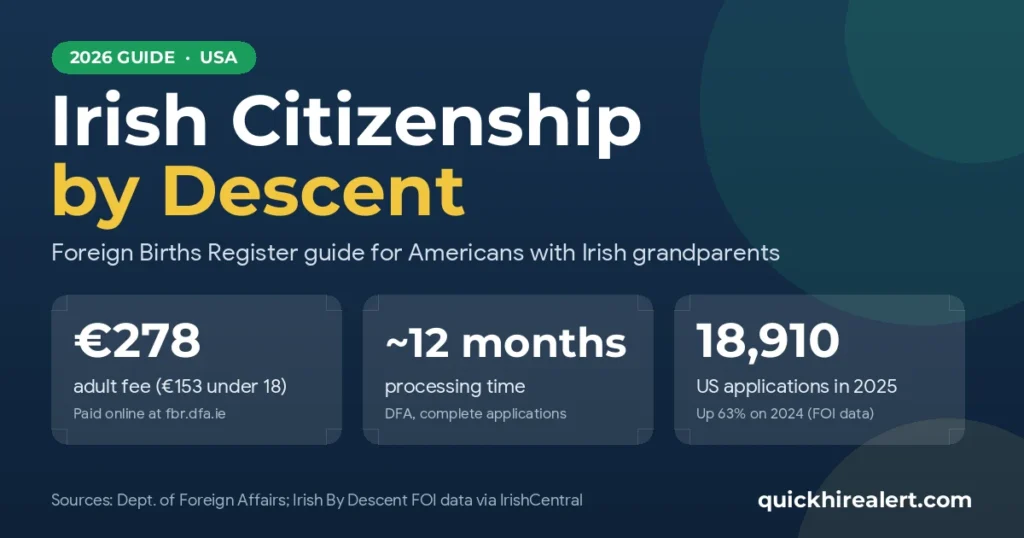
If one of your grandparents was born anywhere on the island of Ireland, you can probably become an Irish citizen without ever living there. The route is called Foreign Birth Registration, and Americans are using it in record numbers. Freedom of Information figures obtained by the Washington-based group Irish By Descent and reported by IrishCentral show US applications rising from 11,601 in 2024 to 18,910 in 2025, with 6,605 more filed in 2026 up to 18 May.
The process is entirely paper-driven. There is no interview and no test, but there is a strict document chain, a witness rule that trips people up, and a wait of about a year. This guide walks US residents through who qualifies, what to order from which office, how much it costs and the mistakes that send applications back across the Atlantic.
Quick answer
You can get Irish citizenship by descent through the Foreign Births Register if a grandparent was born on the island of Ireland (including Northern Ireland), or if your parent was already an Irish citizen when you were born. You apply online at fbr.dfa.ie, pay €278 as an adult (€153 for a child), then post original birth and marriage certificates for three generations to Dublin. Processing currently takes about 12 months. You become a citizen on the date you are entered on the register, and you can then apply for an Irish passport online for €75 plus €15 postage from the US. If your parent was born in Ireland, you are already a citizen and only need the passport.
Key Facts at a Glance
| Item | Current position |
|---|---|
| Who it is for | People born abroad with an Irish-born grandparent, or a parent who was an Irish citizen (but not Irish-born) at their birth |
| Where you apply | Online at fbr.dfa.ie; documents are posted to Ireland |
| Adult fee (18+) | €278 (€270 registration and certificate + €8 return postage) |
| Child fee (under 18) | €153 (€145 + €8 return postage) |
| Processing time | About 12 months for a complete application, handled in strict date order |
| Documents | Original civil records for you, your parent and your grandparent |
| Photos | 4 colour photos, 2 of them witnessed |
| Interview or test | None |
| Irish consulates in the US | Do not accept or process applications |
| First Irish passport afterwards | €75 online + €15 postage if you live outside Ireland |
| Keep US citizenship? | Yes. US law does not make you choose |
Do You Qualify? The Three Common Routes
Everything depends on where your Irish link sits in the family tree and, for the later generations, on dates.
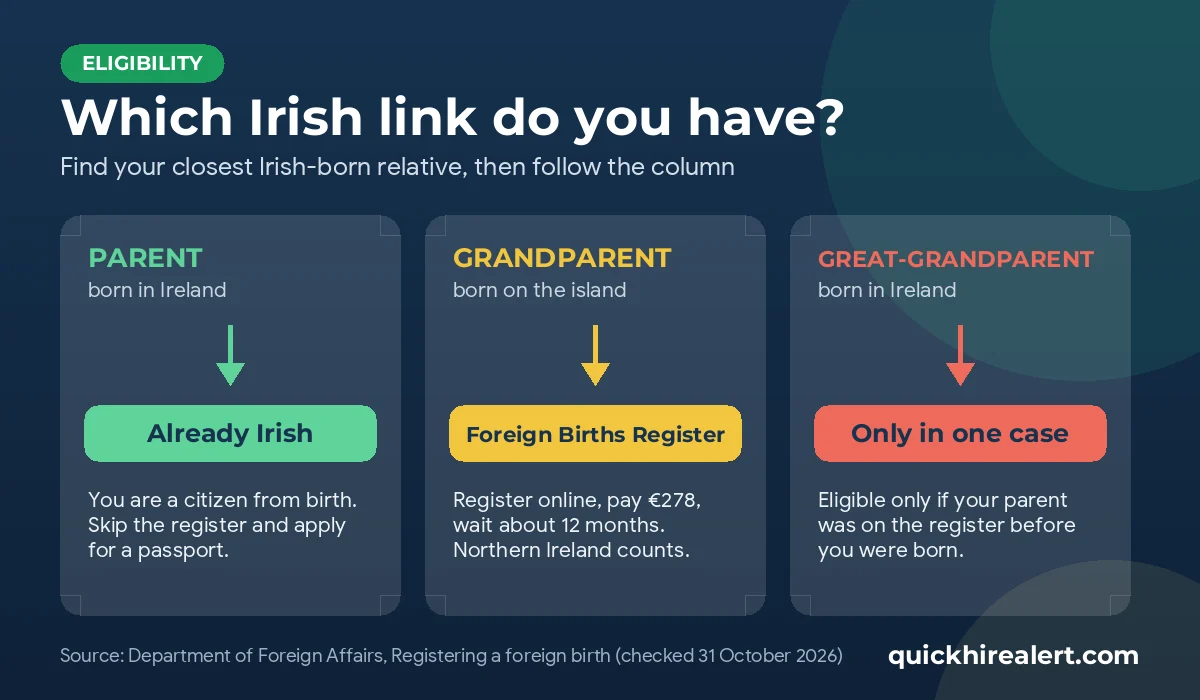
- Your parent was born on the island of Ireland. You are already an Irish citizen from birth. You do not use the Foreign Births Register at all. You apply straight for a passport with your parent’s Irish birth certificate.
- Your grandparent was born on the island of Ireland, and your parent was born abroad. This is the classic Foreign Birth Registration case and the one most Americans fall into. It does not matter which grandparent, which side of the family, or whether the grandparent is still alive.
- Your parent was an Irish citizen when you were born, but was not born in Ireland. For example, your parent was registered on the Foreign Births Register, or naturalised, before your birth. You can register too. If your parent registered after you were born, this route is closed to you.
What about great-grandparents? A great-grandparent alone does not qualify you. It only works if your parent claimed citizenship through the register (using that great-grandparent as their grandparent) before you were born. If your parent is still alive and eligible, they can register now, which protects any children born to you afterwards but not you, unless you were born after their registration.
Northern Ireland counts. The DFA’s eligibility wording refers to a grandparent born on the “island of Ireland”, so a grandparent born in Belfast or Derry qualifies you the same way as one born in Cork or Galway.
What Irish Citizenship Gives an American
- An Irish passport, which is an EU passport. You can live, work and study in Ireland and in any other EU country without a visa or employment permit.
- No work permit needed in Ireland. Americans without citizenship normally need an employer to secure a Critical Skills or General Employment Permit. As an Irish citizen you can take any job, including roles on the Ineligible Occupations List. See our jobs in Ireland for Americans guide for how the permit route works if you are not eligible.
- Citizenship you can pass on. Once you are on the register, children born to you afterwards can register too.
- You keep your US citizenship. The US State Department says US law does not require a citizen to choose between US nationality and another. Ireland also allows dual citizenship. You must still use your US passport to enter and leave the United States.
Documents You Need for Three Generations
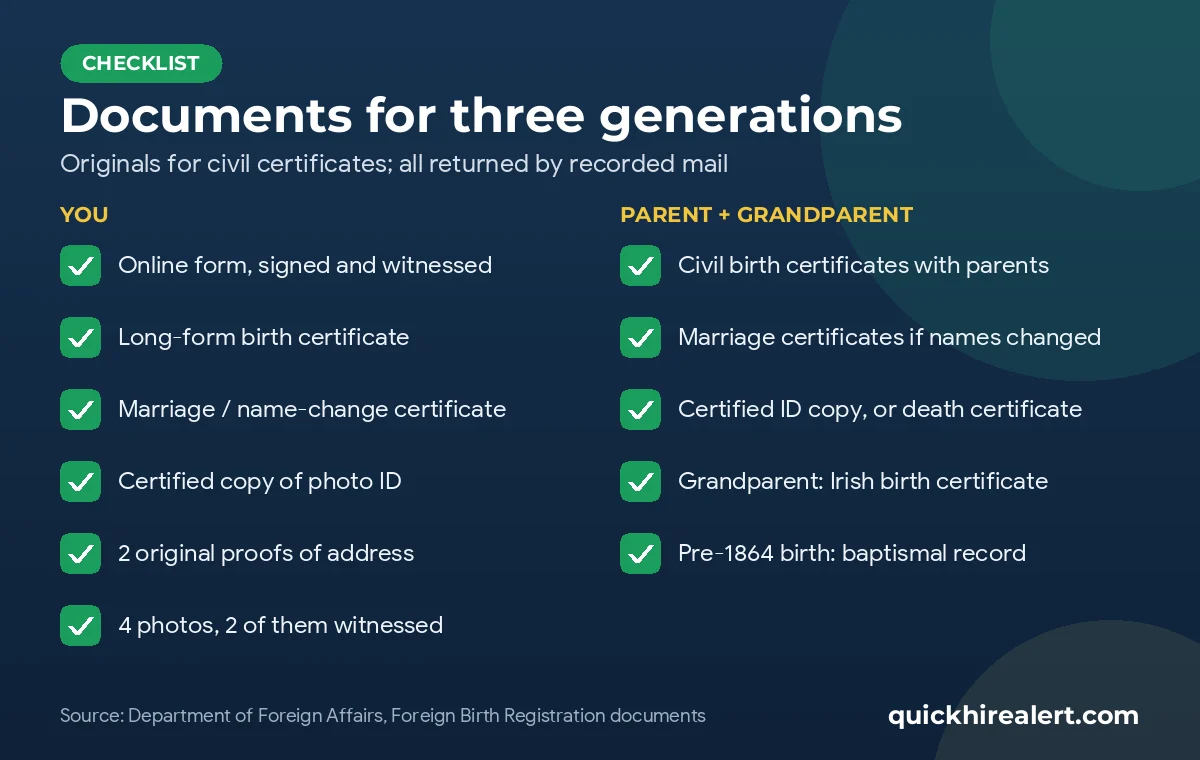
The DFA wants originals, not photocopies, for civil certificates. All originals are returned to you by recorded mail once your file is decided. Do not send your original photo ID; send a certified photocopy.
| Person | What to send |
|---|---|
| You (adult applicant) | Online application form, printed, signed and witnessed; original civil birth certificate showing your parents’ names; original marriage certificate or name-change document if your name changed; certified photocopy of state-issued photo ID (US passport or driver’s license); 2 separate original proofs of address; 4 colour passport-style photos, 2 of them witnessed |
| Your parent (the link to the Irish grandparent) | Original civil birth certificate showing their parents; original marriage certificate if their name changed; a certified copy of their photo ID, or an original civil death certificate if they have died |
| Your Irish-born grandparent | Original Irish civil birth certificate; original marriage certificate if the name changed; a certified copy of their photo ID, or an original civil death certificate if they have died |
If your claim is through a parent who was already an Irish citizen, you also send that parent’s Foreign Birth Registration certificate, naturalisation certificate or post-nuptial citizenship certificate, whichever applies. The online form prints a personalised checklist when you submit it, so use that as your final packing list.
Where Americans get each certificate
- US birth, marriage and death certificates: order certified copies from the vital records office of the state (or county) where the event happened. Ask for the long-form version that shows the parents’ names. Short “abstract” birth certificates are a common reason for delays.
- Grandparent born in the Republic of Ireland: order from the General Register Office through certificates.ie. Civil birth registration in Ireland started in 1864.
- Grandparent born in Northern Ireland: order from the General Register Office Northern Ireland through nidirect.gov.uk.
- Grandparent born before 1864: the DFA may accept a baptismal certificate instead of a civil birth certificate.
Watch the names. The chain only works if the records clearly link. If your grandmother was born Bridget but married as Delia, or the family surname changed spelling on arrival in the US, include the document that connects the two names. A mismatch with no explanation is the most common cause of the DFA writing back for more paperwork.
The Witness Rule (Where Many US Applications Go Wrong)
One witness handles everything: they sign and stamp your form, sign the back of two of your four photos, and certify the photocopy of your photo ID as a true copy. The DFA sets three conditions:
- They must know you personally. A stranger at a bank counter does not count.
- They must not be related to you.
- They must currently work in a listed profession, such as a notary public, lawyer, doctor, teacher, police officer, bank manager, accountant, vet or chartered engineer.
In the US, a notary public you actually know (for example through work) is often the easiest choice. If your witness has no official stamp, include their business card. Any paid service that offers to be your witness without knowing you does not meet the rule.
Step by Step: How to Apply from the US
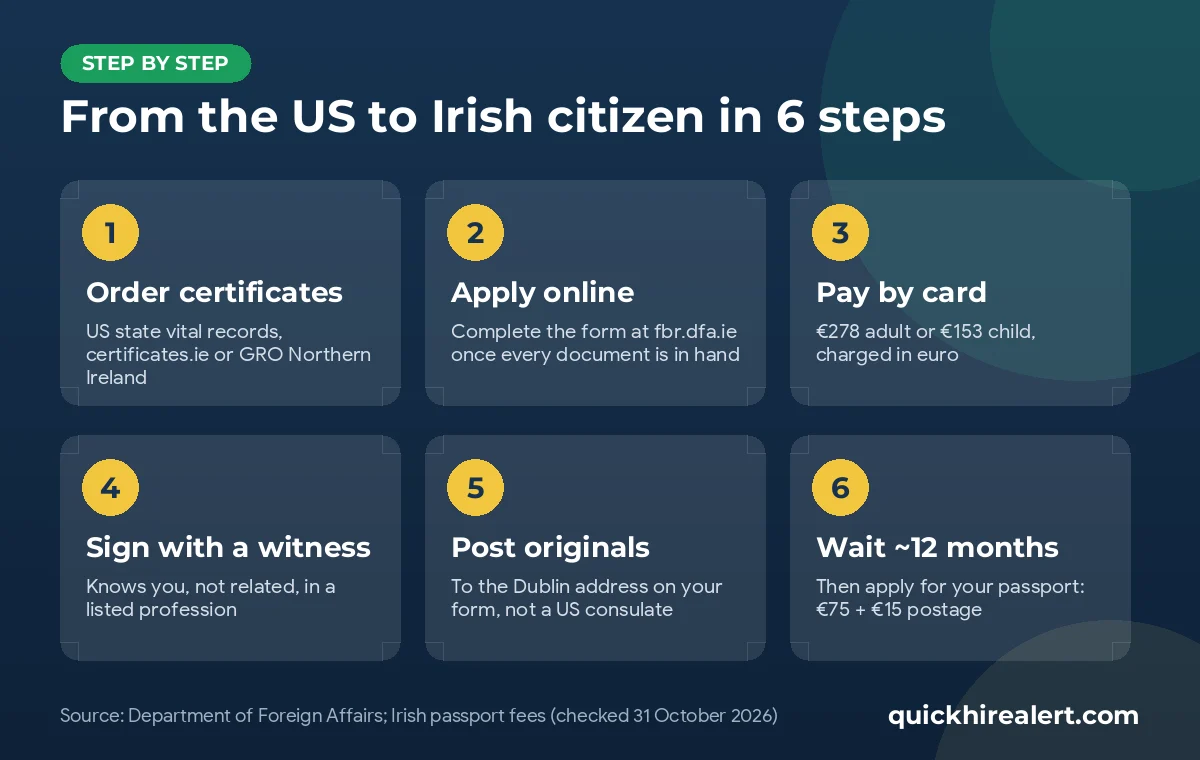
- Confirm your route. Work out whether you claim through a grandparent born on the island of Ireland or through a parent who was already a citizen when you were born. If your parent was Irish-born, skip all of this and apply for a passport.
- Order the certificates first. Getting records for three generations from two or three countries can take weeks or months. The DFA advises gathering everything before you start the online form, because incomplete applications are returned unprocessed.
- Apply online at fbr.dfa.ie and pay. There is no paper form. The fee (€278 adult, €153 child) is paid by card during the online application. Your bank will convert from euro.
- Print, sign and get it witnessed. Print the form, sign it in front of your witness, and have them complete their section, the two photos and your ID copy.
- Post the originals to Ireland. Send everything to the address printed on your form, using a tracked courier or recorded mail. The Embassy in Washington, D.C. and the consulates (such as New York) do not accept applications. Do not put a passport application in the same envelope.
- Wait about 12 months. You will get an email when your documents are received. Files are worked in strict date order, and the DFA may email you if anything is missing. Answer quickly, because a missed request stalls your file.
- Receive your certificate, then apply for a passport. Your Foreign Birth Registration certificate is your proof of citizenship. First-time adult applicants in the US can use Passport Online.
How Much Does It Cost in Total?
| Cost | Amount |
|---|---|
| Foreign Birth Registration, adult (18+) | €278 |
| Foreign Birth Registration, child (under 18) | €153 |
| First adult Irish passport (Passport Online, 10 years) | €75 |
| Postal fee for passport applicants outside Ireland | €15 |
| Certificates, courier and photos | Varies by state and county |
For one adult, the government fees come to €368 for citizenship and a passport. Some Irish-American community centres offer paid help with checking and mailing applications, which is optional. The DFA has also warned about third-party websites that charge to “help” with online passport applications you can file yourself.
Planning a Family? Register Before Your Children Are Born
This is the rule most likely to cost a family its citizenship. Your children can only claim through you if you were already on the register when they were born. A child born while your application is still in the queue cannot claim through you later. Their only option is through their own Irish-born grandparent, if they have one.
If you are an expectant parent and your baby would lose eligibility because your registration is not finished, the DFA accepts urgent requests by phone on +353 1 568 3331 (9:00am to 4:30pm Irish time, Monday to Friday). That is early morning on the East Coast and the middle of the night on the West Coast, so plan your call.
Mistakes That Get FBR Applications Returned
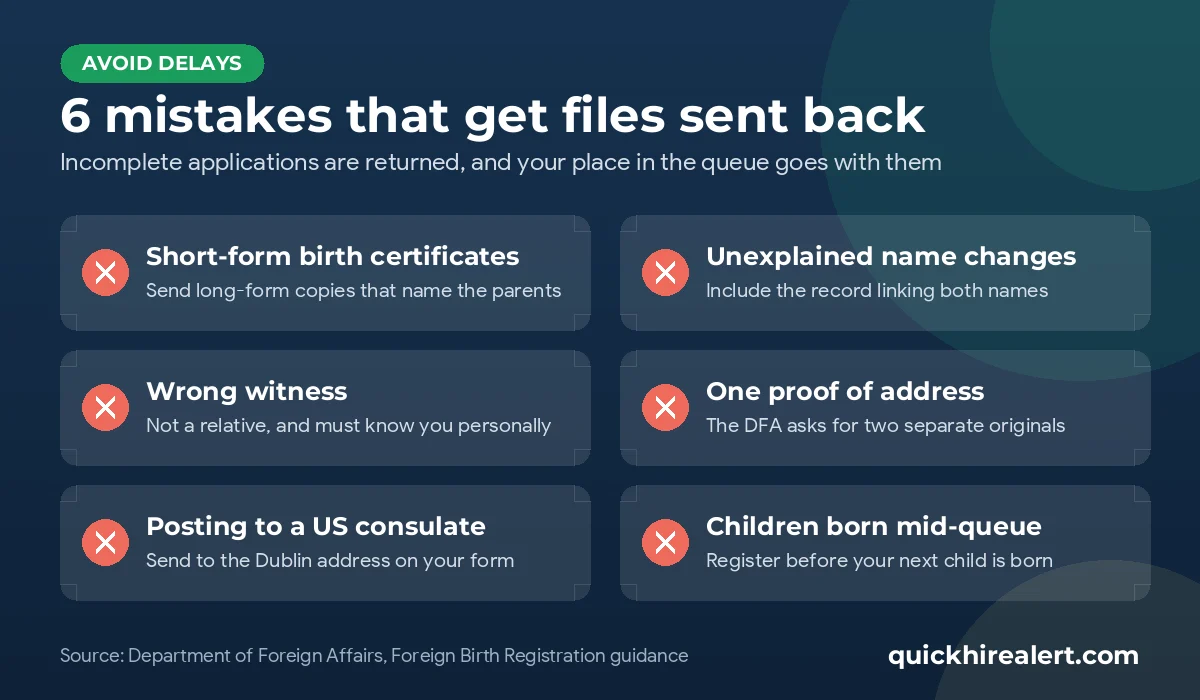
- Sending short-form or “abstract” birth certificates that do not show parents’ names
- No document linking a name change (marriage, Americanised spelling, nickname)
- A witness who is related to you, does not know you, or is not in a listed profession
- Only one proof of address, or photocopies instead of originals
- Missing the death certificate for a parent or grandparent who has died
- Posting the package to an Irish consulate in the US instead of the Dublin address on your form
- Putting a passport application in the same envelope as the FBR application
- Starting the online form before you have every document, then posting an incomplete set
After Citizenship: Moving to Ireland
Once you hold an Irish passport, you can move to Ireland and work without any permit or immigration registration. You compete for jobs on the same footing as any Irish or EU worker. If you are still waiting on your registration, or you do not qualify through descent, the employment permit route is open to Americans. Our step-by-step guide on how to get a job in Ireland as an American covers it. If you move on a permit first, you can later apply for citizenship by residence, explained in our Irish citizenship by naturalisation guide.
Frequently Asked Questions
Can I get Irish citizenship through my grandparent?
Yes. If a grandparent was born on the island of Ireland, including Northern Ireland, you can become an Irish citizen by registering on the Foreign Births Register, even if your parent was born in the US.
Can I get Irish citizenship through a great-grandparent?
Only if your parent was entered on the Foreign Births Register before you were born. A great-grandparent on their own does not make you eligible.
How much does Foreign Birth Registration cost?
€278 for applicants aged 18 or over and €153 for under-18s. Each fee includes €8 for returning your certificate and documents. Payment is made online by card.
How long does Irish citizenship by descent take?
The DFA currently advises allowing about 12 months from when a complete application is received. Incomplete files take longer.
Do I lose my US citizenship if I become an Irish citizen?
No. The US State Department says US law does not require a citizen to choose between US nationality and another nationality, and Ireland allows dual citizenship.
Can I apply at the Irish embassy or a consulate in the US?
No. The Embassy in Washington, D.C. and the consulates do not accept Foreign Birth Registration applications. You apply online and post your documents to the address in Ireland on your printed form.
My parent was born in Ireland. Do I need to register?
No. If your parent was born on the island of Ireland and was an Irish citizen, you are an Irish citizen from birth. You can apply directly for an Irish passport.
Who can witness my Foreign Birth Registration form in the US?
Someone who knows you personally, is not related to you, and currently works in a listed profession such as notary public, lawyer, doctor, teacher, police officer or bank manager.
Can I work in Ireland once I am on the Foreign Births Register?
Yes. From the date you are registered you are an Irish citizen, with the right to live and work in Ireland and the rest of the EU without an employment permit.
Related Guides
- Jobs in Ireland for Americans (2026)
- How to Get a Job in Ireland as an American
- Irish Citizenship by Naturalisation: The 5-Year Rule
- Stamp 4 Ireland: When Permit Holders Qualify
- Critical Skills Employment Permit Ireland
Official Sources
- Department of Foreign Affairs: Registering a foreign birth (eligibility, fees, documents, witnesses)
- Embassy of Ireland, USA: Foreign Births Registration guidelines for US residents
- Citizens Information: The Foreign Births Register
- Department of Foreign Affairs: Passport fees
- US Department of State: Dual nationality
- IrishCentral: US Foreign Birth Registration application figures (FOI data from Irish By Descent)
Verification note: fees, processing times and document rules in this guide were checked against official DFA pages on 31 October 2026. The DFA updates processing times regularly, so check the current figure before you apply. This guide is general information, not legal advice.
Get an email when Ireland's permit rules change
Salary thresholds, occupation lists and visa rules change every year. Subscribe and we will tell you when they do, plus new job guides. Free, no spam.
Subscribe free