
Last updated: 30 October 2026 | Checked against the Irish Nationality and Citizenship Act 1956 (as amended), Immigration Service Delivery (ISD) guidance and the General Scheme of the Irish Nationality and Citizenship (Amendment) Bill 2026, published 21 September 2026.
For people who moved to Ireland on an employment permit, Irish citizenship by naturalisation is the final step: an Irish passport, the right to live and work anywhere in the EU, and no more permit or IRP renewals. Under the law in force today, most permit holders can apply after five years of reckonable residence.
That five-year rule may not last. In September 2026 the Government published plans to raise it to eight years and add language, civics and self-sufficiency tests. Those plans are not law yet. This guide explains the rules that apply right now, how permit holders count their years, the fees and the online process, and exactly where the proposed changes stand.
Quick answer
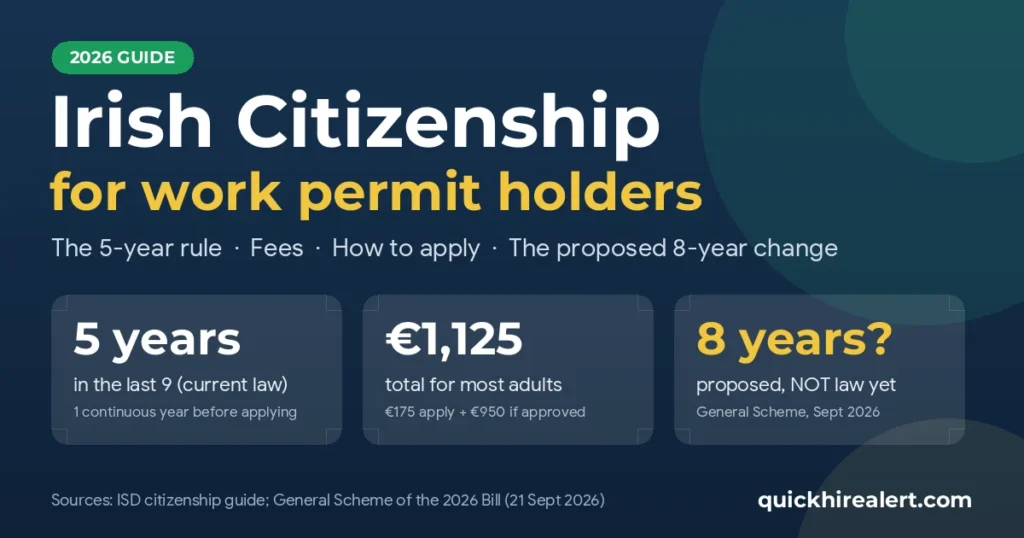
Under current law you can apply for Irish citizenship by naturalisation once you have five years (1,825 days) of reckonable residence in the last nine years, including one year of continuous residence immediately before you apply. Time on Stamp 1 (employment permit) and Stamp 4 counts. You apply online through the ISD portal, pay €175, and pay €950 more if you are approved. A Government Bill would raise the requirement to eight years, but as of 30 October 2026 it is only a General Scheme under committee scrutiny, not law.
Key Facts at a Glance
| Item | Current rule (in force) |
|---|---|
| Total residence needed | 5 years (1,825 days) of reckonable residence in the last 9 years |
| Continuous year | 1 year immediately before the application date |
| Absences allowed in that year | Up to 70 days, plus up to 30 more in exceptional circumstances |
| Stamps that count | Stamp 1 (employment permit) and Stamp 4, among others |
| Time that does not count | Student permission (Stamp 2/2A) and any period without valid permission |
| Application fee | €175 (non-refundable) |
| Certification fee if approved | €950 for most adults; €200 for a minor |
| How to apply | Online through the ISD portal |
| Language or civics test | None under current law |
| Proposed change | 8 years, language and civics tests, self-sufficiency (General Scheme only, not law) |
The Five-Year Rule, Explained
Irish nationality law asks for two things at the same time, and you need both:
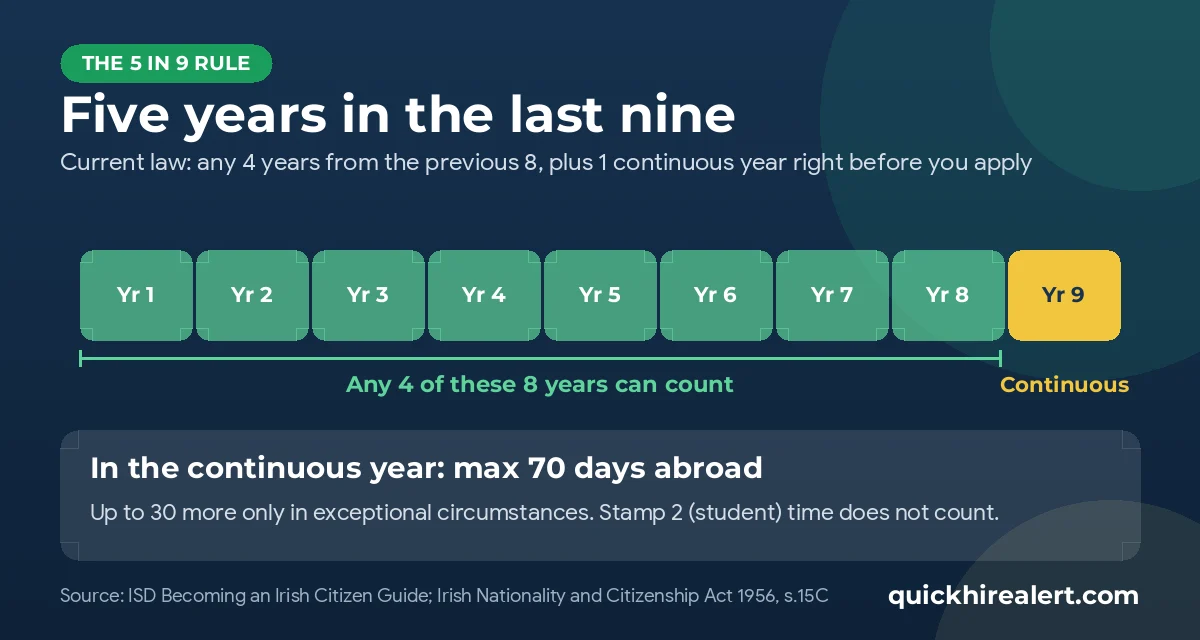
- One year of continuous residence immediately before you apply. The 12 months counted back from your application date. You can be out of Ireland for up to 70 days in that year. The Minister can accept up to 30 further days if exceptional circumstances outside your control caused them. The Department’s guidance says the days you leave and return are not counted as absences.
- Four more years of reckonable residence in the eight years before that. Together with the continuous year, that makes five years (1,825 days) in the last nine.
“Reckonable” means time spent in Ireland on a permission that counts. For employment permit holders, both Stamp 1 and Stamp 4 count. Time on a student permission (Stamp 2 or 2A) does not, and neither does any gap when your permission had expired. A single lapse between IRP renewals can push your eligibility date back, which is why applying for renewals on time matters so much.
How Permit Holders Get to Five Years
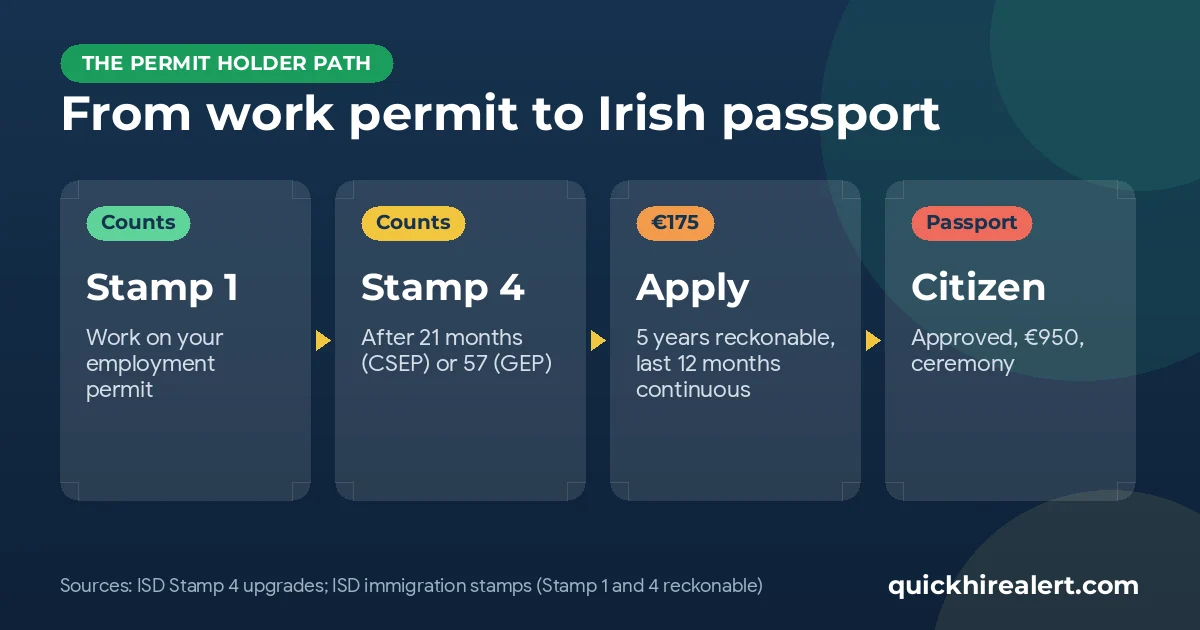
A typical Critical Skills route looks like this:
- Year 1 to month 21: Stamp 1 on your Critical Skills Employment Permit. This counts.
- After 21 months: you can upgrade to Stamp 4 (see our Stamp 4 guide). This also counts.
- After 5 years of reckonable residence: you can apply for citizenship, provided the last 12 months were continuous.
A General Employment Permit holder follows the same five-year clock for citizenship. The difference is only in when Stamp 4 arrives (57 months instead of 21). Both Stamp 1 and Stamp 4 years count towards the same total.
Worked example: a nurse from Pakistan who started work in Ireland on 1 November 2021, kept every renewal on time and spent less than 70 days abroad in the last year reaches five years on 1 November 2026. Under current law, she can apply from that date.
The Proposed Eight-Year Rule: Where It Stands
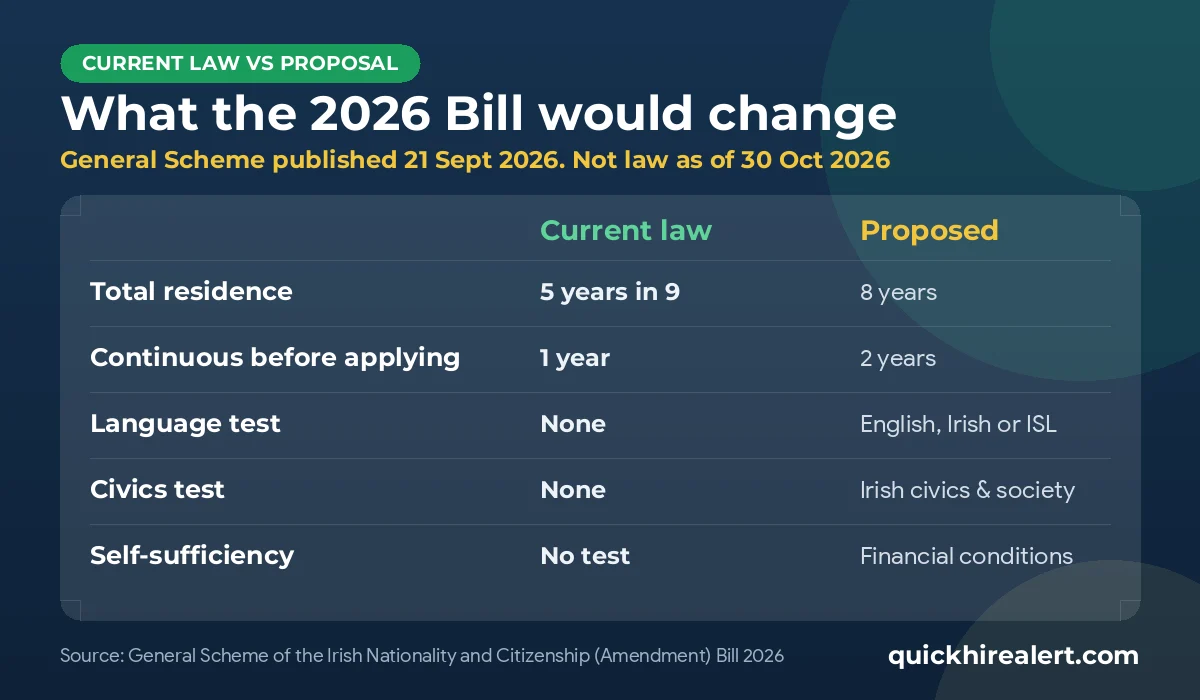
On 9 September 2026 the Government approved priority drafting of the Irish Nationality and Citizenship (Amendment) Bill 2026. Its General Scheme, an outline of the future Bill, was published on 21 September 2026 and referred to the Oireachtas Joint Committee on Justice for pre-legislative scrutiny. The main proposals are:
| Current law | Proposed (not law) | |
|---|---|---|
| Total residence | 5 years in the last 9 | 8 years |
| Continuous residence | 1 year before applying | 2 years before applying, plus 6 more in the prior 10 |
| Language | No test | Test in English, Irish or Irish Sign Language |
| Civics | No test | Test on Irish civics, society and politics |
| Finances | No specific test | Self-sufficiency requirements |
| Spouses of Irish citizens | 3 years | 5 years |
What this means for you today:
- Nothing has changed yet. The five-year rule is still the law. The Bill itself has not been published, debated or passed.
- No transition rule has been confirmed. The General Scheme does not clearly say whether people already living in Ireland, or applications already submitted, would be protected. Legal bodies including The Bar of Ireland have asked for a transitional period for people already living here.
- Current applications are assessed under current law. In a Dáil reply in October 2026, the Minister of State said applications continue to be decided under the existing 1956 Act until new legislation is enacted.
- If you are eligible now, waiting gains you nothing. Applying as soon as you meet the five-year rule is the only way to be decided under the rules you know.
We will update this guide as the Bill moves through the Oireachtas.
Fees
| Fee | Amount |
|---|---|
| Application fee (all applicants, non-refundable) | €175 |
| Certification fee, adult, if approved | €950 |
| Certification fee, minor, or widow/widower/surviving civil partner of an Irish citizen | €200 |
| Certification fee, recognised refugee or stateless person | No charge |
These are set by the Irish Nationality and Citizenship Regulations. An adult permit holder therefore pays €1,125 in total if approved. The first Irish passport is a separate application with its own fee.
How to Apply, Step by Step
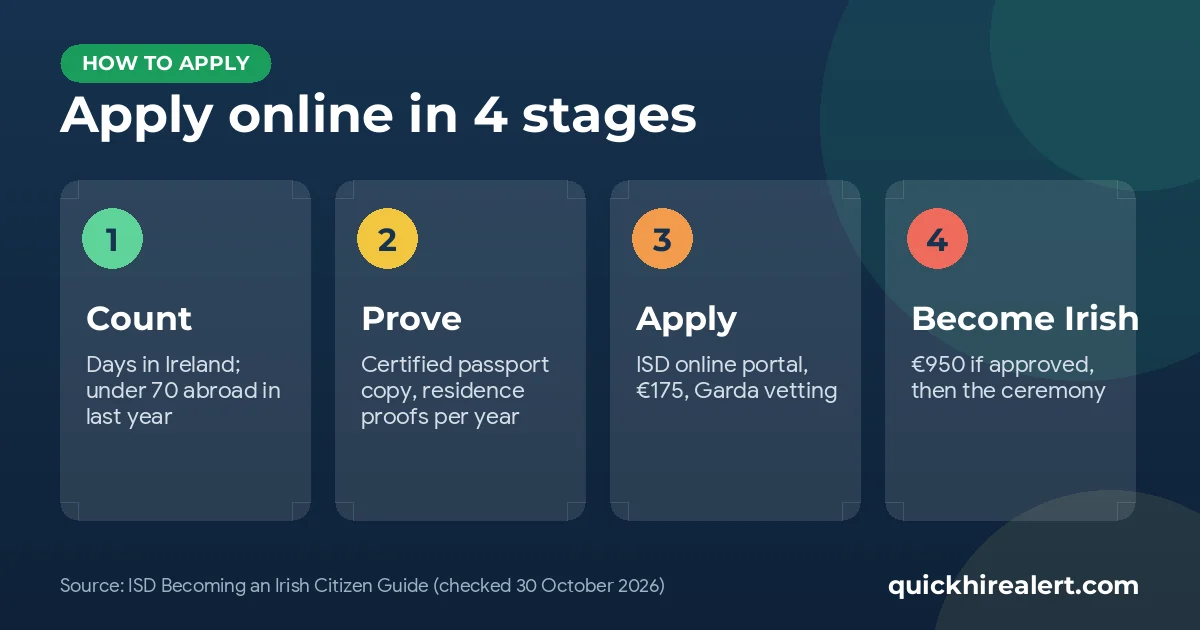
- Count your days. Work out your reckonable residence from your IRP cards and immigration stamps, and list every trip abroad in the last 12 months. Make sure you are under 70 days.
- Gather proof of residence. ISD asks for residence evidence that meets its points threshold for every year you are counting, for example Revenue employment records, bank statements, utility bills and tenancy documents. Collect them year by year.
- Prepare certified identity documents. ISD asks for a high-quality colour copy of your passport photo page certified by a solicitor or notary, and identity documents that add up to 150 points under its identity points rule. Uncertified copies cause delays.
- Apply online through the ISD portal, the same portal used for IRP renewals, and pay the €175 application fee.
- Complete Garda vetting. Adult applicants complete Garda e-vetting, and may need police certificates from other countries where required.
- Wait for a decision. The Department reported a median processing time of about eight months in 2024. Keep your IRP card valid throughout: you still need valid immigration permission while you wait.
- Pay the certification fee and attend a ceremony. If approved, you pay €950 and attend a citizenship ceremony, where you make a declaration of fidelity and receive your certificate. You are an Irish citizen from that point and can apply for a passport.
Common Reasons Applications Fail or Stall
- Too many days abroad in the final year. Over 70 days, without exceptional reasons, makes the application ineligible, and the €175 is not refunded.
- Gaps in permission. A renewal submitted after expiry can leave a gap that does not count.
- Counting student years. Stamp 2 time does not count.
- Weak proof of residence for one or more years, which leads to requests for more documents.
- Undisclosed offences. All convictions and offences must be declared, including minor ones and those abroad.
Frequently Asked Questions
How many years do I need to live in Ireland to get citizenship?
Under current law, five years (1,825 days) of reckonable residence in the last nine years, including one continuous year immediately before you apply. A proposal to increase this to eight years is not yet law.
Does time on a work permit count towards Irish citizenship?
Yes. Time on Stamp 1 based on an employment permit is reckonable residence, and so is time on Stamp 4.
How many days can I be outside Ireland before applying for citizenship?
Up to 70 days in the 12 months before you apply. The Minister can accept up to 30 more days in exceptional circumstances.
How much does Irish citizenship cost?
€175 to apply and €950 for the certificate if you are approved, €1,125 in total for most adults.
Is Irish citizenship changing to eight years?
It has been proposed. The Government published the General Scheme of the Irish Nationality and Citizenship (Amendment) Bill 2026 on 21 September 2026. As of 30 October 2026 it is at pre-legislative scrutiny and is not law. The five-year rule still applies.
Is there an English language test for Irish citizenship?
Not under current law. The proposed Bill would introduce a test in English, Irish or Irish Sign Language and a civics test.
Can I apply for Irish citizenship online?
Yes. Applications are made through the ISD online portal, where you also pay the €175 application fee.
Do I lose my Pakistani or Indian citizenship if I become Irish?
Ireland allows dual citizenship, so Irish law does not require you to give up your existing nationality. Whether you can keep it depends on your home country’s law. Pakistan, for example, allows dual nationality with a list of countries that includes Ireland, while India does not allow dual citizenship. Check your home country’s rules before you apply.
Related Guides
- Irish Citizenship by Descent: Foreign Births Register Guide
- Stamp 4 Ireland: When Permit Holders Qualify
- Stamp 1 vs Stamp 4 Ireland: Key Differences
- Ireland Work Visa from Pakistan (2026)
- Bringing Your Family to Ireland on a Work Permit
- Critical Skills Employment Permit Ireland
Official Sources
- ISD: Becoming an Irish Citizen Guide (5 in 9 rule, 70-day rule, documents)
- ISD: How to become an Irish citizen
- ISD: Immigration permission stamps (reckonable residence)
- Department of Justice, Home Affairs and Migration: General Scheme of the Irish Nationality and Citizenship (Amendment) Bill 2026
Verification note: current eligibility rules and fees in this guide were checked on 30 October 2026. The proposed changes are taken from the General Scheme published on 21 September 2026 and may change before any Bill is enacted. This guide is information, not legal advice; complex cases should be checked with ISD or a solicitor.
Get an email when Ireland's permit rules change
Salary thresholds, occupation lists and visa rules change every year. Subscribe and we will tell you when they do, plus new job guides. Free, no spam.
Subscribe free