
Last updated: 7 November 2026 | Checked against the Residential Tenancies Board (RTB) Rent Index for Q1 2026, the latest published, Citizens Information pages updated on 16 July and 18 September 2026, and Revenue.
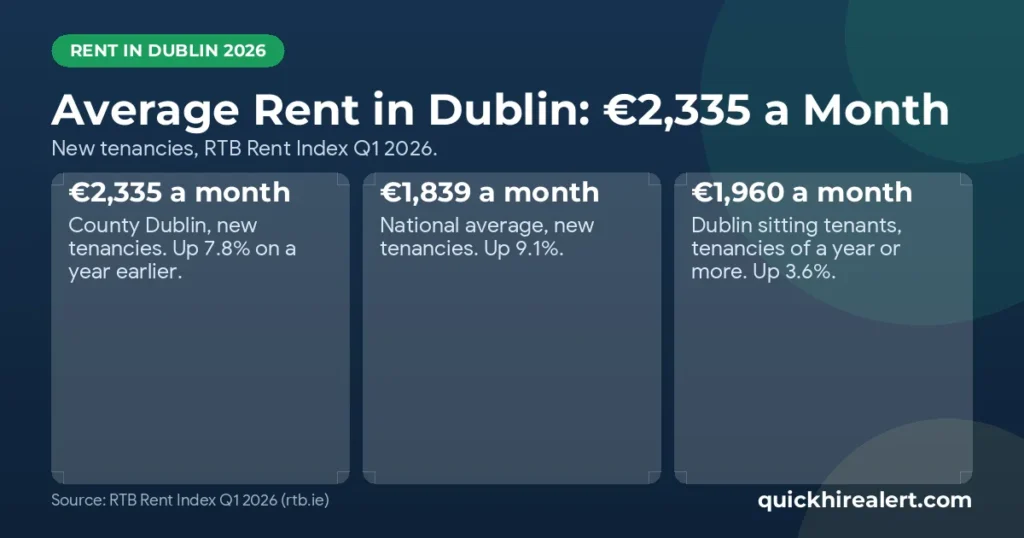
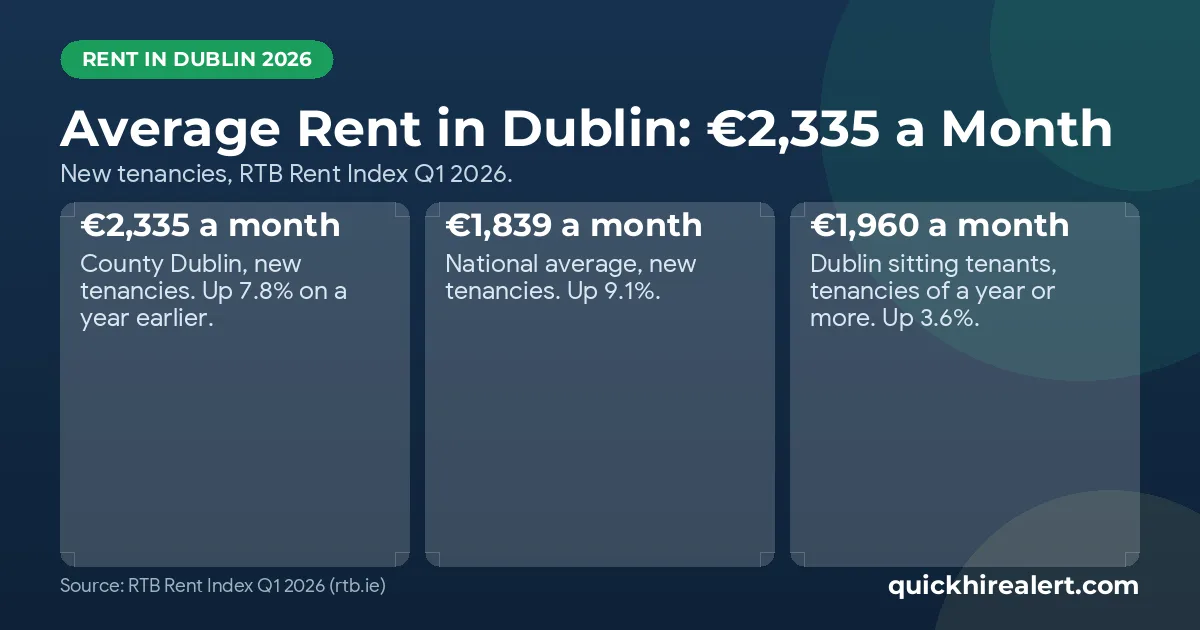
The average rent for a new tenancy in County Dublin was €2,335 a month in the first quarter of 2026, up 7.8% on a year earlier, according to the RTB Rent Index. That is €496 a month more than the national average of €1,839 (our arithmetic). Rents differ a lot by council area, home size and whether you are a new or an existing tenant.
This guide gives the official figures by area and bedrooms, explains the rent rules that apply from 1 March 2026, and covers deposits and rental scams. For wider living costs, see our cost of living in Ireland guide.
Quick answer
- Average rent, new tenancies, County Dublin: €2,335 a month (RTB, Q1 2026).
- Most expensive council area: Dún Laoghaire-Rathdown, €2,629. Lowest of the four: South Dublin, €2,267.
- Apartments: €1,951 for one bedroom, €2,405 for two, €3,038 for three or more.
- Rent increases: capped at the lower of inflation (CPI) or 2% a year for most tenancies.
- Upfront payments: a deposit plus rent in advance cannot add up to more than 2 months’ rent.
Key Facts at a Glance
| Measure | Figure | Source and period |
|---|---|---|
| Average rent, new tenancies, County Dublin | €2,335 a month (up 7.8%) | RTB Rent Index, Q1 2026 |
| Average rent, sitting tenants, County Dublin | €1,960 a month (up 3.6%) | RTB Rent Index, Q1 2026 |
| Average rent, new tenancies, national | €1,839 a month (up 9.1%) | RTB Rent Index, Q1 2026 |
| Maximum yearly rent increase | Lower of CPI or 2% | Citizens Information, 18 September 2026 |
| Maximum upfront payments | 2 months’ rent | Citizens Information, 16 July 2026 |
| Rent Tax Credit | €1,000 single, €2,000 couples (2024 to 2028) | Revenue |
Average Rent in Dublin by Area
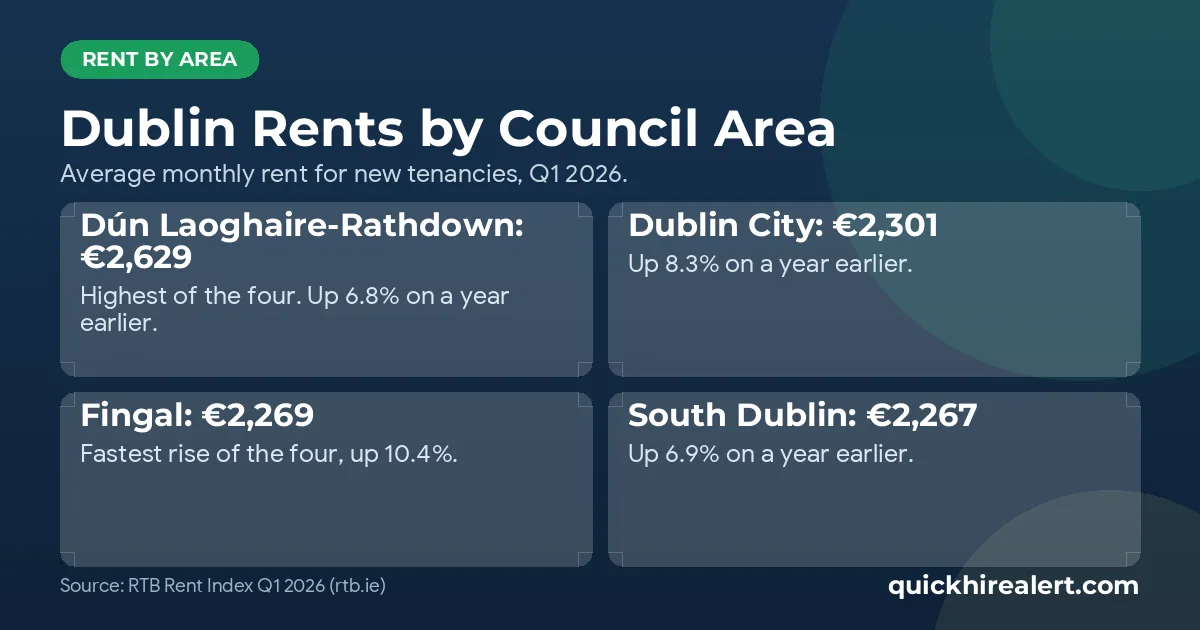
The RTB reports a standardised average rent for each Dublin council area. The table shows new tenancies, which is what you pay if you are moving in now, and sitting tenants, who have rented for at least a year.
| Area | New tenancies (monthly) | Change on a year earlier | Sitting tenants (monthly) |
|---|---|---|---|
| County Dublin | €2,335 | +7.8% | €1,960 |
| Dublin City | €2,301 | +8.3% | €1,901 |
| Dún Laoghaire-Rathdown | €2,629 | +6.8% | €2,301 |
| Fingal | €2,269 | +10.4% | €1,866 |
| South Dublin | €2,267 | +6.9% | €1,934 |
Dún Laoghaire-Rathdown is the most expensive of the four areas. Fingal saw the fastest rise, at 10.4%. Dublin City, South Dublin and Fingal sit within about €35 a month of each other for new tenancies (our arithmetic).
Rent by Home Type and Bedrooms
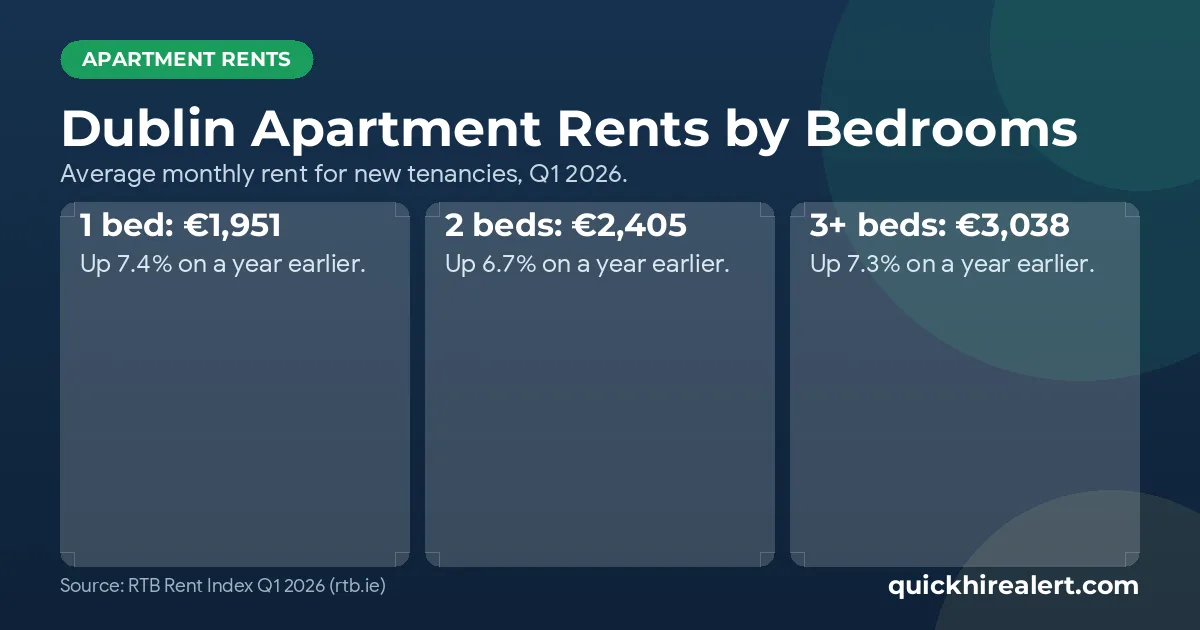
Across County Dublin, the average new-tenancy rent was €2,601 for a house (up 10.3%) and €2,300 for an apartment (up 6.9%). The table breaks this down by bedrooms.
| Home | New tenancies (monthly) | Change on a year earlier |
|---|---|---|
| Apartment, 1 bedroom | €1,951 | +7.4% |
| Apartment, 2 bedrooms | €2,405 | +6.7% |
| Apartment, 3 or more bedrooms | €3,038 | +7.3% |
| House, 1 bedroom | €1,706 | +7.5% |
| House, 2 bedrooms | €2,195 | +5.3% |
| House, 3 bedrooms | €2,584 | +10.8% |
| House, 4 or more bedrooms | €3,315 | +14.9% |
These are averages across the county. A flat in a popular area can cost far more, and the RTB figures describe what was registered, not what is advertised today.
New Tenancy or Sitting Tenant: Why the Numbers Differ
The RTB publishes two sets of figures. New tenancies cover homes let to a new tenant. Sitting tenants cover existing tenancies that have run for at least a year. In County Dublin the averages were €2,335 and €1,960, a gap of €375 a month (our arithmetic). If you are arriving from abroad, the new-tenancy figure is the one to budget for.
Rent Rules From 1 March 2026
Citizens Information sets out the rules for private rented tenancies. The main points:
- Yearly cap: a rent increase is capped at the general inflation rate (measured by CPI) or 2% a year, whichever is lower. The 2% cap does not apply to newly built apartments with a commencement notice on or after 10 June 2025, where increases are capped only by CPI.
- How often: for tenancies created from 1 March 2026, rent can be reviewed every 12 months.
- Notice: the landlord should serve the Notice of Rent Review Form at least 90 days before the new rent begins. Since 14 September 2026 the landlord has 7 days to send a copy to the RTB, or the notice is invalid.
- Whole country covered: the RTB says the whole country came under Rent Pressure Zone rules on 20 June 2025.
- Fines: since 14 September 2026 the RTB can fine landlords €200 for certain breaches, including setting rent above the limits.
- Between tenancies: from 1 March 2026 a landlord can reset the rent to market level in set situations, for example when the tenant leaves voluntarily. The landlord must show three comparable properties from the RTB rent register.
- Six-year tenancies: new tenancies from 1 March 2026 become a 6-year tenancy after 6 months, and you can still end yours at any time with written notice and the right amount of notice.
Tenancies created before 1 March 2026 are not affected by some of the new rules, so check which date applies to you. Use the RTB’s rent calculator to find the maximum increase.
Deposits, Rent in Advance and Paperwork
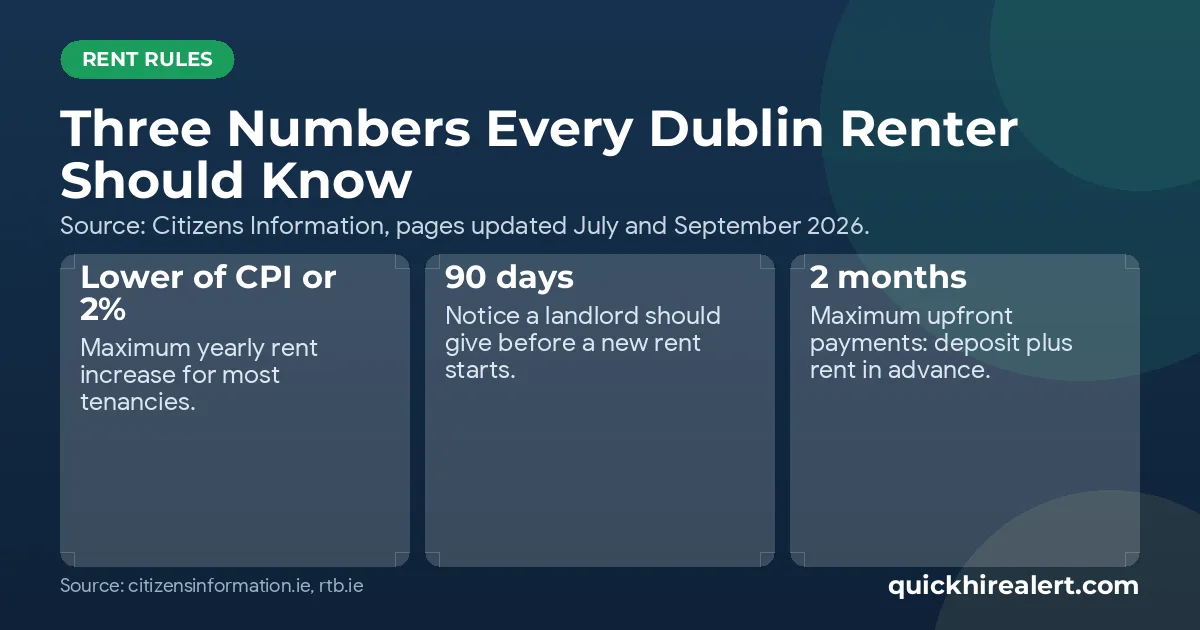
- Upfront payments: you cannot be forced to pay more than 2 months’ rent upfront. Citizens Information lists one month’s rent as a deposit and one month in advance as the two payments within that limit. This applies to tenancies created from 9 August 2021. Students in student-specific tenancies can opt out.
- Receipt: you should get a written receipt for any deposit, including a holding deposit.
- Rent book: your landlord must provide one, and it should state the deposit amount and include the inventory.
- Registration: landlords must register each tenancy with the RTB every year.
Where to Look
Daft.ie and MyHome.ie are two main property listing sites. Citizens Information advises you to view the property in person before you pay anything or agree to anything, and not to rely only on online photos or videos. If you are arriving from abroad, plan a short stay for your first days so you can view homes before you commit (our suggestion).
If your employer offers housing, our guide to jobs in Ireland with accommodation shows real adverts and the rules. For city job listings, see jobs in Dublin.
Rental Scams to Avoid
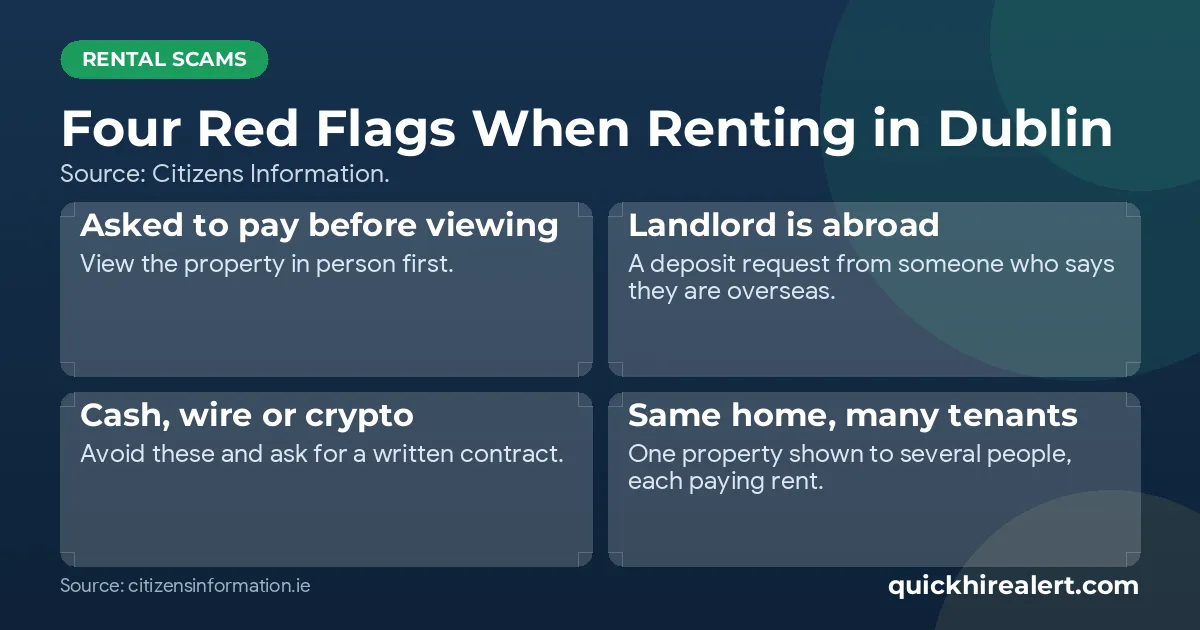
Citizens Information describes three common scams: someone asking for a deposit while claiming to be abroad, one property shown to several people who each pay rent, and fake keys handed over after an ordinary-looking process. To avoid them:
- Inspect the property in person.
- Avoid cash, wire transfers and cryptocurrency.
- Ask for a written contract.
- Take your time before deciding.
If you are scammed, contact your bank immediately, report it to your local Garda station and report it to Threshold.
Ways to Cut the Cost
The Rent Tax Credit reduces the Income Tax you owe. Revenue says it is worth up to €1,000 a year for a single person and €2,000 for jointly assessed couples, for tax years 2024 to 2028. You need an Income Tax liability to use it, and conditions apply to the property and the tenancy. Check the amounts on Revenue’s rent credit page before you claim.
To see what a salary leaves after tax, use our salary calculator. For typical pay, see average salary in Ireland and the minimum wage guide. If you are moving from the United States, read moving to Ireland from the US.
Related Guides
- Cost of Living in Ireland
- Jobs in Dublin
- Jobs in Ireland With Accommodation
- Salary Calculator Ireland
- Average Salary in Ireland
- How to Get a Job in Ireland
Frequently Asked Questions
What is the average rent in Dublin?
The RTB Rent Index for Q1 2026 gives an average of €2,335 a month for new tenancies in County Dublin, up 7.8% on a year earlier. For sitting tenants in County Dublin it was €1,960.
How much is a one-bedroom apartment in Dublin?
The RTB's Q1 2026 average for a one-bedroom apartment in County Dublin on a new tenancy was €1,951 a month, up 7.4%. A two-bedroom apartment averaged €2,405.
Which part of Dublin is the most expensive?
Dún Laoghaire-Rathdown, at €2,629 a month for new tenancies in Q1 2026. Dublin City was €2,301, Fingal €2,269 and South Dublin €2,267.
How much can my landlord increase the rent?
For most private tenancies, the increase is capped at the lower of general inflation (CPI) or 2% a year. Rent can be reviewed every 12 months and the landlord should give at least 90 days' notice. The 2% cap does not apply to certain newly built apartments, where only CPI applies.
How much deposit can a landlord ask for?
Citizens Information says you cannot be forced to pay more than 2 months' rent upfront, counting the deposit and rent in advance together. Its example is one month as a deposit and one month in advance. You should get a written receipt for any deposit.
Is Dublin a Rent Pressure Zone?
The RTB says the whole country came under Rent Pressure Zone legislation on 20 June 2025.
How do I avoid rental scams in Dublin?
View the property in person before paying anything, avoid cash, wire transfers and cryptocurrency, ask for a written contract and take your time. If you are scammed, contact your bank, report it to your local Garda station and tell Threshold.
Is there a tax credit for renters in Ireland?
Yes. The Rent Tax Credit is worth up to €1,000 a year for a single person and €2,000 for jointly assessed couples for tax years 2024 to 2028, according to Revenue. You need an Income Tax liability and must meet the conditions.
Official Sources
- RTB: Rent Index Q1 2026
- Citizens Information: Rent increases in private rented housing
- Citizens Information: Changes to the rules for renting from March 2026
- Citizens Information: Looking for a flat or house to rent
- Revenue: Rent Tax Credit
Rent figures are RTB averages for Q1 2026 and may be revised. Averages describe groups of homes, not the price of a particular home. The RTB publishes new quarters through the year, and we update this page when it does. This is general information, not legal advice.
Get an email when Ireland's permit rules change
Salary thresholds, occupation lists and visa rules change every year. Subscribe and we will tell you when they do, plus new job guides. Free, no spam.
Subscribe free