
Last updated: 18 November 2026 | Information verified: Citizens Information pages on working hours, work breaks and rest periods, and night work (each last edited 27 January 2025, read on 17 November 2026). The Workplace Relations Commission is cited for the complaints route.
Working hours in Ireland are controlled by the Organisation of Working Time Act 1997. It sets a limit on how long you can be asked to work, how much rest you must get and when you are owed a break. These rules apply to most employees, including people working in Ireland on an employment permit.
This guide explains the 48 hour average week, breaks, daily and weekly rest, notice of your hours, Sunday work, overtime, night work and young workers. It also shows how to complain if your employer does not follow the rules.
Quick answer
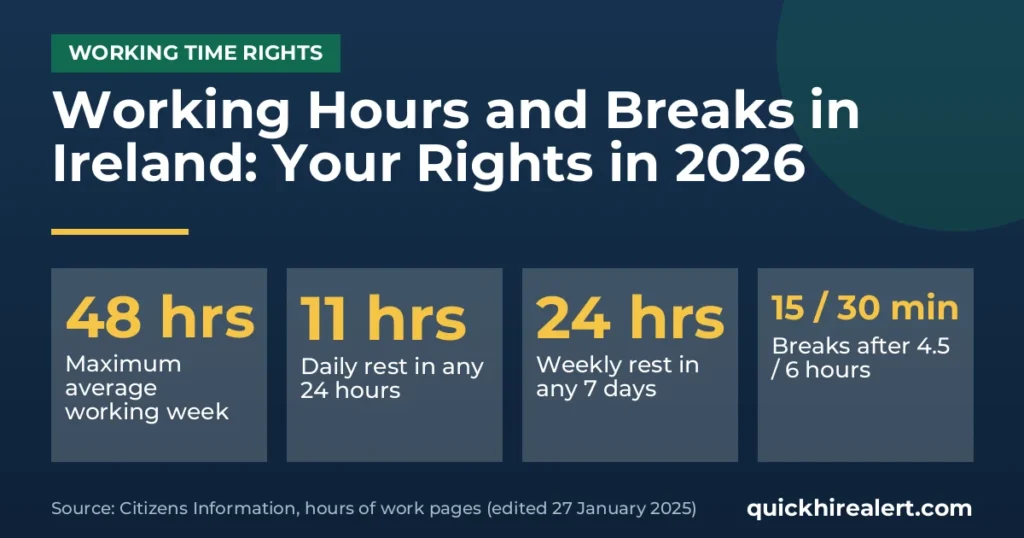
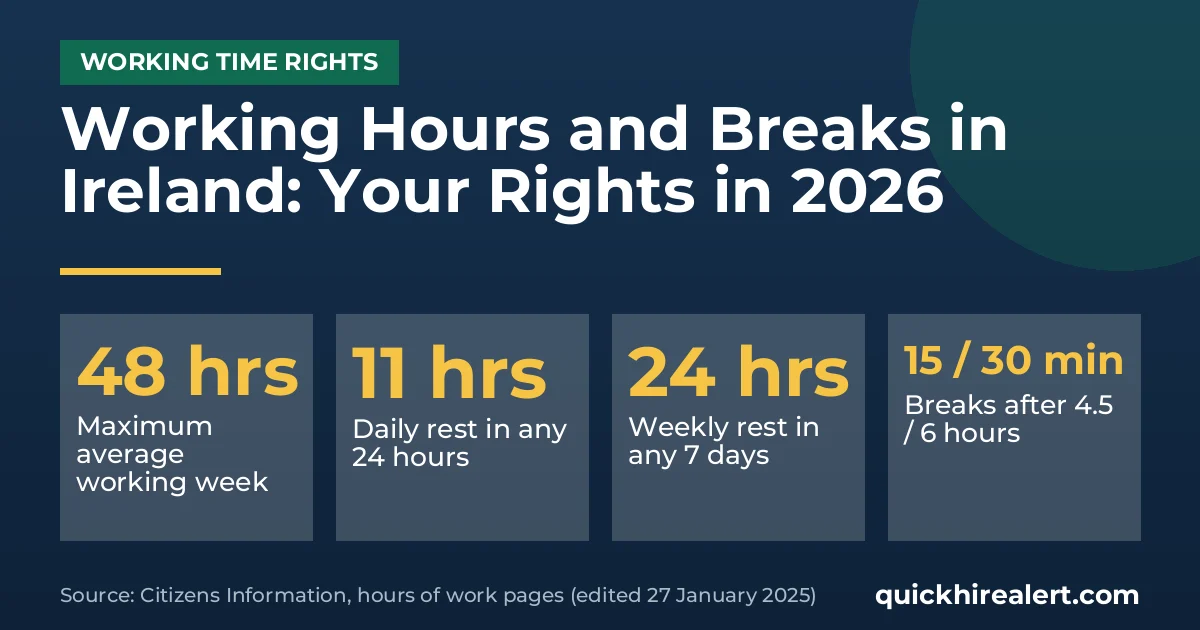
- Maximum week: an average of 48 hours, worked out over a reference period (usually 4 months).
- Breaks: 15 minutes after more than 4.5 hours, 30 minutes after more than 6 hours.
- Daily rest: 11 consecutive hours in any 24 hours.
- Weekly rest: 24 consecutive hours in any 7 days.
- Changing hours: at least 24 hours notice if your hours vary.
- Overtime: no legal right to extra pay, so check your contract.
Working Hours in Ireland: Key Facts
| Item | What the official source says |
|---|---|
| Maximum average week | 48 hours, averaged over a reference period |
| Reference period | 4 months for most employees, 6 months for some sectors, 12 months if agreed and approved by the Labour Court |
| Break after 4.5 hours | 15 minutes |
| Break after 6 hours | 30 minutes (can include the first 15 minutes) |
| Daily rest | 11 consecutive hours in any 24 hours |
| Weekly rest | 24 consecutive hours in any 7 days |
| Notice of variable hours | At least 24 hours |
| Night work | Between midnight and 7am |
| WRC complaint time limit | 6 months, extendable by up to 6 more with reasonable cause |
The 48 Hour Maximum Working Week
The maximum average working week is 48 hours. A single week can be longer than 48 hours. What counts is the average over a set reference period.
Leave is not counted in the 48 hours. This covers annual leave, sick leave, maternity leave, adoptive leave, parental leave, carer’s leave and force majeure leave. If you are off for any of these reasons, those days do not pull your average up or down.
How the average is worked out
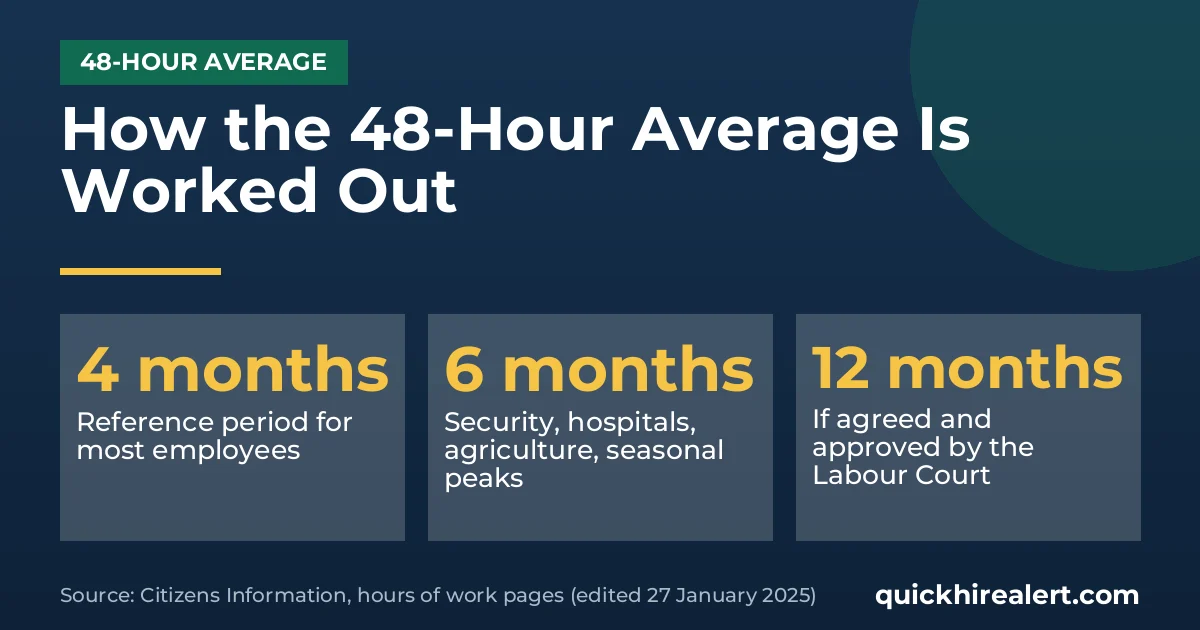
The reference period is 4 months for most employees. It is 6 months for security, hospitals, prisons, gas and electricity, airports and docks, agriculture and businesses with seasonal peaks such as tourism. A 12 month period is possible if it is agreed with your employer and approved by the Labour Court.
Citizens Information gives a worked example. An employee works a 40 hour week, plus 12 hours of overtime in 10 of the 17 weeks in the period. That is 800 hours over 17 weeks, an average of 47.06 hours a week, which is inside the limit.
Who is not covered
Some groups are outside the working time and rest rules. These include the Gardai, Defence Forces members on active service or specific duties, employees who control their own working hours, family employees on farms or in private homes and certain civil protection services. Workers under 18 have their own rules under the Protection of Young Persons (Employment) Act 1996.
Your Hours in Your Contract
Your hours of work are usually set out in your contract of employment, or in an Employment Regulation Order or Registered Employment Agreement if one covers your sector. Your employer must also keep detailed records of the hours you work.
Travel to and from work generally does not count as working time. Different rules may apply to workers with no fixed place of work.
Notice of Your Hours and Banded Hours
If your hours change from week to week, your employer must give you:
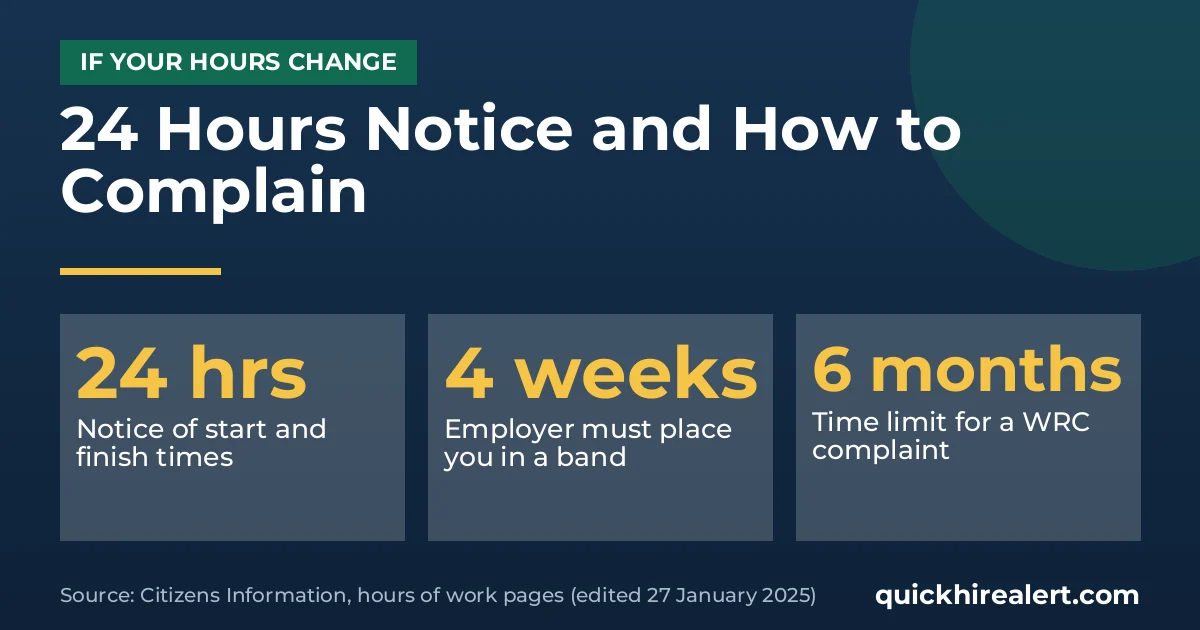
- at least 24 hours notice of your start and finish times before the first day of the week,
- 24 hours notice of each day’s hours, and
- 24 hours notice of any additional hours.
Less notice is allowed only in unforeseen cases, such as covering a colleague who is sick. If you are not given 24 hours notice, you can refuse the work without penalty. This comes from Section 17 of the 1997 Act, as updated by the European Union (Transparent and Predictable Working Conditions) Regulations 2022.
Banded hours
If you are on a low hours contract but regularly work more, you can ask in writing to be placed in a band based on your average weekly hours over the past 12 months. Your employer must place you in a band within 4 weeks. You are then entitled to the average hours of that band for the next 12 months.
| Band | Average weekly hours |
|---|---|
| A | 3 to less than 6 |
| B | 6 to less than 11 |
| C | 11 to less than 16 |
| D | 16 to less than 21 |
| E | 21 to less than 26 |
| F | 26 to less than 31 |
| G | 31 to less than 36 |
| H | 36 or more |
An employer can refuse in set cases. Examples include no evidence of the hours, significant adverse changes in the business, a temporary situation that has ended, or hours set by a collective agreement. You can complain to the WRC if you think a refusal is wrong.
Breaks at Work
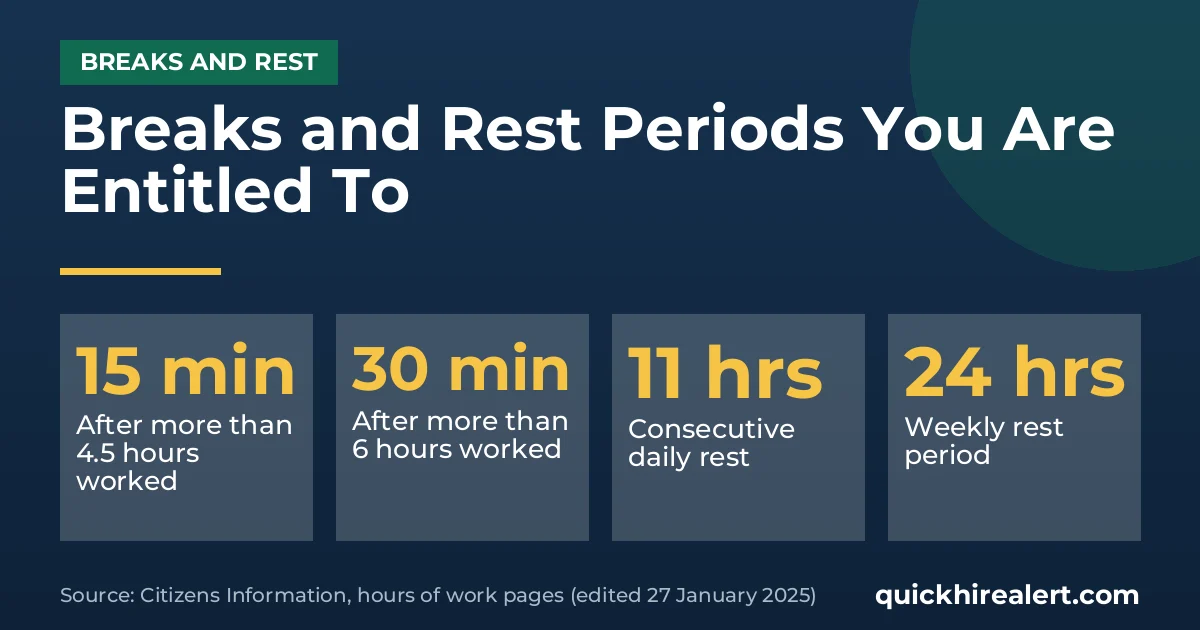
You are entitled to a 15 minute break after more than 4.5 hours of work and a 30 minute break after more than 6 hours. The 30 minute break can include the first 15 minutes. The break should not be at the very end of your working day.
There is no legal right to be paid for these breaks. They are not counted as working time, so whether you are paid depends on your contract. There is also no legal right to smoking breaks.
- Shop workers: if you work more than 6 hours that include the period between 11.30am and 2.30pm, you are entitled to one consecutive hour break in that window.
- Breastfeeding: you can take 60 minutes off a day (one 60 minute, two 30 minute or three 20 minute breaks), or reduce your hours by 60 minutes in an 8 hour day. It is paid for the first 2 years (104 weeks) of the baby’s life.
- Remote workers: you must still get your daily and weekly rest. The duty is on the employer, and the Code of Practice on the right to disconnect applies.
Daily and Weekly Rest
You are entitled to 11 consecutive hours of rest in any 24 hours. For example, if you finish at 8pm, you should not be required to start before 7am.
You are also entitled to a weekly rest period. This is either 24 consecutive hours in any 7 days, following a daily rest period, or two 24 hour rest periods in a week that follows a week with none. The weekly rest should include a Sunday unless your contract says otherwise.
There are exceptions for emergencies, unforeseeable events, Labour Court approved collective agreements, Employment Regulation Orders, Registered Employment Agreements and certain shift work such as split or changing shifts. In those cases you are entitled to compensatory rest instead. Transport workers and fishermen are also outside these rules, along with the groups listed earlier.
Sunday Work
If you work on a Sunday, you are entitled to a benefit. This is usually set out in your contract. If nothing has been agreed, your employer must give you one or more of the following: a reasonable allowance, a reasonable pay increase or reasonable paid time off. Retail staff can also look at the WRC Code of Practice on Sunday working in the retail trade.
Overtime
There is no legal right to extra pay for extra hours, and no statutory overtime rate. Check your contract to see whether overtime can be required and what the rate is. Some sectors have higher rates through Employment Regulation Orders or Registered Employment Agreements.
Overtime still counts towards your 48 hour average. If you are paid the national minimum wage, see our guide to the minimum wage in Ireland for the current rates.
Night Work
Night work means work between midnight and 7am. You are a night worker if you normally work at least 3 hours in that window and at least half of your yearly working hours fall in it.
- Night workers should work no more than an average of 8 hours in 24, averaged over 2 months (or longer under a collective agreement).
- If the work involves special hazards or heavy physical or mental strain, the limit is an absolute 8 hours in any 24.
- Your employer must offer a free health assessment before you start night work and at regular intervals. If night work makes you ill, you should be moved to day work where possible.
- If you are pregnant and a quarter of your hours are night work, you can be exempted with a doctor’s certificate. This applies up to 14 weeks after the birth.
- Under 18s generally may not do night work.
- For sleepover shifts in residential care (continuous 8 hours or more between 11pm and 8am), you must be paid at least the minimum wage even if you are allowed to sleep between tasks.
Young Workers
Under 16s are entitled to a 30 minute break after 4 hours, 14 consecutive hours of daily rest and 2 days of weekly rest. For 16 and 17 year olds the figures are a 30 minute break after 4.5 hours, 12 consecutive hours of daily rest and 2 days of weekly rest. These rules do not apply if the young person works for a close relative. For the rules on jobs for teenagers, see our guide to jobs for 14, 15 and 16 year olds, and for students see part time jobs for students in Ireland.
Working Time Rules for Employment Permit Holders
Working time rules apply to you whatever your nationality. If you hold an employment permit and your employer asks you to work more than the rules allow, you can still raise it with the WRC. If you are thinking of changing job, read about changing employer on a work permit before you act.
Scam and Pressure Warning
Be careful with job offers that promise very long hours for fixed pay, ask you to sign away your rest or hold your passport. A legitimate employer cannot ask you to give up your legal rest and break entitlements. If something does not look right, get advice before you travel or sign.
How to Complain
- Raise the problem with your employer first, ideally in writing.
- If it is not resolved, make a complaint to the Workplace Relations Commission using its online complaint form.
- Do this within 6 months of the problem. The WRC can extend the deadline by a further 6 months (up to 12 months in total) if you had reasonable cause for the delay.
Frequently Asked Questions
What is the maximum working week in Ireland?
The maximum average working week is 48 hours. One week can be longer than 48 hours as long as your average over the reference period stays within the limit. Leave such as annual leave, sick leave and maternity leave is not counted in the 48 hours.
How many breaks do you get at work in Ireland?
You are entitled to a 15 minute break after more than 4.5 hours of work and a 30 minute break after more than 6 hours of work. The 30 minute break can include the first 15 minute break. There is no legal right to be paid for these breaks, so check your contract.
How much rest must you get between shifts?
You are entitled to 11 consecutive hours of rest in any 24 hour period. If you finish work at 8pm, you should not be required to start again before 7am.
Do you get paid extra for overtime in Ireland?
There is no general legal right to extra pay for overtime and no statutory overtime rate. Whether overtime is required, and how it is paid, depends on your contract. Some sectors have higher rates set through Employment Regulation Orders or Registered Employment Agreements.
Can your employer change your hours at short notice?
If your hours vary from week to week, your employer must give you at least 24 hours notice of your start and finish times, and 24 hours notice of any additional hours. If you are given less notice, you can refuse the work without penalty. Shorter notice is allowed only in unforeseen cases, such as covering a sick colleague.
Do you have to work on Sundays?
Your contract usually sets this out. If you work on a Sunday you are entitled to a benefit, normally agreed in the contract. If nothing is agreed, your employer must give you a reasonable allowance, a reasonable pay increase or reasonable paid time off.
What is night work and what limits apply?
Night work is work between midnight and 7am. A night worker normally works at least 3 hours in that window and at least half of their yearly hours in it. Night workers should work no more than an average of 8 hours in 24, averaged over 2 months, and employers must offer a free health assessment before night work starts.
How do you complain if your employer breaks the working time rules?
Raise it with your employer first. If that does not work, you can make a complaint to the Workplace Relations Commission (WRC) using its online complaint form. You normally have 6 months from the problem, and the WRC can extend this by a further 6 months if you had a reasonable cause for the delay.
Related Guides
- annual leave in Ireland
- sick leave in Ireland
- minimum wage in Ireland
- bank holidays in Ireland
- part time jobs for students in Ireland
- jobs for 14, 15 and 16 year olds
- changing employer on a work permit
Official Sources
- Citizens Information: Working hours
- Citizens Information: Work breaks and rest periods
- Citizens Information: Night work
- Workplace Relations Commission
Verification note: every rule above comes from the Citizens Information pages listed, each last edited on 27 January 2025 and read on 17 November 2026. Rules can change, so check the live pages before you rely on them for a decision.