
Last updated: 19 November 2026 | Information verified: Citizens Information, Contract of employment (page edited 10 August 2026, read on 18 November 2026) and the Workplace Relations Commission (WRC) guidance on ending the employment relationship (minimum notice).
You have a contract of employment from the moment you start working for an employer for regular pay, even if nobody hands you a document. What the law requires is that your employer gives you a written statement of your main terms, and that statement is the document you will use for payslips, leave, probation and notice.
This guide explains what must be in writing and when, how long probation can last, what notice you and your employer must give, and where to complain. It is written for employees in Ireland, including people on an employment permit.
Key Facts at a Glance
| Topic | What the rule says |
|---|---|
| Do you have a contract? | Yes, automatically, if you work for regular wages or salary. It does not all have to be written. |
| Core terms in writing | Within 5 days of starting |
| Remaining terms in writing | Within 1 month of starting |
| Who signs? | Employer signs and dates. You do not have to sign. |
| Maximum probation | 6 months, extendable by up to 6 more in exceptional cases (12 months total) |
| Employer notice | 1 to 8 weeks depending on service (after 13 weeks) |
| Your notice when resigning | At least 1 week after 13 weeks of service, unless the contract says longer |
| Where to complain | Your employer first, then the WRC (1 month of service needed) |
What Is a Contract of Employment in Ireland?
Anyone who works for an employer for a regular wage or salary has a contract of employment. Most contracts are open-ended. Others are fixed-term or specified-purpose.
Terms can be express, meaning agreed verbally or in writing, or implied, for example through custom and practice, case law or as an obvious consequence of the job. Your statutory rights, such as the minimum wage and annual leave, override anything in the contract. If a contract says less than the law gives you, the law wins.
What Must Be in Writing Within 5 Days
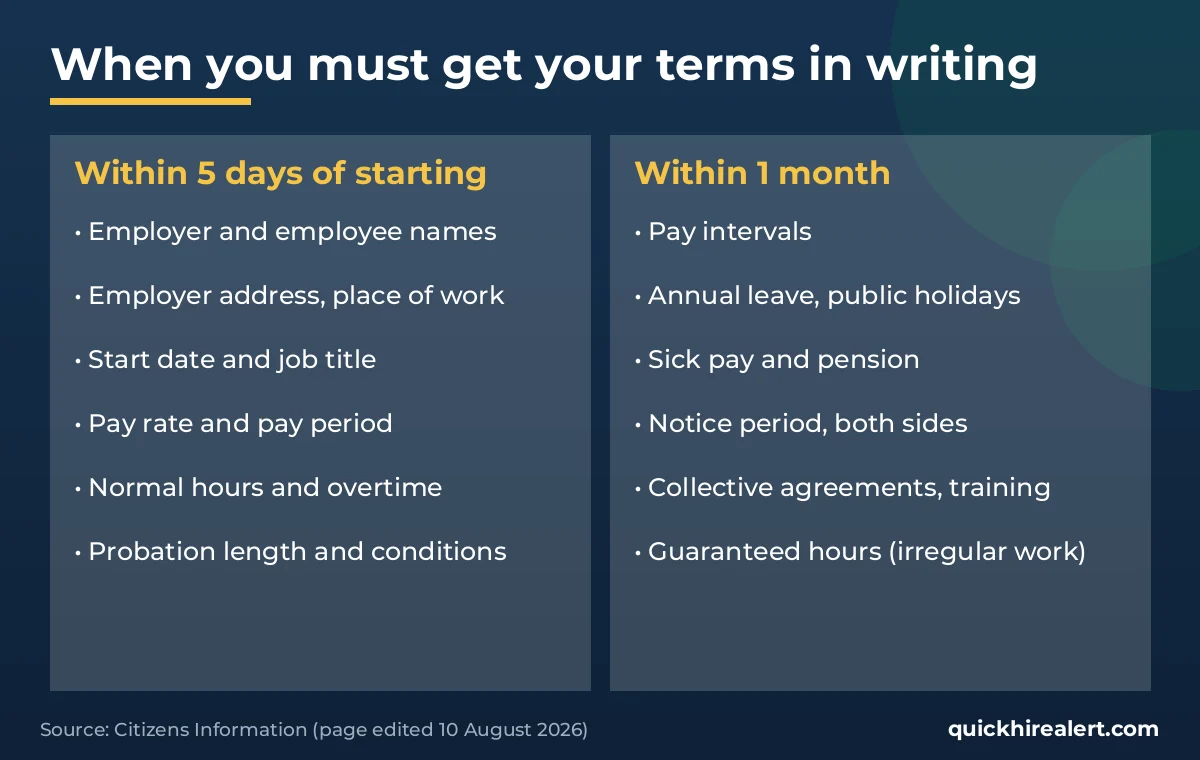
The law requires a written statement of terms of employment. Within 5 days of you starting, it must include:
| Term |
|---|
| Full names of the employer and the employee |
| The employer’s address |
| Your place of work, or a statement that you work in various places or are free to choose |
| Your start date |
| Your job title, grade or the nature of the work |
| The expected duration, if the job is temporary or fixed-term |
| Your rate of pay, or how it is calculated, and the pay reference period |
| The normal length of your working day and week that the employer reasonably expects |
| The duration and conditions of any probation |
| Terms on hours of work, including overtime |
This comes from the Employment (Miscellaneous Provisions) Act 2018, updated by the European Union (Transparent and Predictable Working Conditions) Regulations 2022. Employers face serious penalties if they do not comply. For your hours and break rights, see our guide to working hours and breaks in Ireland.
What Must Be Given Within 1 Month
| Term |
|---|
| Pay intervals |
| Paid leave, including annual leave and public holidays |
| Sick pay |
| Pension and pension schemes |
| Notice period for the employer and the employee |
| Any collective agreements that apply |
| Training provided |
| For agency workers, the identity of the hirer |
| For mostly unpredictable work patterns: guaranteed hours, the hours and days you may be required to work and the minimum notice of assignments |
| The identity of the social security agency and related protection |
These rules come from the Terms of Employment (Information) Acts 1994 to 2014 as amended by the 2022 Regulations. They do not apply if you work under 8 hours a week or have been employed for under a month.
To check your entitlements against your contract, read our guides to annual leave in Ireland and sick leave in Ireland, and to the minimum wage.
Signatures, Copies and Written Procedures
Your employer must sign and date the written statement. You do not legally have to sign it. Your employer must keep a copy during your employment and for at least a year after it ends.
Your employer must also have written grievance and disciplinary procedures, in line with the WRC Code of Practice, and give you a copy at the start. Within 28 days, you must also be given written details of the procedures that apply before a dismissal (Unfair Dismissals Acts).
If you are required to work outside Ireland for at least a month, you must get a written statement before you leave. It covers the countries, the duration, the currency of pay and any benefits for working abroad.
Probation in Ireland: The Rules
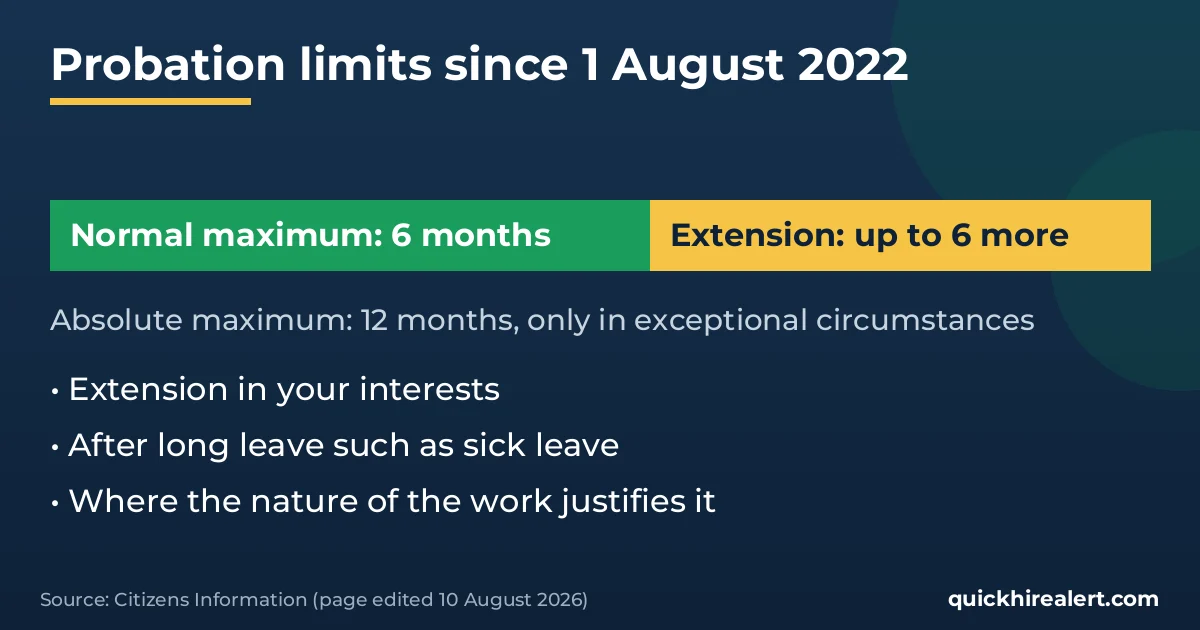
From 1 August 2022, probation cannot be more than 6 months. In exceptional circumstances it can be extended by up to a further 6 months, with a maximum of 12 months in total. Citizens Information lists these situations:
- The extension is in your interests.
- You were on extended leave, such as sick leave, during probation.
- The nature of the work justifies it, for example in the public service.
The Unfair Dismissals Acts do not apply to a dismissal during probation or training if the contract is in writing and the probation or training is one year or less and specified in the contract. There are exceptions. Protection still applies to dismissal for trade union membership or activity, for pregnancy-related matters, or for maternity, parental, adoptive, parent’s, paternity, force majeure or carer’s leave entitlements.
Even in probation you have the right to fair procedures if you are dismissed for misconduct. Citizens Information says dismissal for poor performance is generally not covered where the contract allows it. If you have under 12 months of service you may still be able to bring a wrongful dismissal claim in the civil courts, for example for breach of contract or inadequate notice.
Older guidance online still mentions a 2-month probation limit. Use the current 6-month rule above.
Notice Periods: What You and Your Employer Must Give
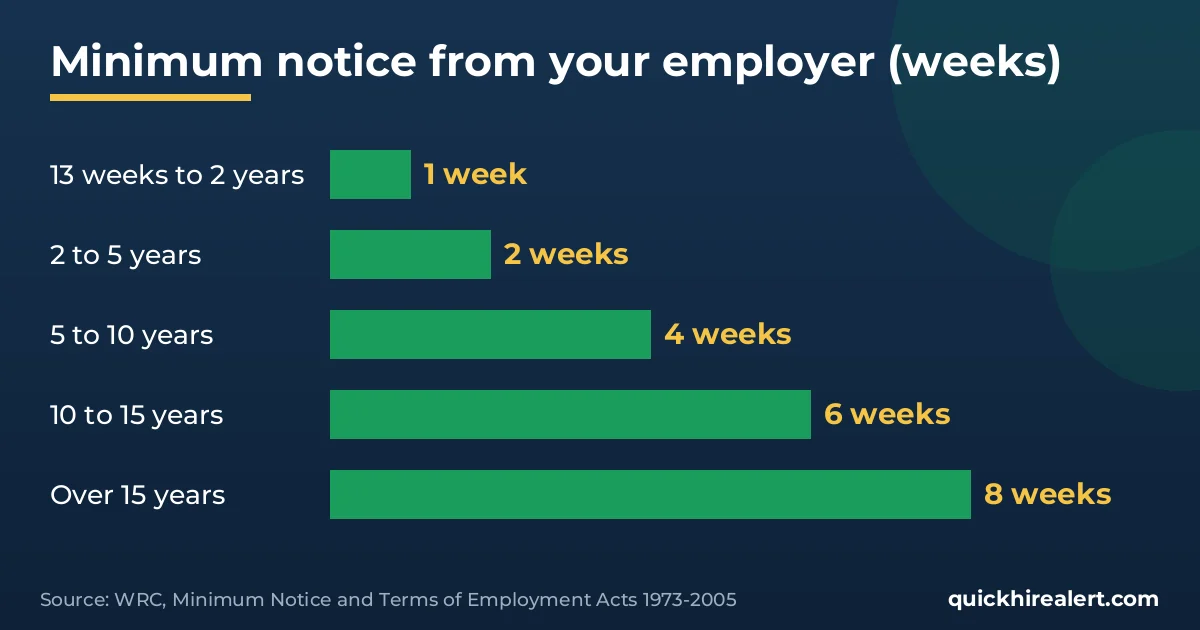
Minimum notice from your employer is set by the Minimum Notice and Terms of Employment Acts 1973 to 2005 and depends on your continuous service:
| Length of continuous service | Minimum notice from employer |
|---|---|
| 13 weeks to 2 years | 1 week |
| 2 to 5 years | 2 weeks |
| 5 to 10 years | 4 weeks |
| 10 to 15 years | 6 weeks |
| Over 15 years | 8 weeks |
If your employer does not need you to work out your notice, the employer must pay you for that period. Absences of up to 26 weeks between periods of employment count as service if they were due to lay-off, sickness or injury, or agreed. Your contract cannot give you less than the statutory minimum, but it can give you more.
If you resign after 13 weeks of service, you must give at least 1 week of notice unless your contract says longer, according to the WRC Leaving Work booklet.
Restrictive Clauses and Second Jobs
Some contracts restrict you from working in the same sector or with former clients for a period after you leave. These clauses can be complicated, so get legal advice before you sign. The Law Society directory lists solicitors, and fees vary.
Your employer cannot stop you taking other work unless the restriction is proportionate and based on objective reasons: health and safety, business confidentiality, conflicts of interest or statutory or regulatory obligations. The restriction and the reasons must be given to you in writing, and you are protected from penalisation.
Changing Your Contract
Changes in employment law change your contract automatically. For other changes, your employer cannot alter your terms without your agreement.
Employment Permit Holders: Keep Your Written Statement
This section is our practical advice, not a legal rule. If you work in Ireland on an employment permit, keep your written statement of terms safe. It is a useful record of your job title, pay and hours, and you may need to show your employment details when you deal with immigration or other official bodies. Read our guides to Stamp 4 in Ireland and getting a PPS number, and use the salary calculator to check your take-home pay. If your first payslip looks wrong, see emergency tax in Ireland.
Scam Warning: Job Offers That Skip the Contract
Be careful with any job offer that asks for money before you start, will not give you a written statement of terms, or is vague about pay and hours. A genuine employer gives you your terms in writing. If you are not sure, check the employer before you travel or pay anyone.
How to Complain If Your Employer Breaks the Rules
Raise the problem with your employer first. If it is not resolved, you can make a complaint to the Workplace Relations Commission (WRC) using its online complaint form. You need at least one month of continuous service. The WRC Information and Customer Service office is at O’Brien Road, Carlow R93 E920, open Monday to Friday 9.30am to 1pm and 2pm to 5pm, telephone (059) 917 8990.
Frequently Asked Questions
Do I need a written employment contract in Ireland?
Every employee has a contract of employment, even if nothing is signed. The whole contract does not have to be in writing, but the law requires your employer to give you a written statement of your terms. Your employer must sign and date it. You do not legally have to sign it.
How long does my employer have to give me my terms in writing?
Core terms such as names, place of work, start date, job title, pay and normal hours must be given within 5 days of you starting. The remaining terms, such as pay intervals, leave, sick pay, pension and notice periods, must be given within 1 month.
How long can probation last in Ireland?
Since 1 August 2022 probation cannot be longer than 6 months. In exceptional circumstances it can be extended by up to a further 6 months, which makes 12 months the maximum in total.
Can I be dismissed during probation?
The Unfair Dismissals Acts do not apply to a dismissal during probation or training if the contract is in writing and the probation or training is one year or less and specified in the contract. There are exceptions, including dismissal for trade union membership or activity, pregnancy-related matters, and maternity, parental, adoptive, parent's, paternity, force majeure or carer's leave entitlements.
How much notice does my employer have to give me?
With 13 weeks to 2 years of continuous service the minimum is 1 week. It rises to 2 weeks (2 to 5 years), 4 weeks (5 to 10 years), 6 weeks (10 to 15 years) and 8 weeks (over 15 years). Your contract cannot give you less than the statutory minimum.
How much notice do I have to give if I resign?
If you have been working for 13 weeks or more, you must give your employer at least 1 week of notice, unless your contract sets a longer period.
Can my employer stop me taking a second job?
Not unless the restriction is proportionate and based on objective reasons such as health and safety, business confidentiality, conflicts of interest or legal obligations. The restriction and the reasons must be given to you in writing. You are protected from penalisation for taking other work.
Where do I complain if I do not get my written terms?
Raise it with your employer first. If that does not work, you can make a complaint to the Workplace Relations Commission (WRC) using its online complaint form. You need at least one month of continuous service.
Related Guides
- Working Hours and Breaks in Ireland: Your Rights in 2026
- Annual Leave in Ireland (2026)
- Sick Leave in Ireland (2026)
- Minimum Wage Ireland 2026 and 2027
- Stamp 4 Ireland (2026)
- Salary Calculator Ireland 2026
Official Sources
- Citizens Information: Contract of employment
- Citizens Information: Contracts of employment
- Workplace Relations Commission: Ending the employment relationship (minimum notice)
- Workplace Relations Commission
Verification note: the Citizens Information page was edited on 10 August 2026 and read on 18 November 2026. The notice table follows the WRC guidance. This guide is general information, not legal advice. Check the current official pages or contact the WRC before you act.