
Last updated: 15 November 2026 | Information verified: 15 November 2026 against the publicjobs.ie information hub, career path, application advice and new recruitment platform pages, and Citizens Information (civil service page, last edited 6 May 2025).
Public sector jobs in Ireland include the civil service, senior local authority roles, HSE medical consultants, the Garda Siochana and State Boards. Most of these are recruited through publicjobs.ie, the website of the Public Appointments Service. If you want a stable job with set pay scales and a clear promotion path, this is where you apply.
This guide explains who publicjobs recruits for, who can apply, the starting pay for each civil service grade, the recruitment stages and how to submit an application step by step. It uses the published publicjobs and Citizens Information pages only. Each competition has its own booklet, and the booklet always overrides a general guide like this one.
Quick answer
- Where to apply: publicjobs.ie. Read the Competition Information Booklet, create an account, click Apply Now and submit before the closing date.
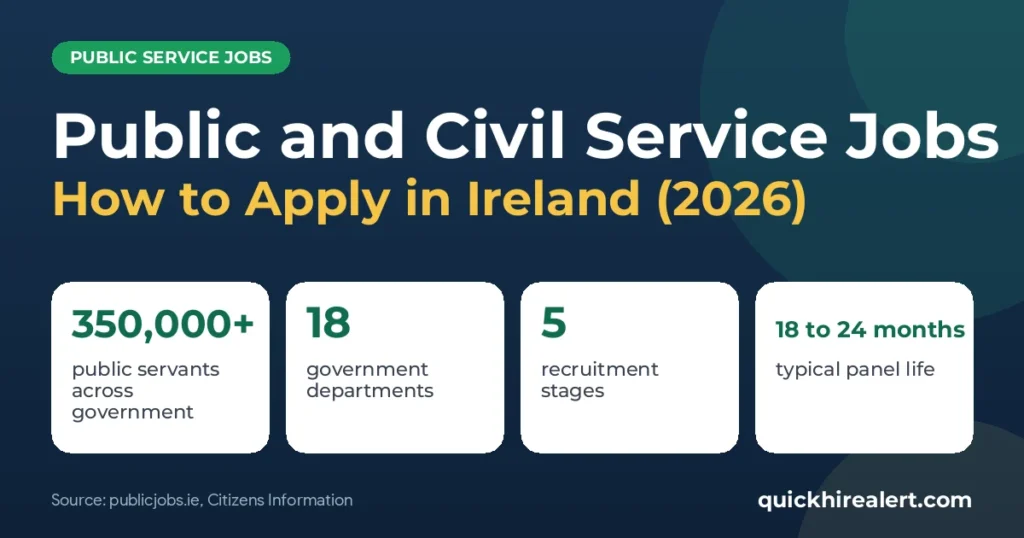
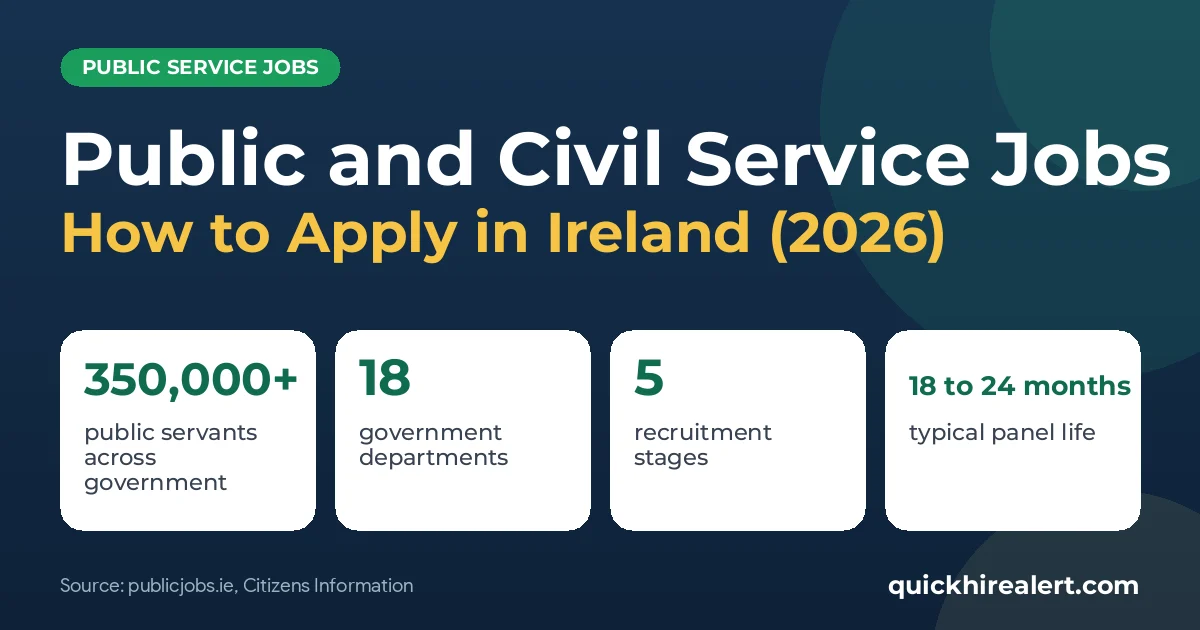
- Size: publicjobs says there are more than 350,000 public servants in Ireland, and the civil service has 18 government departments.
- Who can apply: the vast majority of roles are open to EEA citizens. Some roles need Irish citizenship, and rules for Stamp 4 holders were widened from 1 September 2023 and again in April 2024. Check the booklet.
- Starting pay: from €31,811 for a Clerical Officer to €108,152 for a Principal Officer, as listed on the publicjobs career path page.
- Stages: application, testing, skills assessment, interview, then pre-employment and clearance. Not every competition uses every stage.
- After the interview: successful candidates go on a ranked panel that is typically active for about 18 to 24 months.
Key Facts at a Glance
| Run by | Public Appointments Service (publicjobs.ie) |
| Jobs covered | Civil service, senior local authority roles, HSE medical consultants, Garda trainees, State Boards and other public bodies |
| Size | More than 350,000 public servants; 18 government departments |
| Entry grades | Clerical Officer from €31,811, Executive Officer from €38,803 |
| Eligibility | Set per competition; vast majority open to EEA citizens; some need Irish citizenship |
| Stages | Application, testing, skills assessment, interview, pre-employment and clearance |
| Test results | Normally 3 to 4 weeks after the test closing date |
| Panel life | Typically about 18 to 24 months; differs per competition |
| Declining an offer | You are withdrawn from that competition |
Who Recruits Through publicjobs.ie
The Public Appointments Service runs recruitment for a wide range of public employers. On its "we recruit for" pages, publicjobs lists the civil service, senior local authority positions, HSE medical consultants, the Garda trainee competitions, State Boards and other public bodies such as RTE.
The civil service is the biggest group of jobs for most applicants. It covers the 18 government departments and offices, and entry-level competitions such as Clerical Officer and Executive Officer are the usual way in. Many people then move up the grades through promotion competitions.
One point to know before you search: not every public sector job is on publicjobs. Most HSE nursing, midwifery and health support jobs are advertised on the HSE's own recruitment pages, not on publicjobs. Our guides to HSE jobs and how to apply for HSE jobs explain that route. Local councils and other bodies also advertise some jobs on their own sites, so check the employer's website as well.
Who Can Apply
Eligibility is set for each competition and written in the Competition Information Booklet. You should read that section before you spend time on the application form.
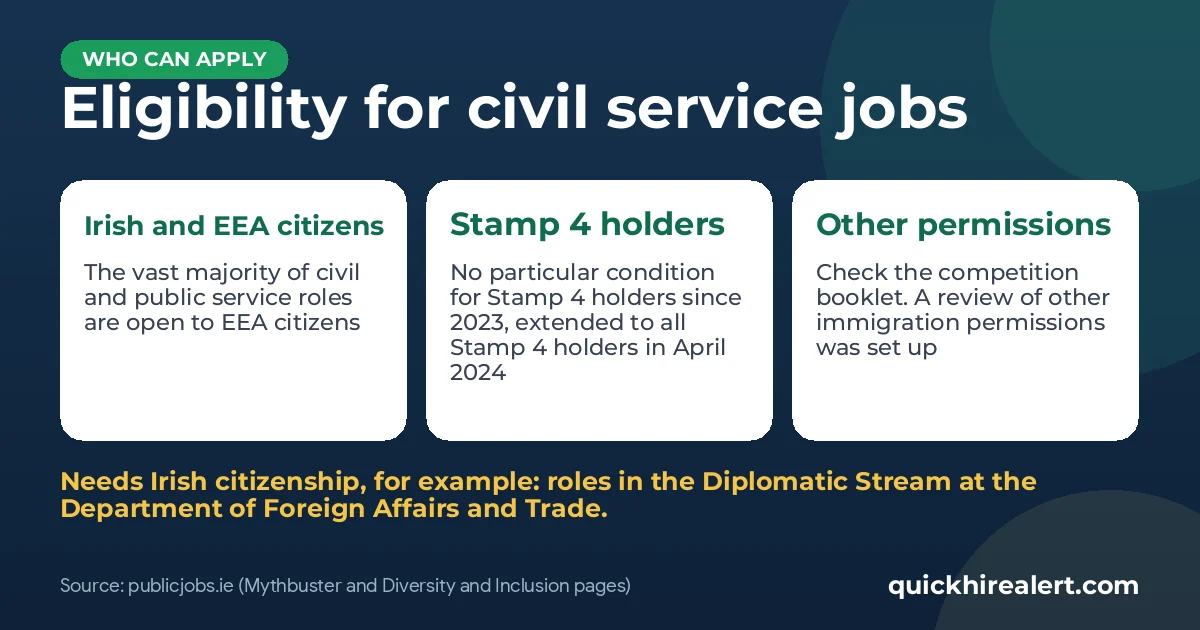
- EEA citizens: publicjobs says the vast majority of roles are open to citizens of the European Economic Area.
- Irish citizenship only: some roles are restricted. The Diplomatic Stream run with the Department of Foreign Affairs requires Irish citizenship.
- Stamp 4 holders: publicjobs says the civil service citizenship rules changed from 1 September 2023, and in April 2024 the change was extended to all Stamp 4 holders.
- Other immigration permissions: publicjobs says these are under review, and it does not list the full current criteria on the pages we checked. Read the booklet, or contact the recruitment unit named in it, before you apply.
If you are outside Ireland and need permission to work here, a public sector competition does not replace the normal permit route. Our guides to the Ireland work visa and jobs in Ireland for foreigners cover that side, and the Stamp 1 page explains one common permission.
Civil Service Grades and Starting Pay
The civil service uses grades, and each grade has its own pay scale. The publicjobs career path page lists the starting salary for each main grade. That page shows no effective date, so treat the figures as a guide and confirm the pay in the booklet of the competition you want.
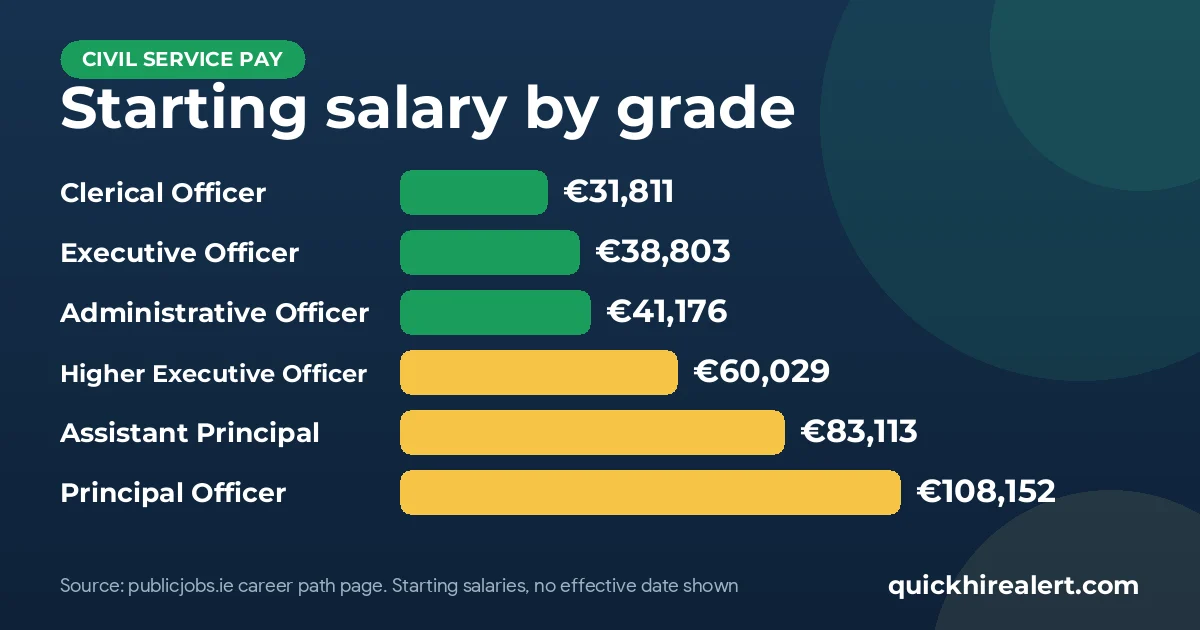
| Grade | Starting salary |
|---|---|
| Clerical Officer (CO) | €31,811 |
| Executive Officer (EO) | €38,803 |
| Administrative Officer (AO) | €41,176 |
| Higher Executive Officer (HEO) | €60,029 |
| Assistant Principal (AP) | €83,113 |
| Principal Officer (PO) | €108,152 |
Source: publicjobs.ie civil service career path page. No effective date is shown on the page.
Entry is usually at Clerical Officer or Executive Officer level, and the higher grades are normally filled by promotion or by specialist competitions. Pay in the booklet is the figure that counts when you apply.
The Recruitment Stages
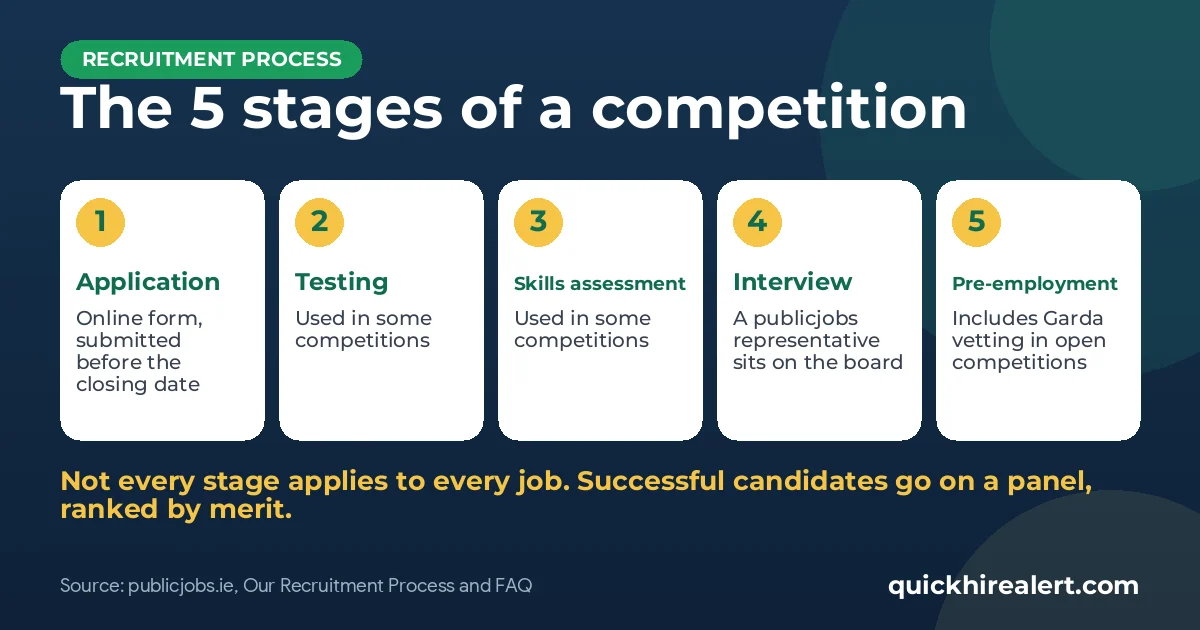
publicjobs describes up to five stages. Which ones apply depends on the competition, so the booklet shows the exact process.
- Application: you apply online before the closing date. Some competitions ask for a CV only if the booklet says so.
- Testing: many competitions use an online test. publicjobs says results are normally issued 3 to 4 weeks after the test closing date.
- Skills assessment: used in some competitions to check job-related skills.
- Interview: candidates are interviewed by a board. You can ask the recruitment unit for feedback on your interview.
- Pre-employment and clearance: references, vetting and other checks before you start.
How to Apply Step by Step
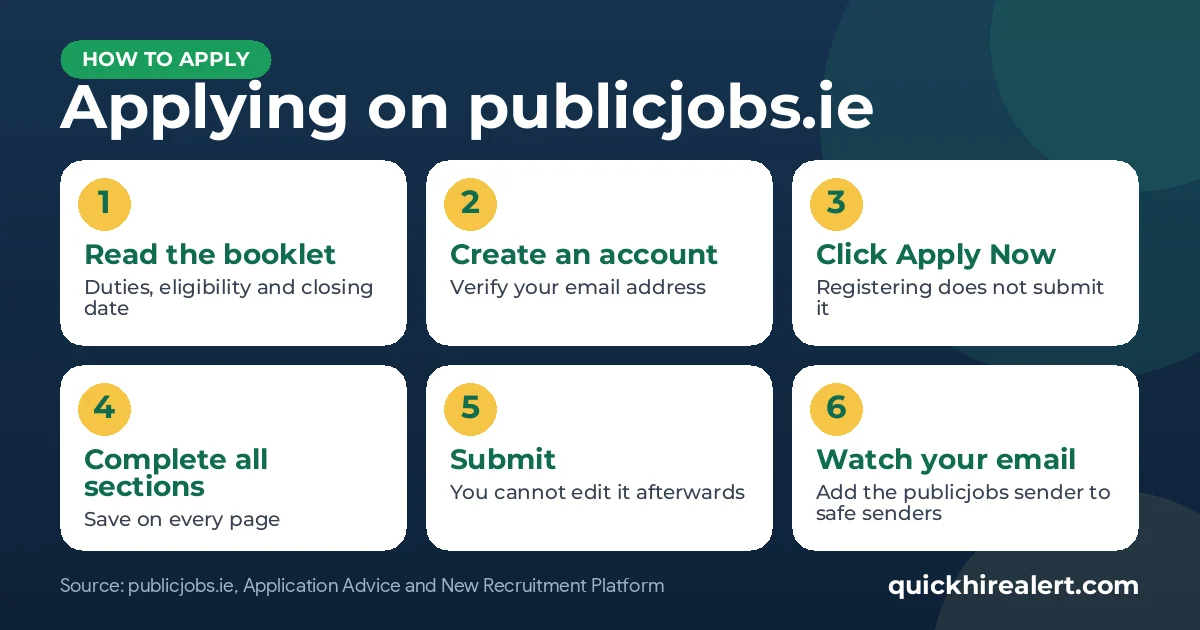
These steps follow the publicjobs application advice.
- Read the Competition Information Booklet. It lists the duties, eligibility rules, pay and closing date.
- Create an account on publicjobs.ie and verify your email address.
- Click Apply Now. Registering does not submit an application.
- Complete every section. Use Save and Continue on each page. publicjobs warns that you can lose your data after 30 minutes of inactivity.
- Submit. You should receive a confirmation email within a few hours. You cannot edit the application after you submit it.
- Watch your email. publicjobs contacts candidates by email, not by SMS.
Attach a CV only if the booklet asks for one. If the form asks for written answers, draft them in a document first, then paste them in, so that you do not lose your work if the page times out.
Using the New Recruitment Platform
publicjobs has a new recruitment platform, and its information page says candidates need to register again on it. A few practical points from that page:
- Set up job alerts in your Application Centre, under Alert Centre, so that you hear about new competitions.
- Add the publicjobs email domain, @publicjobs.tal.net, to your safe senders list so that messages do not go to spam.
- Check your email, including the spam folder, regularly. Test invitations and interview dates arrive by email.
Checks Before You Start
A job offer from a panel is subject to pre-employment checks.
- References: publicjobs says your current employer is contacted before an assignment is made. For private sector employers it says there is no contact without your prior knowledge.
- Garda vetting: applies to all candidates in open competitions.
- Police disclosure: candidates who have lived outside the island of Ireland for six months or more since the age of 16 are asked for police disclosure, according to the pre-employment checks guidance. If you have lived abroad, start collecting these documents early.
Panels, Offers and Waiting
After the interview, successful candidates are placed on a panel in order of merit. Departments and offices then make offers from the panel as vacancies arise. publicjobs says a panel is typically active for about 18 to 24 months, but the expiry date differs for each competition.
Be careful with offers. publicjobs says that if you decline an assignment offer you are withdrawn from that competition. If you may not be able to take a post in a certain location, ask the recruitment unit what your options are before you apply.
Example: Executive Officer Competition 2026
publicjobs ran an Executive Officer competition in the civil service in early 2026. It opened on 6 February and closed on 23 February 2026. According to the booklet, it set an education requirement of Leaving Certificate at level 4 or above, was open nationwide and listed 23 days of annual leave. It shows how short the application window can be, which is why job alerts matter. Check the publicjobs site for the current Executive Officer and Clerical Officer competitions, because they change.
Tips for Applicants From Outside Ireland
- Read the eligibility section of the booklet first. If your nationality or permission is not clearly covered, contact the recruitment unit named in the booklet.
- Set up job alerts and apply early in the window. Closing dates are firm.
- Prepare references and any police disclosure documents before you are asked.
- Compare publicjobs with other routes. Our jobs in Dublin and how to get a job in Ireland guides cover private sector options, and the PPS number page explains the number you will need to start work.
Frequently Asked Questions
Is publicjobs.ie the official site for civil service jobs in Ireland?
Yes. publicjobs.ie is the website of the Public Appointments Service, which runs recruitment for the civil service and a number of other public bodies. Each competition has its own Competition Information Booklet with the duties, eligibility rules and closing date.
Can non-EU citizens apply for civil service jobs in Ireland?
It depends on the competition. publicjobs says the vast majority of roles are open to citizens of the European Economic Area, and some, such as the Diplomatic Stream, require Irish citizenship. Rules for other nationalities changed from 1 September 2023 and were extended to all Stamp 4 holders in April 2024, and publicjobs says other immigration permissions are under review. Always read the eligibility section of the booklet for the specific competition.
How much does a civil service job pay in Ireland?
The publicjobs career path page lists starting salaries of 31,811 euro for a Clerical Officer, 38,803 euro for an Executive Officer, 41,176 euro for an Administrative Officer, 60,029 euro for a Higher Executive Officer, 83,113 euro for an Assistant Principal and 108,152 euro for a Principal Officer. The page shows no effective date, so check the pay in the competition booklet.
How long does the civil service recruitment process take?
It varies by competition. publicjobs says test results are normally issued 3 to 4 weeks after the test closing date, and a panel of successful candidates is typically active for about 18 to 24 months, although the expiry differs for each competition. Offers can come at any point while the panel is live.
Can I edit my application after I submit it?
No. publicjobs advises that you cannot edit an application once it is submitted. Save as you go, because the system can lose your data after 30 minutes of inactivity, and check every section before you submit.
What happens if I turn down a job offer from a panel?
According to publicjobs, if you decline an assignment offer you are withdrawn from that competition. Think carefully before you refuse, and ask the recruitment unit named in the booklet if you are unsure.
Do I need Garda vetting for a public sector job?
Yes. publicjobs says Garda vetting applies to all candidates in open competitions. Candidates who have lived outside the island of Ireland for six months or more since the age of 16 are also asked for police disclosure, according to the pre-employment checks guidance.
Related Guides
- HSE jobs in Ireland
- How to apply for HSE jobs
- Jobs in Dublin
- How to get a job in Ireland
- Jobs in Ireland for foreigners
- Ireland work visa
- PPS number in Ireland
- Salary calculator Ireland
Official Sources
- publicjobs.ie: We recruit for
- publicjobs.ie: Civil service career path
- publicjobs.ie: Our recruitment process
- publicjobs.ie: Application advice
- publicjobs.ie: New recruitment platform
- publicjobs.ie: FAQs
- publicjobs.ie: Expanded eligibility requirements for the civil service
- publicjobs.ie: Executive Officer in the Civil Service 2026
- Citizens Information: The civil service
Last verified: 15 November 2026. This guide explains the published rules and is not legal advice. Competition rules, eligibility and pay change, so confirm everything in the booklet of the competition you want on publicjobs.ie.
Get an email when Ireland's permit rules change
Salary thresholds, occupation lists and visa rules change every year. Subscribe and we will tell you when they do, plus new job guides. Free, no spam.
Subscribe free