
Last updated: 15 November 2026 | Information verified: 15 November 2026 against the Irish Immigration Service (ISD) study pages, student finances page and students FAQ, and Citizens Information (student visas page, last edited 23 June 2026).
If you are from outside the EEA and want to study in Ireland, you need an offer from a recognised college, a student visa if your nationality requires one, proof that you can pay your way, and registration with immigration after you arrive. This guide shows each step using the official ISD and Citizens Information pages.
It covers the C and D study visas, the money you must show, the documents, the fees, work hours on Stamp 2, how long you can stay and what happens after you graduate. It explains the published rules only. It does not recommend colleges or agents.
Quick answer
- Visa: if your nationality needs one, apply online before you travel. ISD says a short-stay C visa is for study under 90 days and a long-stay D visa is for study over 90 days.
- Course: full-time, on the Interim List of Eligible Programmes (ILEP), with at least 15 hours of study a week.
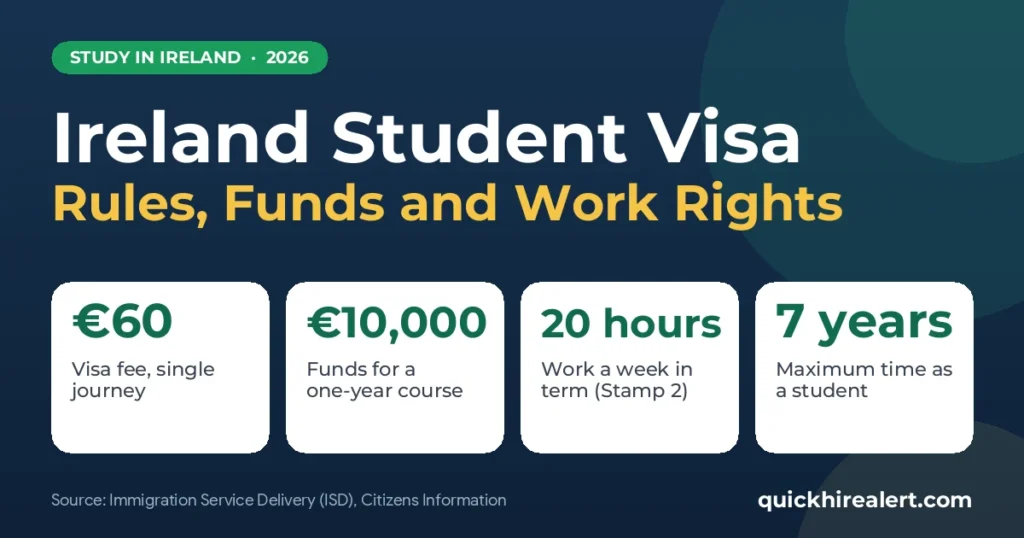
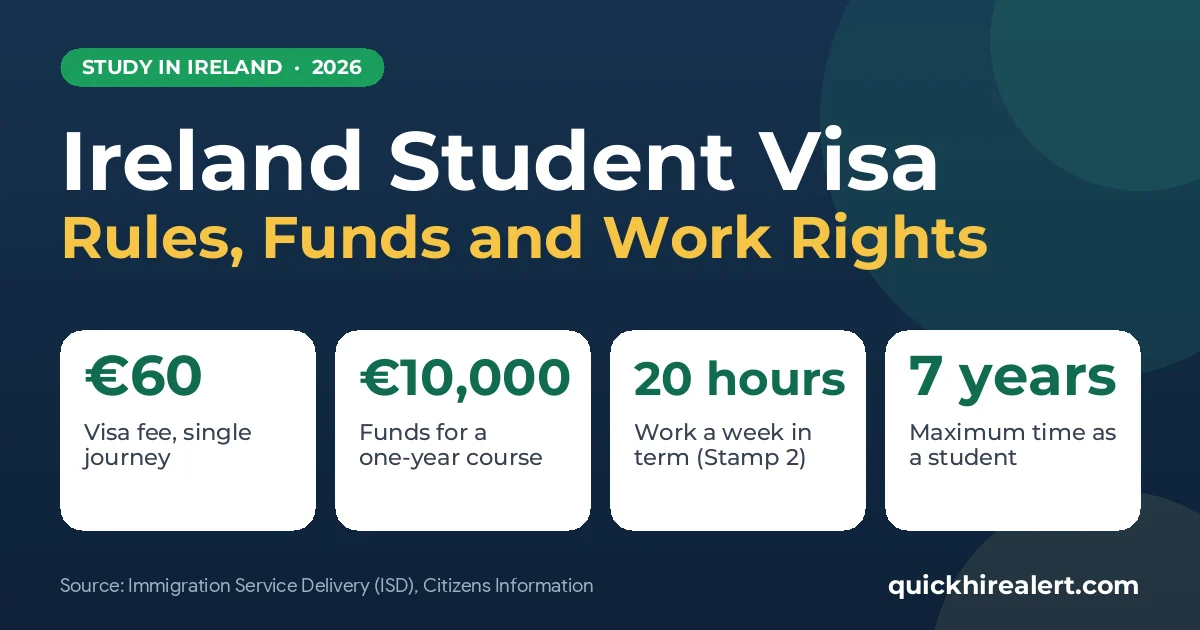
- Money: access to at least €10,000 for a one-year course, and ready access to €10,000 for each later year plus course fees. For 6 to 8 month courses it is €833 a month (€4,998 for 6 months, €6,665 for 8 months).
- Visa fee: €60 for a single journey or €100 for multiple journeys, and it is not refundable.
- After you arrive: if you stay over 90 days you must register with ISD. The registration fee is €300 and you must show proof of funds and private medical insurance.
- Work: on Stamp 2 you can work up to 20 hours a week in term and 40 hours a week in the holiday periods. On Stamp 2A you cannot work.
Key Facts at a Glance
| Question | Answer |
|---|---|
| Visa for study under 90 days | Short-stay C study visa, if your nationality needs a visa (ISD) |
| Visa for study over 90 days | Long-stay D study visa, applied for online before you travel (ISD) |
| Course | Full-time, on the ILEP, at least 15 hours of study a week |
| Money to show, first year | €10,000 for a one-year course (ISD) |
| Money to show, later years | €10,000 a year plus course fees (ISD) |
| Visa fee | €60 single, €100 multiple, non-refundable (Citizens Information) |
| Registration fee | €300, if you stay over 90 days (ISD FAQ) |
| Health insurance | Private medical insurance is required |
| Work | Stamp 2: 20 hours in term, 40 in holidays. Stamp 2A: none |
| Family | Students are typically not permitted to bring family members |
| Longest stay as a student | Up to seven years (ISD FAQ) |
Do You Need a Student Visa?
It depends on your nationality. Citizens of some countries must get a visa before they travel. EEA nationals do not need one. If your nationality does not need an entry visa, you do not need a student visa, but you must still get permission to enter at the port of entry and register with immigration if you will stay longer than 90 days.
Check your nationality on the ISD pages first. Nothing in this guide changes that list, and the Citizens Information and ISD study pages do not list the countries themselves.
C Visa or D Visa?
- Short-stay C study visa: for study of less than 90 days, if you need a visa.
- Long-stay D study visa: for study of more than 90 days, if you need a visa.
You apply online through the ISD visa application system (AVATS). Stays of more than 90 days also need registration after you arrive in Ireland.
What Your Course Must Meet
- It must be a full-time course lasting an academic year, with at least 15 hours of study a week (Citizens Information).
- Non-EEA students must be enrolled on a programme on the Interim List of Eligible Programmes (ILEP). Part-time and distance learning do not qualify (ISD FAQ).
- Permission is granted only when you have enrolled on and started an ILEP programme (ISD FAQ). Ask your college to confirm that your exact programme is on the list before you pay.
English language programmes
The ISD FAQ sets stricter rules for English language courses:
- At least 25 weeks long, with at least 15 hours of class time a week.
- Classes between 9am and 5pm on at least four weekdays.
- You must attend at least 85% of classes and sit a recognised exam at the end.
- Permission covers a maximum of three English language programmes of 8 months each, which is two years in total. After that you must enrol on a higher education programme on the ILEP.
How Much Money You Must Show
ISD asks visa-required students to show immediate access to at least €10,000 for the first academic year, and ready access to €10,000 for each later year, in addition to course fees for each of those years. For courses of 6 to 8 months, the rate is €833 a month. ISD says this applies to visa-required and non-visa-required students.
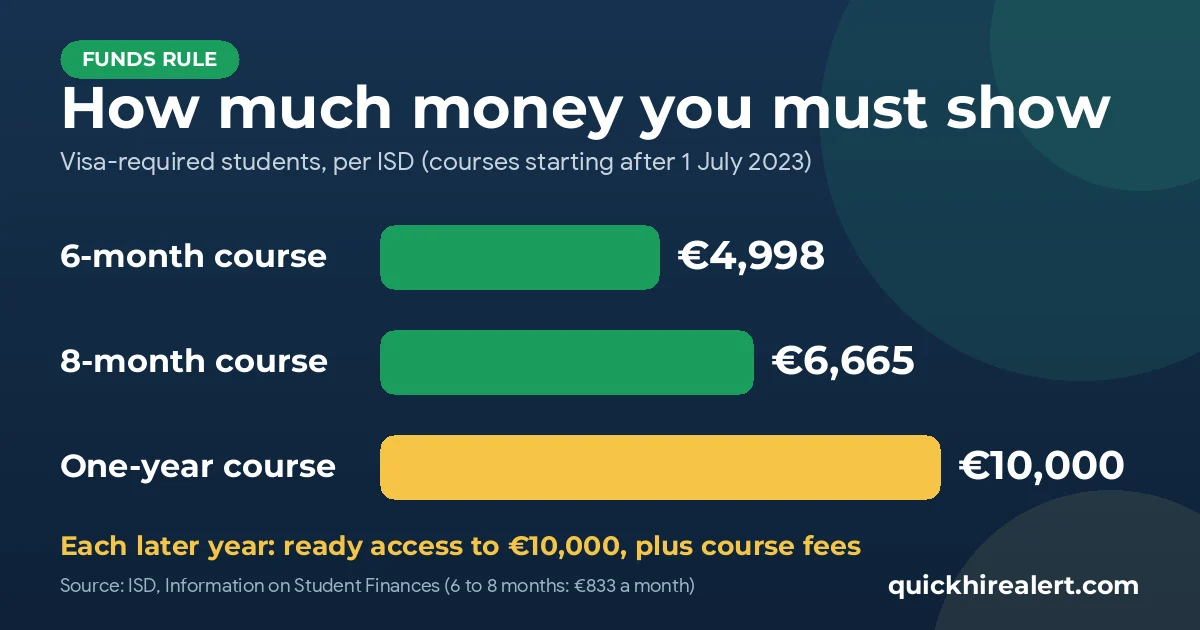
| Course length | Amount to show |
|---|---|
| 6 months | €4,998 (€833 a month) |
| 8 months | €6,665 |
| One-year course | €10,000, with immediate access |
| Each later year | €10,000 plus that year’s course fees |
Students from countries that do not need a visa must show direct access to the money when they arrive: €10,000 for courses that lead to more than 8 months in Ireland, and €833 a month up to €6,665 for 8 months or less.
What evidence ISD accepts
- Bank statements for the last six months showing money paid in and out. Visa-required applicants must provide these whether or not they are paying for themselves.
- Statements on headed paper. Internet printouts are accepted only if every page is notarised by the bank and a bank letter confirms they are genuine. Handwritten entries are not accepted.
- Your name, address, account number and account type must be visible.
- Large or irregular lodgements, such as a student loan or a property sale, must be explained.
- For a savings account, a bank letter confirming you can access the funds.
- Credit cards are not accepted.
If a sponsor pays
List each sponsor and their relationship to you, with documents such as birth or marriage certificates. Show that the money is available and that the sponsor can also support their own household. ISD gives an employer letter with three recent payslips, or a business registration certificate, as examples. Each sponsor also needs six months of bank statements.
Education bond (degree students)
ISD describes a pilot for degree students on ILEP courses at levels 7 to 10. The bond must be at least €10,000, lodged with an approved fee payment service and held from the visa application until you register in Ireland. It can be cashed on arrival, or if the visa is refused or you do not take up your place. The bond is a contract between you and the provider. ISD is not a party to it.
The €10,000 figure is the minimum ISD wants to see, not a budget. See our cost of living in Ireland and rent in Dublin guides for what daily life costs.
Documents You Need
Citizens Information lists these documents for a student visa application. Originals must be in English or come with a notarised translation.
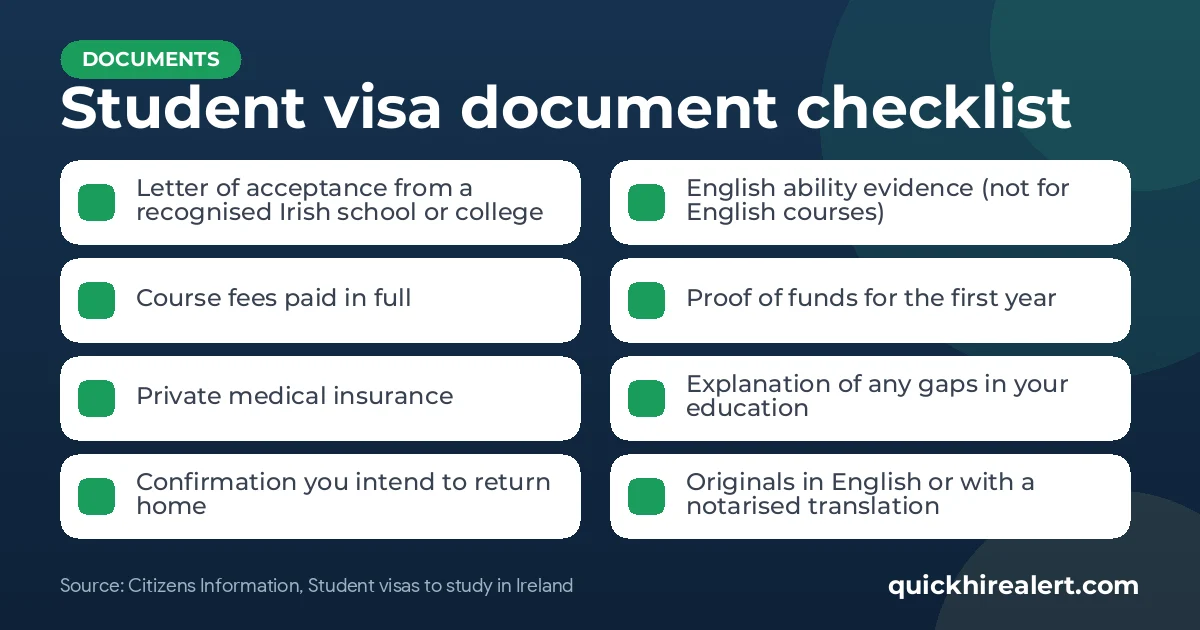
- A letter of acceptance from a recognised Irish school, college or university.
- Evidence of English-language ability for your course (not needed for English language courses).
- Proof that your course fees are paid in full.
- Proof of funds to cover the first part of your stay, and access to at least €10,000 for each later year in addition to course fees.
- Private medical insurance.
- An explanation of any gaps in your educational history.
- Confirmation that you intend to return to your country of permanent residence.
The Irish Embassy network also publishes a study visa checklist. Compare it with your own list before you submit.
How to Apply, Step by Step
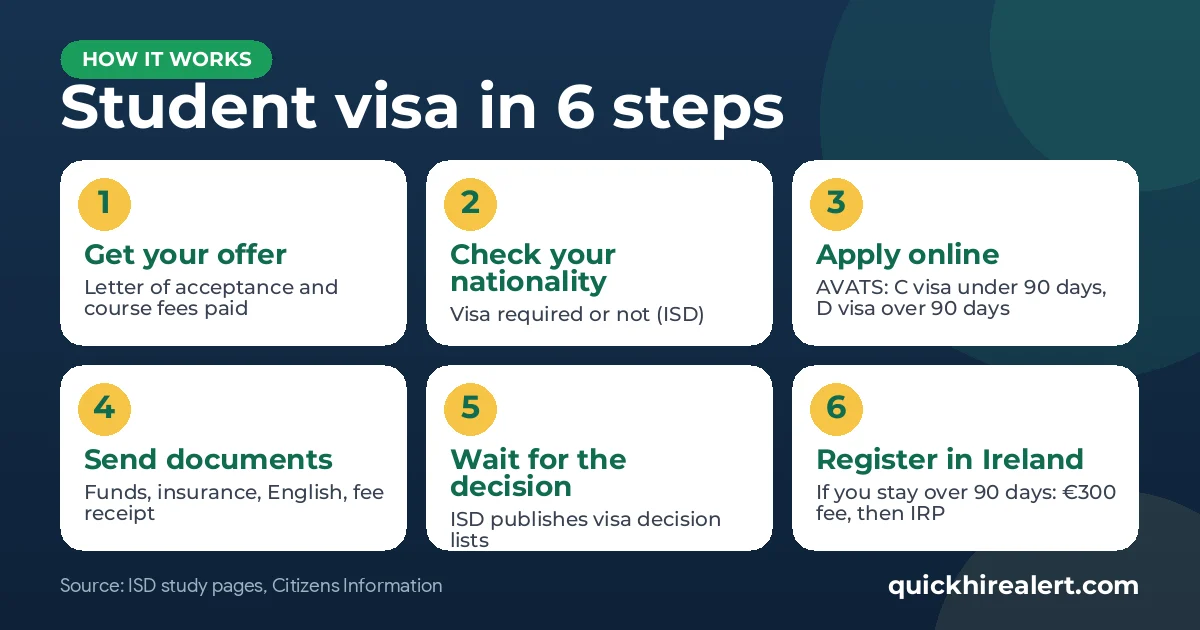
- Get your offer and pay your fees. ISD says non-EEA students need a letter of enrolment and proof that fees are paid.
- Check whether your nationality needs a visa.
- Apply online through AVATS. Choose the C visa for study under 90 days or the D visa for study over 90 days.
- Submit your documents. Use originals, in English or with a notarised translation.
- Wait for the decision. ISD publishes the latest visa decisions. Our Ireland visa tracking guide explains how to read them.
- Travel and arrive. You still need permission to enter at the port of entry.
- Register if you will stay over 90 days. See the next section.
Visa fees and processing time
The visa fee is €60 for a single journey and €100 for multiple journeys, and neither is refundable. Some applicants are exempt, including non-EU spouses of EU citizens. People from Short-stay Visa Waiver Programme countries who are long-term legal residents of the UK or the Schengen area still need a visa but do not pay the fee. Fees can change, so check with the embassy or the Visa Office.
The ISD and Citizens Information pages we checked do not give a fixed processing time for student visas. Use the decisions list above instead of relying on a number from an agent.
If You Apply From Pakistan
The ISD rules are the same for every nationality that needs a visa. For Pakistan, ISD pages we checked on 30 October 2026 show that applications are decided by the Dublin Visa Office and that Pakistan is on the AVATS online payment list. Dublin publishes decision dates and lists every Tuesday.
Prepare your documents early. Everything must be an original in English or have a notarised translation, and your bank statements need to follow the ISD format described above.
After You Arrive: Registration and Stamp 2
If you will stay longer than 90 days, book a first-time registration appointment through the ISD Customer Portal. The ISD FAQ names the Registration Office at Burgh Quay, Dublin, so check the ISD registration pages for your area. The fee is €300 and you must show proof of financial resources and private medical insurance.
Your passport is endorsed with the conditions and the length of your permission, and you then get an Irish Residence Permit (IRP). Renewal is online and you can use the system when you have less than 12 weeks left on your permission. Our IRP renewal guide covers that step.
Work Rights on a Student Permission
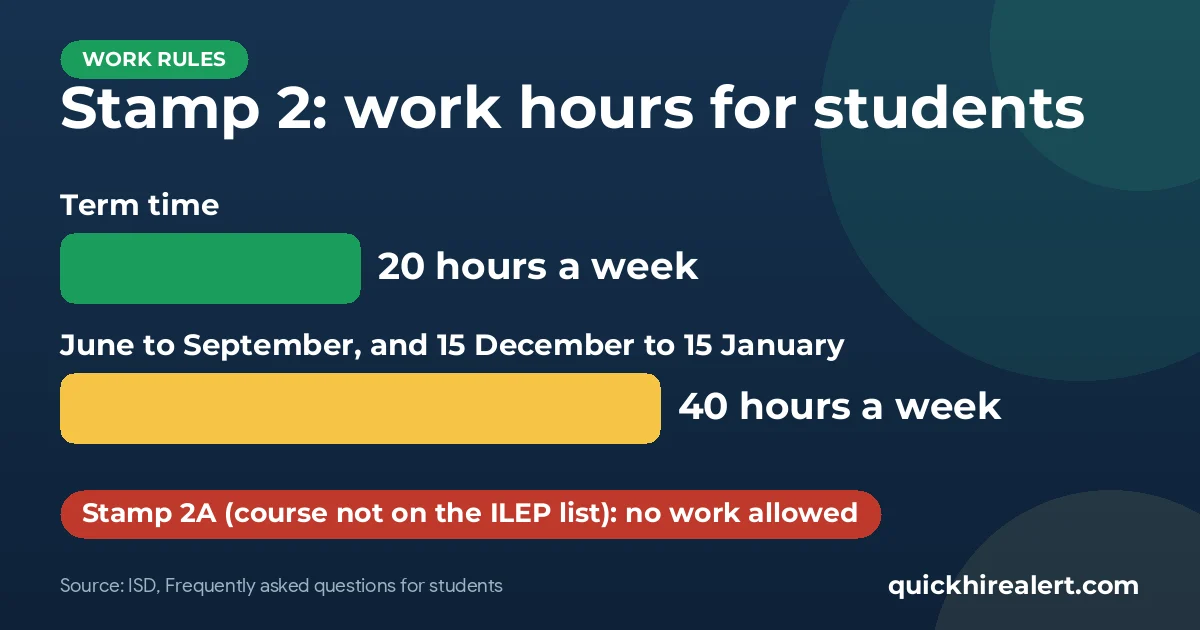
- Stamp 2 (an ILEP course): casual work of up to 20 hours a week in term time, and up to 40 hours a week in June, July, August and September and between 15 December and 15 January. Work rights end when your permission expires.
- Stamp 2A (a course not on the ILEP): no part-time work and no self-employment.
Our part-time jobs for students guide covers the rules in detail, and the minimum wage guide shows what you must be paid. You will also need a PPS number before you start work.
Family and Dependants
The ISD FAQ says students are typically not permitted to bring family members with them, apart from very exceptional circumstances. Citizens Information adds that a student visa does not automatically allow anyone to join or visit you, and that non-EEA students coming for the first time may not get permission to stay if they bring children or plan for children to join later.
How Long You Can Stay and What Comes After
ISD says you can stay up to seven years as a student, and time you have already studied in Ireland counts toward that total. New English-language students can receive up to two years.
The Third Level Graduate Programme (Stamp 1G) lets legally resident, Irish-educated non-EEA graduates with a level 8 or level 9 award from a recognised Irish awarding body stay after their studies. The ISD FAQ gives 12 months for a level 8 award and 24 months for a level 9 award or above. Stamp 1G holders must get an employment permit before their permission ends, and extensions to apply late are generally not permitted.
To plan your next step, read our guides to the Ireland work visa, the occupation shortage list, Stamp 1 and how to get a job in Ireland.
Common Mistakes to Avoid
- Choosing a course that is not on the ILEP, or a part-time or distance course.
- Sending bank statements that ISD does not accept: handwritten entries, credit cards or internet printouts without bank notarisation.
- Leaving large lodgements unexplained.
- Forgetting to explain a gap in your education.
- Not paying the full course fee before you apply.
- Sending translations that are not notarised.
- Planning to bring a spouse or children on a student permission.
- Working more than the Stamp 2 limit, or working at all on Stamp 2A.
Frequently Asked Questions
Do I need a visa to study in Ireland?
It depends on your nationality. EEA nationals do not need a visa. If your nationality needs an entry visa, you must apply for a C visa (study under 90 days) or a D visa (study over 90 days) before you travel. If you do not need a visa, you still need permission to enter at the port of entry and must register if you stay over 90 days.
How much money do I need to show for an Irish student visa?
ISD asks visa-required students for immediate access to at least 10,000 euro for the first year of a one-year course, and ready access to 10,000 euro for each later year plus course fees. For courses of 6 to 8 months the rate is 833 euro a month, which is 4,998 euro for 6 months and 6,665 euro for 8 months.
Can I work while I study in Ireland?
On Stamp 2, which applies to ILEP courses, you can work casually up to 20 hours a week in term time and up to 40 hours a week in June, July, August and September and between 15 December and 15 January. On Stamp 2A you cannot work or be self-employed.
Can my family come with me on a student visa?
ISD says students are typically not permitted to bring family members, apart from very exceptional circumstances. Citizens Information says a student visa does not automatically allow anyone to join you, and first-time students may not get permission to stay if they bring children or plan for children to join later.
How long can I study in Ireland on a student permission?
ISD says you can stay up to seven years as a student, and time you have already studied in Ireland counts toward the total. New English-language students can receive up to two years, made up of up to three English programmes of 8 months each.
What can I do after I graduate?
The Third Level Graduate Programme (Stamp 1G) lets Irish-educated non-EEA graduates with a level 8 or level 9 award stay after their studies: 12 months for level 8 and 24 months for level 9 or above, according to the ISD FAQ. You must get an employment permit before your permission ends.
Is the student visa fee refundable?
No. Citizens Information says the visa fee is 60 euro for a single journey and 100 euro for multiple journeys, and it is not refundable. Some applicants are exempt, including non-EU spouses of EU citizens.
Do I need health insurance to study in Ireland?
Yes. ISD says all non-EEA students coming to Ireland need private medical insurance, and you must show proof of it when you register your permission.
Related Guides
- Part-time jobs for students in Ireland
- Ireland visa tracking
- Ireland visa decisions
- IRP renewal in Ireland
- PPS number in Ireland
- Cost of living in Ireland
- Rent in Dublin
- Jobs in Ireland for foreigners
Official Sources
- Citizens Information: Student visas to study in Ireland
- ISD: Coming to study in Ireland
- ISD: What are my study visa options?
- ISD: Information on student finances
- ISD: Reminder on student finance requirements
- ISD: Frequently asked questions for students
- ISD: Latest visa decisions
Last verified: 15 November 2026. This guide explains the published rules and is not legal advice. Rules, fees and lists change, so confirm your own situation on irishimmigration.ie and with your college international office before you apply.
Get an email when Ireland's permit rules change
Salary thresholds, occupation lists and visa rules change every year. Subscribe and we will tell you when they do, plus new job guides. Free, no spam.
Subscribe free