
Last updated: 19 November 2026 | Checked against the CSO (Labour Force Survey Q2 2026, released 20 August 2026, and Earnings Analysis 2025, updated 11 November 2026), DETE employment permit statistics 2025 (county table), the RTB Rent Index Q1 2026 and the HSE jobs site on 19 November 2026.
Sligo is the main town in County Sligo, in the Border region of north-west Ireland. The labour market is smaller than in the east, pay is a little below the national median and rents are lower than in the Dublin commuter belt.
This guide uses official figures to show which sectors employ the most people in the region, what people earn, how many work permits are issued, what rent costs and where to find live vacancies. It also covers what international applicants need to know about jobs in Sligo.
Quick answer
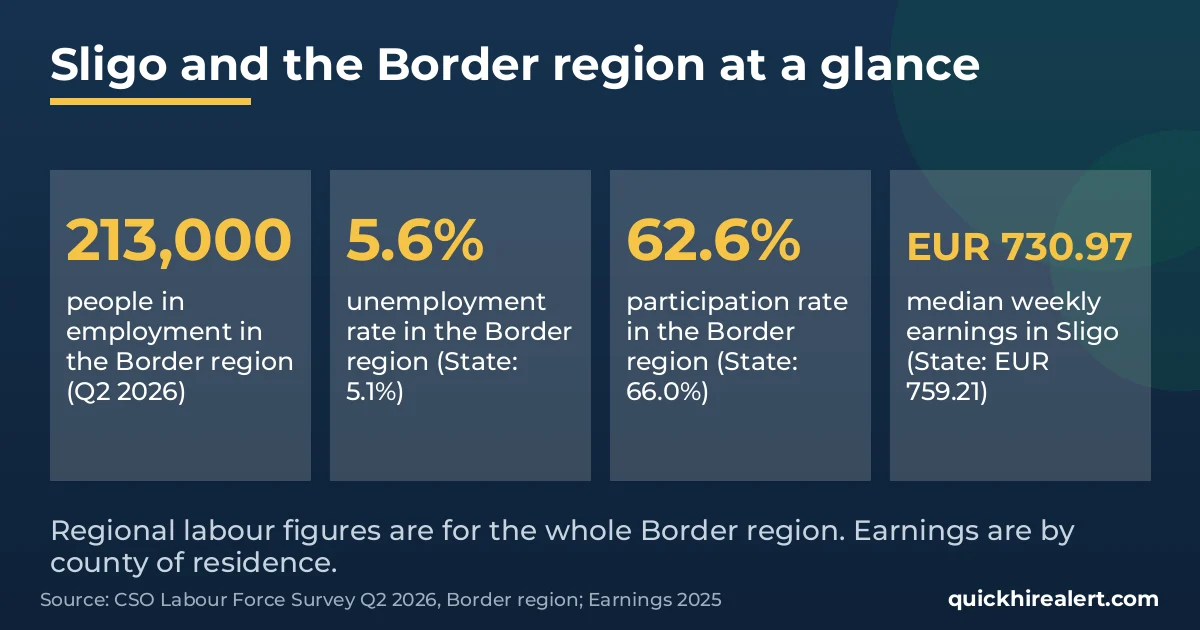
- Jobs: 213,000 people were employed in the Border region (Cavan, Donegal, Leitrim, Monaghan and Sligo) in Q2 2026, and the unemployment rate was 5.6%, against 5.1% nationally (CSO).
- Pay: median weekly earnings among Sligo residents were EUR 730.97 in 2025, against EUR 759.21 for the State (CSO).
- Work permits: DETE issued 218 employment permits for Sligo in 2025 and refused 52.
- Rent: the standardised average rent in Sligo was about EUR 1,290 a month for new tenancies and about EUR 946 for existing tenancies in Q1 2026 (RTB).
- Foreign applicants: most non-EEA nationals need an employment permit before they start work. Check the rules in our guides below.
Live Jobs in Sligo
We list a job only after reading it on the employer’s own vacancy page and confirming that it is open to all applicants. Always read the full specification for the contract, pay and requirements before you apply.
No live vacancy is listed for Sligo today. Use the HSE jobs page below and the employers’ own careers pages.
For more vacancies, search the HSE jobs page and the careers pages of the employers you want to work for. Our guide to how to apply for HSE jobs explains each step of the HSE process.
Which Sectors Employ the Most People Around Sligo?
The CSO reports employment for the Border region, which covers Cavan, Donegal, Leitrim, Monaghan and Sligo, so the figures below include all of those counties and not Sligo alone.
| Sector (CSO, Q2 2026) | People employed, Border region |
|---|---|
| Human health and social work | 36,000 |
| Industry (manufacturing, energy, water) | 34,300 |
| Wholesale and retail trade | 23,900 |
| Education | 18,900 |
| Construction | 17,300 |
| Accommodation and food service | 15,000 |
| Agriculture, forestry and fishing | 12,200 |
| Professional, scientific and technical | 8,400 |
| All sectors | 213,000 |
Health and social work is the biggest employer in the Border region, followed by industry and wholesale and retail trade.
Pay in Sligo
The CSO publishes earnings by the county where employees live, using 2025 data. These are residents of Sligo, wherever they work.
| 2025 (CSO) | Sligo | State |
|---|---|---|
| Median weekly earnings | EUR 730.97 | EUR 759.21 |
| Mean weekly earnings | EUR 884.69 | EUR 974.08 |
| Median annual earnings | EUR 44,400 | EUR 46,305 |
| Mean annual earnings | EUR 52,380 | EUR 58,127 |
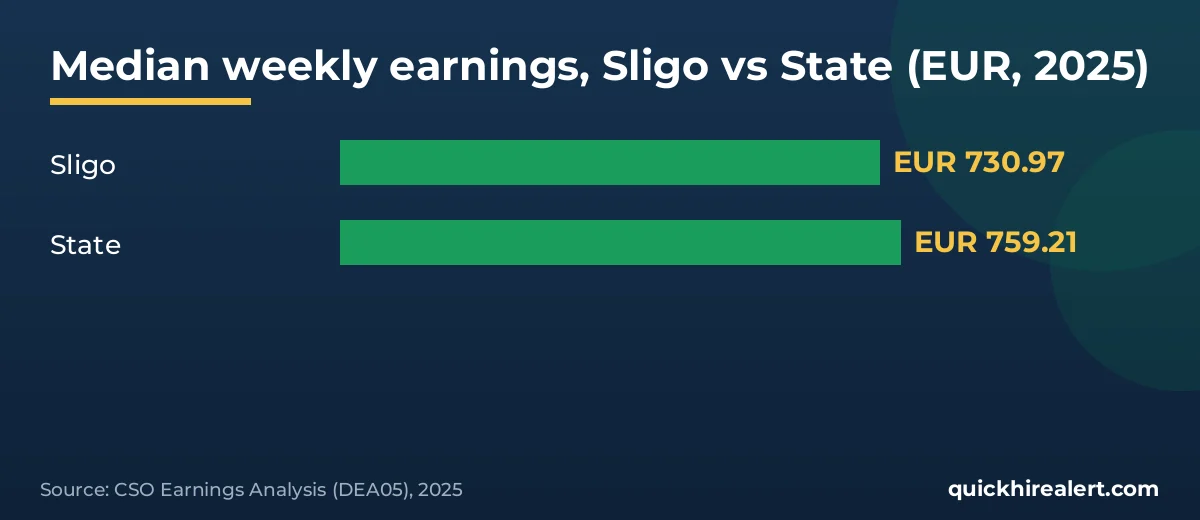
Median weekly earnings among Sligo residents were about EUR 28 below the State median in 2025 (our arithmetic: 759.21 minus 730.97).
Mean annual earnings by sector for Sligo residents in 2025 (CSO): industry EUR 61,995, human health and social work EUR 55,404, construction EUR 48,390, and wholesale and retail trade EUR 36,480.
The national minimum wage is EUR 14.15 an hour from 1 January 2026 for workers aged 20 and over (WRC). See our guides to the minimum wage and the salary calculator to work out take-home pay.
Work Permits and Employers in Sligo
| Employment permits 2025 (DETE) | Issued | Refused |
|---|---|---|
| Sligo | 218 | 52 |
| All counties (State) | 31,044 | 3,432 |
Sligo accounted for about 0.7% of the permits issued in the State in 2025 (our arithmetic: 218 divided by 31,044). The table shows the county where the employer is based, so a permit shown here may be for a job in another part of the county.
Check our guides to the Critical Skills Employment Permit and Stamp 4 to see which permit may apply to you. We do not name employers here unless the employer’s own page confirms a vacancy.
Rent in Sligo
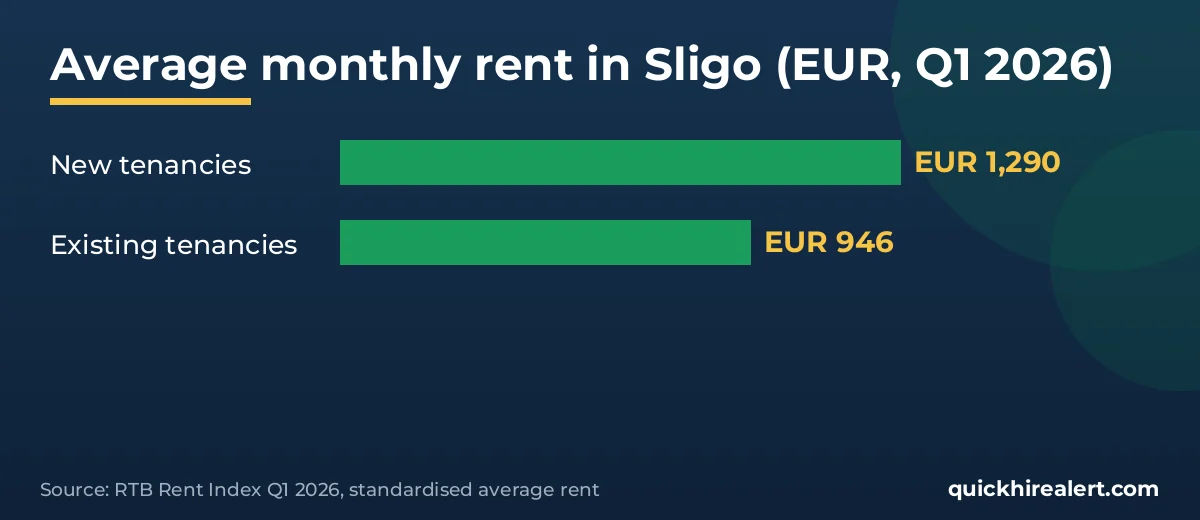
The RTB Rent Index for Q1 2026 puts the standardised average rent in Sligo at about EUR 1,290 a month for new tenancies and about EUR 946 a month for existing tenancies. New tenancies are leases that began in the quarter, so they are the better guide if you are looking for a home now.
How to Find a Job in Sligo
- Search the HSE jobs page for health service vacancies and read each specification in full.
- Check the careers pages of local employers and the sectors that employ the most people in the table above.
- Get a PPS number before you start work.
- Ask for your terms in writing. Our guide to the employment contract in Ireland explains what must be in writing within 5 days and 1 month.
- Know your working hours and breaks rights.
Part-Time and Student Work in Sligo
Many part-time and seasonal jobs are in retail, accommodation and food service. If you are a non-EEA student, the Irish Immigration Service says you can work up to 20 hours a week during term time, and up to 40 hours a week during June, July, August and September and between 15 December and 15 January. Check your own immigration permission and the current rules on the official student pages before you accept any job.
If you are under 18, special rules apply to hours and night work. Our guide to teen jobs in Ireland explains them. Whatever your age, ask for your pay and hours in writing and check that your first payslip shows the correct tax. If it does not, read our guide to emergency tax in Ireland.
Jobs in Sligo for International Applicants
Most non-EEA nationals need an employment permit before they start work in Ireland, and the employer usually applies for it. Do not pay anyone who promises you a job or permit in Sligo. A genuine employer does not ask you for money to hire you. If you are from the USA, see our guide to jobs in Ireland for Americans.
Frequently Asked Questions
Is it easy to find a job in Sligo?
The unemployment rate in the Border region was 5.6% in Q2 2026, against 5.1% for the State (CSO). Health, industry and retail are among the largest sectors by number of people employed.
What is the average pay in Sligo?
Median weekly earnings among Sligo residents were EUR 730.97 in 2025, against EUR 759.21 for the State. Mean annual earnings were EUR 52,380 (CSO).
Which industries employ the most people around Sligo?
In the Border region, human health and social work and industry are the two biggest sectors by number of people employed in Q2 2026 (CSO).
How many work permits are issued for Sligo?
DETE issued 218 employment permits for Sligo in 2025 and refused 52.
Can foreigners get jobs in Sligo?
Yes, but most non-EEA nationals need an employment permit before they start work, and the employer usually applies for it. EU and EEA citizens do not need one.
How much is rent in Sligo?
The RTB standardised average rent in Sligo in Q1 2026 was about EUR 1,290 a month for new tenancies and about EUR 946 for existing tenancies.
What is the minimum wage in Ireland?
The national minimum wage is EUR 14.15 an hour from 1 January 2026 for workers aged 20 and over (WRC).
Where can I find the latest jobs in Sligo?
Check the live jobs list on this page, the HSE jobs site and the careers pages of local employers. Read each vacancy page for the closing date and who can apply.
Related Guides
- Jobs in Waterford
- Average Salary in Ireland 2026
- Minimum Wage Ireland 2026 and 2027
- How to Get a PPS Number in Ireland
- Employment Contract in Ireland
- Stamp 4 Ireland
Sources
- CSO: Labour Force Survey Q2 2026 (regional tables QLF07 and QLF08)
- CSO: Distribution of Earnings by Gender and County 2025 (tables DEA05, DEA06, DEA08)
- DETE: Employment Permit Statistics 2025 (permits by county)
- RTB: Rent Index Q1 2026
- Irish Immigration Service: FAQ for students (work hours)
- WRC: National minimum wage
Verification note: CSO figures were read from the CSO PxStat tables on 19 November 2026. Regional labour figures cover the whole Border region. Percentages and differences marked as ours are our own arithmetic. Rent figures are rounded.