
Last updated: 20 November 2026 | Information verified: Citizens Information pages on redundancy payments (last edited 27 October 2022), the right to redundancy pay (edited 11 August 2026) and redundancy notice periods (edited 11 August 2026), read on 19 November 2026. The Workplace Relations Commission is cited for complaints.
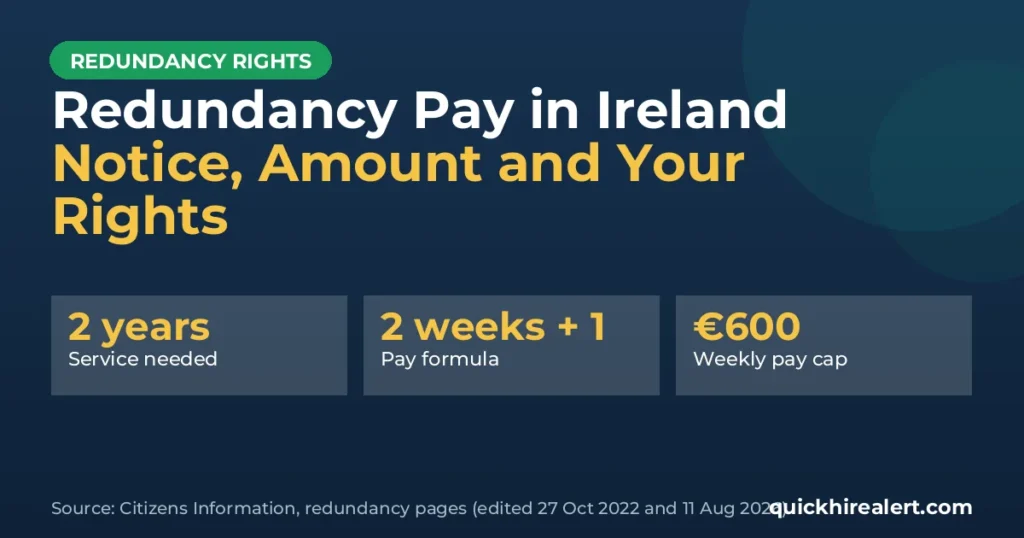
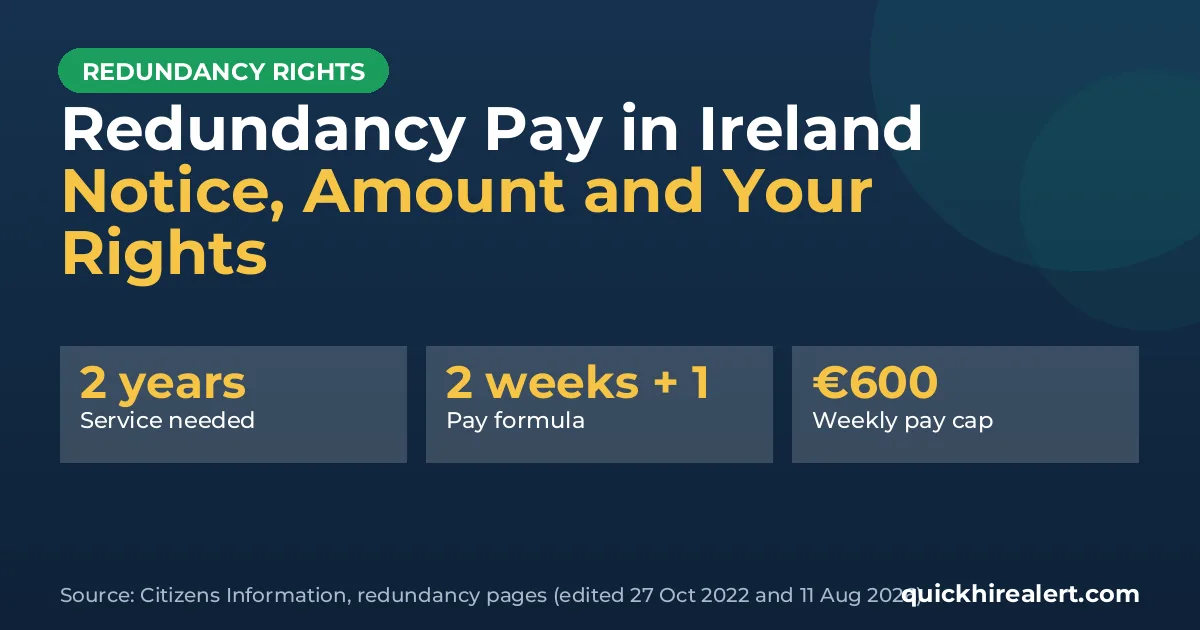
Redundancy pay in Ireland is a lump sum you can claim if you lose your job because it no longer exists and you have worked for your employer for at least 2 years. The statutory amount is two weeks pay for every year of service plus one extra week, using a weekly pay figure capped at €600.
This guide explains who qualifies, how the payment is worked out, what notice your employer must give, how part-time, fixed-term and agency workers are treated, and what to do if you are not paid. The pay page we use was last edited by Citizens Information in October 2022, so we show the edit date and tell you where to check the current position.
Quick answer
- Who qualifies: employees over 16 with at least 2 years (104 weeks) of continuous service, made redundant.
- Formula: two weeks pay for every year of service plus one extra week.
- Weekly pay cap: €600 a week, even if you earn more.
- Tax: the statutory redundancy payment is tax-free, according to Citizens Information.
- Notice: from 1 week up to 8 weeks, in writing, depending on service.
- Not paid? Write to your employer, use form RP77, then the WRC.
Starting a new job after redundancy? Read our guide to the employment contract in Ireland so you know what must be in writing, and check your leave rights in our annual leave in Ireland guide.
Redundancy Pay in Ireland: Key Facts
| Item | What the official source says |
|---|---|
| Law | Redundancy Payments Acts 1967 to 2014 |
| Minimum service | 2 years (104 weeks) with the same employer, over age 16 |
| Formula | 2 weeks pay per year of service, plus 1 week |
| Weekly pay cap | €600 a week (€31,200 a year) |
| Monthly pay to weekly | Divide by 4.33 |
| Statutory payment tax | Tax-free |
| Minimum notice | 1 to 8 weeks, depending on service |
| Time off to look for work | Paid, in the last 2 weeks of notice |
| Form if unpaid | RP77 |
| Upper age limit | None |
Who Qualifies for Redundancy Pay in Ireland
Citizens Information sets out four conditions. You must be over 16, and your employment must be fully insurable under the Social Welfare Acts. You must have at least 2 years (104 weeks) of continuous employment with the same employer after the age of 16. And you must have been made redundant, which means dismissed because the job no longer exists.
Constructive dismissal also counts when you were forced to leave because of your employer’s conduct. The law is the Redundancy Payments Acts 1967 to 2014.
Part-time, casual and agency workers
Part-time and casual workers have the same right as full-time staff if they meet the 2 years. Agency workers are protected, and if the agency pays your wages, the agency pays the redundancy.
Apprentices, fixed-term and seasonal workers
Apprentices may qualify with 2 years over the age of 16, but not if they are dismissed within one month of the end of the apprenticeship. Fixed-term workers may qualify if the contract is not renewed on the same or similar terms, and consecutive contracts can add up to 2 years. Seasonal workers with 2 years of service may qualify, and the question arises when the usual seasonal work would start.
Company directors and older workers
Directors may qualify if they have the right tax contributions. There is no upper age limit, because the former limit at age 66 was removed by the Protection of Employment Act 2007.
How Redundancy Pay Is Calculated
Statutory redundancy is a lump sum based on your pay and your length of service. The formula is two weeks pay for every year of service plus one additional week pay. The weekly amount used is capped at €600 a week (€31,200 a year), even if you earn more.
What counts as weekly pay
Weekly pay means your gross pay before tax and PRSI: your normal weekly pay, plus average regular overtime and benefits in kind. If you are paid monthly, divide the monthly pay by 4.33 to get the weekly figure. If your pay is irregular, the average of the last 52 weeks worked is used.
For overtime, Citizens Information says the 13 weeks before the redundancy date are excluded. You take the total overtime in the previous 26 weeks, extend back for any weeks not worked, and divide by 26.
Worked examples (our arithmetic)
These examples apply the formula above to whole years of service only. We have not covered part years, so use the official calculator for those.
| Example | Calculation | Lump sum (gross) |
|---|---|---|
| 4 years, €500 a week | (2 x 4) + 1 = 9 weeks x €500 | €4,500 |
| 6 years, €700 a week | (2 x 6) + 1 = 13 weeks x €600 (cap) | €7,800 |
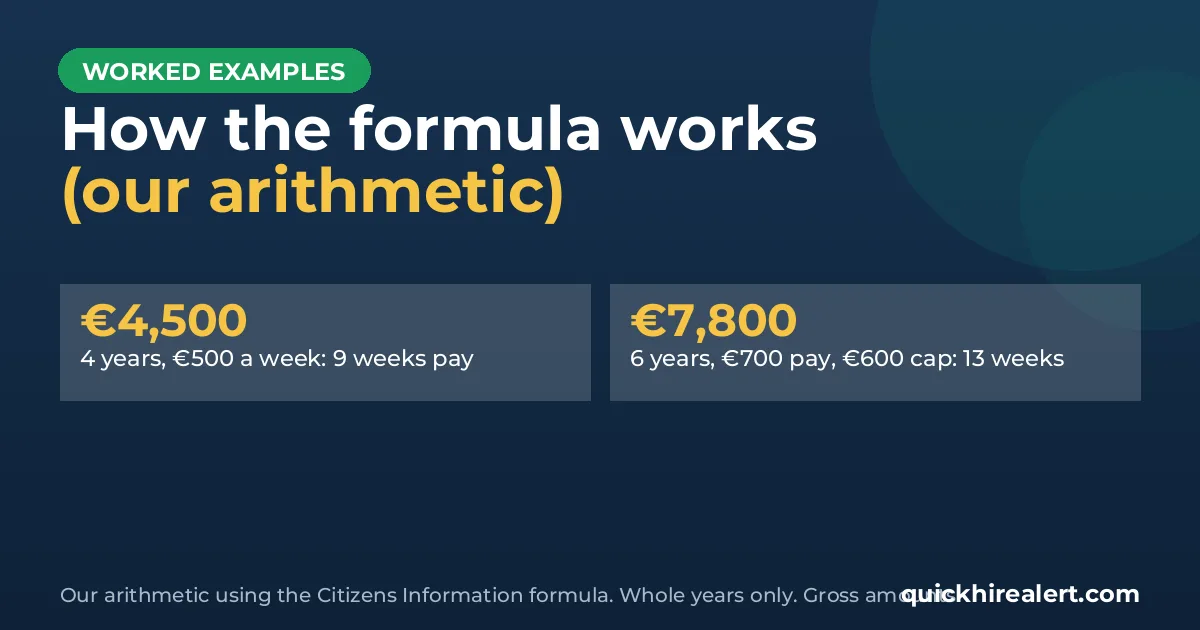
In the first example, 4 years of service gives 2 x 4 = 8 weeks, plus 1 week, which is 9 weeks. At €500 a week that is €4,500. A monthly pay of €2,165 divided by 4.33 gives about €500 a week. In the second example, 6 years gives 2 x 6 = 12 weeks plus 1, which is 13 weeks. Weekly pay of €700 is above the cap, so €600 is used and the lump sum is €7,800.
Low pay and top-up payments
If you earn below the minimum wage, you may be paid on a minimum wage basis, with exceptions for statutory apprentices and workers under 20. See our minimum wage in Ireland guide for the rates. Employer top-up payments are not legally required unless they are in your contract, a collective agreement or custom and practice.
Citizens Information says a redundancy calculator and examples are available on gov.ie. Use it to check any figure your employer gives you.
What Time Counts Towards Your Service
Time actually worked counts, as do holidays and illness absence within the limits below, agreed absences such as a career break, and maternity, adoptive, paternity, parental, parent’s and carer’s leave. Lock-outs also count, and continuity protected under the Unfair Dismissals Acts is preserved.
Over the last 3 years before your employment ends, these periods do not count: more than 52 consecutive weeks off because of an injury at work, more than 26 consecutive weeks off because of illness, a strike, and lay-off. See our guide to sick leave in Ireland and maternity leave in Ireland for those rights.
Redundancy Notice Periods in Ireland
Your employer must give you notice before your job ends. The minimum depends on your length of service.
| Length of service | Minimum notice |
|---|---|
| 13 weeks to 2 years | 1 week |
| 2 to 5 years | 2 weeks |
| 5 to 10 years | 4 weeks |
| 10 to 15 years | 6 weeks |
| Over 15 years | 8 weeks |
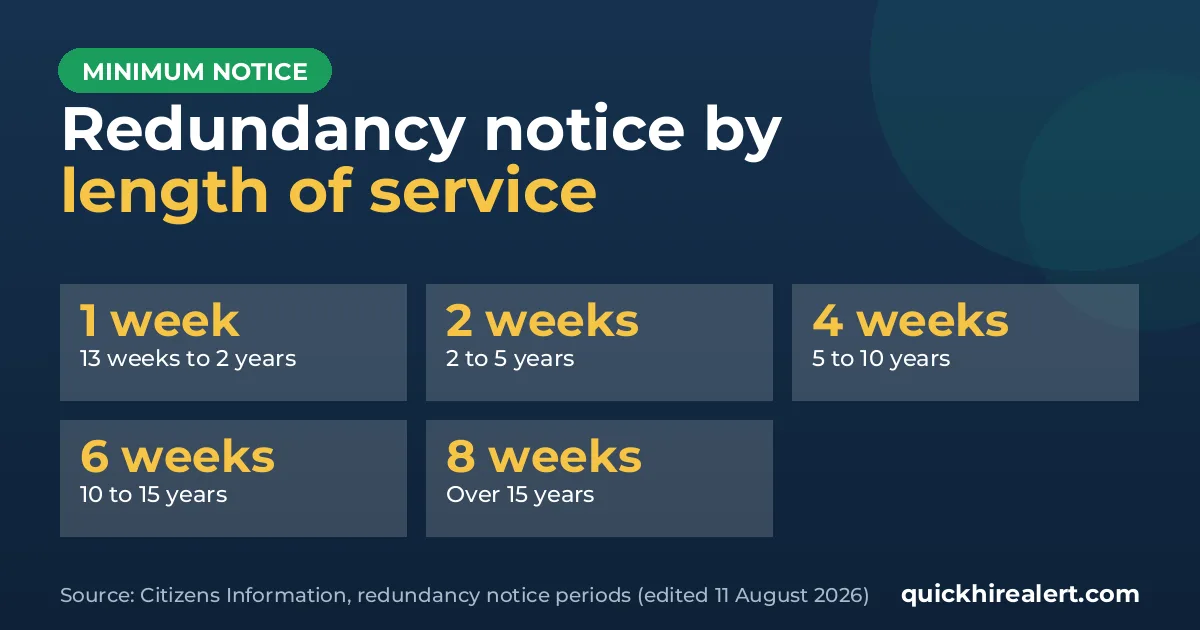
Notice must be in writing and state the end date. It starts when it is given, not when your job is first at risk. In the last 2 weeks of notice, you are entitled to paid time off to look for work, and your employer may ask for proof. Outstanding annual leave can be taken or paid in lieu.
If you leave early during the notice period, you must use form RP6 and your employer decides, which may affect your entitlement.
How and When You Are Paid
Your employer pays the lump sum when your employment ends, for example on the last day of notice or the next pay day. Your employer does not need to submit an online form to claim it. They should give you proof of payment and a written statement of how the amount was worked out.
If you are not paid
Write to your employer and apply using form RP77. If your employer is insolvent, you can apply to the Social Insurance Fund. Citizens Information gives the contact as the Redundancy Payments Section, Department of Social Protection, Gandon House, Amiens Street, Dublin 1, D01 A361, telephone (01) 673 4500 or 0818 111 112.
If you disagree with the amount
You can make a complaint to the Workplace Relations Commission using its online complaint form. The pay page says within one year of dismissal. For notice and pay complaints, the time limit is 6 months, which can be extended up to 12 months with reasonable cause. Check the live page before you rely on a deadline.
Is Redundancy Pay Taxable?
Citizens Information says the statutory redundancy payment is tax-free. Compensation lump sums for losing a job may be partly tax-free, and Revenue explains how. If you start a new job, your first payslips may show emergency tax, so read our emergency tax in Ireland guide.
Redundancy Checklist
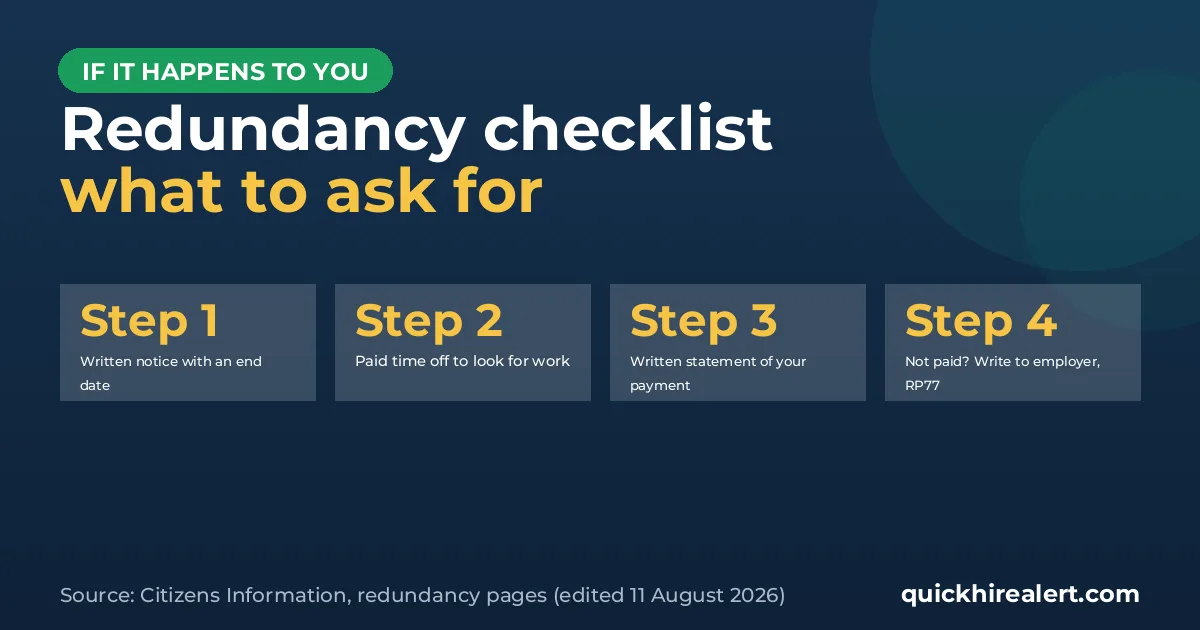
Keep your payslips, contract and all letters about the redundancy. Check the written notice, the end date and the calculation before you sign anything.
Redundancy if You Work on an Employment Permit
The redundancy pay rules above apply to employees who meet the conditions. They do not depend on your nationality. Your permission to stay and work is a separate matter. See our guide to changing employer on a work permit and check the official immigration pages before you make any decision about your status.
Scams and Bad Advice After Redundancy
After a redundancy, you may see adverts that offer to claim money for you for a fee, or job offers that ask you to pay for training or a visa. The statutory process does not require you to pay anyone to claim from your employer or the Social Insurance Fund. Never share your PPS number or bank details with someone you have not verified.
Frequently Asked Questions
How much redundancy pay do you get in Ireland?
Citizens Information says statutory redundancy is two weeks pay for every year of service plus one additional week pay. The weekly pay used is capped at €600 a week, even if you earn more. The payment is a lump sum.
How long do you have to work to get redundancy pay in Ireland?
You need at least 2 years (104 weeks) of continuous employment with the same employer after the age of 16. Your employment must also be fully insurable under the Social Welfare Acts, and you must have been made redundant.
Is redundancy pay taxable in Ireland?
Citizens Information says the statutory redundancy payment is tax-free. Other lump sums paid for losing a job may be partly tax-free, and Revenue explains how. Check with Revenue or your payroll before you assume how an extra payment is taxed.
Can part-time or casual workers get redundancy pay?
Yes. Citizens Information says part-time and casual workers have the same right if they meet the 2 years of service. Agency workers are also protected, and if the agency pays your wages, it pays the redundancy.
How much notice must your employer give for redundancy?
The minimum is 1 week for 13 weeks to 2 years of service, 2 weeks for 2 to 5 years, 4 weeks for 5 to 10 years, 6 weeks for 10 to 15 years and 8 weeks for over 15 years. Notice must be in writing with the end date.
What if your employer does not pay your redundancy?
Write to your employer first and apply using form RP77. If your employer is insolvent, you can apply to the Social Insurance Fund at the Redundancy Payments Section of the Department of Social Protection. You can also make a WRC complaint.
Is there an age limit for redundancy pay in Ireland?
No. Citizens Information says there is no upper age limit, because the former limit at age 66 was removed by the Protection of Employment Act 2007.
Related Guides
- Employment contract in Ireland
- Minimum wage in Ireland
- Annual leave in Ireland
- Sick leave in Ireland
- Maternity leave in Ireland
- Working hours and breaks in Ireland
- Emergency tax in Ireland
- Changing employer on a work permit
- Salary calculator for Ireland
Official Sources
- Citizens Information: Redundancy payments
- Citizens Information: Right to redundancy pay
- Citizens Information: Redundancy notice periods
- Workplace Relations Commission
Verification note: every rule above comes from Citizens Information’s redundancy pages. The pay page was last edited on 27 October 2022, so treat the figures, including the €600 weekly cap, as according to Citizens Information on the day we read it (19 November 2026) and check the current gov.ie calculator. The right to redundancy pay and notice period pages were last edited on 11 August 2026. Worked examples are our own arithmetic. Rules can change, so check the live pages before you rely on them.
Get an email when Ireland's permit rules change
Salary thresholds, occupation lists and visa rules change every year. Subscribe and we will tell you when they do, plus new job guides. Free, no spam.
Subscribe free