
Last updated: 1 November 2026 | Checked against the Nursing and Midwifery Board of Ireland (NMBI), the RCSI aptitude test pages, Immigration Service Delivery (Atypical Working Scheme and immigration registration), the Department of Enterprise’s employment permit rules, HSE pay scales from 1 June 2026 and the US Bureau of Labor Statistics.
Ireland is short of nurses, and US-trained nurses have one big head start over almost everyone else applying from abroad: if you trained in English in the United States, NMBI does not ask you for IELTS or OET. That removes one of the slowest steps in the whole process.
The rest still takes planning. You need NMBI registration, usually a test or supervised placement in Ireland, a two-year contract and an employment permit. Pay is also lower than in most US states, so it is worth knowing the numbers before you start. This guide covers all of it, in order.
Quick answer
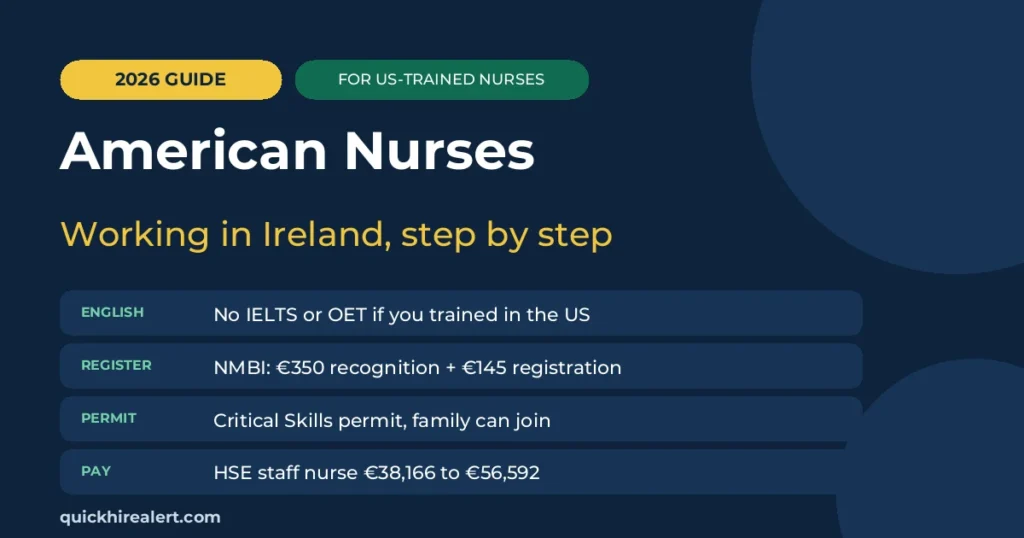
Yes, American nurses can work in Ireland. Apply to NMBI for qualification recognition (€350) with certified copies of your degree, transcript and US license; nurses who trained in English in the US are exempt from IELTS and OET. Most nurses trained outside the EU are then asked to pass the RCSI aptitude test (€2,800) or complete a supervised adaptation period in Ireland, which needs a signed two-year contract and Atypical Working Scheme permission (€250, up to 6 months). After you pass and register (€145), your employer applies for a Critical Skills Employment Permit. HSE staff nurses earn €38,166 to €56,592 a year. If you have an Irish-born grandparent, Irish citizenship can remove the permit steps entirely.
Key Facts at a Glance
| Item | What applies to US-trained nurses |
|---|---|
| Irish regulator | Nursing and Midwifery Board of Ireland (NMBI), online through MyNMBI |
| English test | Not needed if you trained in English in the US, or have 3 years’ practice there in the last 5 years |
| NMBI fees | €350 recognition, €145 registration, €100 a year after that |
| Usual NMBI outcome | Compensation measure: RCSI aptitude test or adaptation period, both in Ireland |
| RCSI aptitude test | €2,800 (€2,500 if an eligible employer pays RCSI) |
| Coming to Ireland for the test | Atypical Working Scheme: €250 fee, at least 20 working days to process, up to 6 months’ permission |
| Work permit | Critical Skills Employment Permit: €1,000 fee, two-year contract, family can join straight away |
| Immigration registration | Irish Residence Permit (IRP) within 90 days, €300 |
| Irish pay | HSE staff nurse €38,166 to €56,592 a year (1 June 2026 scales) |
| US pay for comparison | Median $97,550 a year for registered nurses (BLS, May 2025) |
🔔 Want to see who is hiring? Jump to the nursing jobs open this week, checked on the HSE jobs site.
First: Do You Have an Irish Grandparent?
Check this before anything else. If one of your grandparents was born anywhere on the island of Ireland, you can probably become an Irish citizen through the Foreign Births Register. As an Irish (and therefore EU) citizen you need no employment permit and no Atypical Working Scheme permission.
Citizenship does not change your nursing registration: you still go through NMBI recognition, and possibly a compensation measure, because your training is from the US. But it removes the immigration steps, the two-year contract requirement and the permit fee. The Foreign Births Register takes about 12 months, so start it in parallel with NMBI. Our guide to Irish citizenship by descent for Americans explains who qualifies and how to apply.
The 6 Steps for US-Trained Nurses
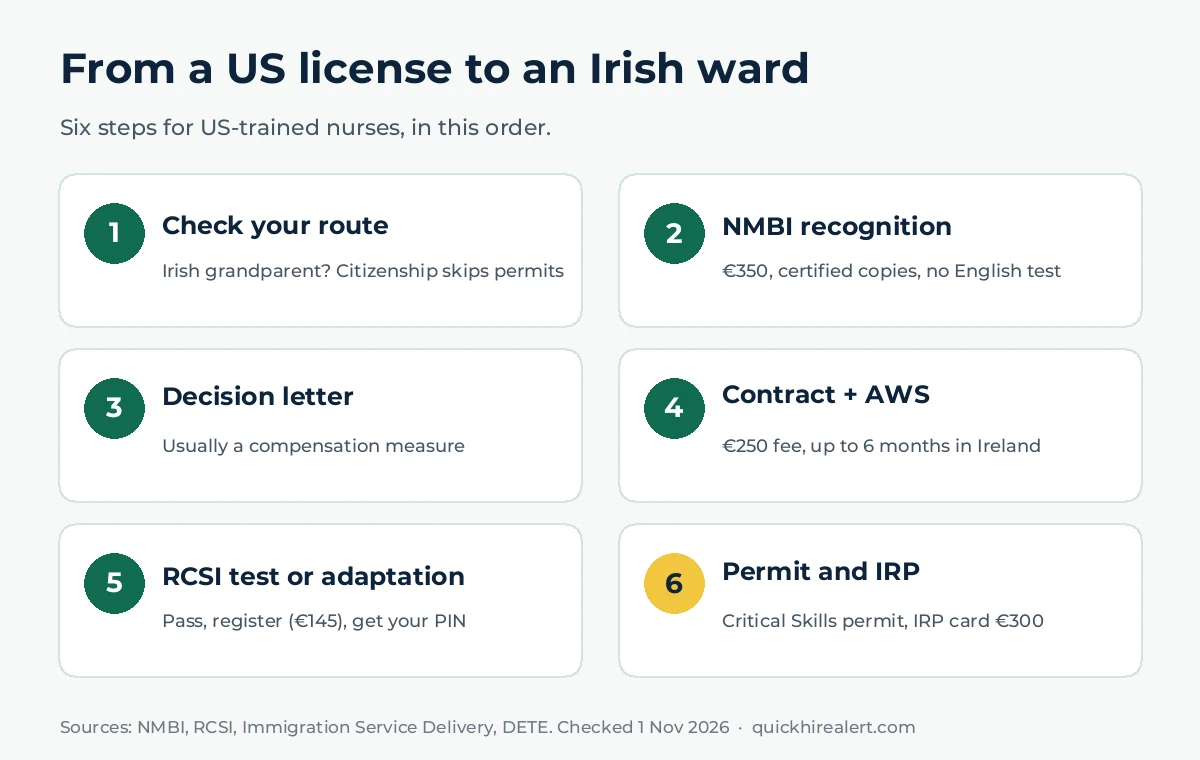
- Check your route: Irish citizenship by descent, or the standard permit route.
- Apply to NMBI for qualification recognition with certified documents.
- Receive your decision letter, which usually asks for a compensation measure.
- Sign a two-year contract and get Atypical Working Scheme permission.
- Pass the RCSI aptitude test or an adaptation period, register with NMBI and get your PIN.
- Your employer applies for your Critical Skills permit, and you register for your IRP card in Ireland.
Our NMBI registration guide covers the Irish side of every step in more detail. Below is what is different for nurses coming from the US.
Step 2: NMBI Recognition for US Nurses
No IELTS or OET
NMBI exempts nurses from the English test through two routes, and the United States is one of only five countries on both (with the UK, Canada, Australia and New Zealand):
- Pathway 1: you completed your nursing education in English in the US. Your qualification document must show where the college is.
- Pathway 2: you have at least three years of post-registration practice in the US within the last five years, shown by a letter from your employer or nursing authority.
If you trained elsewhere (for example in the Philippines or India) and now work in the US, Pathway 2 can still exempt you once you have three years of US practice.
Your documents
NMBI asks for certified copies of your passport, your nursing degree (diploma), your transcript, evidence of your current registration or license, and evidence of any change of name. A notary public can certify them: the notary must confirm they saw the original, write their full name and profession, and stamp, sign and date each first-generation copy.
NMBI’s published pages do not mention NCLEX results, Nursys or state board verification forms. Your active state license is the “evidence of current professional registration” on its list. NMBI also requires a certificate of good standing from your licensing authority to complete an overseas application. MyNMBI shows the exact documents for your application, so follow that list rather than a US agency’s checklist.
The decision letter
Your €350 application is paid on MyNMBI. Because US nursing education is not covered by the EU rules, expect a full qualification assessment. The letter will say your qualification is recognised, that more information is needed, that you must complete a compensation measure, or that recognition is provisionally refused. For nurses trained outside the EU, a compensation measure is the usual outcome. The letter is normally valid for 12 months, and NMBI does not publish a processing time.
Step 4: The Atypical Working Scheme
Both compensation measures happen in Ireland. To come for them you need permission under the Atypical Working Scheme (AWS) for nurses. Immigration Service Delivery’s rules include:
- You apply online, from outside Ireland, and pay a €250 non-refundable fee by credit card.
- Allow at least 20 working days after ISD has all your documents.
- Do not book travel until you have your AWS approval letter.
- You need a signed employment contract of at least two years (or permanent) with a licensed, registered facility. A letter of offer is not accepted.
- Permission lasts up to 6 months, for one employer and one location. Agency work is not allowed, and you cannot work in any other job, including as a healthcare assistant.
Travel nurses, note this. A short agency contract of the kind common in US travel nursing does not meet the AWS rules. Ireland’s route for overseas nurses is built around a two-year contract with one employer, such as an HSE hospital or a licensed private hospital or nursing home.
Step 5: RCSI Test or Adaptation, Then Your PIN
General and psychiatric nurses can choose either option. Nurses applying to other divisions (for example children’s or midwifery) must do an adaptation period.
- RCSI aptitude test: a multiple-choice theory test, then an OSCE practical exam, at the Smurfit Building, Beaumont Hospital, Dublin 9. The €2,800 fee covers two attempts at each part.
- Adaptation period: at least 6 weeks of supervised practice in an NMBI-approved Irish facility, extendable to 12 weeks or more. You or your employer arrange it.
When you pass, you apply for registration on MyNMBI, pay €145 and receive your NMBI PIN.
Step 6: Critical Skills Permit and Your IRP Card
With your PIN, your employer applies for your Critical Skills Employment Permit, including a copy of your AWS approval letter. The application fee is €1,000. Registered nurses are on the Critical Skills list, which means:
- No labour market test for your employer.
- Your spouse and children can join you straight away, and your spouse can work on Stamp 1G.
- You can apply for Stamp 4 after 21 months of employment, then change employers freely.
Once you are in Ireland with your permission, register it within 90 days to get your Irish Residence Permit (IRP) card. The fee is €300, paid by card. For a first registration on AWS, ISD lists your AWS approval letter among the documents to bring.
Pay: Ireland vs the US
| Measure | Amount |
|---|---|
| US registered nurses, median pay (BLS, May 2025) | $97,550 a year |
| HSE Staff Nurse, first point (1 June 2026) | €38,166 a year |
| HSE Staff Nurse, top of the scale | €56,592 a year |
| HSE Clinical Nurse Manager 1 | €57,780 to €70,087 a year |
| Minimum for a Critical Skills permit (private employers) | €40,904 a year |
See every Irish nursing grade and take-home pay after tax in our nurse salary in Ireland guide.
On base salary alone, Ireland pays less than most of the US. Overtime, night and weekend premiums are added to the HSE scales, and the cost of living, tax and healthcare work very differently, so compare your own take-home pay and expenses before you decide. Our guide to jobs in Ireland for Americans covers pay, tax and living costs in more depth.
What It Costs
| Cost | Amount |
|---|---|
| Notary certification of documents | Varies by state and notary |
| NMBI qualification recognition | €350 |
| Atypical Working Scheme | €250 |
| RCSI aptitude test (if you choose it) | €2,800, or €2,500 via an eligible employer |
| NMBI registration | €145 |
| Critical Skills Employment Permit | €1,000 (usually paid by the employer or applicant, as agreed) |
| IRP registration | €300 |
Flights and accommodation are extra. Ask which costs your employer will reimburse and get it written into your contract.
Nursing Jobs Open This Week
These are real vacancies that we checked on the HSE’s own jobs site. “Open to all” means anyone can apply, not only current HSE staff. HSE nursing posts expect NMBI registration, so use them to see what employers ask for while you work through the steps.
8 open vacancies · checked on 2 November 2026. Closed jobs are removed automatically.
Nurses (NMBI registration needed)
- Staff Nurse, Emergency Department, Connolly Hospital Blanchardstown, Dublin (HSE). Permanent, whole-time; open to all applicants; closes 13 November 2026, 12:00 Irish time. View the vacancy.
- Staff Nurse, Stroke Unit, Connolly Hospital Blanchardstown, Dublin (HSE). Permanent, whole-time; open to all applicants; closes 13 November 2026, 12:00 Irish time. View the vacancy.
- Staff Nurse, SCBU (neonatal), Regional Hospital Mullingar and Midland Regional Hospital Portlaoise (HSE). Permanent, whole-time; closes 13 November 2026, 12:00 Irish time. Needs NICU, SCBU or PICU experience. View the vacancy.
- Staff Nurse, Children's, Sligo University Hospital, Sligo (HSE). Permanent, whole-time; open to all applicants; closes 13 November 2026, 12:00 Irish time. View the vacancy.
- Staff Nurse, Theatre, Galway University Hospitals (HSE). Permanent, whole-time; open to all applicants; closes 27 November 2026, 10:00 Irish time. Apply only through the online form; CVs are not accepted. View the vacancy.
- Staff Nurse, Disability Services (rolling campaign), Disability services, Cavan & Monaghan (HSE). Permanent, whole-time; open to all applicants; closes 21 December 2026, 17:00 Irish time. Intellectual Disability nurse grade View the vacancy.
- Staff Nurse, Mental Health (rolling campaign), Mental health services, Limerick / Clare / North Tipperary (HSE). Permanent, whole-time; open to all applicants; closes 31 December 2026, 00:00 Irish time. View the vacancy.
- Staff Nurse, Theatre/Anaesthetics and Recovery, University Hospital Waterford (HSE). Permanent, whole-time (panel); closes 31 December 2026, 14:00 Irish time. View the vacancy.
Read how to apply for HSE jobs from abroad before you send an application: HSE campaigns often want their own application form rather than a US-style resume. Our Irish CV guide helps when a CV is accepted, and you can subscribe to job alerts to get new vacancies first.
Frequently Asked Questions
Can American nurses work in Ireland?
Yes. US-trained nurses can work in Ireland once they are registered with NMBI and hold an employment permit (or Irish or EU citizenship). Registered nurses are on Ireland’s Critical Skills list, so the Critical Skills Employment Permit is the usual route.
Do US nurses need IELTS or OET for Ireland?
No, if you completed your nursing education in English in the United States, or have three years of post-registration practice in the US within the last five years. NMBI lists the US among five countries that qualify for its English exemption.
Is NCLEX accepted in Ireland?
NMBI’s published registration pages do not mention NCLEX. NMBI assesses your nursing education and asks for evidence of your current registration, which for a US nurse is your state license. Passing NCLEX does not replace NMBI’s assessment or any compensation measure.
Do American nurses have to take the RCSI aptitude test?
Most nurses trained outside the EU are asked for a compensation measure. General and psychiatric nurses can choose the RCSI aptitude test or a supervised adaptation period; nurses in other divisions must do an adaptation period. Both take place in Ireland.
How much does it cost an American nurse to move to Ireland?
The main official fees are €350 for NMBI recognition, €250 for the Atypical Working Scheme, €2,800 for the RCSI test if you choose it, €145 for NMBI registration, €1,000 for the Critical Skills permit and €300 for your IRP card. Many employers reimburse some of these.
How much do nurses earn in Ireland compared with the US?
HSE staff nurses earn €38,166 to €56,592 a year on the 1 June 2026 scales, before overtime and shift premiums. The US Bureau of Labor Statistics puts the median for registered nurses at $97,550 a year (May 2025).
Can I work in Ireland as a travel nurse?
Not through the usual overseas route. The Atypical Working Scheme requires a contract of at least two years with one employer and does not allow agency work, so short travel-nurse contracts do not qualify.
Can I skip the work permit with Irish ancestry?
If a grandparent was born on the island of Ireland, you can probably become an Irish citizen through the Foreign Births Register. As an Irish citizen you need no employment permit, though you still need NMBI registration to work as a nurse.
Sources
- NMBI: English language requirements, certifying documents, compensation measures and fees
- RCSI Faculty of Nursing and Midwifery: aptitude test fees
- Immigration Service Delivery: Atypical Working Scheme, AWS for nurses and first registration documents and fee
- Department of Enterprise, Tourism and Employment: employment permits for nurses
- HSE: consolidated salary scales, 1 June 2026
- US Bureau of Labor Statistics: Occupational Outlook Handbook, Registered Nurses
This guide is general information, not legal, immigration or professional registration advice. QuickHireAlert is an independent publisher, not a recruiter or agency. NMBI decides registration, the Department of Enterprise decides employment permits and Immigration Service Delivery decides immigration permissions. Always confirm the current rules with them before you pay for tests or travel.
Get an email when Ireland's permit rules change
Salary thresholds, occupation lists and visa rules change every year. Subscribe and we will tell you when they do, plus new job guides. Free, no spam.
Subscribe free