
Last updated: 26 November 2026 | Information verified: apprenticeship.ie (FAQ, Accounting Technician and Plumbing programme pages), gov.ie Become an apprentice and the Citizens Information Apprenticeships page, read on 26 November 2026 from search extracts of the official pages.
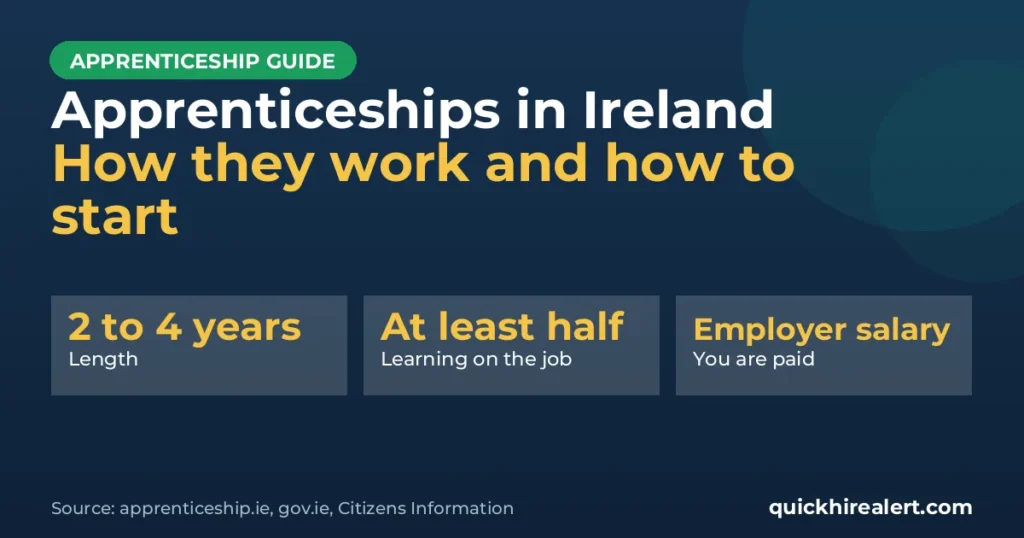
An apprenticeship in Ireland lets you earn a salary while you train for a qualification. It mixes learning in a college or training centre with learning at work, and at least half of it is done on the job.
The part that surprises most people is how you get started. You do not enrol like a student. An approved employer has to hire you. This guide shows how that works, what we can and cannot say about pay, and where to look for vacancies.
Quick answer
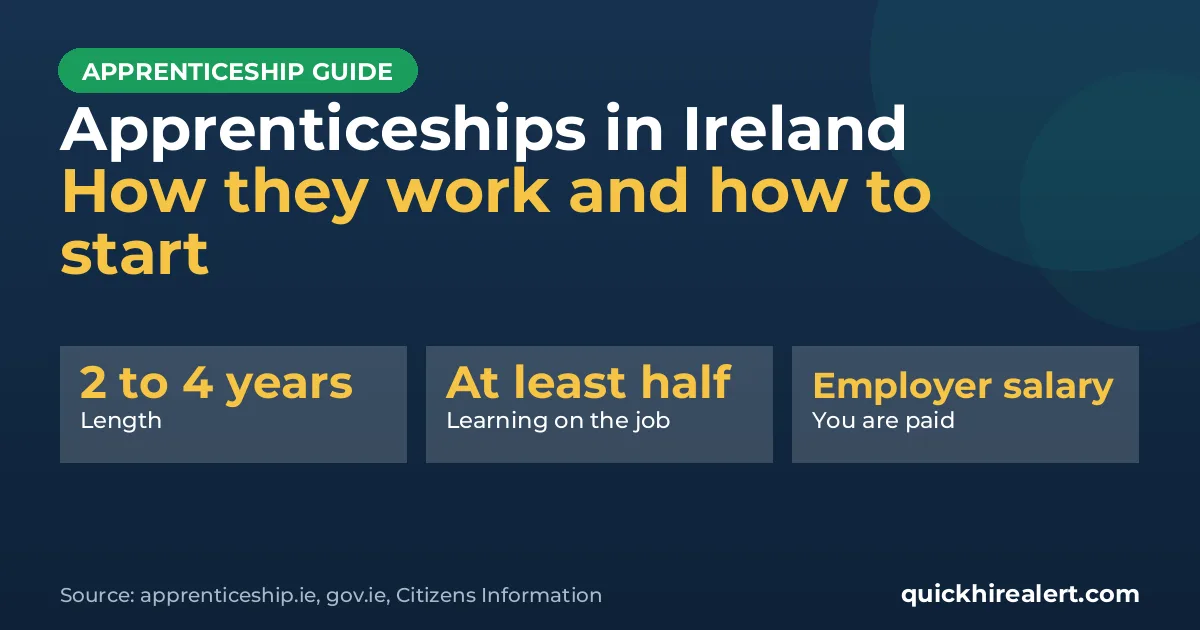
- What it is: Paid training that combines college or training-centre learning with work-based learning, at least half of it on the job (gov.ie).
- Length: Between two and four years (gov.ie).
- How to start: You must be hired by an employer that SOLAS has approved (apprenticeship.ie).
- Pay: A salary agreed between you and your employer. We found no national rate.
- Where to look: The Apprenticeship Jobs page on apprenticeship.ie, or your local Education and Training Board.
Apprenticeships Ireland: Key Facts
| Item | What the official sources say |
|---|---|
| Structure | College or training-institution learning plus work-based learning; at least half on the job |
| Contract | Formal contract of employment and a salary |
| Length | Between two and four years |
| Level | NFQ level 6 to level 10 (gov.ie, older page) |
| Who hires | Employers formally approved by SOLAS in advance |
| Pay | Agreed between apprentice and employer |
| Fees | Generally none, apart from a pro-rata registration fee if training is in a college |
| Vacancies | Apprenticeship Jobs page on apprenticeship.ie, searchable by location and apprenticeship |
| Entry requirements | Set for each apprenticeship |
How an Apprenticeship Works
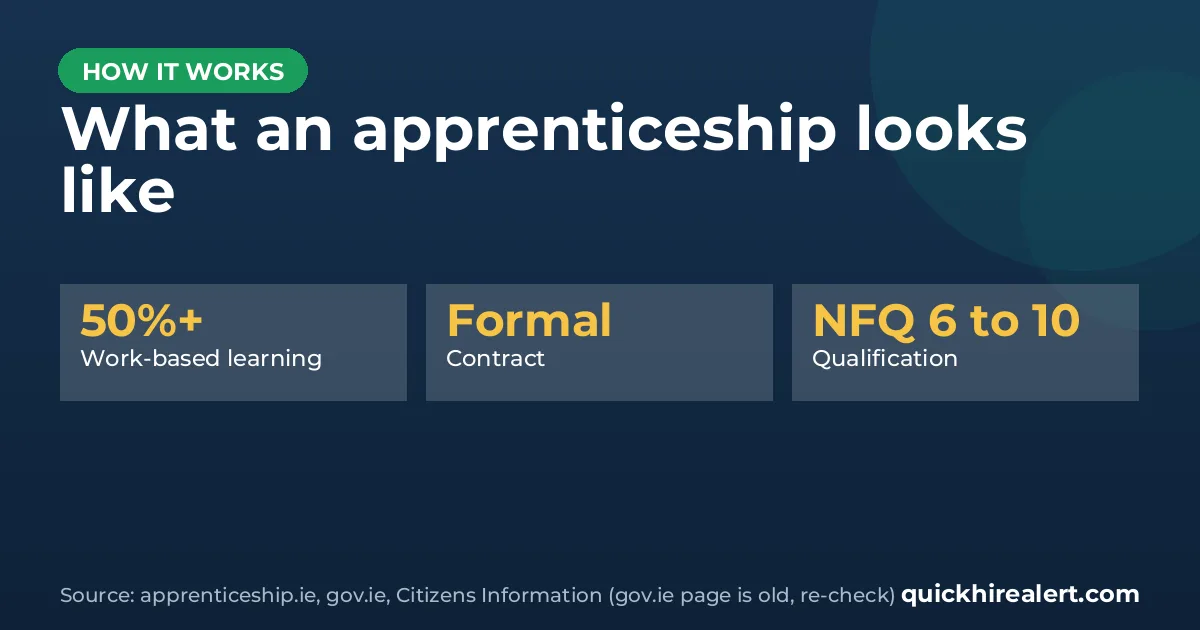
You have two places of learning. Part of your time is off-the-job training in a college or training institution. The rest is work-based learning in the company that employs you. gov.ie says at least half of the learning is done on the job.
You are an employee from the start. gov.ie says you have a formal employment contract and a salary, and that you earn while you learn. Apprenticeships last between two and four years, and the qualification sits between NFQ level 6 and level 10. gov.ie has also described more than 80 types of apprenticeship, but that page is old, so check the current number on apprenticeship.ie.
How to Get an Apprenticeship in Ireland
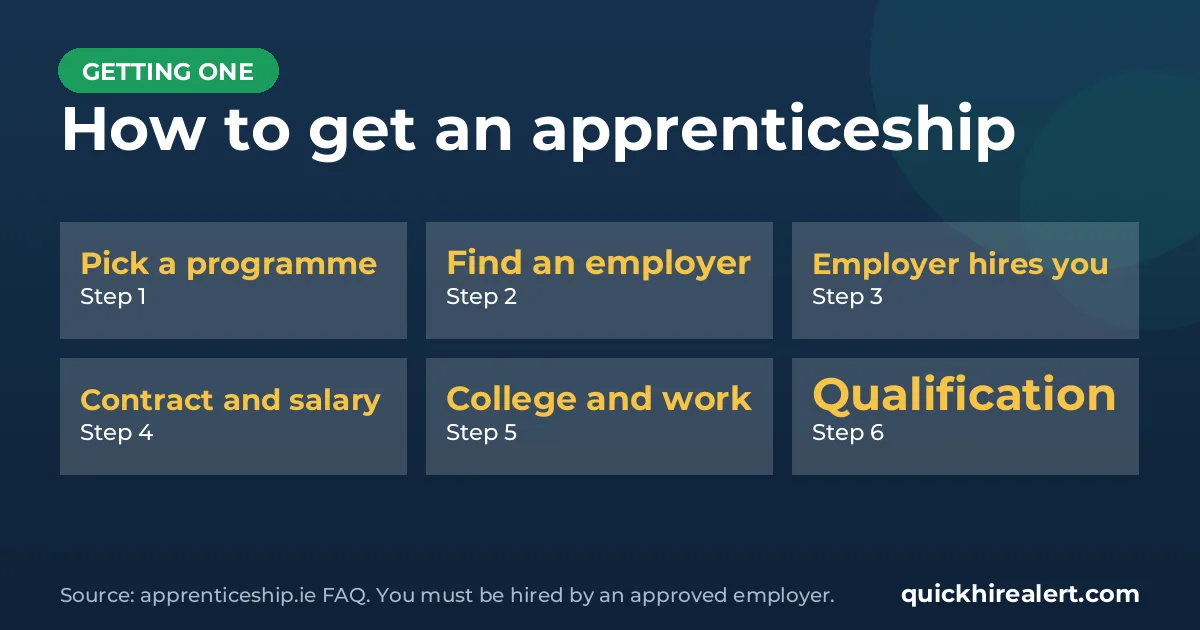
The route is employer first. apprenticeship.ie says that to become an apprentice you must be hired by an employer, and that apprenticeship employers are formally approved by SOLAS in advance. So the site lists jobs and programme details, but the hiring decision is the employer’s.
- Choose the programme you want on apprenticeship.ie and read its entry requirements.
- Search the Apprenticeship Jobs page, which you can filter by location and by apprenticeship.
- Contact your local Education and Training Board, which may hold details of employers looking for an apprentice (apprenticeship.ie FAQ and gov.ie).
- Apply to the employer. Keep your CV current: our Irish CV format guide shows the layout employers expect.
- If hired, you receive a formal contract of employment. Read it carefully, and see our guide to the employment contract in Ireland.
How Much Do Apprentices Earn?
apprenticeship.ie says the employer pays a salary during both the on-the-job and the off-the-job training, and that the rate of pay is agreed between you and your employer. We could not find a general national apprentice rate, so we do not give one.
One programme page does state a figure. apprenticeship.ie says Accounting Technician (Level 6) apprentices earn a minimum of EUR 27,593 a year during the apprenticeship. That number applies to that programme only. For other programmes, read the programme page and the job advert, and compare with the minimum wage in Ireland as a floor for any employee. Younger workers should also check the rates for under 18s.
Do You Pay Fees?
Citizens Information says that generally an apprentice does not pay fees. The exception is a pro-rata registration fee, called a student contribution, if the off-the-job training takes place in a college. Ask the employer or the programme page what applies to your course.
Which Apprenticeships Exist?
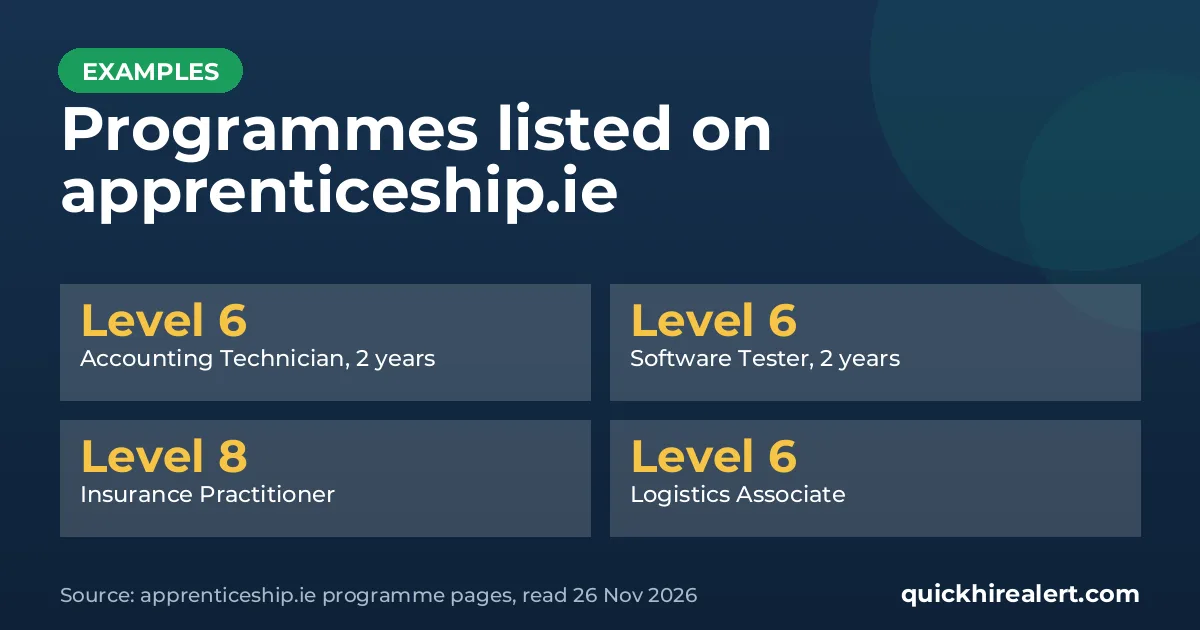
Apprenticeships are no longer only for the traditional crafts. Citizens Information says newer apprenticeships exist in ICT, finance, hospitality, farming and the public service. Examples it gives are software development, accounting technician, commis chef, farm management and digital marketing. apprenticeship.ie also lists finance, insurance and logistics programmes by NFQ level.
Entry requirements are set for each apprenticeship. For example, apprenticeship.ie says plumbing apprentices must pass the Ishihara Colour Vision Test (24 Plate Edition). Always read the programme page before you apply.
Students and Workers From Abroad
If you need immigration permission to work in Ireland, check that your permission allows the job before you accept an offer. We have not verified how apprenticeships interact with student or employment permissions, so confirm with the Irish Immigration Service. Our guides to part-time jobs for students and the Ireland student visa cover work rules for students.
Frequently Asked Questions
How long is an apprenticeship in Ireland?
gov.ie says apprenticeships last between two and four years. The length depends on the programme: apprenticeship.ie lists Accounting Technician (Level 6) and Software Tester (Level 6) as two-year programmes. We have not verified the length of craft apprenticeships such as electrician, so check the programme page.
Do you get paid as an apprentice in Ireland?
Yes. gov.ie says you earn while you learn, with a formal employment contract and a salary. apprenticeship.ie says the employer pays a salary during both the on-the-job and off-the-job training, and the rate is agreed between you and your employer.
How much does an apprentice earn in Ireland?
There is no single national figure we can verify. apprenticeship.ie gives one programme-specific number: Accounting Technician (Level 6) apprentices earn a minimum of EUR 27,593 a year during the apprenticeship. Do not read that as a rate for other programmes.
Do you apply for an apprenticeship through apprenticeship.ie?
Not directly. apprenticeship.ie says you must be hired by an employer, and apprenticeship employers are approved by SOLAS in advance. The site lists apprenticeship jobs you can search by location and by apprenticeship, and it holds the programme details.
Do apprentices pay fees?
Citizens Information says apprentices generally do not pay fees, but they pay a pro-rata registration fee, called a student contribution, if the off-the-job training takes place in a college.
What qualification do you get?
gov.ie says apprenticeship qualifications run from NFQ level 6 to level 10. That page is old, so confirm the level of your chosen programme on apprenticeship.ie.
Are apprenticeships only for trades like plumbing?
No. Citizens Information says newer apprenticeships exist in ICT, finance, hospitality, farming and the public service, for example software development, accounting technician, commis chef, farm management and digital marketing. apprenticeship.ie also lists insurance and logistics programmes.
Are there entry requirements?
Entry requirements are set for each apprenticeship, so read the programme page. As one example, apprenticeship.ie says plumbing apprentices must pass the Ishihara Colour Vision Test (24 Plate Edition).
Related Guides
- Employment contract in Ireland: what must be in writing
- Minimum wage in Ireland 2026 and 2027
- Minimum wage for under 18s in Ireland
- Irish CV format: how to write a CV for jobs in Ireland
- Part-time jobs for students in Ireland
- Public and civil service jobs in Ireland
- Tax refund in Ireland
Official Sources
- apprenticeship.ie: Discover apprenticeships
- apprenticeship.ie: Accounting Technician (Level 6)
- apprenticeship.ie: Plumbing (Level 6)
- gov.ie: Become an apprentice
- Citizens Information: Apprenticeships
Verification note: We read the official pages above on 26 November 2026 from search extracts, because apprenticeship.ie needs JavaScript and cannot be read automatically. The gov.ie page is old and the Citizens Information page is more than a year old, so details such as the number of apprenticeship types can change. We did not verify craft apprenticeship lengths or pay, entry age and education minimums, or how many apprenticeship types are listed today. Check apprenticeship.ie before you apply.
Get an email when Ireland's permit rules change
Salary thresholds, occupation lists and visa rules change every year. Subscribe and we will tell you when they do, plus new job guides. Free, no spam.
Subscribe free