

Quick Answer: Can Americans Work in Ireland?
Yes. Americans can legally work in Ireland with an employer-sponsored employment permit. Most US citizens qualify for the Critical Skills Employment Permit (roles paying €40,904+) or the General Employment Permit (roles paying €36,605+). A confirmed job offer from an Irish employer is required before applying. Check DETE’s published processing dates for current timelines.
Quick Answer: Do Americans Need a Work Visa?
Yes. As a non-EU/EEA citizen, you cannot work in Ireland without an employment permit unless you hold Irish citizenship or have another exempt immigration status. Ireland does not issue a traditional “work visa” — instead, the employment permit system authorises your right to work and is sponsored entirely by your Irish employer.
Quick Answer: What Is the Critical Skills Employment Permit?
The Critical Skills Employment Permit (CSEP) is Ireland’s primary work permit for skilled non-EEA workers. It requires a job offer with a salary of at least €40,904 for roles on the Critical Skills Occupations List (or €68,911 where the occupation is not listed), a relevant degree, and a registered Irish employer. It is valid for two years and allows immediate family reunification.
More Americans are looking at Ireland and seeing something they want — a strong job market, an English-speaking culture, and a genuine path to a different kind of life. It is not a small trend anymore. According to IDA Ireland, more than 300,000 people are employed by US multinational companies in Ireland — making it one of the world’s most concentrated hubs of American corporate activity outside the United States. Over the past few years, interest in jobs in Ireland for Americans has grown steadily, driven by a mix of economic opportunity and lifestyle appeal that few other countries offer at the same time.
Part of this comes down to the companies. Ireland is home to European headquarters for some of the biggest American employers in the world — Google, Meta, Apple, Microsoft, Pfizer, and dozens more. For many US professionals, taking a role in Ireland doesn’t mean leaving the corporate world they know. It means continuing a career with a familiar company, just in a different country.
There’s also a quality-of-life factor that keeps coming up in conversations about moving to Ireland from the US. Universal healthcare access, generous paid leave, walkable cities, and a slower pace of life all appeal to Americans who feel stretched thin by the demands of the US system. Add in the fact that Ireland speaks English, and the usual barriers to international relocation — language, cultural shock, professional isolation — become much smaller.
This guide is built for Americans who are seriously considering working in Ireland as an American — whether that means applying for jobs from the US, exploring Ireland work visa for US citizens options, or simply trying to understand what salaries, costs, and daily life actually look like. We’ll cover the visa system, the best industries and cities, realistic salary expectations, and a full relocation checklist — everything you need to move from “thinking about it” to “actually doing it”.
Can Americans Work in Ireland?
Yes — Americans can absolutely work in Ireland, but it does require some preparation. Unlike EU citizens, US citizens don’t have automatic rights to live and work in Ireland. You’ll generally need a job offer and a work permit before you can start.
That said, thousands of Americans work in Ireland right now, and the systems for getting there are well established and reasonably efficient. The key is understanding the process early, rather than discovering the requirements after you’ve already started job hunting.
Do Americans Need a Visa to Work in Ireland?
In most cases, yes. As a non-EU/EEA citizen, you’ll need an employment permit to work legally in Ireland. This is different from a general entry visa — it’s specifically tied to your right to be employed.
The two main employment permits relevant to most Americans are the Critical Skills Employment Permit and the General Employment Permit, both of which we’ll explain in detail later in this guide. Both require a confirmed job offer from an Irish employer before you can apply.
There is one notable exception: if you have an Irish or EU grandparent, you may be eligible for Irish citizenship by descent, which would give you full EU work rights with no permit required at all. It’s worth checking this option before assuming you’ll need to go through the permit process.
Can a US Citizen Move to Ireland?
Yes, a US citizen can absolutely move to Ireland — but “moving” and “working legally” are two separate things. You can travel to Ireland visa-free for up to 90 days as a tourist, but that status doesn’t allow you to work.
To move to Ireland long-term and work, you’ll typically need to secure a job offer first, then apply for the relevant employment permit, and finally register your immigration status once you arrive (more on this in the relocation checklist section below).
Some Americans also explore alternative routes, such as enrolling in an Irish university (which comes with limited work rights) or pursuing self-employment through Ireland’s Start-up Entrepreneur Programme — though these paths are less common than standard employment-based relocation.
Working in Ireland as an American
Once you have a valid employment permit, working in Ireland as an American feels remarkably similar to working in the US — with a few key differences. You’ll be entitled to the same employment protections as any Irish worker, including minimum wage, paid annual leave (a minimum of four weeks, far more generous than typical US standards), and protection from unfair dismissal.
You’ll also pay into the Irish tax and social insurance system (PRSI), which funds public healthcare, pensions, and other benefits. We’ll cover taxes in more detail later, but it’s worth knowing upfront that the Irish system is genuinely different from what you’re used to in the US – and generally considered more generous to employees.
Why Ireland Is a Popular Destination for Americans

Strong Economy
Ireland’s economy has been one of the most resilient in Europe for over a decade. Low corporate tax rates have attracted enormous foreign investment, particularly from American companies, and that investment has translated directly into a deep, diverse job market. GDP per capita in Ireland regularly ranks among the highest in the world — though it’s worth noting this figure is skewed upward by multinational corporate activity, so it doesn’t fully reflect average household wealth.
Still, the practical reality is clear: Ireland has more job openings in tech, finance, healthcare, and engineering than it has qualified local workers to fill them. That gap is exactly where opportunity exists for skilled Americans.
English-Speaking Workplace
This might be the single biggest practical advantage Ireland offers compared to other European relocation destinations. You won’t need to learn a new language to function professionally — or socially. Meetings, contracts, healthcare visits, and everyday interactions all happen in English.
For Americans who’ve considered (and maybe abandoned) the idea of relocating to Germany, France, or Spain because of the language barrier, Ireland removes that obstacle entirely.
High Quality of Life
Ireland regularly ranks highly on global quality of life indexes, and for good reason. Universal access to healthcare (through the public HSE system, often supplemented by private insurance), strong worker protections, beautiful natural scenery, and a famously warm, sociable culture all contribute to why so many Americans who move to Ireland end up staying far longer than they originally planned.
Crime rates are low, public spaces are walkable, and the work culture — while still demanding in many sectors — tends to respect personal time in a way that can feel refreshing for Americans used to a more “always-on” professional culture.
Growing Opportunities for Skilled Workers
Ireland’s government actively wants skilled foreign workers. The entire employment permit system is built around filling genuine skills gaps, not restricting access. Sectors like technology, healthcare, engineering, and pharmaceuticals are experiencing sustained growth, and Irish employers — many of them American companies themselves — are accustomed to hiring and relocating international talent.
This isn’t a market where foreign workers are tolerated. It’s a market that actively needs them.
How to Get a Job in Ireland as an American
Getting hired in Ireland from the US is absolutely achievable, but it works best as a structured process rather than a scattershot approach. Here’s a step-by-step breakdown.
Research the Irish job market.
Before applying anywhere, take time to understand which sectors are hiring and which of your skills are most transferable. Check Ireland’s Critical Skills Occupations List (covered in detail later) to see if your profession qualifies for the faster, more favourable permit pathway. This single step can save you months of wasted effort applying for roles that won’t realistically lead to a visa.
Create an Irish-Style CV
American resumes and Irish CVs are not the same document. Irish employers expect a CV that’s typically one to two pages maximum — significantly shorter than many American resumes. Drop anything related to age, marital status, or a headshot (none of these are standard or expected in Ireland, and including them can actually look unusual).
Focus on quantified achievements rather than just listing responsibilities. Use a clean, professional format, and make sure your contact details, LinkedIn profile, and current location are clearly listed at the top.
Apply Before Moving
This is one of the most important pieces of practical advice in this entire guide: secure a job offer before you relocate. Because most employment permits are employer-sponsored, you generally need a confirmed offer in hand before you can even begin the visa process. Moving to Ireland first and job hunting in person is far riskier and not recommended for most Americans.
Prepare for Video Interviews
Given the distance and time zone difference, most of your interview process will likely happen remotely — often over Zoom or Microsoft Teams. Treat these interviews with the same seriousness as an in-person meeting: test your tech beforehand, dress professionally, and be ready to discuss your availability and relocation timeline clearly and confidently.
Network with Recruiters and Employers
Irish recruitment agencies like Cpl, Morgan McKinley, Hays Ireland, and Sigmar specialise in placing candidates across major industries, and many have direct experience working with international applicants. Getting registered with two or three relevant agencies — even before you’ve finalised your decision to move — can dramatically accelerate your search and give you market insight you won’t find on job boards alone.
LinkedIn is equally important. Many Irish hiring managers search LinkedIn before they even post a role publicly, so a complete, well-optimised profile can put you in front of recruiters who are specifically looking for candidates with your background.
Step-by-step summary:
- Research target industries and check the Critical Skills Occupations List
- Build an Irish-style CV and tailored cover letter
- Apply directly through job boards, recruiters, and company career pages
- Complete remote interviews professionally
- Receive and review your job offer carefully
- Work with your employer to submit your employment permit application
- Plan your relocation timeline around permit processing
- Arrive in Ireland and register your immigration status
Best Job Boards and Recruitment Agencies in Ireland for Americans
Knowing where to search is as important as knowing what to apply for. The Irish job market has its own platforms, agencies, and hiring culture — and understanding which channels deliver results for international applicants will significantly improve your search efficiency. Most successful American job seekers in Ireland use a combination of specialist job boards and direct recruitment agency relationships.
Top Irish Job Boards
IrishJobs.ie is Ireland’s longest-running and most widely used job board, with the broadest coverage of roles across all sectors and experience levels. It is the first place most Irish employers post vacancies and the first place recruiters search for candidates. Create a full profile, upload your CV, and set up keyword-based job alerts for your target roles.
Jobs.ie is another high-traffic Irish job board with strong coverage of entry-to-mid-level positions, SME employers, and roles outside Dublin. It is particularly useful for exploring the regional job market in Cork, Galway, Limerick, and Waterford.
LinkedIn Ireland is essential. The majority of senior, tech, and finance roles in Ireland are filled through LinkedIn — either through direct applications or through recruiter outreach. Ensure your LinkedIn profile clearly states that you are open to roles in Ireland, specify your work authorisation status (or that you are applying for a Critical Skills permit), and connect proactively with Irish-based recruiters in your sector.
Indeed.ie aggregates roles from both IrishJobs.ie and direct employer postings, making it a useful supplementary search tool. However, the dedicated Irish boards above typically have fresher postings and more direct employer access.
Rezoomo is increasingly used by Irish public sector bodies, healthcare employers, and multinational companies for direct applications. If you are pursuing roles in the HSE, Irish universities, or large multinational companies, check Rezoomo alongside the boards above.
Leading Recruitment Agencies for International Candidates
CPL is one of Ireland’s largest and most established recruitment agencies, with specialist divisions across technology, finance, healthcare, engineering, and professional services. CPL works extensively with multinational employers — including many of the US tech and pharma companies headquartered in Ireland — and has strong experience placing international candidates with work permit needs.
Morgan McKinley specialises in financial services, technology, and professional roles, with a strong presence in Dublin’s IFSC and tech sector. They are a go-to agency for senior finance, accounting, and compliance roles at multinational firms and have a dedicated international talent practice.
Hays Ireland is a global recruiter with a strong Irish operation across construction, engineering, IT, and accountancy. Hays is particularly useful for Americans in the engineering and project management space and has experience navigating the employment permit application process alongside clients.
Sigmar Recruitment is a well-regarded Irish agency covering technology, finance, supply chain, and multilingual roles. They are known for working closely with candidates through the entire application and permit process, making them a practical choice for Americans managing the logistics of an international job search.
Brightwater and Eolas Recruitment are strong choices for finance, legal, and compliance roles in Dublin’s financial district.
Tips for Working With Irish Recruiters
- Be upfront about your immigration status from the very first conversation — Irish recruiters need to know whether an employer will need to sponsor a work permit, as this affects which roles they can put you forward for
- Register with multiple agencies simultaneously — exclusivity is not standard practice in Irish recruitment
- Ask each recruiter directly which of their clients have experience sponsoring non-EEA applicants — this will narrow your list to realistic opportunities immediately
- Keep your Irish-style CV ready before making first contact — many agencies will submit your profile to roles within days of registration
Best Jobs in Ireland for Americans
IT and Technology Jobs

Demand: Extremely high. Ireland’s tech sector is the backbone of its modern economy, with over a thousand multinational tech companies operating in the country.
Requirements: A relevant degree or equivalent experience, strong technical skills (particularly in cloud platforms, full-stack development, or cybersecurity), and ideally some experience working in international or remote teams.
Average salary: €65,000 to €95,000 for mid-level developers, rising well above €120,000 for senior engineers and architects.
Career prospects: Excellent. Ireland’s tech sector continues to grow, and experience gained here – particularly at recognisable companies like Google or Meta – carries significant weight on a global résumé.
Healthcare and Nursing Jobs

Demand: Very high, particularly for registered nurses, healthcare assistants, and specialist clinicians.
Requirements: Foreign-trained nurses and doctors must register with the relevant Irish professional body (the NMBI for nurses, the Medical Council for doctors) before they can practise. This process can take several months, so it’s worth starting early.
Average salary: €38,000 to €55,000 for registered nurses, with senior clinical roles and consultants earning considerably more.
Career prospects: Strong and stable. Ireland’s ageing population means healthcare demand is unlikely to slow down anytime soon.
Engineering Jobs

Demand: High across civil, structural, mechanical, and electrical disciplines, driven by Ireland’s ongoing construction and infrastructure boom.
Requirements: A relevant engineering degree, and ideally chartered status or progress toward it through Engineers Ireland.
Average salary: €45,000 to €75,000 for mid-level engineers, with senior professionals earning €80,000 or more.
Career prospects: Strong, particularly given Ireland’s national housing targets and ongoing infrastructure investment.
Finance and Accounting Jobs
Demand: Consistent and strong, given Dublin’s status as a major European financial hub.
Requirements: A relevant degree, plus professional qualifications like ACA, ACCA, CPA, or CFA, which carry significant weight with Irish employers.
Average salary: €50,000 to €75,000 for qualified accountants and analysts, with senior finance leaders earning well over €100,000.
Career prospects: Excellent, particularly for those with experience in multinational or Big Four environments, which translates directly to the Irish market.
Education and Teaching Jobs
Demand: Moderate to high, particularly for STEM subjects, special education, and international school positions.
Requirements: A recognised teaching qualification and, in many cases, registration with the Teaching Council of Ireland. American teaching credentials are not always automatically recognised, so this is worth researching carefully before applying.
Average salary: €40,000 to €65,000 for secondary school teachers, with international schools sometimes offering different compensation structures.
Career prospects: Solid, particularly in growing commuter towns where school capacity is struggling to keep pace with population growth.
Hospitality and Tourism Jobs
Demand: High, particularly for experienced chefs and hotel management professionals.
Requirements: Formal qualifications are less critical here than demonstrated experience, especially for senior kitchen and hospitality management roles.
Average salary: €35,000 to €55,000 for experienced chefs and hospitality managers, with entry-level roles starting closer to the national minimum wage.
Career prospects: Decent, with genuine opportunities for advancement, though this sector tends to offer less structured visa sponsorship support than tech, healthcare, or engineering.
High-Demand Jobs in Ireland in 2026

Looking specifically at where Ireland’s job market is heading in 2026, certain roles stand out as offering the strongest combination of demand, salary, and visa sponsorship likelihood for American applicants.
Software engineers remain the single most in-demand professional group in the country, with full-stack, backend, and cloud-native development skills particularly valuable.
Cybersecurity specialists are in critically short supply as Irish financial institutions and tech firms work to protect against increasingly sophisticated threats.
Data scientists are needed across nearly every industry as businesses shift toward data-driven decision-making, with strong demand for skills in Python, SQL, and machine learning frameworks.
AI specialists represent one of the fastest-growing categories of all, as Irish tech companies race to integrate artificial intelligence into their products — creating genuinely new roles in prompt engineering, ML operations, and AI safety.
Registered nurses continue to face chronic shortages across nearly every hospital department, particularly in ICU, theatre, and psychiatric nursing.
Pharmacists are needed across both retail and hospital settings, with shortages particularly pronounced outside Dublin.
Civil engineers remain essential to Ireland’s housing and infrastructure programmes, with demand showing no signs of slowing.
Quantity surveyors are among the hardest roles for Irish construction firms to fill domestically, making this a strong opportunity for qualified Americans.
Construction managers are needed to oversee increasingly large and complex development projects across the country.
Renewable energy professionals — including grid engineers, solar specialists, and offshore wind technicians — are seeing rapidly growing demand as Ireland accelerates its transition to green energy.
Ireland Work Visa for US Citizens
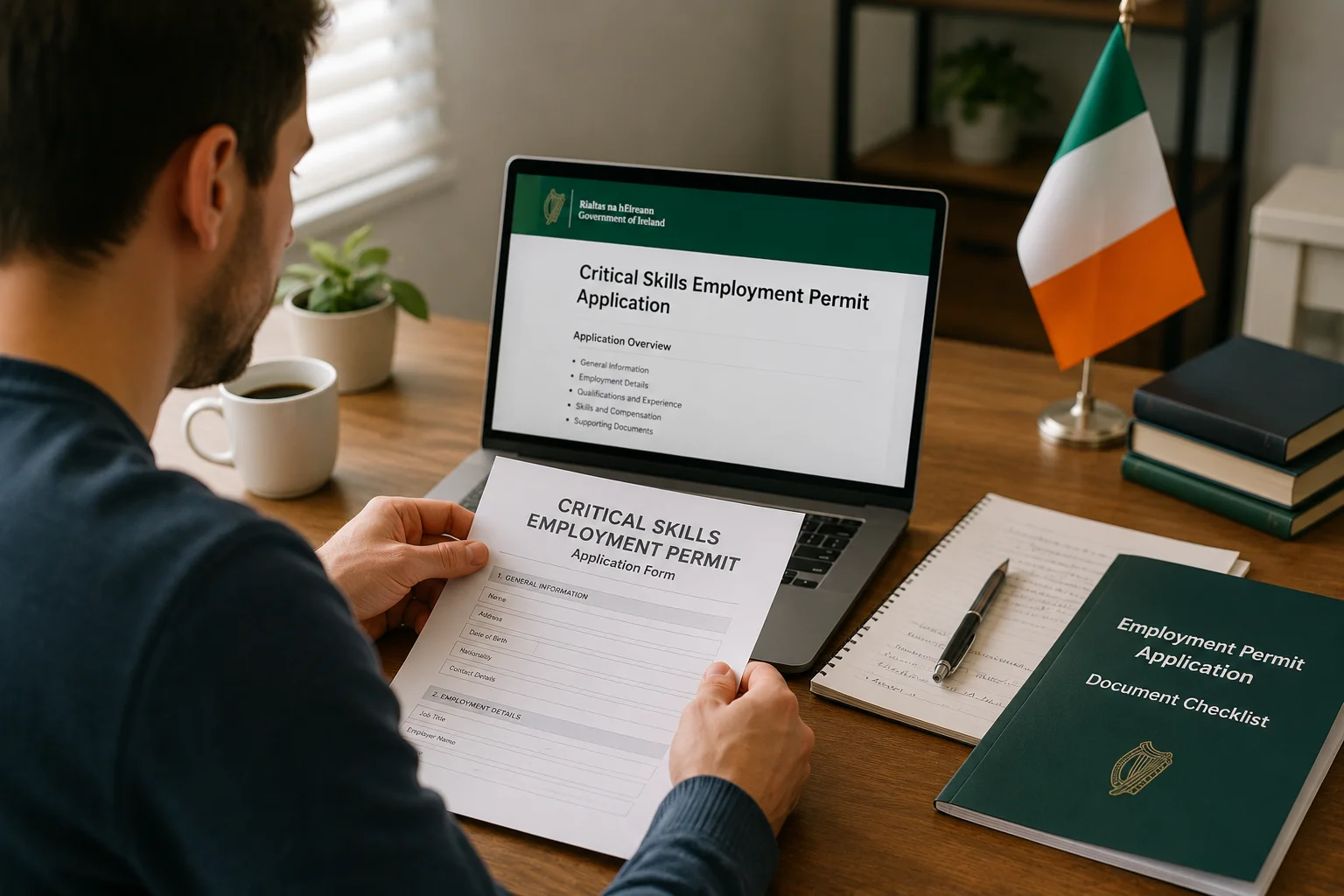
Understanding the Ireland work visa for US citizens system is essential before you start applying for jobs. Ireland’s employment permit system is managed by the Department of Enterprise, Trade and Employment, and it’s built specifically to bring skilled international workers into roles that Irish employers can’t fill locally.
Critical Skills Employment Permit
The Critical Skills Employment Permit is the most desirable option for skilled American professionals. It’s reserved for roles on the official Critical Skills Occupations List and offers a faster, more favourable path to long-term residency.
General Employment Permit
The general employment permit covers a broader range of roles not on the critical skills list. It requires your employer to complete a labour market needs test, proving they couldn’t find a suitable candidate within the EU/EEA before offering the role to you.
Employment Permit Application Process
In most cases, your employer (or an immigration lawyer acting on their behalf) will submit the employment permit application through the Employment Permits Online System (EPOS). The application requires a signed contract of employment, proof of your qualifications, and various supporting documents (detailed below).
Required Documents
Typical documentation includes the following:
- A valid US passport
- A signed employment contract or job offer letter
- Proof of relevant qualifications (degree certificates, professional registrations)
- A detailed CV
- Proof of the employer’s registration with the Companies Registration Office (your employer handles this)
- The appropriate application fee
Processing Times
Processing times generally range from four to eight weeks, though this can vary depending on application volume and document completeness. It’s wise to begin the process as early as possible once you’ve accepted a job offer.
Comparison Table: Critical Skills vs. General Employment Permit
| Feature | Critical Skills Employment Permit | General Employment Permit |
|---|---|---|
| Eligible roles | Critical Skills Occupations List only | Most roles not on the Ineligible List |
| Minimum salary | €40,904 (€68,911 for unlisted occupations) | €36,605 |
| Labour Market Needs Test required | No | Yes |
| Family reunification | Immediate | After 12 months |
| Path to Stamp 4 (long-term residency) | After 2 years | After 5 years |
| Processing time | 4–8 weeks | 4–8 weeks |
| Best suited for | Tech, healthcare, engineering, finance specialists | Broader range of professional and skilled roles |
Critical Skills Employment Permit Explained
Given how central this permit is to most Americans’ relocation plans, it’s worth digging into the details a bit further.
Eligibility is determined primarily by your occupation. If your role appears on the Critical Skills Occupations List — which includes software developers, nurses, engineers, financial analysts, and many other in-demand professions — you’re eligible to apply, provided you also meet the salary threshold.
Salary thresholds are set at a minimum of €40,904 annually for Critical Skills roles with a relevant degree, and €36,605 for the General Employment Permit, with a reduced threshold of €32,691 for defined roles including healthcare assistants and home carers.
The benefits of this permit are significant compared to the general employment permit. There’s no Labour Market Needs Test required, meaning your employer doesn’t have to prove they couldn’t find a local candidate. Processing is also generally smoother given the permit’s priority status within the system.
Family reunification is immediate under this permit — your spouse and dependent children can join you in Ireland right away, rather than waiting twelve months as required under the General Employment Permit.
The pathway to residency is also faster and clearer. After two years on a Critical Skills Employment Permit, you become eligible to apply for Stamp 4 immigration status, which removes the employer-specific restriction and allows you to work for any employer in Ireland without needing a new permit. After five years of legal residence, you may become eligible to apply for Irish citizenship through naturalisation.
Can Americans Claim Irish Citizenship Through Ancestry?
Before spending months navigating employment permit applications, it is worth checking whether you may already qualify for Irish citizenship through descent — because if you do, you can bypass the permit system entirely. According to the Department of Foreign Affairs, Irish citizenship through descent is one of the most commonly used pathways by Americans with Irish heritage, and it provides the same rights as any Irish-born citizen, including the full right to live and work in Ireland indefinitely.
Citizenship Through a Parent
If one of your parents was born in Ireland, you are automatically entitled to Irish citizenship by birth. In this case, you simply need to register your birth on the Foreign Births Register and apply for an Irish passport. You are not required to apply for an employment permit, and you are free to work for any employer in any sector without restriction.
Citizenship Through a Grandparent
If one of your grandparents was born on the island of Ireland, you may be entitled to Irish citizenship through the Foreign Births Register (FBR). This is the most common route for Americans claiming Irish citizenship through descent. The process requires registering your birth (and, if applicable, your parent’s birth) on the FBR maintained by the Department of Foreign Affairs. Once registered, you can apply for an Irish passport and enjoy full EU rights to live and work not only in Ireland but across all 27 EU member states.
The registration process involves providing certified birth, death, and marriage certificates for the qualifying grandparent, your parent, and yourself. Processing times can range from 12 to 24 months, so applying early — ideally before or during your Irish job search — is strongly recommended.
Who Qualifies
You may qualify if:
- You were born in Ireland (automatic citizenship)
- At least one parent was born in Ireland (citizenship by descent — straightforward)
- At least one grandparent was born on the island of Ireland, and your parent’s birth has been registered on the Foreign Births Register
Citizenship through great-grandparents alone is not available under current Irish law unless your parent has already registered their own entitlement through the FBR.
Benefits Compared to an Employment Permit
Irish citizenship through ancestry removes every employment restriction associated with work permits. You do not need a job offer before moving. You are not restricted to a specific employer or salary threshold. You can change jobs freely, work in any industry, and access the full Irish public services system — including the public healthcare system (HSE) — on the same terms as any Irish citizen. If you believe you may qualify, verify your entitlement through the Department of Foreign Affairs or Citizens Information at citizensinformation.ie before beginning a visa application.
Jobs in Ireland With Visa Sponsorship
Jobs in Ireland with visa sponsorship are genuinely available — but understanding how sponsorship actually works will help you target your search more effectively.
How Sponsorship Works
When an Irish employer “sponsors” your visa, they’re agreeing to support your employment permit application. This means confirming your job offer in writing, meeting the relevant salary threshold, and taking on the administrative responsibility of submitting and managing the permit process alongside you.
Which Industries Sponsor Foreign Workers
Industries with the most established track record of sponsoring American and other international workers include technology, healthcare, engineering, pharmaceuticals, and financial services. These are precisely the sectors facing the most acute skills shortages in Ireland, which makes employers far more willing to take on the sponsorship process.
How to Identify Sponsorship Opportunities
Look for job listings that explicitly mention “visa sponsorship available” or “work permit support provided”. Multinational companies — particularly large American employers with established Irish operations — tend to have streamlined, well-practised sponsorship processes, having done it many times before for other international hires.
Working with specialist recruitment agencies that focus on international placements can also be highly effective, as they typically maintain direct relationships with employers known to be open to sponsorship.
Common Mistakes Applicants Make
The most common mistake is applying broadly without checking whether a role realistically aligns with the Critical Skills Occupations List or meets the relevant salary threshold. Another frequent error is failing to mention visa requirements upfront in a cover letter or application, which can create unnecessary uncertainty for an employer reviewing your application. Being upfront, informed, and confident about your visa situation actually works in your favour — it signals professionalism rather than risk.
American Companies in Ireland Hiring Workers

One of the most practical advantages for Americans considering a move to Ireland is the sheer number of major US companies already operating substantial Irish operations.
Google has its European headquarters in Dublin, employing thousands of people across engineering, sales, and operations roles.
Meta operates a significant Dublin office handling European operations, content policy, and engineering functions.
Apple has a major operation in Cork, one of its largest sites outside the United States, spanning manufacturing, customer support, and corporate functions.
Microsoft maintains a substantial Dublin campus covering cloud services, sales, and engineering.
Amazon has multiple Irish operations, including logistics, cloud computing (AWS), and corporate roles based in Dublin.
Salesforce operates a significant Dublin presence as part of its EMEA operations.
Pfizer has deep roots in Ireland’s pharmaceutical manufacturing sector, with multiple sites across the country supporting global drug production.
Intel operates one of its largest manufacturing facilities outside the US in Leixlip, County Kildare, employing thousands in advanced semiconductor manufacturing.
Why Americans May Find These Employers Attractive
For many US professionals, working at the Irish office of an American company offers a uniquely smooth transition. The corporate culture is often familiar, internal systems and processes may already be recognisable, and in some cases, intra-company transfer options exist, allowing employees already working for these companies in the US to relocate to their Irish offices through a simplified process.
Even without an internal transfer, these companies are generally very experienced with the employment permit process, having sponsored international hires many times before — which often makes the visa process smoother and faster than with smaller, less internationally experienced employers.
Best Cities in Ireland for Americans

Dublin
Dublin is Ireland’s economic and cultural capital, home to the majority of multinational corporate offices, the widest range of professional job opportunities, and the largest concentration of American expats. It also has, by a clear margin, the highest cost of living in the country — particularly when it comes to housing.
Cork

Cork has become a genuine secondary hub, particularly for pharmaceutical, life sciences, and technology employers, with Apple’s major Irish operation based here. The cost of living is noticeably lower than in Dublin while still offering strong professional opportunities.
Galway

Known for its strong medical technology and life sciences sector alongside a growing tech scene, Galway offers an excellent quality of life with a more relaxed, artistic culture compared to Dublin’s corporate intensity.
Limerick
Limerick has attracted significant investment in technology and financial services in recent years, offering solid professional opportunities at a noticeably more affordable cost of living than Dublin or Cork.
Waterford
Waterford continues to build out its pharmaceutical and manufacturing base, offering steady employment opportunities, particularly in technical and engineering roles, alongside one of the more affordable costs of living among Ireland’s major cities.
City Comparison Table
| City | Job Opportunities | Avg. Salary Level | Cost of Living | Lifestyle |
|---|---|---|---|---|
| Dublin | Excellent — widest range, most multinationals | Highest | Very high | Fast-paced, cosmopolitan |
| Cork | Strong — tech, pharma, life sciences | High | Moderate-high | Balanced, growing |
| Galway | Good — medtech, life sciences, tech | Moderate-high | Moderate | Relaxed, artistic |
| Limerick | Good tech, financial services | Moderate | Moderate | Affordable, up-and-coming |
| Waterford | Moderate — pharma, manufacturing | Moderate | Lower | Quiet, traditional |
Salary Expectations in Ireland
Understanding realistic salary expectations is essential for planning your move and negotiating job offers confidently.
Average Salary by Industry
| Industry | Entry-Level | Mid-Career | Senior-Level |
|---|---|---|---|
| Technology | €40,000 – €55,000 | €65,000 – €95,000 | €100,000 – €150,000+ |
| Healthcare/Nursing | €32,000 – €38,000 | €40,000 – €55,000 | €60,000 – €100,000+ |
| Engineering | €35,000 – €45,000 | €50,000 – €75,000 | €80,000 – €110,000+ |
| Finance/Accounting | €30,000 – €40,000 | €50,000 – €75,000 | €90,000 – €160,000+ |
| Education | €36,000 – €42,000 | €45,000 – €60,000 | €60,000 – €75,000+ |
| Hospitality | €25,000 – €32,000 | €35,000 – €50,000 | €50,000 – €70,000+ |
It’s important to remember that Dublin-based roles typically pay 15 to 25 per cent more than equivalent positions in regional cities — but this premium is largely offset by Dublin’s significantly higher cost of living, particularly for housing.
Taxes for Americans Working in Ireland
Taxation is one of the most important — and most frequently misunderstood — topics for Americans considering a move to Ireland. Unlike most other countries, the United States taxes its citizens on worldwide income regardless of where they live. This means that as an American working in Ireland, you will be subject to both Irish taxation and US reporting obligations simultaneously. Understanding both systems before you move is essential for avoiding costly surprises.
Important: Tax rules are complex and subject to change. Always consult a qualified cross-border tax professional or registered tax advisor before making decisions based on this information. The following is a general overview intended to help you ask the right questions, not to substitute for professional advice. For official guidance, visit Revenue.ie and the IRS website.
Irish Tax System: PAYE, USC, and PRSI
As an employee in Ireland, your income tax is deducted at source under the Pay As You Earn (PAYE) system, administered by Revenue (Ireland’s tax authority). In addition to income tax, two further deductions apply to every Irish payslip:
- Universal Social Charge (USC): A graduated charge applied to gross income above €13,000. Rates in 2026 are 0.5% on income up to €12,012, 2% on income up to €25,760, and 4% on income above that threshold. Most earners pay USC across all three bands.
- Pay Related Social Insurance (PRSI): Ireland’s social insurance contribution, equivalent to the US’s Social Security and Medicare taxes. As an employee, you pay 4.1% of gross earnings. Your employer pays a much higher rate on top of that. PRSI contributions build entitlement to Irish social welfare benefits, including the State Pension (Contributory) over time.
Ireland operates a tax credit system rather than a deduction system. Every worker is entitled to a Personal Tax Credit and an Employee (PAYE) Tax Credit, which reduce your income tax bill directly. As of 2026, the standard rate of income tax is 20% on income up to €44,000 for a single person, and 40% on income above that threshold.
The US-Ireland Tax Treaty
Ireland and the United States have a bilateral tax treaty — officially the Convention Between the Government of the United States of America and the Government of Ireland with Respect to Taxes on Income and Capital Gains — that prevents true double taxation in most situations. Under this treaty, tax paid in Ireland on Irish-sourced income can generally be credited against your US tax liability on the same income. In practical terms, if you are paying Irish tax at a rate higher than the equivalent US rate, you will typically owe little or no additional federal income tax to the IRS on that income, though you may still owe state tax depending on your last US state of residence.
Foreign Earned Income Exclusion (FEIE)
Americans living and working abroad may qualify to exclude a significant portion of their foreign-earned income from US federal income tax using IRS Form 2555 — the Foreign Earned Income Exclusion (FEIE). For the 2025 tax year, the exclusion amount is $126,500 (adjusted annually for inflation). To qualify, you must meet either the Physical Presence Test (at least 330 days outside the US in a 12-month period) or the Bona Fide Residence Test (established residency in a foreign country for a full tax year).
The FEIE and the Foreign Tax Credit (FTC) cannot be used simultaneously on the same income, so choosing the most advantageous approach depends on your specific salary, Irish tax paid, and individual circumstances. A cross-border tax specialist who works with US expats in Ireland is strongly recommended.
FBAR and FATCA Reporting
As an American with Irish bank accounts, you will also need to comply with US foreign account reporting requirements. If the total value of your foreign accounts exceeds $10,000 at any point during the year, you must file an FBAR (FinCEN Form 114) annually with the US Treasury. FATCA (Foreign Account Tax Compliance Act) may also require you to report foreign financial assets on Form 8938 with your tax return if account values exceed certain thresholds. These are reporting requirements, not additional taxes, but failure to file carries significant penalties.
Practical Tax Planning Tips for Americans in Ireland
- Register with Revenue Ireland as soon as you start work — your employer will need your Irish PPS number to set up payroll correctly
- Engage a US expat tax specialist before your first tax year in Ireland — the combined cost of Irish and US preparation is typically €500–€1,500 per year for a straightforward employment situation
- Notify your last US state of residence of your departure to avoid continued state tax obligations if relevant
- Keep records of all Irish tax paid — you will need P60 or employer statements for your US tax return
- Be aware that Social Security under the US-Ireland Totalization Agreement prevents double contributions to both PRSI and Social Security for the same income period
Living in Ireland as an American
Housing Costs

Housing is, without question, the biggest financial challenge Americans face when relocating to Ireland. Dublin in particular has a well-documented housing shortage, with rental prices that can rival — or exceed — major US cities. A one-bedroom apartment in central Dublin can easily cost €1,800 to €2,500 per month, with regional cities offering more affordable alternatives, often 30 to 50 per cent lower.
Healthcare System
Ireland operates a public healthcare system (the HSE) funded through general taxation and PRSI contributions, alongside a robust private insurance market. As a worker contributing to PRSI, you’ll have access to public healthcare, though wait times for certain non-emergency services can be lengthy. Many employers offer private health insurance as part of their benefits package, which significantly improves access to faster, more flexible care.
Banking
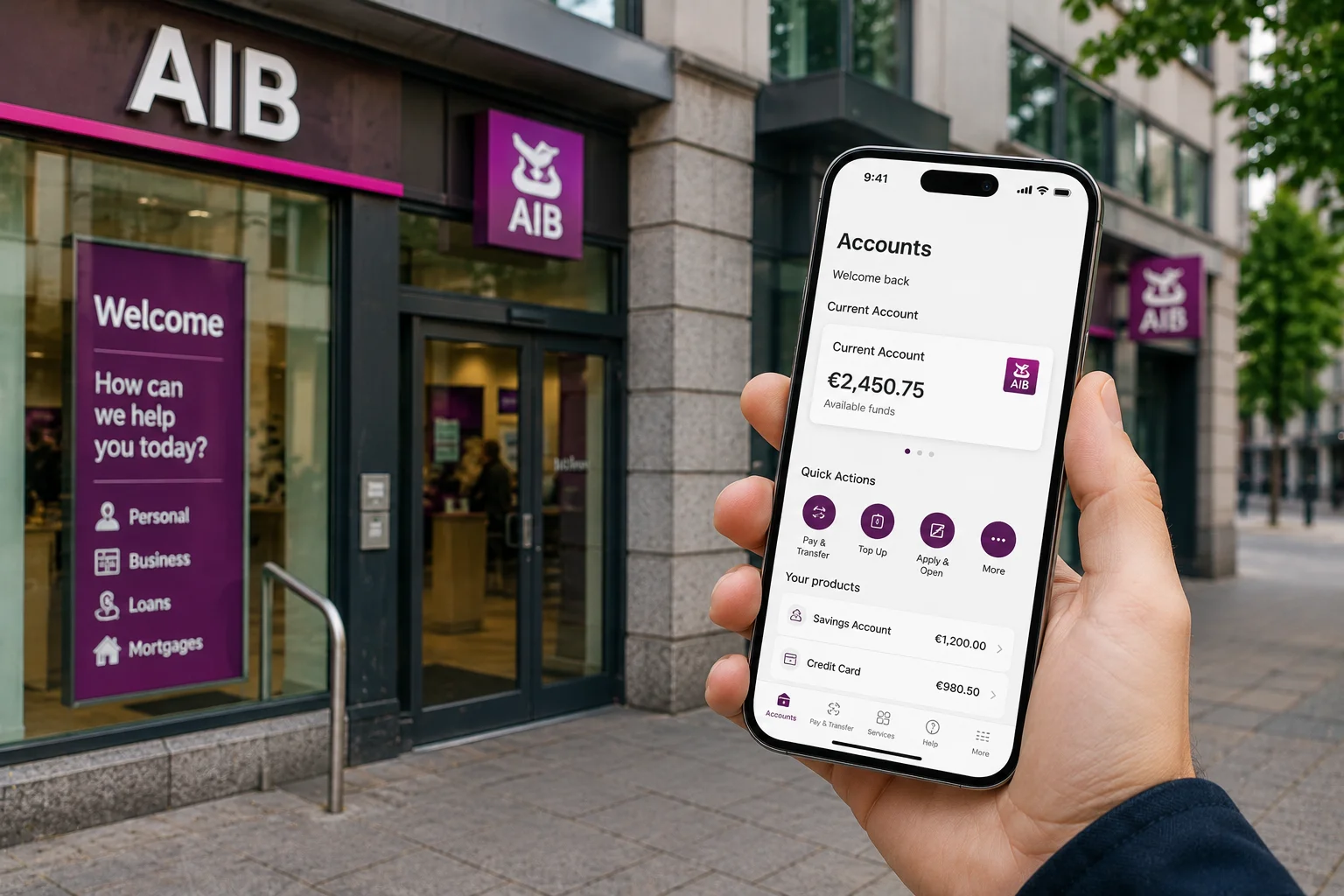
Opening an Irish bank account is straightforward once you arrive, though some banks now allow you to begin the process online before relocating. Popular options include Bank of Ireland (BOI), AIB, and the digital-first Revolut, which many expats find easiest to set up quickly.
Taxes
Ireland’s tax system differs significantly from the US system. Income tax rates are progressive, and you’ll also pay PRSI (social insurance) and USC (Universal Social Charge). Importantly, because the US taxes citizens on worldwide income regardless of residency, you’ll likely need to file US taxes even while living and working in Ireland. The US-Ireland double taxation agreement prevents you from being taxed twice on the same income, but navigating this properly is worth doing with a cross-border tax professional, particularly in your first year.
Transportation
Dublin has a public transport network (buses, the Luas tram system, and DART rail) that’s improving but still considered limited compared to major US or European cities. Outside Dublin, owning a car is often essential, particularly for commuting in suburban or rural areas.
Work-Life Balance
This is one of the areas where Americans most consistently report a positive surprise. A minimum of four weeks of paid annual leave (often more, depending on the employer), strong parental leave policies, and a cultural emphasis on disconnecting after work hours all contribute to a notably different relationship with work compared to typical US norms.
Pros and Cons Summary
Pros: Universal healthcare access, generous paid leave, English-speaking environment, strong job market in key sectors, EU residency pathway, high overall quality of life.
Cons: Significant housing shortage and high rental costs (especially Dublin), higher income tax burden than the US in many cases, limited public transport outside major cities, ongoing US tax filing obligations, and a notably wetter, cloudier climate than most of the US.
Moving to Ireland From the US
Relocating is a significant undertaking, and having a clear checklist makes the entire process considerably less overwhelming.
Before You Move
Secure your job offer and begin the employment permit application process with your employer. Research housing options in your target city, even if you won’t finalise anything until closer to your move date. Arrange international health insurance to cover the gap before your Irish coverage begins. Notify your US bank and credit card providers of your upcoming move, and research the tax implications of becoming a non-resident for state tax purposes (this varies significantly depending on which US state you’re leaving).
After You Arrive
Register your immigration status and obtain your Irish Residence Permit (IRP) at your local immigration office. Apply for your PPS Number (Personal Public Service Number), which is essential for working, paying tax, and accessing public services. Register with a local GP (general practitioner) to establish your healthcare access.
Opening a Bank Account
Bring your passport, proof of address (often a letter from your employer or landlord is accepted initially), and your PPS number once available. Many expats find it easiest to start with a digital bank like Revolut for initial flexibility, then open a traditional account once fully settled.
Finding Accommodation
Start your housing search as early as possible, using platforms like Daft.ie and Rent.ie. Be prepared for a competitive rental market, particularly in Dublin, and have references and proof of income ready to move quickly when you find a suitable property.
Registering for Services
Set up utilities (electricity, gas, internet) under your name once you’ve secured accommodation, and register with the relevant local authority if required for your specific area.
Relocation Checklist Table
| Task | Timing | Notes |
|---|---|---|
| Secure job offer | Before moving | Required for most employment permits |
| Apply for employment permit | Immediately after offer | 4–8 week processing time |
| Arrange international health insurance | Before moving | Covers the gap before Irish coverage starts |
| Notify US bank/credit providers | Before moving | Avoid account freezes or fraud flags |
| Research target city housing | Before moving | Helps set realistic budget expectations |
| Apply for IRP | Within arrival window | Required for legal residency status |
| Apply for PPS Number | Soon after arrival | Needed for work, tax, and services |
| Register with a GP | Soon after arrival | Establishes healthcare access |
| Open Irish bank account | Soon after arrival | Needed to receive salary |
| Secure accommodation | Before or soon after arrival | Highly competitive market, especially Dublin |
| Set up utilities | After securing housing | Electricity, gas, internet |
Getting a PPS Number in Ireland

Your Personal Public Service (PPS) Number is the single most important administrative step you will take after arriving in Ireland. Without it, you cannot legally receive a salary, pay income tax, access public services, or register with the Irish healthcare system. Every American relocating to Ireland for work needs to obtain a PPS number as soon as possible after arrival — and understanding the process in advance will save you valuable time during your first weeks in the country.
The PPS number is a unique seven-character reference code (six digits followed by either one or two letters) issued by the Department of Social Protection. It functions as a combination of your US Social Security Number and your tax identification number — it identifies you to Revenue, the Department of Social Protection, the HSE, and dozens of other public bodies simultaneously.
Why You Need a PPS Number
Your PPS number is required for the following purposes, among others:
- Starting employment: Your employer needs your PPS number to register you on the PAYE system with Revenue and pay your salary legally
- Paying income tax: Revenue uses your PPS number to issue tax credits and track PAYE deductions
- Accessing public healthcare: Required to register with the HSE and use public health services under PRSI entitlement
- Opening a bank account: Many Irish banks require a PPS number as part of their identity verification process
- Renting accommodation: Some landlords and letting agencies request a PPS number as part of the tenancy application
- Registering with social services: Including Child Benefit (if applicable), housing supports, and other state services
How to Apply for a PPS Number
PPS numbers are issued by the Department of Social Protection through its network of Intreo Centres and Social Welfare Branch Offices. The application must be made in person — you cannot apply by post or online as a first-time applicant. The process is straightforward:
- Locate your nearest Intreo Centre or Social Welfare Branch Office using the Finder tool at gov.ie/pps-number
- Book an appointment if required (some offices accept walk-ins; others require advance booking — check your local office’s policy)
- Attend in person with your required documents
- Complete the DEASP1 application form (available at the office or downloadable from Gov.ie)
- Your PPS number will typically be issued within one to five working days
Required Documents
When applying for your PPS number, you must bring the following documents to your appointment:
- Valid passport or national identity card: Your US passport is fully accepted
- Proof of address in Ireland: A utility bill, bank statement, tenancy agreement, or letter from your employer confirming your Irish address — issued within the last three months
- Proof of reason for needing a PPS number: Your employment contract, a letter from your employer, or documentation confirming your purpose for residing in Ireland
- IRP card (if already issued): Your Irish Residence Permit card, if you have already registered with Immigration Service Delivery
If you have just arrived and do not yet have proof of an Irish address (a common situation for Americans still in temporary accommodation), a letter from your employer on company letterhead confirming your role, start date, and expected address is usually accepted.
Processing Times
In most cases, PPS numbers are issued within one to five working days of a completed in-person application. However, during peak periods — particularly September and January when large numbers of people start new roles — processing can take up to two weeks. Planning your application for your first or second week in Ireland, rather than your first day, is a sensible approach that accounts for practical settling-in tasks.
For full, up-to-date guidance on PPS numbers, visit Citizens Information — Ireland’s official public information service.
Common Challenges Americans Face in Ireland
Housing Shortages
This is, by far, the most commonly cited challenge among American expats. Limited housing supply, particularly in Dublin, drives up rental prices and creates genuine competition for available properties. Starting your search early and being flexible about location can help significantly.
Cost of Living
Beyond housing, everyday costs like groceries, dining out, and childcare can feel notably higher than in many parts of the US. Salaries in Ireland generally reflect this, but the adjustment period can still come as a surprise for new arrivals.
Visa Requirements
Navigating the employment permit system, gathering the right documentation, and managing processing timelines requires patience and attention to detail. Working closely with your employer’s HR or immigration team — or, for complex cases, an immigration lawyer — can make this process considerably smoother.
Weather Adjustment
Ireland’s climate is notably cooler, cloudier, and wetter than most of the United States, even compared to famously rainy American cities. Many Americans find this one of the more underrated adjustments — not difficult, but genuinely different from what they’re used to.
Professional Qualification Recognition
Depending on your profession, US qualifications and licenses don’t always transfer automatically. Nurses, doctors, teachers, and several other regulated professions need to go through a formal recognition process with the relevant Irish professional body, which can take several months and is worth starting as early as possible.
Frequently Asked Questions
Can Americans work in Ireland? Yes. Americans can work in Ireland, but in most cases will need an employer-sponsored employment permit, such as the Critical Skills Employment Permit or General Employment Permit, before starting work.
How do I get a job in Ireland as an American? Start by researching in-demand sectors, particularly those on the Critical Skills Occupations List. Build an Irish-style CV, apply through job boards and recruitment agencies, complete remote interviews, and secure a job offer before beginning the employment permit process with your employer.
Do Americans need a work visa for Ireland? Yes, in most circumstances. Non-EU citizens, including Americans, need a valid employment permit to work legally in Ireland, unless they qualify for Irish citizenship through descent or another exempt category.
What jobs are in demand in Ireland? Software developers, registered nurses, civil engineers, quantity surveyors, cybersecurity specialists, pharmacists, and data scientists are among the most in-demand jobs in Ireland currently, particularly for international applicants.
What is the average salary in Ireland? Average salaries vary significantly by industry and experience level, but a mid-career professional salary typically falls between €45,000 and €75,000, with technology and finance roles often paying considerably more.
Is Ireland a good place to live for Americans? Many Americans find Ireland an excellent place to live, citing universal healthcare access, generous paid leave, an English-speaking environment, and a strong job market as key advantages, though housing costs remain a significant challenge.
Can Americans get visa sponsorship in Ireland? Yes. Many Irish employers, particularly in technology, healthcare, engineering, and pharmaceuticals, are experienced in sponsoring employment permits for qualified American applicants.
How difficult is it to move to Ireland? The process is manageable but requires preparation. Securing a job offer, navigating the employment permit system, and arranging housing are the three biggest practical hurdles, each of which is well-documented and achievable with proper planning.
Do I need a job offer before applying for an Irish work visa? Yes, in nearly all cases. Both the Critical Skills Employment Permit and General Employment Permit require a confirmed job offer from an Irish employer before you can apply.
Can I bring my family with me to Ireland? Yes. Under the Critical Skills Employment Permit, immediate family reunification is allowed right away. Under the General Employment Permit, your family can join you after twelve months.
Will my US qualifications be recognised in Ireland? It depends on your profession. Regulated professions like nursing, medicine, and teaching require formal recognition through the relevant Irish professional body, while many other qualifications are accepted more straightforwardly by employers.
How long does the Irish work permit process take? Processing times for both major employment permits typically range from four to eight weeks, though this can vary based on application volume and document completeness.
Do I have to pay US taxes while working in Ireland? Yes. The US taxes citizens on worldwide income regardless of where they live. A double taxation agreement between the US and Ireland prevents you from being taxed twice on the same income, but you’ll generally still need to file US taxes.
What is the best city in Ireland for American expats? Dublin offers the widest range of job opportunities and the largest expat community, but Cork, Galway, and Limerick offer strong alternatives with a lower cost of living and excellent quality of life.
Can I work remotely for a US company while living in Ireland? This is legally complex and depends on your specific visa status, your employer’s policies, and tax residency rules. Most standard employment permits are tied to a specific Irish employer, so working remotely for a US company typically requires a different visa category or separate legal advice.
What is a PPS Number and do I need one to work in Ireland? A PPS (Personal Public Service) number is a unique seven-character reference code issued by the Department of Social Protection. It is Ireland’s equivalent of a Social Security Number and tax ID combined. Without it, you cannot legally receive a salary, pay income tax, access public health services, or open a bank account. You apply in person at your nearest Intreo Centre, and the number is typically issued within one to five working days.
Can Americans claim Irish citizenship through their grandparents? Yes, in many cases. If one of your grandparents was born on the island of Ireland, you may be entitled to Irish citizenship through the Foreign Births Register (FBR), maintained by the Department of Foreign Affairs. Once registered, you receive an Irish passport and full EU residency and work rights — bypassing the employment permit system entirely. Processing times for FBR registration currently range from 12 to 24 months, so applying early is strongly recommended.
What is Stamp 1 permission in Ireland? Stamp 1 is an immigration permission endorsed on your passport or Irish Residence Permit (IRP) by Immigration Service Delivery. It confirms that you are permitted to reside in Ireland for the purpose of employment under a specific employment permit. Stamp 1 is tied to your employer and your permit — if you change jobs, you will generally need to apply for a new employment permit, which will result in a new Stamp 1 being issued. After five years of continuous legal residence in Ireland (including on Stamp 1), you may be eligible to apply for Stamp 4, which grants unrestricted work rights.
What is the Labour Market Needs Test and does it apply to my job? The Labour Market Needs Test (LMNT) is a process that requires Irish employers to demonstrate they were unable to fill a vacancy with a suitably qualified Irish or EU/EEA candidate before sponsoring a non-EEA worker on a General Employment Permit. The employer must advertise the role for a minimum period (generally two weeks on Jobs Ireland and at least one other national platform) and document the outcome. The LMNT does not apply to Critical Skills Employment Permit applications or to roles on the Critical Skills Occupations List. If your role is eligible for a CSEP, the process is faster and this step is skipped entirely.
Do Americans pay taxes in both Ireland and the US? The US taxes its citizens on worldwide income regardless of where they live, so yes — you will have US tax filing obligations even while working in Ireland. However, the US-Ireland Tax Treaty, the Foreign Tax Credit (FTC), and the Foreign Earned Income Exclusion (FEIE) together prevent true double taxation in most situations. In practice, most Americans earning typical Irish professional salaries owe little or no additional federal income tax after applying these mechanisms, but filing obligations remain. FBAR and FATCA reporting requirements also apply. A cross-border tax specialist is strongly recommended.
Can I work remotely in Ireland for a US company? Yes, but the tax and immigration implications are more complex than simply relocating. If you remain employed by a US company and work remotely from Ireland for more than 183 days in a tax year, you will generally become Irish tax resident and will owe Irish income tax (PAYE, USC, and PRSI) on your earnings. Your US employer may not be set up to process Irish payroll, which creates a practical challenge. Some Americans establish themselves as self-employed contractors or engage a Professional Employer Organisation (PEO) to manage Irish payroll compliance. You may also need to confirm that your Irish immigration permission allows remote employment for a foreign company. Seek specialist advice before committing to this arrangement.
How much does an Irish work permit cost? As of 2026, the application fee for both the Critical Skills Employment Permit and the General Employment Permit is €1,000, paid online through the Employment Permits Online System (EPOS) administered by the Department of Enterprise, Trade and Employment. If your application is refused, 90% of the fee (€900) is refunded. Fees are subject to change — always check the current fee schedule at enterprise.gov.ie before submitting your application.
Recommended Related Resources
If you found this guide useful, the following resources on Quickhirealert will help you go deeper on specific aspects of working and living in Ireland as an American:
- How to Get a Job in Ireland — A step-by-step guide to the Irish job application process, from CV formatting to interview preparation and offer negotiation.
- Critical Skills Employment Permit Guide — Everything you need to know about Ireland’s fastest and most accessible work permit for skilled non-EEA professionals.
- Jobs in Ireland With Visa Sponsorship — How to identify employers who actively sponsor employment permits and which sectors offer the most opportunities.
- High-Demand Jobs in Ireland — The complete list of roles on Ireland’s Critical Skills Occupations List, with current salary benchmarks and hiring outlook for 2026.
- Best Cities in Ireland — A detailed comparison of Dublin, Cork, Galway, Limerick, and Waterford for job seekers and expats, covering cost of living, job market strength, and quality of life.
- Cost of Living in Ireland — A full breakdown of housing, transport, healthcare, groceries, and daily expenses for Americans planning their Irish relocation budget.
- Moving to Ireland From the US — The complete relocation checklist covering immigration registration, PPS number, banking, healthcare, utilities, and everything else you need in your first 30 days.
Get Ireland job alerts by email
Ireland’s permit rules and salary thresholds changed twice in the last eighteen months. Subscribe and we will email you when they change again, plus new job alerts and guides.
Conclusion
For Americans seriously considering a move abroad, Ireland offers a genuinely rare combination: a strong, growing job market, an English-speaking culture, and a quality of life that consistently exceeds expectations. The presence of major American employers — Google, Apple, Meta, Pfizer, and many others — means that for many professionals, working in Ireland doesn’t require starting over. It means continuing a career in a more supportive, balanced environment.
The path isn’t without its challenges. Housing costs, visa paperwork, and the adjustment to a new tax and healthcare system all require real preparation. But none of these challenges are insurmountable, and thousands of Americans navigate this exact process successfully every year.
The best pathway forward is straightforward: identify which in-demand sector matches your skills, target employers experienced in sponsoring international hires, prepare a strong Irish-style application, and approach the employment permit process with patience and the right documentation. From there, Ireland’s job market — and its famously welcoming culture — does the rest.
Sources and References
The information in this guide is drawn from official Irish and US government sources, regulatory bodies, and authoritative industry references. Readers are strongly encouraged to verify all immigration, tax, and employment information directly with the relevant authorities, as rules and requirements can change. The following sources were used in preparing this guide and are recommended for further reading:
- Department of Enterprise, Trade and Employment (DETE) — Employment Permits: The official source for all employment permit types, current salary thresholds, the Critical Skills Occupations List, and the Employment Permits Online System (EPOS). enterprise.gov.ie/employment-permits
- Citizens Information: Ireland’s official public information service covering work permits, PPS numbers, moving to Ireland, housing, healthcare, and social welfare. An essential first resource for any American relocating to Ireland. citizensinformation.ie
- Revenue Ireland: The Irish tax authority — official guidance on PAYE, USC, PRSI, tax credits, and the tax obligations of workers moving to Ireland. revenue.ie
- IDA Ireland: Ireland’s inward investment agency — publishes annual statistics on US multinational employment in Ireland, FDI data, and sector-by-sector investment reports. idaireland.com
- Qualifications Recognition Ireland (NARIC): The National Academic Recognition Information Centre for Ireland — use this resource to verify whether your US educational qualifications are recognised in Ireland. qualificationsrecognition.ie
- Department of Foreign Affairs — Foreign Births Register: Official guidance on registering Irish citizenship through descent and applying for an Irish passport. ireland.ie/citizenship
- Immigration Service Delivery (ISD): Manages Irish Residence Permit (IRP) registration, immigration stamps, and residency permissions for non-EEA nationals. irishimmigration.ie
- Internal Revenue Service (IRS) — US Citizens Abroad: Official IRS guidance on Foreign Earned Income Exclusion (Form 2555), Foreign Tax Credit (Form 1116), FBAR, and FATCA obligations for Americans living overseas. irs.gov/international-taxpayers
This guide was last reviewed in June 2026. Immigration rules, permit fees, salary thresholds, and tax rates are subject to change. Always verify current requirements directly with the Department of Enterprise, Trade and Employment and consult a qualified immigration or tax professional before making relocation decisions.