
Last updated: 27 November 2026 | Information verified: Citizens Information Parent’s Leave page (page edited 25 February 2026) and its social welfare rates 2027 page (edited 7 October 2026), read on 25 November 2026.
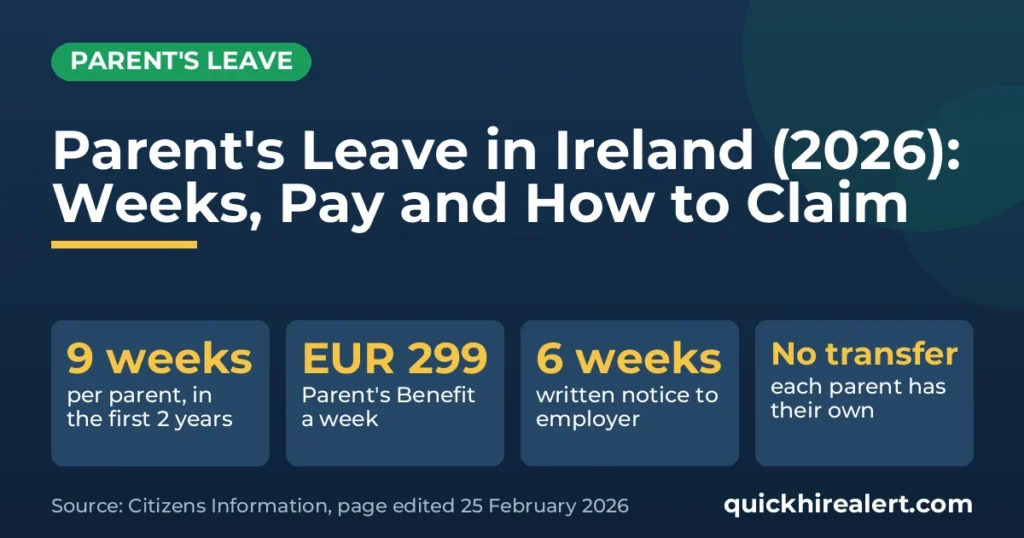
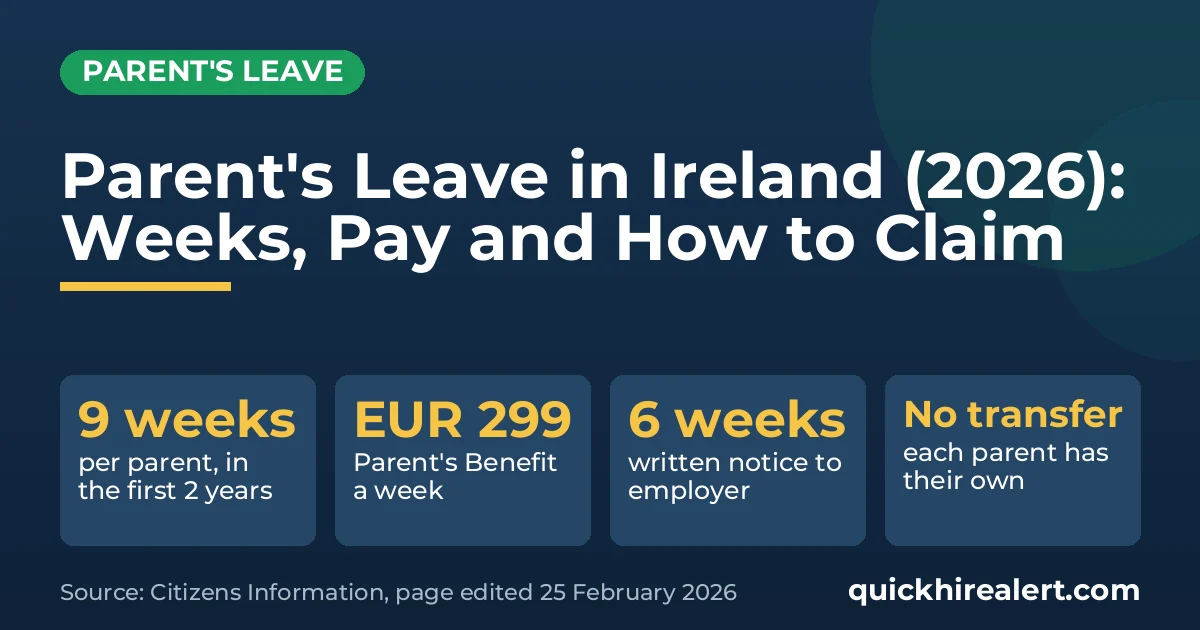
Parent’s Leave in Ireland gives each parent 9 weeks off work in the first two years of a child’s life, or in the first two years after an adoption placement. If you searched for parents leave Ireland, this is the leave you want. It is paid through Parent’s Benefit, not by your employer, as long as you have enough PRSI.
This guide explains who qualifies, how many weeks you get, how much Parent’s Benefit pays, how to give notice and what your employer can and cannot do. It also shows how Parent’s Leave differs from Parental Leave, which is unpaid and has a different age limit.
Quick answer
- Entitlement: 9 weeks per parent, for children born or adopted after 1 August 2024.
- When: In the first 2 years of the child’s life, or 2 years after adoption placement.
- Pay: Parent’s Benefit of EUR 299 a week for 9 weeks, if you have enough PRSI.
- Notice: At least 6 weeks in writing, with the birth or adoption placement certificate.
- From 2027: Parent’s Benefit rises from EUR 299 to EUR 309 a week (Budget 2027).
Parent’s Leave Ireland: Key Facts
| Item | What Citizens Information says |
|---|---|
| Weeks per parent | 9 weeks (up from 7) for children born or adopted after 1 August 2024 |
| Who can take it | Employees and self-employed people who are a relevant parent |
| Time window | First 2 years of the child’s life; within 2 years of placement for adoption |
| Multiple births | Same 9 weeks per parent |
| Pay during leave | Parent’s Benefit, EUR 299 a week for 9 weeks (2026), paid by the Department of Social Protection |
| Employer pay | Not required; some employers top up |
| How to take it | One block of 9 weeks, or separate periods of not less than 1 week |
| Notice to employer | At least 6 weeks in writing, with a birth or adoption placement certificate |
| Transfer to the other parent | Not allowed |
| Employer postponement | Once, for up to 12 weeks, with written notice at least 4 weeks before the start date |
| Complaints | Workplace Relations Commission, within 6 months |
| Law | Parent’s Leave and Benefit Act 2019, as amended |
Who Can Take Parent’s Leave in Ireland?
Parent’s Leave is for a relevant parent who is an employee or self-employed. Citizens Information defines a relevant parent broadly. It includes the parent of the child, the spouse, civil partner or cohabitant of the parent, and the parent of a donor-conceived child under section 5 of the Children and Family Relationships Act 2015. For adoption, it includes the adopting parent or parents and the civil partner or spouse of an adopting parent.
Each parent has their own entitlement. You cannot transfer your weeks to the other parent. If a parent dies, the surviving parent gets the untaken weeks of the parent who died.
The leave applies in the same way to multiple births. If you have twins, each parent still has 9 weeks, not 9 weeks per child.
How Many Weeks of Parent’s Leave Do You Get?
The entitlement is 9 weeks per parent. It increased from 7 weeks for children born or adopted after 1 August 2024. You can take the 9 weeks as one block, or as separate periods of not less than 1 week each. The second option suits families who want to cover a return to work, a nursery start or a gap in childcare.
There is a transition rule for older children. If your child was under 2 on 1 August 2024, you can claim an extra 2 weeks on top of the original entitlement. You must finish that leave by the child’s second birthday. After that date the window is closed.
The leave must be used within 2 years of the birth. For adoption, the 2 years run from the placement. Our guides to maternity leave and paternity leave cover the earlier leave that comes before it.
Parent’s Benefit: How Much Does Parent’s Leave Pay?
Parent’s Leave itself is a right to time off. The pay comes from Parent’s Benefit, a payment from the Department of Social Protection. Citizens Information gives the 2026 rate as EUR 299 a week for 9 weeks. You need enough PRSI contributions to qualify. Your employer does not have to pay you during the leave, although some employers top up the benefit.
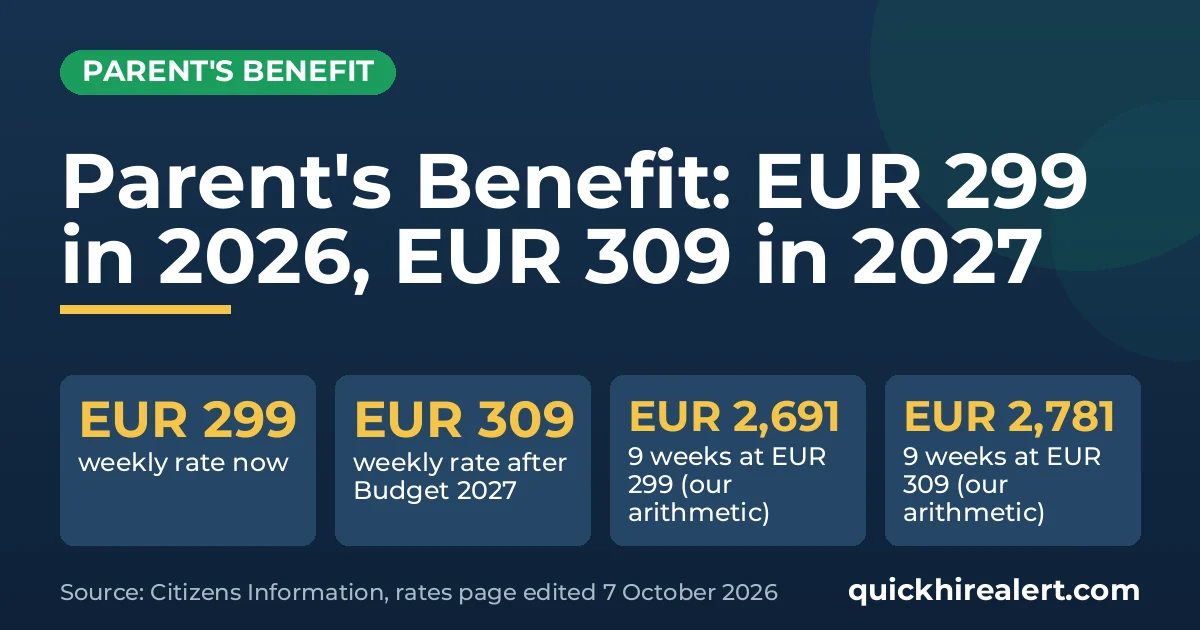
Budget 2027 raises Parent’s Benefit from EUR 299 to EUR 309 a week. Maternity Benefit, Adoptive Benefit and Paternity Benefit rise by the same amount. The Citizens Information 2027 rates page does not state the start date for the new rate, so check the date before you plan around it.
| Rate | Weekly | 9 weeks (our arithmetic) |
|---|---|---|
| 2026 | EUR 299 | EUR 2,691 |
| 2027 (Budget 2027) | EUR 309 | EUR 2,781 |
The 9-week totals are our own arithmetic (9 multiplied by the weekly rate). They are not figures published by Citizens Information, and they assume you take all 9 weeks and qualify for the full weekly rate.
How to Claim Parent’s Leave: Step by Step
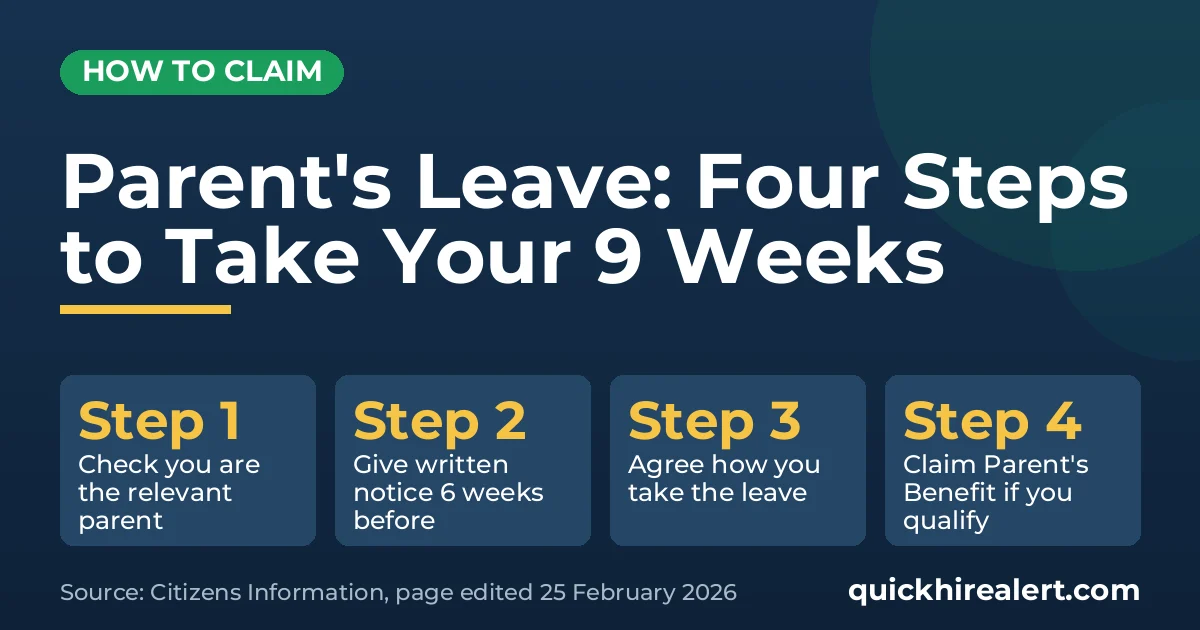
There are two separate things to do. First you arrange the leave with your employer. Then you claim Parent’s Benefit from the Department of Social Protection.
- Check you are a relevant parent. Confirm that you are an employee or self-employed, and that your child is within the 2-year window.
- Give written notice. Citizens Information says you must give your employer at least 6 weeks’ notice in writing.
- Include the required details. The notice must state the start date, how you will take the leave (one block or separate periods), the length of the leave and a certificate. The certificate is the birth certificate or, for adoption, the placement certificate.
- Agree the dates. If your employer postpones, agree a new start date in writing.
- Claim Parent’s Benefit. Apply to the Department of Social Protection. We did not open the application page in this run, so use the link on the Citizens Information page and confirm the current steps there.
If you are self-employed there is no employer to notify, but the benefit conditions and PRSI record still apply. Check them on the Citizens Information page before you apply.
Planning Your 9 Weeks: Three Ways to Use the Leave
The law lets you choose between one block and separate periods of at least 1 week. These three patterns are examples of how families can use that choice. They are our illustrations, not official advice, and each one still needs written notice at least 6 weeks before every start date.
- One block of 9 weeks. Suits a parent who wants a long, uninterrupted stretch at home, for example to extend time with a baby after the other parent returns to work.
- Several blocks of 1 to 3 weeks. Suits a parent who wants to cover gaps, such as the weeks before a childcare place starts or a school holiday.
- One block now and one later. Suits a parent who wants to keep part of the entitlement for a second milestone inside the 2-year window, such as the first birthday.
Whichever pattern you choose, keep a copy of every notice you send. If your employer postpones a block, the written record helps you agree the new date and protects your position if you later need to complain.
Can Your Employer Refuse or Postpone Parent’s Leave?
Your employer can refuse only if you are not entitled to the leave. If you are entitled, the employer cannot say no.
An employer can postpone the leave once, for up to 12 weeks. To do that, the employer must give written notice at least 4 weeks before your start date, explain the reasons and agree a new date with you. If the leave is postponed, your eligibility period can be extended by a maximum of 12 weeks after the postponement.
If you think your employer has broken the rules, you can complain to the Workplace Relations Commission. Use the online form on workplacerelations.ie within 6 months. This may be extended by up to a further 6 months if you have reasonable cause.
Your Rights During Parent’s Leave
Citizens Information says you are treated as being in employment while you are on Parent’s Leave. In practice that gives you these protections:
- Annual leave continues to build up during the leave. See our guide to annual leave in Ireland.
- You are entitled to public holidays that fall within the leave.
- You get PRSI credits.
- You have the right to return to your job.
- You are protected against penalisation and unfair dismissal for taking the leave.
Your written terms should still apply when you come back. Our guide to the employment contract in Ireland explains what must be in writing.
Parent’s Leave vs Parental Leave and Other Family Leave
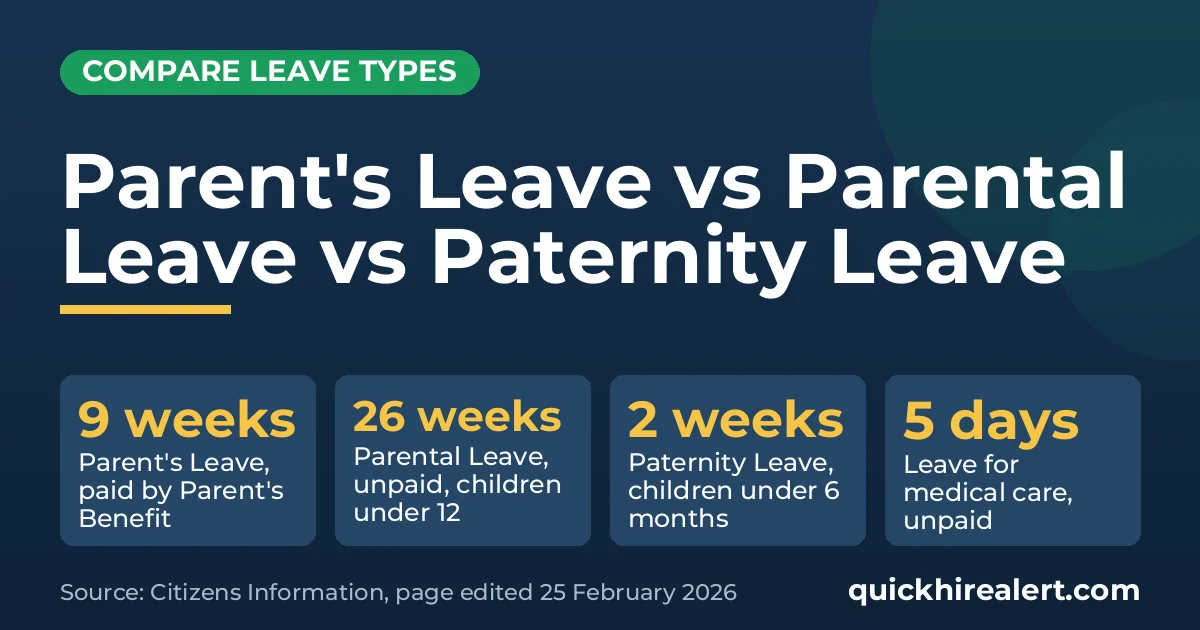
People often mix up Parent’s Leave and Parental Leave. They are different entitlements with different rules. Parent’s Leave is 9 weeks with Parent’s Benefit and a 2-year window. Parental Leave is 26 weeks, unpaid, for children under 12.
| Leave | Length | Pay | Child’s age or timing |
|---|---|---|---|
| Parent’s Leave | 9 weeks per parent | Parent’s Benefit, EUR 299 a week (2026) | First 2 years of life or after placement |
| Parental Leave | 26 weeks | Unpaid | Children under 12 |
| Paternity Leave | 2 weeks | Paternity Benefit | Children under 6 months |
| Maternity Leave | 26 weeks, plus up to 16 weeks unpaid | Maternity Benefit for 26 weeks | Around the birth |
| Adoptive Leave | 24 weeks, plus up to 16 weeks unpaid | Adoptive Benefit | Adoption placement |
| Leave for medical care | 5 days in any 12 consecutive months | Unpaid | Medical care of a relative |
The comparison above follows the table on the Citizens Information Parent’s Leave page. Parental Leave rules have their own page, which we did not read in full, so check the age limit and notice rules there before you apply.
Common Mistakes to Avoid
- Giving verbal notice only. The notice must be in writing, at least 6 weeks before you start.
- Forgetting the certificate. You need the birth certificate or adoption placement certificate with your notice.
- Assuming you can pass weeks to your partner. The entitlement is personal and cannot be transferred.
- Missing the 2-year window. The leave must be taken within 2 years of the birth or placement, with limited extension after a postponement.
- Missing the extra 2 weeks. If your child was under 2 on 1 August 2024, finish the extra weeks by the second birthday.
- Not checking your PRSI record. Parent’s Benefit depends on enough PRSI contributions. The leave itself does not.
If you moved to Ireland recently, your PRSI record may be short. Check your contributions with the Department of Social Protection before you count on the benefit. Our guide to the PPS number explains how contributions are recorded.
How Parent’s Leave Fits With Child Benefit and Your Working Hours
Parent’s Leave does not replace other supports. Child Benefit is a separate monthly payment and does not depend on your leave. Your normal working hours and breaks rights apply again when you return.
If you plan a return to work in stages, you can use the separate-periods option. Taking the 9 weeks in blocks of at least 1 week lets you spread the leave across the 2-year window. Each block still needs notice, so plan the dates early.
Frequently Asked Questions
How many weeks is Parent's Leave in Ireland?
Parent's Leave is 9 weeks per parent for children born or adopted after 1 August 2024. It was 7 weeks before that. You can take it in one block or in separate periods of not less than 1 week.
Is Parent's Leave paid in Ireland?
It is paid through Parent's Benefit from the Department of Social Protection if you have enough PRSI. The 2026 rate is EUR 299 a week for 9 weeks. Your employer does not have to pay you, although some employers top up the benefit.
How much notice do you need to give for Parent's Leave?
You must give your employer at least 6 weeks' notice in writing. The notice should say the start date, how you will take the leave, how long it lasts and include the birth certificate or adoption placement certificate.
Can you transfer your Parent's Leave to your partner?
No. Each parent has their own entitlement and it cannot be transferred. If a parent dies, the surviving parent gets the untaken weeks of the parent who died.
Can your employer refuse Parent's Leave?
An employer can refuse only if you are not entitled to the leave. An entitled employee cannot be refused, but the employer can postpone the leave once for up to 12 weeks, with written notice at least 4 weeks before your start date.
What is the difference between Parent's Leave and Parental Leave?
Parent's Leave is 9 weeks per parent with Parent's Benefit, within 2 years of birth or placement. Parental Leave is 26 weeks of unpaid leave for children under 12. They are separate entitlements.
Will Parent's Benefit increase in 2027?
Citizens Information says Parent's Benefit rises from EUR 299 to EUR 309 a week in 2027 under Budget 2027. The page does not give a start date for the new rate, so check the date before you rely on it.
Where do you complain if your employer breaks the rules?
You can complain to the Workplace Relations Commission using the online form on workplacerelations.ie. The time limit is 6 months, which may be extended by up to a further 6 months if you have reasonable cause.
Related Guides
- Maternity leave in Ireland: weeks, pay and how to apply
- Paternity leave in Ireland
- Child Benefit in Ireland: rates, who can claim and how to apply
- Annual leave in Ireland: entitlement and public holiday pay
- Employment contract in Ireland: what must be in writing
- Working hours and breaks in Ireland
Official Sources
- Citizens Information: Parent’s Leave
- Workplace Relations Commission
- gov.ie: Department of Social Protection
Verification note: We read the Citizens Information Parent’s Leave page (edited 25 February 2026) and its 2027 social welfare rates page (edited 7 October 2026) on 25 November 2026. The 9-week totals in the rates table are our arithmetic. We did not read the Parental Leave page or the Parent’s Benefit application page, and the 2027 start date is not stated on the rates page. Rules and rates change, so confirm on citizensinformation.ie or gov.ie before you apply.
Get an email when Ireland's permit rules change
Salary thresholds, occupation lists and visa rules change every year. Subscribe and we will tell you when they do, plus new job guides. Free, no spam.
Subscribe free