
Last updated: 23 October 2026 | Permit figures: Department of Enterprise, Tourism and Employment (DETE) statistics for 2025 and January to September 2026.
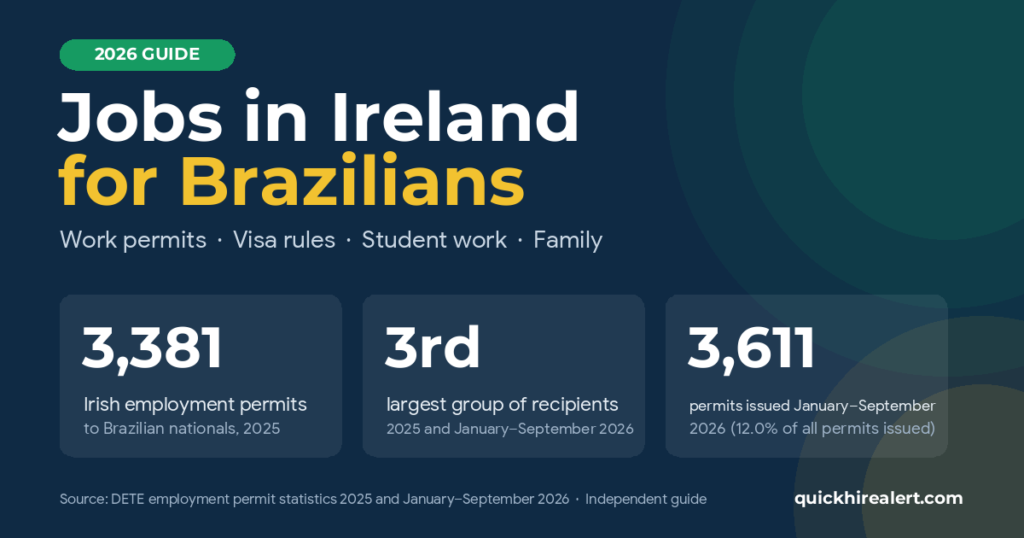
Brazilians are the third-largest group of non-EEA workers receiving Irish employment permits, after Indians and Filipinos. DETE issued 3,381 employment permits to Brazilian nationals in 2025, and 3,611 in January to September 2026. This guide explains how Brazilians can work in Ireland legally: the permit routes, the salary thresholds, entry and registration, studying and working, and how to bring your family.
Key Facts at a Glance
| Topic | What applies to Brazilian citizens |
|---|---|
| Permits issued | 3,381 in 2025 (3rd); 3,611 in January to September 2026 (3rd) |
| Permits refused | 522 in 2025; 603 in January to September 2026 |
| Entry visa | Not required: Brazil is on Ireland’s list of non-visa required nationalities |
| Working holiday | Not available: Brazil is not one of the participating countries |
| Permit routes | Critical Skills Employment Permit; General Employment Permit |
| Critical Skills salary | €40,904 for listed occupations with a relevant degree (from 1 March 2026) |
| General Permit salary | €36,605, or €32,691 for healthcare assistants, home support workers and certain other roles |
| Permit fee | €1,000 for a new permit of up to 24 months; €500 for a General Employment Permit of six months or less |
| After arrival | Irish Residence Permit (IRP), €300 |
| Stamp 4 | After 21 months (Critical Skills) or 57 months (General Employment Permit) |
Brazilians and Irish Employment Permits: The Official Numbers
DETE publishes the number of employment permits issued and refused by nationality each year. The table below shows the number of permits issued to the top five nationalities.
| Nationality | 2025 | Jan–Sep 2026 |
|---|---|---|
| India | 9,947 | 9,120 |
| Philippines | 3,398 | 4,402 |
| Brazil | 3,381 | 3,611 |
| China | 1,922 | 1,719 |
| Pakistan | 1,453 | 1,448 |
| Total | 31,044 | 29,989 |
Source: DETE, employment permits by nationality 2025 and 2026 (2026 file covers January to September).
Brazilians received about 11% of all permits issued in 2025 and about 12% of those issued in January to September 2026. DETE does not publish a breakdown of Brazilian permits by sector or occupation, so the figures cannot tell you which jobs Brazilians were hired for. To see which employers hold the most permits overall, read our guide to companies with the most employment permits in Ireland.
Do Brazilians Need a Visa for Ireland?
No entry visa is needed. Brazil is listed among the non-visa required nationalities on the Government of Ireland’s list (updated 12 May 2025). This means you do not apply for an Irish visa before you travel.
However, not needing a visa does not give you the right to work. To take up a job you still need the right immigration permission, which for most Brazilian workers means an employment permit issued by DETE before you start work. At the border, the immigration officer decides whether to let you in and for how long, so carry your passport, your employment permit and your job documents.
Ireland is not in the Schengen area. Permission to enter Ireland does not cover Schengen countries, and a stay in a Schengen country does not count as permission to be in Ireland.
If you hold an EEA, Swiss or UK passport
Citizens of the EEA (the EU plus Iceland, Liechtenstein and Norway), Switzerland and the UK can live and work in Ireland without an employment permit. If you also hold one of those citizenships, you can work in Ireland as a citizen of that country.
No working holiday route for Brazilians
Ireland’s Working Holiday Authorisation is open only to citizens of the participating countries: Andorra, Argentina, Australia, Canada, Chile, Hong Kong, Japan, New Zealand, South Korea, Taiwan and the USA. Brazil is not on this list, so Brazilians cannot use a working holiday to work in Ireland.
The Two Main Employment Permit Routes
Meeting the criteria below means you can apply. It does not guarantee a job offer, an employment permit or permission to enter Ireland: DETE decides each permit application, and an immigration officer decides on entry at the border.
1. Critical Skills Employment Permit
This permit is for occupations on the Critical Skills Occupations List, such as many ICT, engineering and healthcare roles. From 1 March 2026 the minimum salary is €40,904 for listed occupations where you hold a relevant degree. There is no Labour Market Needs Test, your family can join you straight away, and you can apply for Stamp 4 after 21 months. Read the full Critical Skills Employment Permit guide.
2. General Employment Permit
This permit covers occupations that are not on the Ineligible Occupations List. The minimum salary is generally €36,605, or €32,691 for healthcare assistants, home support workers and certain other roles. In most cases the employer must first complete a Labour Market Needs Test. See the General Employment Permit guide and the Ireland occupation shortage list.
Permit fees
The fee for a new permit is €1,000 for up to 24 months. A General Employment Permit of six months or less costs €500. Under section 55 of the Employment Permits Act 2024, your employer must not deduct permit fees, recruitment costs or travel expenses they paid from your pay, or try to recover them from you, and must not keep your passport or other personal documents.
Studying in Ireland and Working Part-Time
Many Brazilians first come to Ireland to study. Students from outside the EU, EEA, Switzerland and the UK who are on a full-time course of at least one year leading to a recognised qualification can work without a work permit:
- up to 20 hours a week during term
- up to 40 hours a week during holiday periods: June to September (inclusive) and 15 December to 15 January
You need a valid IRP card showing Stamp 2 and a PPS number. Students with Stamp 2A permission are not allowed to work. Student permission is for study, so do not plan on part-time work to cover all your costs.
How to Get a Job in Ireland From Brazil: Step by Step
- Check your occupation. Look up whether your job is on the Critical Skills Occupations List or the Ineligible Occupations List, and check that the salary offered meets the minimum.
- Find an employer willing to sponsor you. Apply directly to Irish employers that hire international staff. Our guide to jobs in Ireland with visa sponsorship explains where to look.
- Get a written job offer. It should state the job title, duties, salary and hours.
- Apply for the employment permit. You or your employer apply to DETE online. Check current work permit processing times before you plan your move.
- Travel to Ireland. As a Brazilian citizen you do not need an entry visa. Bring your passport, employment permit and job documents to show at the border.
- Register and get your IRP. You have up to 90 days from the date on your landing stamp to register. The fee is €300. Then get a PPS number and register with Revenue.
- Work towards Stamp 4. You can apply after 21 months on a Critical Skills permit, or 57 months on a General Employment Permit. See Stamp 1 vs Stamp 4.
If you want to move to a new job once you are in Ireland, read our guide to changing employer on a work permit.
Where to Find Current Jobs
These links open live searches on official and established job sites, including JobsIreland, the State’s public employment service, so the results are always current. A job appearing in these results does not mean the employer will support an employment permit. Check that the role is eligible and meets the salary threshold, and ask the employer about permit support before you apply.
- All sectors: all vacancies on JobsIreland and all current HSE vacancies.
- Healthcare: HSE nursing vacancies and LinkedIn results for “nurse visa sponsorship”.
- Technology and engineering: LinkedIn results for “software engineer visa sponsorship” and LinkedIn results for “engineer visa sponsorship”.
Never pay anyone for an Irish job offer or for “sponsorship”; see how to avoid job scams.
Bringing Your Family From Brazil
Critical Skills holders: there is no waiting period, so your spouse or partner and children can apply to join you straight away.
General Employment Permit holders: you can apply to bring your spouse or partner and children after 12 months in Ireland on an eligible permission. The 2026 policy requires gross income above €30,000 in the previous year for a couple with no children, with higher thresholds when children are included. You must also provide documentary evidence of suitable accommodation.
Avoid Job Scams
- A genuine Irish employer does not ask you to pay for a job offer or for an employment permit to be “guaranteed”.
- Employers cannot deduct recruitment expenses from your wages.
- No one can promise that DETE will approve a permit. Only DETE makes that decision.
- Check that the company is real and matches the details in your job offer before you send documents or money.
Frequently Asked Questions
Can Brazilians work in Ireland without a work permit?
Only in limited cases. Brazilian citizens who also hold an EEA, Swiss or UK passport do not need an employment permit. Eligible full-time students on Stamp 2 can work up to 20 hours a week in term and 40 hours a week in holiday periods. Most other Brazilians need an employment permit.
Do Brazilians need a visa to move to Ireland for work?
No entry visa is needed, because Brazil is on Ireland’s list of non-visa required nationalities. You still need an employment permit before you start work, and you must register for an IRP after arrival.
How many Brazilians get Irish work permits?
DETE issued 3,381 employment permits to Brazilian nationals in 2025 and 3,611 in January to September 2026. Brazil ranked third by nationality in both periods.
Can Brazilians get a working holiday visa for Ireland?
No. Brazil is not one of the countries that take part in Ireland’s Working Holiday Authorisation scheme.
What is the minimum salary for an Irish work permit?
From 1 March 2026 it is €40,904 for a Critical Skills Employment Permit and generally €36,605 for a General Employment Permit, or €32,691 for roles such as healthcare assistants and home support workers.
Related Guides
- Jobs in Ireland for Foreigners
- Jobs in Ireland for Indians
- Jobs in Ireland for Pakistanis
- Jobs in Ireland for Chinese Citizens
- Jobs in Ireland for South Africans
- Jobs in Ireland for Nigerians
- Ireland Work Visa Requirements
- Critical Skills Employment Permit
- General Employment Permit
- Jobs in Ireland for Filipinos
Official Sources
- DETE: Employment permit statistics 2025
- DETE: Employment permit statistics 2026
- DETE: Employment permits
- DETE: Employment permit fees
- Ireland: Visa required and non-visa required nationalities (updated 12 May 2025)
- Government of Ireland: Working Holiday Authorisation
- Citizens Information: Immigration rules for full-time non-EEA students
- Citizens Information: Coming to work in Ireland
- DETE: Roadmap for employment permit salary thresholds (2 December 2025)
- DETE: General Employment Permit
- DETE: Critical Skills Employment Permit
- Employment Permits Act 2024, section 55
- ISD: Family Reunification Policy, 12 June 2026
- ISD: Update to eligibility requirements for Stamp 4 upgrades
- Citizens Information: Registering as a non-EEA national
Verification note: every rule in this guide was checked against the official sources above on 22 and 23 October 2026. The non-visa required nationalities list was last updated on 12 May 2025. Rules and thresholds change, so always confirm current requirements on the official sites before you apply.