
Last updated: 21 October 2026 | Permit figures: Department of Enterprise, Tourism and Employment (DETE) statistics for 2025 and January to May 2026.
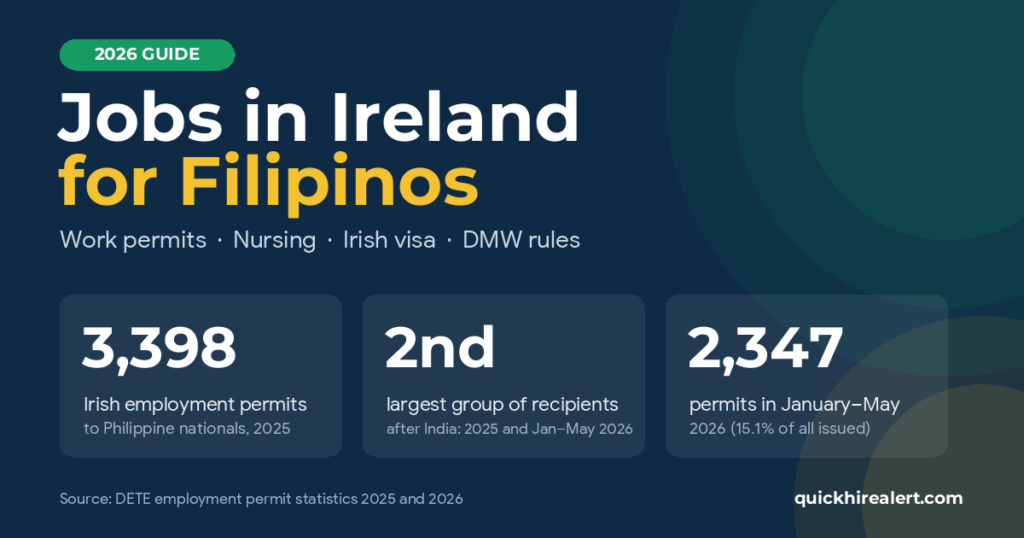
Filipinos are now the second-largest group of non-EEA workers receiving Irish employment permits. In 2025, Philippine nationals were granted 3,398 of the 31,044 employment permits DETE issued, second only to India. In the first five months of 2026 they received 2,347, which is 15.1% of all permits issued in that period and already more than two-thirds of the 2025 full-year total (DETE 2025; DETE 2026).
The reasons are familiar to anyone in Philippine healthcare. Ireland has a long-running shortage of nurses and care workers, English is the working language, and the permit system gives a defined route from a job offer to long-term residence. Filipino applicants also face something applicants from most other countries do not: two sets of rules. Ireland decides whether you can work and live there. The Philippine government, through the Department of Migrant Workers (DMW), regulates how you are recruited and cleared to leave.
This guide covers both sides. It explains which permits Filipinos use, what the salary thresholds are, how the Irish visa process works from the Philippines, which documents you need, and the Philippine requirements to check before you sign anything or pay anyone.
Disclaimer: This is general information, not legal or immigration advice. Irish salary thresholds rose on 1 March 2026, and Philippine deployment procedures are being digitised. Always confirm the current position with DETE, Immigration Service Delivery (ISD), the Embassy of Ireland in the Philippines and the Department of Migrant Workers before acting.
Quick Answer
Can Filipinos get jobs in Ireland in 2026? Yes. Philippine citizens can work in Ireland with an employment permit, and they received more Irish permits than any nationality except Indians in both 2025 and January to May 2026. Because Philippine nationals are visa-required, there are two Irish stages: first a job offer and employment permit, then a Long Stay D Employment visa applied for online and lodged through VFS Global in the Philippines. Separately, Philippine rules on recruitment and departure clearance apply, so check your recruiter and contract with the DMW.
Key Facts for Filipino Applicants (2026)
| Item | Detail |
|---|---|
| Employment permit needed? | Yes |
| Irish visa needed? | Yes. Philippine nationals are on Ireland’s visa-required list |
| Permits issued to Philippine nationals | 3,398 in 2025 (2nd); 2,347 in January to May 2026 (2nd) |
| Main permit routes | Critical Skills Employment Permit; General Employment Permit |
| Critical Skills minimum salary | €40,904 for listed occupations with a relevant degree (from 1 March 2026) |
| General Employment Permit minimum salary | €36,605, or €32,691 for healthcare assistants, home support workers and certain other roles |
| Where to lodge an Irish visa | Online application, then VFS Global Philippines (Embassy of Ireland) |
| Nurse registration in Ireland | Nursing and Midwifery Board of Ireland (NMBI); IELTS Academic 7.0 overall or OET Grade B (with one C+ allowed) |
| Document legalisation | Apostille from the Philippine Department of Foreign Affairs (DFA), since 14 May 2019 |
| Philippine-side regulator | Department of Migrant Workers (DMW) |
| Route to Stamp 4 | After 21 months (Critical Skills) or 57 months (General Employment Permit) |
Filipinos and Irish Employment Permits: The Official Numbers
DETE publishes the number of employment permits issued and refused by nationality. The table below compares Philippine nationals with the overall totals.
| Period | Issued to Philippine nationals | Share of all permits issued | Rank | Refused (Philippine nationals) |
|---|---|---|---|---|
| 2025 (full year) | 3,398 | 10.9% of 31,044 | 2nd, after India | 335 |
| January to May 2026 | 2,347 | 15.1% of 15,535 | 2nd, after India | 233 |
Three points stand out:
- The 2025 ranking was very close. Philippine nationals finished just 17 permits ahead of Brazilian nationals (3,381).
- The 2026 lead is wider. In January to May 2026, the Philippines had 2,347 permits against Brazil’s 1,898.
- Refusals are relatively low. Refusals were about 9% of decided applications in both periods (issued plus refused), below the overall rate of roughly 10%.
These figures count permits, not people. A renewal counts as a new permit, and the data does not show which jobs Filipinos were hired for.
Nursing gives a separate indication. The NMBI’s State of the Register 2025 report lists 7,324 Philippine nationals on its register (India: 20,419). The same report records 388 new registrants educated in the Philippines in its calendar-year figures.
Can Filipinos Work in Ireland? Two Sets of Rules
The Irish side: permit, then visa
Stage 1: the employment permit. You need a job offer from an Irish employer and an employment permit from DETE. The permit is tied to the employer, the job and the salary. See our General Employment Permit and Critical Skills Employment Permit guides.
Stage 2: the Long Stay D Employment visa. Once the permit is granted, you apply online for an Irish visa and lodge your documents through VFS Global in the Philippines. You can travel only after the visa is approved. After arrival you register for an Irish Residence Permit (IRP).
The Philippine side: the DMW
Philippine law regulates overseas recruitment. The Department of Foreign Affairs guidance on direct hiring explains that the Labor Code and related rules prohibit the direct hiring of overseas Filipino workers, with limited exemptions. The DMW defines direct hiring as employing a worker without the assistance of a licensed recruitment agency. According to the DMW’s direct-hiring FAQs, one exemption covers professionals and skilled workers whose contracts are verified or authenticated and set terms above the minimum standards. No more than five professionals and skilled workers may be hired this way for the first time, and a group hire counts as one. Direct-hire documents are evaluated online through the DMW’s POPS-Direct system. In practice, that means being recruited through a DMW-licensed agency, or having a direct-hire contract processed under one of the exemptions.
Before departure, overseas Filipino workers must also be cleared by the DMW. The DMW’s FAQs still describe the Overseas Employment Certificate (OEC): it is valid for 60 days from the date of issue and can be used for a single exit from the Philippines. Press reports say the DMW is replacing the OEC with a digital OFW Pass, starting with returning workers, but the DMW’s own OFW Pass page was still marked as under development when we checked. Confirm the current requirement for first-time workers with the DMW before you travel.
Why this matters: an Irish employment permit and visa do not, on their own, satisfy the Philippine departure requirements. Confirm both sides before you resign from your current job or book flights.
Where Filipinos Get Hired in Ireland
DETE does not publish permits broken down by both nationality and sector, so this section lists the eligible routes most relevant to Filipino applicants. It does not rank them.
1. Nursing
Nurses are on the Critical Skills Occupations List, which means there is no Labour Market Needs Test, family can join immediately, and Stamp 4 is available after 21 months. Before you can work as a nurse, you must register with the NMBI. For applicants trained outside the EU, NMBI requires an English language test unless an exemption applies:
- IELTS Academic: 7.0 overall, with at least 7.0 in three components and 6.5 in one.
- OET (Nursing): Grade B in three components and C+ in one.
- Validity: results must be less than two years old.
Philippine nursing training does not qualify for the trained-in-English exemption, which is limited to Australia, Canada, New Zealand, the USA and the UK. See our Nursing Jobs in Ireland guide.
2. Healthcare assistants, home support and care work
Healthcare assistants and home support workers can be hired on a General Employment Permit with a reduced minimum salary of €32,691. DETE expects healthcare assistants to hold a relevant QQI Level 5 (or comparable) qualification within two years of starting, and checks this when the permit is renewed. If you hold a comparable health or social care qualification instead, the clinical lead, your employer and you complete a DETE form confirming your skills, which is submitted with the renewal (DETE). Care worker and home carer permits are also capped: S.I. No. 213 of 2026 sets a maximum of 1,495 General Employment Permits for care workers or home carers for the period starting 13 May 2026. See Healthcare Assistant Jobs in Ireland and Caregiver Jobs in Ireland.
3. Other health and social care roles
Several allied health professions are on the Critical Skills list, each with its own registration body. Our Healthcare Jobs in Ireland guide sets these out.
4. IT, engineering and other professional roles
ICT, engineering and finance roles on the Critical Skills list are open to Filipino graduates on the same terms as any other nationality. The salary and degree conditions apply, and the role must be on the list. Check the current Ireland Occupation Shortage List before you apply.
5. Hospitality and other General Employment Permit roles
Roles not on the Ineligible List, including some chef and hospitality posts, can be sponsored under a General Employment Permit. In most cases the employer must first run a 28-day Labour Market Needs Test. Check the current lists, because eligibility changes after each review.
Salaries and the Thresholds You Must Meet
| Role | Pay reference | Permit route |
|---|---|---|
| Staff nurse (HSE) | €38,166 – €56,592 (HSE scale, 1 June 2026) | Critical Skills |
| Healthcare assistant (HSE) | €36,651 – €45,939 (HSE scale); permit minimum €32,691 | General Employment Permit |
| Critical Skills occupations | Minimum €40,904 (with relevant degree) | Critical Skills |
| Other eligible occupations | Minimum €36,605 | General Employment Permit |
Source: HSE consolidated salary scales, 1 June 2026 and DETE thresholds from 1 March 2026. HSE scales apply to HSE posts, and private nursing homes and agencies set their own pay above the permit minimum. Weigh pay against the cost of living, especially rent in Dublin.
The Irish Visa Process From the Philippines
- Apply online. Complete the Long Stay D Employment visa application on the Irish online visa system once your permit is granted. Make sure every detail matches your passport exactly.
- Lodge through VFS Global. According to the Embassy of Ireland in Manila, since 5 September 2022 all visa queries and applications must go through VFS Philippines. VFS Philippines runs Ireland visa application centres in Manila and Cebu, plus a premium centre in Manila (Shangri-La) by appointment. You book an appointment and pay VFS’s service fee online. VFS says Irish visa applicants are not currently required to give biometrics, and a representative may submit the application for you. The Embassy says it cannot give updates on individual applications.
- Pay the fees. The Irish visa fee is €60 for single entry or €100 for multiple entry (Government of Ireland). VFS Philippines says the visa fee can be paid in cash at the centre. Its service fee is separate, and so are employment permit fees.
- Wait for the decision, and apply early. ISD publishes visa decisions on its visa decisions page every Tuesday.
- Travel and register. After arrival, register for your IRP within the period shown on your landing stamp (up to 90 days). The fee is €300 (Citizens Information). Then get a PPS number and register with Revenue.
Ireland is not in the Schengen area. A Schengen visa does not let you enter Ireland, and an Irish visa does not cover Schengen countries.
Documents Filipino Applicants Need
ISD’s employment visa document list includes:
- the signed application summary
- your current passport and any previous passports
- two passport photographs
- proof that you paid the fee
- medical or travel insurance
- a signed application letter
- evidence of personal circumstances
- details of any previous visa refusals or criminal convictions
For a DETE employment permit visa, it also asks for:
- the permit itself
- a copy of your employment contract
- a letter from your Irish employer
- evidence of your qualifications and experience
- six months of bank statements
Apostille. The Philippines has issued apostilles under the Hague Convention since 14 May 2019 (Philippine DFA). Philippine Embassies and Consulates cannot issue an apostille, so documents are apostilled in the Philippines. Start this early if your employer, NMBI or ISD asks for authenticated copies.
Police clearance. ISD’s standard list asks you to declare criminal convictions but does not list a police certificate as a standard document. An employer or registration body may still ask for an NBI clearance, so follow the checklist you are given.
How to Get a Job in Ireland From the Philippines: Step by Step
- Check that your occupation is eligible. Look it up on the Critical Skills list and the Ineligible List.
- Start registration early if your profession is regulated. Nurses should begin NMBI recognition and English testing before or alongside job applications.
- Prepare an Irish-style CV. Keep it to two pages, with no photo, date of birth or marital status, and focus on results and registrations.
- Apply through real channels. Use Irish employers’ own careers pages, public sector sites such as HSE Jobs, or a DMW-licensed agency. Our How to Get a Job in Ireland guide covers this in detail.
- Interview and get a written offer. Most first interviews are held online.
- Get the employment permit. The employer or you apply to DETE. A 28-day Labour Market Needs Test usually comes first for General Employment Permits.
- Complete the Philippine requirements. Have your contract processed and obtain DMW departure clearance.
- Apply for the Irish visa through VFS Philippines, then travel and register.
- Work towards Stamp 4. According to ISD, you can apply after completing 21 months of employment in Ireland on a Critical Skills permit, or 57 months on a General Employment Permit. See Stamp 1 vs Stamp 4.
Bringing Your Family From the Philippines
- Critical Skills holders: there is no waiting period, so your spouse or partner and children can apply to join you straight away. An eligible spouse or partner is registered on Stamp 1G and can work without a separate permit.
- General Employment Permit holders: you can apply to bring your spouse or partner and children after 12 months in Ireland on an eligible permission. The 2026 policy requires gross income above €30,000 in the previous year for a couple with no children, with higher thresholds when children are included. You must also be able to show suitable accommodation, which ISD may ask you to prove after you apply. Since May 2024, an eligible spouse or partner is registered on Stamp 1G and can work without a separate permit (ISD notice).
The family reunification rules changed on 12 June 2026 (ISD); the details are in ISD’s Family Reunification Policy. See our guide to bringing family to Ireland on a work permit.
Avoiding Recruitment and Visa Scams
- Irish law limits what employers can charge. Under section 23 of the Employment Permits Act 2006, your employer, or whoever made the job offer, must not deduct from your pay, or recover from you, charges connected with the permit application or renewal, your recruitment, or travel expenses they paid. They also must not keep your passport or other personal documents. Breaking these rules is an offence.
- Check any Philippine agency with the DMW before paying anything. The DMW publishes a directory of licensed recruitment agencies and a list of approved job orders. The DMW, not Irish law, sets what Philippine agencies may charge.
- Be wary of guaranteed results. No one can guarantee you an Irish visa or a job without an interview.
- Use only official visa channels. Irish visas are lodged through VFS Philippines, and no agent can fast-track a decision.
- Verify the employer. Check that it is registered on the Companies Registration Office register.
Frequently Asked Questions
Do Filipinos need a visa to work in Ireland?
Yes. Philippine nationals are visa-required, so after the employment permit is granted you need a Long Stay D Employment visa, lodged through VFS Global in the Philippines.
How many Filipinos get Irish work permits?
DETE issued 3,398 employment permits to Philippine nationals in 2025 and 2,347 in January to May 2026, second only to India in both periods.
Can a Filipino nurse work in Ireland?
Yes, once registered with the NMBI. Nurses are on the Critical Skills list. NMBI requires IELTS Academic 7.0 overall (with one component at 6.5 allowed) or OET Grade B (with one C+ allowed) for most nurses trained outside the EU.
Can I be hired directly by an Irish employer without an agency?
Philippine rules restrict direct hiring, with limited exemptions for professionals and skilled workers on verified contracts. Check your situation with the DMW before you sign.
What is the minimum salary for an Irish work permit?
From 1 March 2026 it is €40,904 for a Critical Skills Employment Permit and generally €36,605 for a General Employment Permit, or €32,691 for roles such as healthcare assistants and home support workers.
Do my Philippine documents need an apostille?
Where authenticated documents are requested, yes. The Philippines has issued DFA apostilles since 14 May 2019.
Can I bring my family?
Critical Skills holders can bring their family immediately. General Employment Permit holders can normally do so after 12 months, subject to income and accommodation rules.
Is an Irish visa valid for Schengen countries?
No. Ireland is outside the Schengen area and runs its own visa system.
Related Guides
- Jobs in Ireland for Foreigners
- Nursing Jobs in Ireland
- Healthcare Assistant Jobs in Ireland
- Caregiver Jobs in Ireland
- Ireland Work Visa Requirements
- Critical Skills Employment Permit
- General Employment Permit
- Ireland Occupation Shortage List
Official Sources
- DETE: Employment permit statistics 2025
- DETE: Employment permit statistics 2026
- DETE: Employment permits
- Ireland: Visa required and non-visa required nationalities (updated 12 May 2025)
- Embassy of Ireland, Philippines: Visas
- ISD: Employment visa required and additional documents
- NMBI: English language requirements (qualified outside the EU)
- NMBI: State of the Register
- HSE: Consolidated salary scales, 1 June 2026
- Employment Permits Act 2006, section 23
- Philippine DFA: Guidelines on direct hiring of Filipino professionals and skilled workers
- Philippine DFA: Philippines enters the Apostille Convention
- DMW: Frequently asked questions (direct hiring, OEC)
- DMW: Licensed recruitment agencies
- VFS Global: Ireland visa services in the Philippines
- Government of Ireland: Visas for Ireland (fees)
- S.I. No. 213 of 2026: Employment Permits (Amendment) Regulations 2026
- ISD: Family Reunification Policy, 12 June 2026
- ISD: Update to eligibility requirements for Stamp 4 upgrades
- Citizens Information: Registering as a non-EEA national
- ISD: Visa decisions
- Department of Migrant Workers (DMW)
DETE nationality figures, NMBI requirements and register figures, the Embassy of Ireland visa page, the ISD visa-required list and document list, section 23 of the Employment Permits Act, S.I. No. 213 of 2026, the DMW FAQs and agency directory, VFS Philippines, the Government of Ireland visa fee page, ISD’s Family Reunification Policy, Stamp 4 and visa decisions pages, Citizens Information on registration and the Philippine DFA pages were checked on 21 October 2026. Always confirm current requirements on the official sites.