
If you’re looking for main jobs in Ireland and thinking about building a career in Ireland, you’re not alone. Over the past decade, Ireland has quietly become one of Europe’s most exciting job markets — and for good reason. A booming tech sector, a stable economy, and a genuine demand for skilled professionals have made it a go-to destination for graduates, experienced workers, and international job seekers alike.
But with so many options out there, knowing where to start can feel overwhelming. That’s exactly why understanding the main jobs in Ireland matters — not just the job titles themselves, but the industries driving them, the salaries attached to them, and the realistic pathways into them.
From technology and healthcare to finance, construction, and hospitality, the Irish job market spans a wide range of sectors, each with its own demand, growth potential, and entry requirements. Whether you’re a recent graduate hunting for your first role, a skilled professional considering a move abroad, or a foreign worker exploring jobs in Ireland with visa sponsorship, there’s more opportunity here than most people realise.
In this guide, we’ll walk you through the most common, popular, and in-demand jobs in Ireland right now. We’ll cover which industries are hiring, what employers are actually looking for, realistic salary expectations, and practical steps to help you land a job — whether you’re already living in Ireland or planning to relocate.

What Are the Main Jobs in Ireland?
So, what are the main jobs in Ireland right now? The short answer is it depends on where you look. Ireland’s job market is surprisingly diverse, spanning everything from technology and healthcare to finance, construction, hospitality, retail, and logistics. And as more multinational companies continue to set up European headquarters on Irish soil, the range of opportunities just keeps expanding.
When most people think of common jobs in Ireland, roles like ‘software developers’, ‘nurses’, ‘accountants’, ‘engineers’, and ‘construction workers’ come to mind first – and for good reason. These professions sit at the heart of the Irish economy and are consistently in demand across major cities including Dublin, Cork, Galway, Limerick, and Waterford. Alongside these, you’ll find steady demand for customer service representatives, healthcare assistants, teachers, and logistics professionals — roles that keep the country running day to day.
What makes Ireland particularly interesting for job seekers right now is the pace of growth in certain sectors. Technology and healthcare, in particular, have seen a sharp rise in demand for skilled workers over recent years. Many of these roles come with competitive salaries, strong career progression, and — importantly for international applicants — visa sponsorship opportunities for those who qualify.
Whether you’re mapping out your first career move or considering a fresh start in a new country, getting a clear picture of Ireland’s main employment sectors gives you a real advantage. It helps you match your skills and experience to the roles most likely to hire, grow, and reward you over the long term.

Main Industries in Ireland
To really understand the main jobs in Ireland, it helps to first look at the industries creating them. Ireland’s economy isn’t built on one or two sectors — it’s supported by a broad mix of thriving industries, each generating thousands of jobs every year for professionals, skilled tradespeople, graduates, and international workers.
Technology sits at the top of the list. Ireland has become Europe’s Silicon Valley in many ways, with giants like Google, Meta, Apple, and Microsoft all choosing Dublin and Cork as their European bases. The concentration of tech companies here has created an enormous demand for software developers, data analysts, cybersecurity specialists, and IT professionals at every level.
Healthcare is another cornerstone of Irish employment. An ageing population and growing demand for medical services mean hospitals, clinics, and care facilities across the country are consistently hiring — from consultants and GPs to nurses, healthcare assistants, and allied health professionals.
Finance and accounting continue to flourish too, thanks to Ireland’s well-established reputation as an international financial hub. For those with the right qualifications, this sector offers some of the most competitive salaries and career paths in the country.
Construction remains in high demand as Ireland pushes forward with residential, commercial, and infrastructure development. Meanwhile, pharmaceuticals, manufacturing, and life sciences — sectors where Ireland genuinely punches above its weight globally — offer well-paid roles for engineers, lab technicians, and researchers.
Rounding out the picture are industries like hospitality and tourism, retail, education, logistics, agriculture, and customer service — sectors that collectively ensure Ireland’s job market stays diverse, accessible, and full of entry points for people at different stages of their careers.

Most Common Jobs in Ireland
While Ireland’s job market covers a lot of ground, certain roles keep coming up time and time again — and for good reason. These are the occupations that sit at the core of the Irish economy, consistently in demand regardless of the season or economic climate. Here’s a closer look at the most common jobs in Ireland right now and what makes each one worth considering.
Software Developer
If there’s one job title that defines modern Ireland’s workforce, it’s software developer. With the likes of Google, Meta, and Amazon all operating out of Dublin, Cork, and Galway, the appetite for talented developers shows no signs of slowing. Expect strong salaries, genuine flexibility, and a career path with real long-term potential.
Registered Nurse
Nursing has always been a pillar of Irish employment – and today it’s more important than ever. Hospitals, clinics, and care facilities across the country rely heavily on registered nurses, making this one of the most in-demand and secure careers in Ireland for both local and internationally trained professionals.
Accountant
Ireland’s status as a global business hub means accountants are never short of work. From Big Four firms in Dublin to SMEs in regional towns, qualified accountants who can handle financial reporting, tax compliance, and business advisory are consistently sought after across every industry.
Construction Worker
Ireland is building fast. The ongoing push to develop new homes, offices, and infrastructure has created a sustained demand for construction workers, electricians, plumbers, site supervisors, and skilled tradespeople right across the country. If you work with your hands, Ireland has a place for you.
Customer Service Representative
Thanks to the sheer number of multinational companies running European customer support operations from Irish soil, customer service roles are widely available and accessible. Strong communication skills and a good attitude often matter more than formal qualifications here, making it a solid entry point into the workforce.
Healthcare Assistant
For those looking to break into the healthcare sector without a clinical degree, the role of healthcare assistant is one of the most popular and accessible options. Supporting nurses and medical teams in day-to-day patient care, this position offers real purpose — and a clear pathway to further qualifications if you want to progress.
Teacher
Qualified teachers remain in steady demand across Ireland, particularly in growing commuter towns and urban areas where school populations are expanding. Primary, secondary, and special education roles are all actively being filled, with good job security and a respected place in the community.
Logistics and Warehouse Worker
The rise of e-commerce has quietly made logistics one of Ireland’s fastest-growing employment areas. Warehouse operatives, delivery drivers, and supply chain coordinators are needed in large numbers — and many roles offer flexible shift patterns alongside competitive pay.
Sales Executive
Sales professionals are the engine behind growth in sectors like tech, finance, real estate, and retail. In Ireland, strong sales performers are well rewarded — often through attractive commission structures, career advancement opportunities, and roles that come with real autonomy and variety.
Engineer
From pharmaceutical plants in Cork to construction sites in Dublin and tech campuses in Galway, engineers of all disciplines — civil, mechanical, electrical, and software — are consistently in demand. Ireland’s mix of global industry and domestic development keeps engineering firmly on the list of the most valuable careers in the country.
Together, these roles represent the backbone of Ireland’s workforce. Whether you’re starting out, switching careers, or relocating from abroad, each of these occupations offers stable employment, competitive salaries, and genuine long-term prospects in one of Europe’s most dynamic job markets.

Popular Jobs in Ireland
When people think about building a career in Ireland, a handful of roles consistently come to mind — and for good reason. The most popular jobs in Ireland tend to cluster around the country’s strongest industries: technology, healthcare, finance, and construction. But popularity here isn’t just about volume. These are roles that offer genuine career satisfaction, strong earning potential, and long-term stability.
Software development, nursing, financial analysis, civil engineering, and digital marketing are among the most talked-about and pursued careers right now. What they share in common is consistent employer demand, competitive pay, and clear pathways for progression — three things that matter whether you’re just starting out or making a strategic career move.
Ireland’s popularity as a destination for multinational companies has also opened up a wider range of roles than you might expect — from UX designers and data scientists to pharmacovigilance specialists and supply chain managers. The market is varied, and that’s exactly what makes it so attractive.

Major Jobs in Ireland
The major jobs in Ireland are those that form the structural backbone of the economy — roles so essential that they exist in every county, every city, and almost every sector. These aren’t niche positions. They’re the careers that Ireland simply cannot function without.
At the top of that list sit roles in healthcare, construction, education, financial services, and technology. Together, these five pillars account for a significant portion of total employment across the country and are consistently listed among the highest-demand occupations by the Department of Enterprise, Trade and Employment.
What’s worth noting is that “major” doesn’t always mean “highly specialised”. Many of Ireland’s most important roles — healthcare assistants, warehouse operatives, retail supervisors, and construction labourers — are accessible to people without advanced degrees. The Irish job market rewards practical skills, reliability, and a willingness to work just as much as it rewards academic qualifications.

What Are the Jobs in Ireland for Local and International Workers?
One of the things that sets Ireland apart from many other European countries is how genuinely open its job market is to both local residents and international workers. Whether you’re an Irish national, an EU citizen, or a skilled professional from outside Europe, there are real and accessible opportunities available — provided you know where to look.
For local workers, the strongest opportunities right now are in healthcare, construction, retail, education, and the public sector. These industries offer job security, structured career progression, and salaries that reflect Ireland’s relatively high cost of living.
For international workers, the picture is equally promising — particularly in sectors facing persistent skills shortages. Technology, nursing, engineering, pharmacy, and financial services are all areas where Irish employers are actively recruiting from abroad. Many roles in these fields come with relocation support, competitive packages, and in some cases, assistance with the visa process.
The key difference for non-EU applicants is the requirement for a valid work permit or employment visa. Ireland operates a critical skills employment permit and a general employment permit system, both designed to make it easier for qualified professionals to enter the workforce legally and build a life here.

What Jobs Are in Demand in Ireland?
Ask any recruiter in Ireland right now what their biggest challenge is, and most will give you the same answer — finding enough qualified people to fill the roles they have open. Demand is outpacing supply in several key areas, creating genuine opportunity for job seekers who have the right skills.
The most in-demand jobs in Ireland currently include:
- Registered Nurses and Healthcare Assistants — The HSE and private healthcare providers are in a near-permanent state of recruitment, particularly for ICU, theatre, and community care roles.
- Software Developers and Engineers — Full-stack developers, cloud engineers, and DevOps professionals are consistently among the hardest roles for Irish tech companies to fill.
- Quantity Surveyors and Civil Engineers — Ireland’s housing crisis has supercharged demand for construction professionals at every level.
- Pharmacists and Pharmacy Technicians — Both retail and hospital pharmacy sectors are experiencing shortages.
- HGV Drivers and Logistics Coordinators — Supply chain pressures have made qualified drivers and logistics coordinators highly sought after.
- Accountants and Financial Analysts — Particularly those with multinational or Big Four experience.
- Data Analysts and Cybersecurity Specialists — Fast-growing areas within Ireland’s already booming tech sector.
If your skills fall into any of these categories, the Irish job market is not just open to you — it’s actively looking for you.

High-Demand Jobs in Ireland in 2026
Looking at where hiring is heading in 2026 specifically, a number of trends are shaping which roles will see the strongest demand over the coming months.
Artificial intelligence and machine learning roles are growing at an extraordinary pace. As Irish tech companies integrate AI into their products and services, demand for ML engineers, AI researchers, and prompt engineers is surging in ways we haven’t seen before.
Mental health professionals — including psychologists, counsellors, and psychiatric nurses — are among the most critically needed workers in Ireland’s healthcare system right now, with waiting lists highlighting the scale of the gap.
Renewable energy engineers are increasingly in demand as Ireland accelerates its transition to wind, solar, and green hydrogen. Roles in energy project management, grid engineering, and sustainability consulting are all on an upward trajectory.
Cybersecurity analysts remain in extremely short supply relative to demand, with Irish financial institutions and tech firms competing fiercely for qualified candidates.
Construction project managers and BIM (Building Information Modelling) specialists are critical to Ireland’s housing targets and infrastructure investment plans for the year ahead.
If you’re planning a career move or considering upskilling, these are the areas where 2026 is likely to offer the strongest return.

Main Work in Ireland Across Different Sectors
The main work in Ireland doesn’t fit neatly into one box. Depending on your background, qualifications, and location, your experience of the Irish job market could look very different from someone else’s — and that diversity is actually one of its greatest strengths.
In urban centres like Dublin, Cork, and Galway, the dominant employers are technology companies, financial services firms, multinational corporations, and large healthcare providers. These cities offer the widest range of roles, the highest average salaries, and the most accessible public transport networks.
In regional towns and rural areas, employment tends to centre around healthcare, education, agriculture, manufacturing, hospitality, and retail. While salaries may be slightly lower than in Dublin, the cost of living is also considerably more manageable – and quality of life for many workers is significantly higher.
Across all sectors and locations, the common thread is a growing emphasis on skills over credentials. More and more Irish employers are open to candidates who can demonstrate relevant competencies, even without a traditional degree — a shift that’s opening doors for career changers, self-taught professionals, and internationally trained workers whose qualifications may not have direct Irish equivalents.

IT and Technology Jobs in Ireland
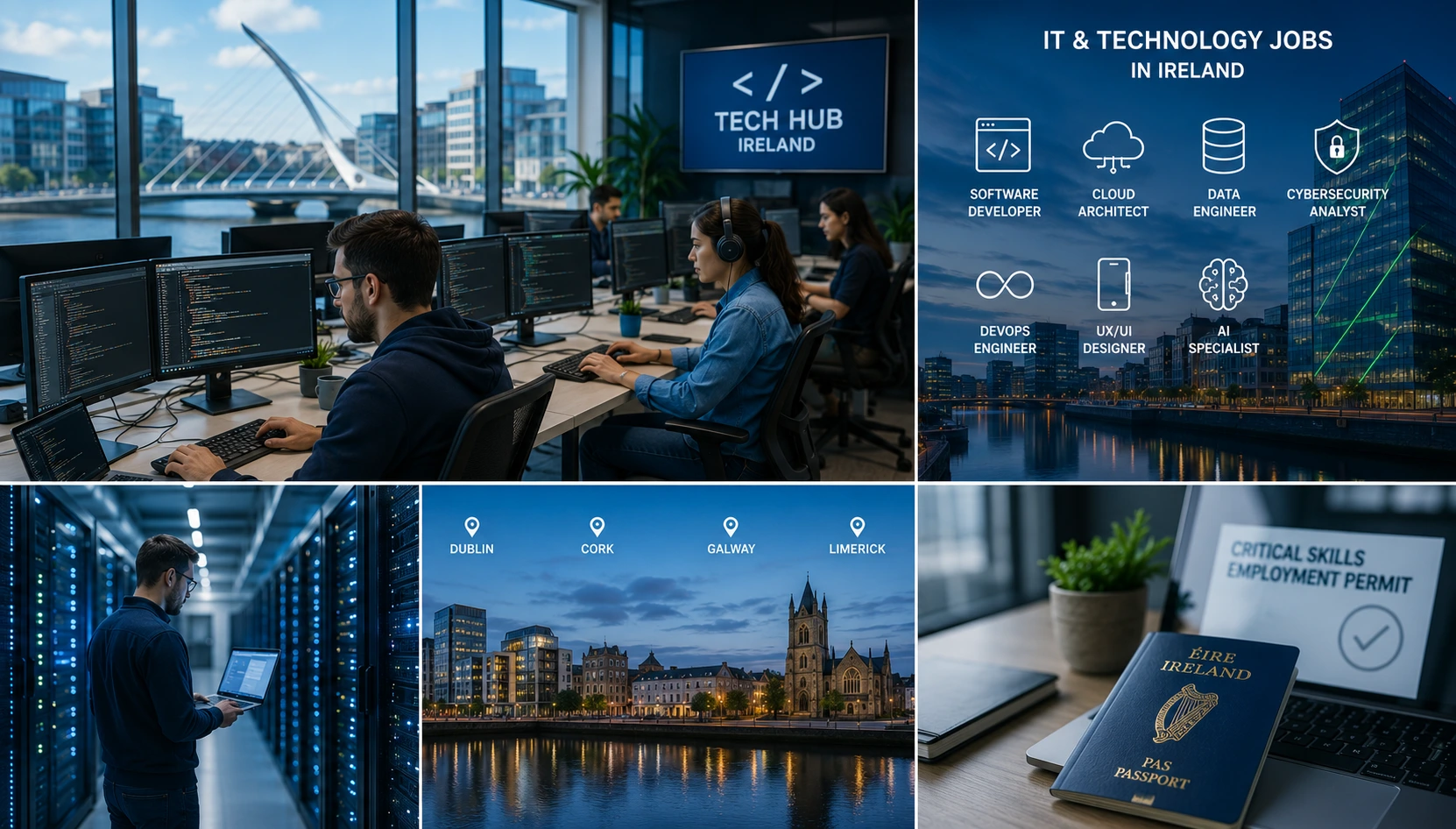
Ireland has firmly established itself as Europe’s technology capital, and the numbers back it up. With over 1,000 multinational tech companies operating in the country — including Google, Meta, Apple, Microsoft, Amazon, and Salesforce — the demand for IT and technology professionals is both enormous and consistent.
The most sought-after IT and technology jobs in Ireland right now include software developers, cloud architects, data engineers, cybersecurity analysts, DevOps engineers, UX/UI designers, and AI specialists. Entry-level roles in tech support, quality assurance, and systems administration are also widely available for those earlier in their careers.
Dublin’s “Silicon Docks” area has become synonymous with tech employment, but Cork, Galway, and Limerick all have thriving tech ecosystems of their own. Salaries in the sector are among the highest in Ireland, with experienced software engineers and cloud specialists regularly earning between €70,000 and €120,000 per year depending on specialisation and employer.
For international tech professionals, Ireland is particularly welcoming. Many roles qualify for the Critical Skills Employment Permit, making the visa process more straightforward than in many other countries.
Healthcare and Nursing Jobs in Ireland
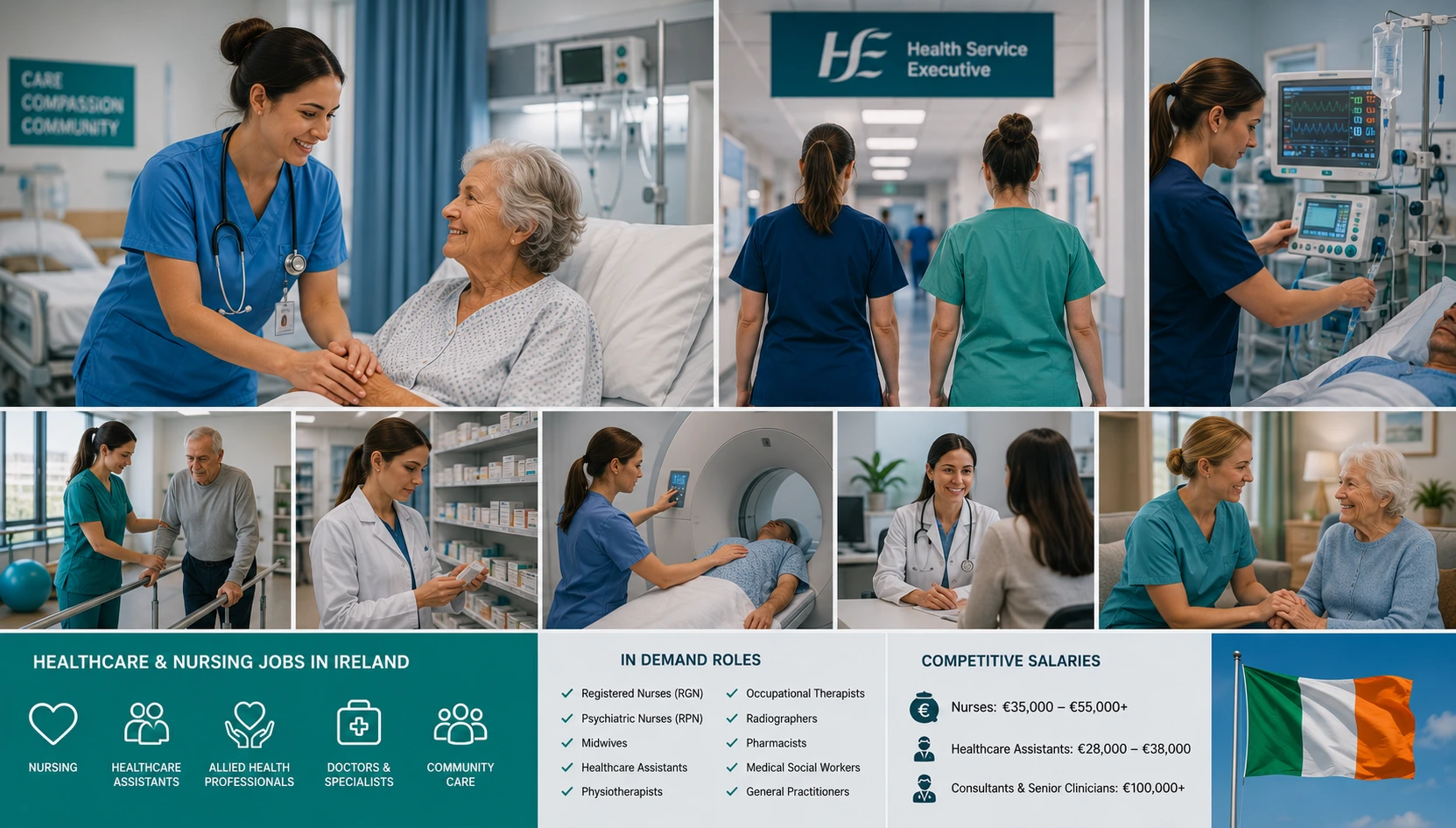
Healthcare is one of the most consistently active employment sectors in Ireland — and one of the most important. The Health Service Executive (HSE), along with a growing network of private hospitals, nursing homes, and community care providers, employs hundreds of thousands of people across the country.
Nursing remains the single most in-demand healthcare role in Ireland. Registered General Nurses (RGNs), Registered Psychiatric Nurses (RPNs), and midwives are all actively recruited, with particular shortages in ICU, theatre, paediatrics, and community nursing. Ireland also actively recruits internationally trained nurses, with structured pathways for registration through the Nursing and Midwifery Board of Ireland (NMBI).
Beyond nursing, healthcare assistants, physiotherapists, occupational therapists, radiographers, pharmacists, and medical social workers are all in high demand. GP practices across rural Ireland are also struggling to attract and retain doctors, creating opportunities for general practitioners willing to work outside major urban centres.
Salaries in healthcare vary widely by role and experience, but nursing positions typically start around €35,000 and can rise well above €55,000 for senior or specialist roles. Healthcare assistants generally earn between €28,000 and €38,000, while consultants and senior clinicians can command six-figure salaries.
Engineering and Construction Jobs in Ireland
Ireland is in the middle of a construction boom that shows no signs of slowing down. Government targets for new housing, combined with major infrastructure projects and commercial development, have created sustained and significant demand for engineering and construction professionals at every level.
Civil engineers, structural engineers, mechanical and electrical engineers, quantity surveyors, and project managers are among the most actively recruited roles in this space. BIM coordinators and sustainability engineers are also increasingly sought after as the industry modernises its approach to design and delivery.
On the trades side, electricians, plumbers, carpenters, plasterers, and general construction labourers are in short supply in almost every county in Ireland. Experienced tradespeople are in a strong negotiating position right now, with many earning well above the national average wage.
Engineering salaries in Ireland are competitive across the board. Graduate engineers typically start between €35,000 and €45,000, while experienced professionals in senior or specialist roles can earn €80,000 or more. Quantity surveyors and project managers with strong track records are among the highest earners in the construction sector.

Finance and Accounting Jobs in Ireland
Ireland’s position as a European headquarters for hundreds of multinational corporations has made Dublin one of the most important financial centres on the continent. The International Financial Services Centre (IFSC) alone employs tens of thousands of people in banking, insurance, asset management, and financial technology.
The most common finance and accounting jobs in Ireland include financial accountants, management accountants, auditors, tax specialists, financial analysts, compliance officers, and treasury managers. Roles in fintech — where Ireland has a rapidly growing cluster of companies — are also expanding quickly, blending financial expertise with technology skills.
Professional qualifications carry significant weight in this sector. Chartered accountants (ACA, ACCA, and CPA) and Chartered Financial Analysts (CFA) are particularly valued by Irish employers, and having a recognised qualification often translates directly into a higher salary and faster progression.
Entry-level finance roles typically start around €30,000 to €40,000, while qualified accountants with a few years of experience can expect to earn between €50,000 and €75,000. Senior finance professionals, CFOs, and specialist roles in investment management regularly command salaries well above €100,000.
Hospitality and Tourism Jobs in Ireland
Tourism is one of Ireland’s most important industries, contributing billions to the economy each year and supporting employment in every corner of the country. From boutique hotels in Killarney to Michelin-starred restaurants in Dublin, the hospitality sector is diverse, vibrant, and always hiring.
The most common hospitality and tourism jobs in Ireland include hotel managers, front-of-house staff, chefs, bartenders, waiters, event coordinators, tour guides, and accommodation managers. Seasonal roles are plentiful, particularly during the summer months and around major festivals and events.
One of the appeals of hospitality work in Ireland is its accessibility. Many roles don’t require formal qualifications, making the sector a popular entry point for young workers, career changers, and international workers new to the country. That said, experienced chefs, hotel managers, and food and beverage directors are genuinely hard to find and can command impressive salaries.
The industry does face challenges — particularly around staff retention and the cost of living in tourist-heavy areas like Dublin — but for those who enjoy a people-facing, fast-paced working environment, hospitality remains one of the most rewarding sectors in Ireland.

Retail and Customer Service Jobs in Ireland
Retail and customer service roles are among the most widely available jobs in Ireland, offering employment opportunities in every town and city across the country. From large supermarket chains and shopping centres to independent boutiques and online retailers, the sector provides accessible work for people at all stages of their career.
Common retail and customer service jobs in Ireland include sales assistants, store managers, customer service representatives, call centre agents, visual merchandisers, and retail buyers. Many multinational companies — particularly in technology and financial services — also run large customer support operations from Irish offices, creating thousands of roles for people with strong communication skills.
What makes this sector particularly valuable for job seekers is its flexibility. Part-time, full-time, and shift-based roles are all widely available, making retail and customer service work compatible with study, family commitments, or a gradual transition into the workforce.
Salaries in retail typically start around the national minimum wage and rise with experience and responsibility. Store managers and senior customer service team leaders in larger organisations can earn €40,000 to €55,000, while specialist roles in retail buying or e-commerce management can pay considerably more.
Logistics and Warehouse Jobs in Ireland
The growth of e-commerce, combined with Ireland’s position as a major European hub for goods distribution, has made logistics and warehousing one of the fastest-expanding employment sectors in the country. Demand for workers in this space has grown sharply over the past few years and shows no sign of plateauing.
The most common logistics and warehouse jobs in Ireland include warehouse operatives, forklift operators, HGV and van drivers, stock controllers, logistics coordinators, and supply chain managers. Many of the country’s largest employers — including Amazon, DHL, and major Irish retailers — are consistently recruiting in this area.
Entry-level warehouse roles are accessible without formal qualifications, making them a popular choice for people entering the workforce or returning after a break. Forklift licences, HGV licences, and supply chain qualifications can significantly increase earning potential and open doors to more senior roles.
Warehouse operatives typically earn between €28,000 and €38,000, while HGV drivers and logistics coordinators can earn €40,000 to €55,000. Senior supply chain and operations managers in larger organisations often earn €60,000 or above.

Common Jobs in Ireland for Foreigners
Ireland is one of the most welcoming countries in Europe for foreign workers, and the job market reflects that. Thousands of international professionals arrive in Ireland each year to work across a wide range of industries — and many go on to build long, successful careers here.
The most common jobs in Ireland for foreigners tend to be in sectors with well-documented skills shortages: nursing and healthcare, IT and software development, engineering, pharmacy, and financial services. These are the areas where Irish employers are most likely to support visa applications and offer relocation packages to attract the right talent from abroad.
For EU citizens, working in Ireland is straightforward — no visa or work permit is required. For non-EU nationals, the two main pathways are the Critical Skills Employment Permit (for high-demand, higher-paid roles) and the General Employment Permit (for a broader range of occupations). Both permits are employer-sponsored, meaning you’ll typically need a job offer before applying.
Beyond the permit-dependent professional roles, hospitality, retail, and customer service jobs are also commonly taken up by international workers — particularly those who arrive on working holiday visas or student visas with work entitlements.
Basic Jobs in Ireland for Beginners
Not every job seeker arrives in Ireland with years of experience or a stack of qualifications — and that’s completely fine. There are plenty of basic jobs in Ireland for beginners that offer a genuine foot in the door, a regular income, and the chance to develop skills over time.
Some of the most accessible entry-level roles include:
- Retail sales assistant — No experience necessary in most cases; training is provided on the job.
- Hospitality and catering staff — Hotels, restaurants, and cafés regularly hire people with no prior experience, particularly for front-of-house and kitchen porter roles.
- Healthcare assistant — Many providers offer training to new starters, making this a great entry point into the healthcare sector.
- Warehouse operative — Physical, shift-based work that typically requires nothing more than a willingness to work hard.
- Cleaning and facilities staff — Widely available across commercial, healthcare, and hospitality settings.
- Call centre agent — Good communication skills are usually the main requirement, with full product and systems training provided.
These roles may not be glamorous, but they’re real jobs with real pay — and in many cases, they’re the starting point for careers that go much further than the entry-level title suggests.

Jobs in Ireland With No Experience
One of the most common concerns among first-time job seekers and career changers is the experience gap — that frustrating situation where every job seems to require experience you don’t yet have. The good news is that Ireland has a healthy number of jobs available with no prior experience required.
Sectors like hospitality, retail, warehousing, and care work regularly take on people with no professional background, provided they can demonstrate the right attitude, basic communication skills, and a willingness to learn. Many employers in these industries have structured onboarding programmes specifically designed to bring new starters up to speed quickly.
Government-backed employment schemes such as Jobpath, Springboard+, and the Back to Education Allowance also provide structured support for people who want to upskill or retrain for higher-demand sectors. These programmes can make a significant difference for anyone who wants to move beyond entry-level work but needs a bridge to get there.
For international job seekers with no Irish work history, building a local reference network and taking an entry-level role first — even if it’s below your previous experience level — is often the most effective way to establish yourself and move forward quickly.
Highest-Paying Jobs in Ireland
Ireland consistently ranks among the highest-paying countries in Europe, and for professionals in the right fields, the earning potential is genuinely impressive. Here are the highest-paying jobs in Ireland across key sectors:
- Medical Consultants and Surgeons — €150,000 to €250,000+
- IT Directors and Chief Technology Officers — €120,000 to €200,000+
- Investment Managers and Fund Managers — €100,000 to €180,000+
- Solicitors and Barristers — €80,000 to €160,000+
- Airline Pilots — €80,000 to €150,000+
- Senior Software Engineers and Architects — €90,000 to €140,000+
- Chief Financial Officers — €100,000 to €160,000+
- Pharmacists (Senior/Specialist) — €70,000 to €100,000+
- Data Scientists and AI Engineers — €75,000 to €120,000+
- Civil and Structural Engineers (Senior) — €70,000 to €100,000+
It’s worth noting that location plays a role here too. Dublin-based roles typically pay 15 to 25 per cent more than equivalent positions in regional cities, reflecting the higher cost of living in the capital.

Average Salaries for Main Jobs in Ireland
Understanding average salaries helps job seekers set realistic expectations and negotiate more effectively. Here’s a practical overview of average salaries for the main jobs in Ireland in 2026:
| Job Title | Average Annual Salary |
|---|---|
| Software Developer | €65,000 – €95,000 |
| Registered Nurse | €38,000 – €55,000 |
| Accountant | €45,000 – €70,000 |
| Civil Engineer | €45,000 – €75,000 |
| Healthcare Assistant | €28,000 – €38,000 |
| Teacher (Secondary) | €40,000 – €65,000 |
| Warehouse Operative | €28,000 – €38,000 |
| Customer Service Rep | €28,000 – €40,000 |
| Chef (Senior) | €35,000 – €55,000 |
| HGV Driver | €38,000 – €52,000 |
| Financial Analyst | €50,000 – €75,000 |
| Pharmacist | €55,000 – €80,000 |
These figures are averages and will vary based on experience, employer size, location, and sector. Benefits such as pension contributions, health insurance, and performance bonuses can also add significant value to overall compensation packages.
How to Get a Job in Ireland
Getting a job in Ireland is entirely achievable — but like any competitive job market, it rewards preparation, persistence, and the right approach. Here’s a practical roadmap to help you navigate the process.
1. Get your CV right. Irish employers expect a clean, concise CV — typically two pages maximum. Focus on achievements rather than just responsibilities, and tailor your CV for each role you apply for.
2. Build a LinkedIn profile. A significant proportion of Irish hiring happens through LinkedIn. A complete, professional profile with a clear headline and relevant experience is essential.
3. Use Irish job boards. Sites like IrishJobs.ie, Jobs.ie, Indeed.ie, and Recruit Ireland are the primary platforms for job listings across all sectors. Set up job alerts for your target roles to stay ahead of new postings.
4. Engage with recruiters. Recruitment agencies play a major role in the Irish job market. Firms like Cpl, Morgan McKinley, Hays Ireland, and Sigmar specialise in placing candidates across most major sectors. Getting registered with two or three relevant agencies can significantly speed up your search.
5. Network actively. Many jobs in Ireland are never advertised. Attending industry events, joining professional associations, and connecting with people in your field can open doors that job boards simply can’t.
6. Prepare for interviews. Irish employers tend to favour structured, competency-based interviews. Prepare specific examples from your experience using the STAR method (Situation, Task, Action, Result) and research the company thoroughly beforehand.
How to Find a Job in Ireland
Finding a job in Ireland is more straightforward than many people expect, especially with the right tools and strategy in place. Here’s where to focus your efforts:
Online job boards remain the most popular starting point. The main platforms to use are IrishJobs.ie, Jobs.ie, Indeed Ireland, LinkedIn Jobs, and Recruit Ireland. Most allow you to set up email alerts so you never miss a relevant posting.
Company career pages are underused but highly effective. If you have specific employers in mind — particularly large multinationals — go directly to their careers page and apply there. Many companies prefer direct applications and fill roles before they appear on third-party sites.
Recruitment agencies are particularly useful if you’re in a specialist field like technology, finance, healthcare, or engineering. A good recruiter will advocate for you, prepare you for interviews, and give you insider knowledge about the role and employer.
Social media and networking — particularly LinkedIn — are increasingly important. Connecting with professionals in your target industry, joining relevant groups, and engaging with content can put you on the radar of hiring managers without you ever submitting a formal application.
The Department of Social Protection’s Intreo offices provide free employment support services, including CV workshops, job matching, and access to training programmes for those currently unemployed or underemployed in Ireland.
Work Visa Requirements for Ireland
For non-EU citizens looking to work in Ireland, understanding the work visa and permit system is an essential first step. Ireland’s employment permit system is managed by the Department of Enterprise, Trade and Employment and operates across several permit types.
Critical Skills Employment Permit — This is the most desirable permit for skilled professionals. It’s available for roles on the Critical Skills Occupations List and typically requires a minimum salary of €40,904 (or €32,691 for certain defined roles). It’s employer-sponsored and, crucially, allows the holder to apply for long-term residency after two years.
General Employment Permit — A broader permit available for roles not on the critical skills list, subject to a labour market needs test confirming that no suitable Irish or EU candidates are available. The minimum salary requirement is €36,605 (from 1 March 2026).
Intra-Company Transfer Permit — For employees of multinational companies transferring to an Irish office from abroad.
Working Holiday Authorisation — Available to young people from certain countries (including Australia, Canada, and Japan) who want to live and work in Ireland for up to 24 months.
EU, EEA, and Swiss citizens do not require a work permit to live and work in Ireland. UK citizens have their own separate arrangements under the Common Travel Area agreement.
Processing times for employment permits vary but typically range from four to eight weeks. It’s advisable to begin the process as early as possible once you have a job offer confirmed.
Jobs in Ireland With Visa Sponsorship
Visa sponsorship is a genuine possibility in Ireland — but it’s important to understand what it actually means. When an Irish employer “sponsors” your visa, they are agreeing to support your employment permit application by confirming that they have offered you a job, that you meet the eligibility criteria, and that they will take responsibility for your employment during the permit period.
The roles most likely to come with visa sponsorship in Ireland are those in high-demand sectors where Irish employers struggle to fill positions locally. These include:
- Nursing and healthcare — The HSE and many private hospitals actively recruit internationally and routinely sponsor permit applications.
- IT and software development — Tech multinationals regularly sponsor critical skills permits for engineers, developers, and data specialists.
- Engineering — Civil, structural, and mechanical engineers with relevant experience are often sponsored, particularly for large infrastructure projects.
- Pharmacy — Both retail and hospital pharmacies regularly sponsor qualified pharmacists from abroad.
- Financial services — Larger firms occasionally sponsor specialist finance roles where specific skills are hard to source locally.
When searching for visa-sponsored roles, look for job listings that explicitly mention “visa sponsorship available” or “work permit supported”. You can also approach recruitment agencies that specialise in international placements – they’ll have established relationships with employers who are open to sponsoring the right candidates.
Careers in Ireland for International Applicants
Ireland has built a genuine reputation as a welcoming, inclusive country for international professionals — and the career opportunities available to international applicants reflect that. Whether you’re an EU citizen looking for a fresh start or a skilled non-EU professional seeking a new chapter, Ireland has structured pathways to make your move work.
The most important thing for international applicants to understand is that Irish employers value international experience. Working across different markets, languages, and business cultures is seen as an asset — particularly in sectors like technology, finance, and customer operations where Ireland’s multinational employers serve clients across the globe.
For those moving from outside the EU, the permit system outlined above provides the framework — but the practical reality for most successful international applicants is that preparation makes all the difference. Having your qualifications assessed and recognised before you arrive, building connections with Irish professionals in your field online, and targeting employers who have a track record of hiring internationally will give you a significant head start.
Professional bodies like CORU (for health and social care professionals), the NMBI (for nurses), Engineers Ireland, and Chartered Accountants Ireland all have registration processes for internationally qualified professionals — and completing these before or shortly after arrival significantly improves your employment prospects.
Future Job Opportunities in Ireland
Ireland’s job market isn’t standing still. Several long-term trends are reshaping what the country’s workforce will look like over the next five to ten years — and understanding these shifts now can give forward-thinking job seekers a real competitive advantage.
Green energy and sustainability are one of the most significant growth areas on the horizon. Ireland has ambitious targets for offshore wind development, solar energy, and reducing carbon emissions across industry and agriculture. This transition will create thousands of new roles for engineers, project managers, environmental scientists, and energy consultants over the coming decade.
Digital transformation continues to reshape almost every sector. As businesses across healthcare, retail, finance, and manufacturing invest in automation, AI, and data-driven operations, demand for professionals who can bridge the gap between technology and business will keep growing.
Ageing population care will drive sustained demand in healthcare, particularly for geriatric nursing, dementia care, physiotherapy, and home care services. Ireland’s demographic shift is already well underway, and the workforce implications will only become more pronounced over time.
Biopharma and life sciences — already a cornerstone of the Irish economy — are poised for further growth as global pharmaceutical companies continue to expand Irish operations. Research, clinical trials, regulatory affairs, and manufacturing roles will all benefit.
Remote and hybrid work has permanently changed where Irish jobs are located. For the first time, workers based in regional towns and rural areas can access Dublin-level salaries without commuting — a shift that’s redistributing opportunity more evenly across the country.
Get Ireland job alerts by email
Ireland’s permit rules and salary thresholds changed twice in the last eighteen months. Subscribe and we will email you when they change again, plus new job alerts and guides.
Frequently Asked Questions
What is the most common job in Ireland? A software developer is currently one of the most common professional roles in Ireland, driven by the concentration of tech multinationals in Dublin and Cork. In terms of total employment volume, roles in retail, healthcare, and hospitality also account for a very large proportion of the overall workforce.
What are the most popular jobs in Ireland? The most popular jobs in Ireland include software developer, registered nurse, accountant, civil engineer, financial analyst, teacher, and customer service representative. These roles are consistently in demand and offer competitive salaries across most parts of the country.
What jobs are in high demand in Ireland? The highest-demand roles in Ireland right now include registered nurses, software engineers, cloud architects, cybersecurity specialists, quantity surveyors, HGV drivers, pharmacists, and mental health professionals. These are areas where vacancies significantly outnumber available candidates.
What are the main industries in Ireland? Ireland’s main industries are technology, healthcare, financial services, construction, pharmaceuticals and life sciences, manufacturing, hospitality and tourism, retail, education, and logistics. Together these sectors account for the vast majority of employment across the country.
Can foreigners get jobs in Ireland? Yes. EU citizens can work in Ireland without any permit. Non-EU citizens typically require a Critical Skills Employment Permit or a General Employment Permit, both of which are employer-sponsored. Ireland actively recruits from abroad in sectors like healthcare, technology, and engineering.
Are there jobs in Ireland with visa sponsorship? Yes. Many Irish employers — particularly in healthcare, technology, engineering, and finance — are willing to sponsor employment permits for qualified international candidates. Roles on the Critical Skills Occupations List are the most likely to come with sponsorship support.
What are the highest-paying jobs in Ireland? The highest-paying jobs in Ireland include medical consultants, IT directors, investment managers, senior software engineers, solicitors, airline pilots, and chief financial officers. Many of these roles offer salaries well above €100,000, particularly in Dublin.
How can I get a job in Ireland as a foreigner? Start by identifying roles on the Critical Skills Occupations List that match your qualifications. Get your credentials assessed by the relevant professional body, build a strong LinkedIn profile, register with Irish recruitment agencies, and target employers with a track record of hiring internationally.
What are the best careers in Ireland? The best careers in Ireland — in terms of salary, demand, and long-term prospects — are in software engineering, healthcare, financial services, engineering, and pharmaceuticals. For those prioritising job accessibility and flexibility, hospitality, retail, and logistics also offer strong options.
What is the main employment sector in Ireland? The technology sector is currently Ireland’s most prominent employment sector in terms of economic output and salary levels, but healthcare is the largest employer by headcount. Both sectors continue to grow year on year and show no signs of contraction.
Whether you’re a local job seeker mapping your next career move or an international professional considering a life-changing relocation, Ireland’s job market offers something real and achievable. The opportunities are there — it’s simply a matter of knowing where to look and how to position yourself to take them.