

Ireland needs workers. Its economy is close to full employment, and thousands of jobs in construction, healthcare, hospitality, transport, and manufacturing cannot be filled locally.
That is exactly why the General Employment Permit exists.
It is Ireland’s most flexible work permit. It covers hundreds of occupations that the Critical Skills route does not. Chefs, electricians, healthcare assistants, HGV drivers, welders, and care workers all come to Ireland on this permit every year.
But the rules changed significantly in 2024, 2025, and again in March 2026. Salary thresholds went up. The Labour Market Needs Test moved fully online. Permit holders gained new rights to change employers.
This guide explains everything under the current 2026 rules. It is written for real applicants and real employers. Every figure below has been checked against the Department of Enterprise, Tourism and Employment (DETE), Citizens Information, and Immigration Service Delivery (ISD).
⚠️ Legal Disclaimer: This article is for general information only. It is not legal advice. Irish immigration and employment permit rules change frequently, sometimes several times a year. Salary thresholds now rise annually under a government roadmap running to 2030. Always confirm current requirements on the official DETE website (enterprise.gov.ie) and Irish Immigration Service (irishimmigration.ie) before applying. If your case is complex, speak to a registered immigration solicitor.
Quick Answer
What is the General Employment Permit Ireland? It is a work permit issued by DETE that allows non-EEA nationals to work in Ireland in almost any occupation not on the Ineligible List. From 1 March 2026, the job must pay at least €36,605 per year. The first permit lasts up to 2 years and can lead to Stamp 4 permission after 57 months of employment.
Key Facts Table (2026)
| Item | Details (2026) |
|---|---|
| Issuing authority | Department of Enterprise, Tourism and Employment (DETE) |
| Minimum salary | €36,605/year (from 1 March 2026) |
| Reduced threshold | €32,691 for healthcare assistants, home carers, meat processors, horticulture workers |
| Legal basis | Employment Permits Act 2024 |
| Labour Market Needs Test | Required in most cases; 28 days online advertising |
| First permit duration | Up to 2 years |
| Renewal duration | Up to 3 years |
| New application fee | €500 (up to 6 months) / €1,000 (6–24 months) |
| Renewal fee | €750 (up to 6 months) / €1,500 (up to 36 months) |
| Immigration stamp | Stamp 1 |
| Change of employer | Allowed after 9 months (same occupation type) |
| Family reunification | After 12 months (income conditions apply) |
| Spouse work rights | Eligible spouse or partner registered on Stamp 1G, can work without a permit (since May 2024) |
| Route to Stamp 4 | After 57 months from the start of employment in Ireland |
| Where to apply | Employment Permits Online System (EPOS) |
What is the General Employment Permit?
The General Employment Permit (GEP) is the main work permit Ireland uses to fill labour shortages across the wider economy.
It replaced the old “Work Permit” under earlier legislation. Today it operates under the Employment Permits Act 2024, which came into force on 2 September 2024 and completely modernised the system.
Here is the key concept. Ireland runs two occupation lists:
- The Critical Skills Occupations List – highly skilled roles like software engineers and doctors. These get the premium Critical Skills Employment Permit.
- The Ineligible List of Occupations – roles Ireland believes can be filled locally.
The General Employment Permit works by exclusion. Every occupation is eligible unless it appears on the Ineligible List. That makes it the broadest permit in the Irish system.
Either you or your employer can apply. The permit is tied to a specific job, a specific employer, and a specific salary. Once granted, you receive Stamp 1 immigration permission, which lets you live in Ireland and work for that employer.
Think of it as a three-way agreement: you, your employer, and the Irish State. Each side has obligations, which we cover in detail below.
General Employment Permit vs “Ireland Work Visa”
People often search for an “Ireland work visa,” but Ireland technically separates two things:
- The employment permit – issued by DETE. This gives you the legal right to work.
- The entry visa (Long Stay D visa) – issued by Immigration Service Delivery. Citizens of visa-required countries (like Pakistan, India, Nigeria, and Bangladesh) need this to enter Ireland.
Americans, Canadians, Australians, and other non-visa-required nationals skip step 2. They still need the permit. We explain both paths later in this guide.
Who Needs a General Employment Permit?

You need an employment permit to work in Ireland if you are not a citizen of:
- The EU or wider EEA (Norway, Iceland, Liechtenstein)
- Switzerland
- The United Kingdom (UK citizens can work freely under the Common Travel Area)
You do not need a permit if you already hold:
- Stamp 4 permission (long-term residence, spouse of Irish citizen, refugee status, etc.)
- Stamp 1G as the eligible spouse or partner of a Critical Skills, General Employment or Intra-Company Transfer permit holder
- Certain student work rights under Stamp 2 (limited hours only)
Everyone else from outside the EEA who wants a full-time job in Ireland needs an employment permit. For most ordinary occupations, that means the General Employment Permit.
Note: Working in Ireland without a valid permit is a criminal offence for both the employee and the employer. On conviction on indictment, employers face fines of up to €250,000 and up to 10 years’ imprisonment (sections 7 and 57 of the Employment Permits Act 2024). Never start work before the permit is issued.
Who is Eligible in 2026?
To qualify for a General Employment Permit Ireland application, you must meet all of the following:
Job requirements:
- A genuine full-time job offer from a company trading in Ireland
- The job must last at least 12 months (the permit can cover contracts from 12 months up)
- The occupation must not be on the Ineligible List of Occupations
- The salary must meet the minimum threshold (see the next section)
Your requirements:
- You have the skills, qualifications, or experience the job requires
- You will be directly employed and paid by the employer named on the permit (agency and subcontractor payment arrangements are now possible under the 2024 Act in limited cases)
Employer requirements:
- The company is registered with Revenue and, where applicable, the Companies Registration Office
- At least 50% of the company’s employees are EEA nationals at the time of application (the “50:50 rule” – exceptions below)
- The employer has usually completed a Labour Market Needs Test
Application timing:
- If you are outside Ireland, the permit must be approved before you travel
- If you are already in Ireland legally on Stamp 1, 1G, 2, 2A, or 3, you can apply without leaving the country
There is no formal degree requirement for the GEP. This is a major difference from the Critical Skills permit. A qualified chef with ten years of experience and no university degree can qualify. What matters is that your background matches the role.
Salary Requirements (2026) – The Most Important Section

This is where most confusion happens, because the numbers changed on 1 March 2026.
In December 2025, the Irish Government published a Roadmap for Minimum Annual Remuneration (MAR). It sets out phased salary increases for all employment permits, with annual reviews linked to average national earnings, running to 2030.
The first phase took effect on 1 March 2026. Any application submitted on or after that date – new or renewal – must meet the new figures. If your permit is due for renewal, see our employment permit renewal guide for the filing window and costs.
Salary Threshold Table (Effective 1 March 2026)
| Category | Old threshold (2025) | New threshold (from 1 Mar 2026) |
|---|---|---|
| General Employment Permit (standard) | €34,000 | €36,605 |
| Healthcare assistants & home carers | €30,000 | €32,691 (€16.12/hour) |
| Meat processing operatives | €30,000 | €32,691 |
| Horticulture workers | €30,000 | €32,691 |
| Critical Skills Employment Permit (for comparison) | €38,000 | €40,904 |
| GEP salary that removes the Labour Market Needs Test | €64,000 | €68,911 or more |
| National Minimum Wage (context) | €13.50/hour | €14.15/hour (€28,696.20/year) |
How the salary is calculated
DETE assesses annual remuneration, generally based on the hourly rate multiplied by a standard working week (39 hours is the reference for many roles). A few practical rules:
- Basic pay must always meet at least the National Minimum Wage
- Board and accommodation deductions can affect the calculation – get advice if your employer provides housing
- Health insurance payments made by the employer can count towards remuneration in some cases
- Unguaranteed bonuses and tips do not count
Healthcare assistants and home carers: extra conditions
The reduced €32,691 threshold applies to Health Care Assistant and Home Support Worker roles. For healthcare assistants, DETE requires a relevant QQI Level 5 qualification within 2 years of starting work in Ireland, checked at permit renewal; a comparable health and social care qualification certified by the employer’s clinical lead can also be accepted.
Don’t use outdated figures: Many websites still quote €30,000 or €34,000 for the General Employment Permit. Those thresholds are gone. Applications submitted from 1 March 2026 with the old salary are refused. Further increases are planned each year under the MAR roadmap, so always check the DETE site before your employer drafts the contract.
What is the General Employment Permit salary in Ireland in 2026? From 1 March 2026, the minimum salary for a General Employment Permit is €36,605 per year. A reduced threshold of €32,691 applies to healthcare assistants, home carers, meat processing operatives, and horticulture workers. Jobs paying €68,911 or more are exempt from the Labour Market Needs Test.
Eligible Occupations
Unlike the Critical Skills route, there is no positive list for the GEP. Any occupation is eligible unless it appears on the Ineligible List.
In practice, the most common General Employment Permit occupations in 2026 include:
- Construction trades: electricians, plumbers, carpenters, welders, steel fixers, plasterers, bricklayers, crane operators
- Healthcare and care: healthcare assistants, home carers, care workers (with the QQI Level 5 condition)
- Hospitality: chefs in specified grades with minimum experience, outside fast-food outlets (other chef roles are on the Ineligible List), restaurant and hotel managers
- Transport and logistics: HGV drivers, mechanics (subject to quotas – see below)
- Food production: meat processing operatives, butchers, deboners, horticulture workers
- Manufacturing and engineering: CNC operators, fitters, maintenance technicians
- Other skilled roles: any occupation off the Ineligible List that pays €36,605+
Watch out for quotas
Some occupations are only open under a fixed quota of permits set by regulation. Once the quota fills, applications are rejected until (and unless) a new quota is announced. For example, DETE announced on 19 March 2026 that the quota of 200 permits for car mechanics, motor mechanics, auto electricians and motor vehicle technicians (set by S.I. No. 119 of 2025) had filled. S.I. No. 213 of 2026 then set a new quota of 1,000 permits for these roles from 13 May 2026, and DETE said a new Labour Market Needs Test must be run. Quotas have also applied historically to HGV drivers, meat processors, horticulture workers, and dairy farm assistants.
Always check the “Latest Employment Permits Updates” page on enterprise.gov.ie before applying for a quota-based role. Our Ireland Occupation Shortage List guide tracks these changes.
Ineligible Occupations
The Ineligible List of Occupations is reviewed regularly. If your job is on it, no employment permit of any type can be issued for that role.
Categories typically found on the Ineligible List include:
- Most clerical and administrative roles (receptionists, general office admin)
- Most retail sales roles (shop assistants, cashiers, checkout operators)
- Waiters, bar staff, and kitchen porters
- Taxi and delivery drivers
- General labourers without a recognised trade
- Domestic workers (with narrow exceptions for carers of people with exceptional medical needs)
- Hairdressers and most personal service roles
The list changes. Roles have been removed from it (making them eligible) when employers proved genuine shortages – that is how healthcare assistants, HGV drivers, and construction trades became permit-eligible in recent years.
Note: Never rely on an old copy of the list. DETE publishes the current Ineligible List on enterprise.gov.ie. Check it on the day you apply.
Employer Requirements
The employer carries most of the compliance burden. Before sponsoring an Ireland work permit, a company must satisfy DETE on the following:
Employer Requirements Table
| Requirement | Detail |
|---|---|
| Revenue registration | Registered as an employer with the Revenue Commissioners |
| Company registration | Registered with the Companies Registration Office (or Registry of Friendly Societies) where applicable |
| Trading in Ireland | The business must be genuinely trading in the State |
| 50:50 rule | At least 50% of employees must be EEA nationals at the time of application |
| Labour Market Needs Test | Completed in the 28 days before applying (unless exempt) |
| Direct employment | The permit holder must work under a contract with the named employer |
| Salary compliance | Pay at or above the relevant 2026 threshold for the entire permit period |
| No illegal deductions | Recruitment fees and permit costs cannot be recovered from the worker’s wages |
The 50:50 rule explained
DETE will not issue a permit if, at the time of application, more than 50% of the company’s workforce is from outside the EEA. This protects against businesses built entirely on permit labour.
Exceptions to the 50:50 rule:
- Start-ups: companies registered with Revenue within the past 2 years that hold a letter of support from Enterprise Ireland or IDA Ireland can be exempt. At renewal, they must show progress towards compliance.
- Sole employee: where the company has no employees and the permit applicant will be the very first and only employee, the Minister can grant an exemption. This continues at renewal while the person remains the sole employee.
Trusted Partner status
Older guides recommend registering for DETE’s Trusted Partner Initiative to get faster processing. DETE now says a separate Trusted Partner Initiative is no longer required, because every employer must submit Revenue documentation and a CRO number to set up and maintain its Employment Permits Online account. Its processing dates are published by application type, not separately for Trusted Partners.
Labour Market Needs Test Explained (2026 Rules)

The Labour Market Needs Test (LMNT) is the step that trips up more applications than any other. It exists to give Irish and EEA workers first refusal on the job.
The Employment Permits Act 2024 modernised the test. The old requirement to advertise in a national newspaper and a local newspaper is gone. The process is now fully online.
Current LMNT requirements
Before submitting a GEP application, the employer must advertise the vacancy:
- On JobsIreland.ie (the Department of Social Protection’s employment service, which connects to the EURES European job network), and
- On at least one other online platform – for example, a recognised jobs website such as Irishjobs.ie or Indeed, or a newspaper’s website
Both advertisements must run for at least 28 consecutive days before the application is submitted.
What the advert must contain
The advertisement must accurately describe:
- The job title and a full description of the role
- The name of the employer and the place of work
- The hours of work
- The minimum annual remuneration (salary)
- The qualifications, skills, or experience required
If the advert understates the salary, misdescribes the job, or runs for only 27 days, the application fails. DETE checks dates precisely.
Who is exempt from the LMNT?
No Labour Market Needs Test is required where:
- The occupation is on the Critical Skills Occupations List
- The job pays €68,911 or more per year
- The role is recommended by Enterprise Ireland or IDA Ireland
- You previously held an employment permit, were made redundant, and notified DETE of the redundancy
- You are a carer for a person with exceptional medical needs who has become dependent on you
- You are an existing GEP holder using the change of employer process (see below)
What is the Labour Market Needs Test in Ireland? It is a requirement to advertise a job vacancy for at least 28 days on JobsIreland.ie/EURES and one other online platform before applying for a General Employment Permit. It proves no suitable Irish or EEA worker was available. Jobs paying €68,911 or more and Critical Skills occupations are exempt.
Required Documents
Applications are made through the Employment Permits Online System (EPOS). Documents are uploaded as scans. Here is what a standard 2026 application needs.
Documents Table
| From the employee | From the employer |
|---|---|
| Passport bio page (valid for at least 6 months beyond intended start) | Company registration details (CRO number) |
| Passport-style colour photo (taken within 6 months) | Revenue employer registration number |
| Signed employment contract | Details of the Labour Market Needs Test (advert copies, dates, platforms) |
| Qualifications, certificates, or evidence of experience (where the job requires them) | Workforce breakdown showing 50:50 compliance |
| Current Irish immigration stamp / IRP details (if already in Ireland) | Enterprise Ireland / IDA letter (start-ups only) |
| Registration details with professional bodies (if the role requires it, e.g. CORU for some health roles) | Details of the person authorised to submit the application |
| QQI Level 5 or comparable qualification evidence, where already held (healthcare assistants) | Job description, salary, and hours as advertised |
Non-English documents must be accompanied by a certified translation. Keep every file clear and legible – blurry scans are one of the most common reasons applications get returned.
Application Checklist
Run through this before anyone presses submit:
- Job is not on the Ineligible List (checked this week, not last year)
- No quota applies, or the quota is still open
- Salary is at least €36,605 (or €32,691 for the reduced-threshold roles)
- Contract length is at least 12 months
- LMNT adverts ran for 28 full consecutive days on JobsIreland/EURES plus one other platform (or a valid exemption applies)
- Adverts match the contract on title, salary, and hours
- Employer passes the 50:50 rule
- Employer is registered with Revenue and the CRO
- Passport is valid and clearly scanned
- Qualifications and experience documents are ready and translated
- Correct fee is ready (€1,000 for a standard 2-year permit)
- Everyone knows the worker cannot start until the permit issues
Step-by-Step Application Process
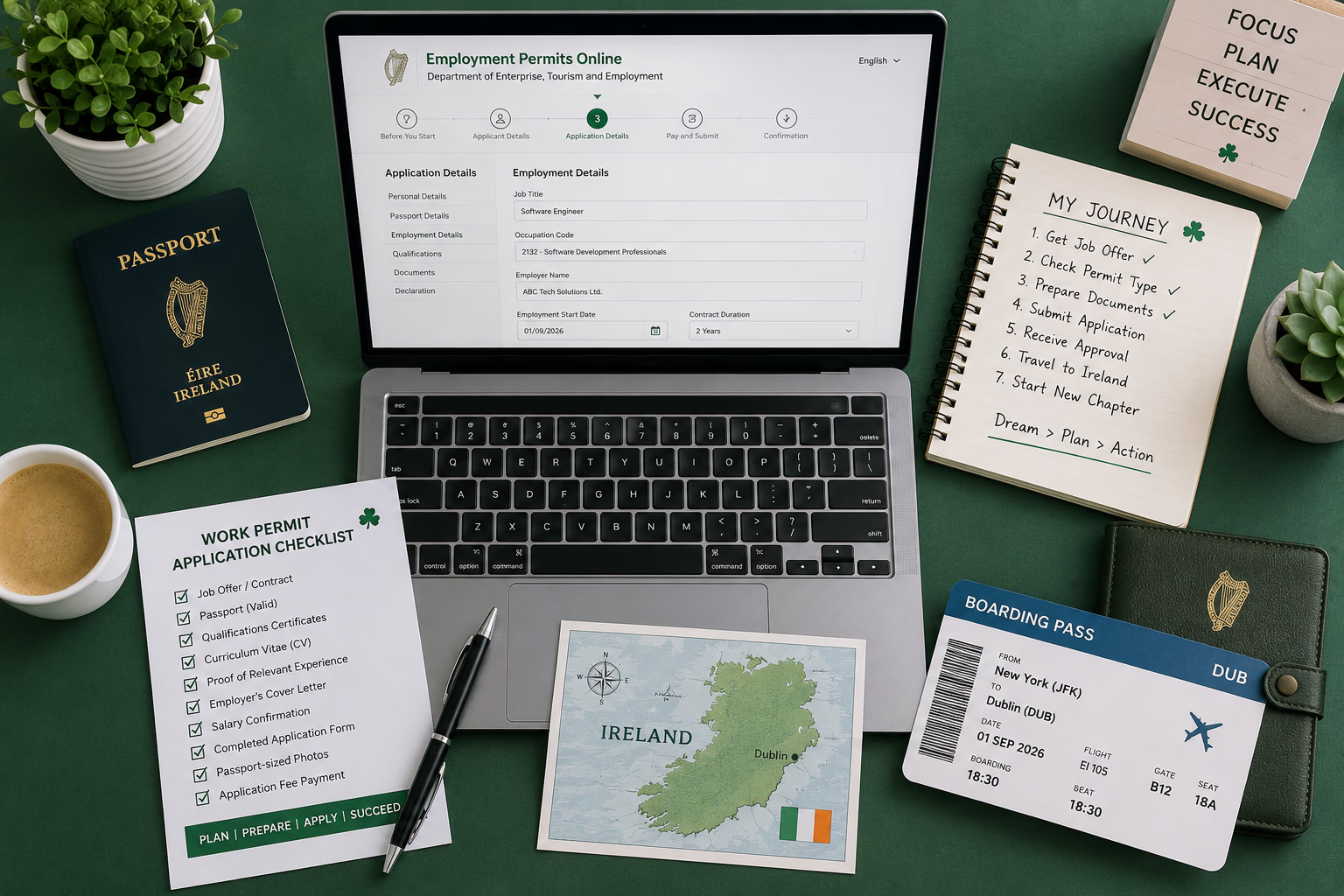
Here is the full journey for a candidate outside Ireland from a visa-required country. Non-visa-required nationals skip steps 7–8.
Step 1 – Get a qualifying job offer. Everything starts with a genuine offer from an Irish employer. Our guide on How to Get a Job in Ireland covers where to find employers who offer Ireland visa sponsorship jobs.
Step 2 – Employer runs the Labour Market Needs Test. 28 days of advertising on JobsIreland.ie/EURES plus one other online platform, unless an exemption applies. Save screenshots and confirmation emails with visible dates.
Step 3 – Prepare the documents. Both sides gather the documents listed above while the adverts run. Sign the employment contract.
Step 4 – Submit on EPOS and pay the fee. Either the employer or the employee can apply on the Employment Permits Online System. Most first permits run 2 years, so the fee is €1,000. The application enters the queue by date of receipt.
Step 5 – DETE processing. Applications go through a completeness check, then a full assessment. If anything is missing, the application is returned for correction – which adds weeks. If DETE intends to refuse, you get a chance to respond, and a refusal can be appealed (a review request) within 28 days.
Step 6 – Permit granted. The original permit issues to the employee, with a certified copy to the employer. Check every detail on it immediately.
Step 7 – Apply for the Long Stay D visa (visa-required nationals only). Apply online via AVATS, then submit your passport, permit copy, and supporting documents to the relevant embassy or visa office. Attend biometrics if required.
Step 8 – Travel to Ireland. Carry your permit and job documents in hand luggage. The immigration officer at the border grants you initial permission to enter.
Step 9 – Register for your Irish Residence Permit (IRP). After arrival, and before your landing permission ends, register with immigration (Burgh Quay in Dublin or your local Garda immigration office). Pay €300 and receive your IRP card with Stamp 1.
Step 10 – Start work. You must start employment within 6 months of the permit’s grant date under the 2024 Act. Then get your PPS number and register with Revenue (covered later).
Application Fees (2026)
Fees Table
| Application type | Duration | Fee |
|---|---|---|
| New General Employment Permit | Up to 6 months | €500 |
| New General Employment Permit | 6 months – 2 years | €1,000 |
| Renewal | Up to 6 months | €750 |
| Renewal | Up to 3 years | €1,500 |
| Long Stay D visa (visa-required nationals) | Single entry | ~€60 |
| Long Stay D visa | Multi entry | ~€100 |
| Irish Residence Permit (IRP) registration | Per year of registration | €300 |
Important fee rules:
- Either the employer or the employee may pay the permit fee
- If the application is refused or withdrawn, 90% of the fee is refunded
- It is illegal for an employer to deduct the permit fee or recruitment costs from your wages
Processing Times
DETE processes applications strictly in date order of receipt, with separate dates for each application type (for example, new General Employment Permits and renewals). It publishes the exact dates it is currently working on at its “Current Processing Dates” page, updated regularly.
Processing Time Table (typical ranges in 2026)
| Stage | Typical time |
|---|---|
| Labour Market Needs Test (advertising) | 28 days minimum |
| GEP processing (new applications) | Check DETE’s current processing dates |
| Correction cycle (if application returned) | +3–4 weeks per return |
| Long Stay D visa (visa-required countries) | ~4–8+ weeks, varies by embassy |
| IRP registration after arrival | Appointment-dependent, allow several weeks |
Realistic total: 3 to 6 months from job offer to first day at work for a visa-required national. Non-visa-required nationals can often manage it in 2 to 3 months.
Note: These are typical ranges, not guarantees. Volumes spike after salary threshold changes and before summer. Always check the live processing dates on enterprise.gov.ie, and never book flights before the permit and visa are physically issued.
Employer Obligations After the Permit Issues
The employer’s job is not done at approval. Ongoing duties include:
- Keep a copy of the permit at the place of work for the full employment
- Pay at least the salary stated on the permit, for the whole permit period
- Meet renewal salary thresholds as they rise under the MAR roadmap
- Comply with all Irish employment law (working time, payslips, leave, minimum notice)
- Never recover permit fees, recruitment fees, or travel costs from the worker’s pay
- Notify DETE of relevant changes, including if the employment ends early
- Retain records for inspection – the Workplace Relations Commission actively inspects permit employers
Employee Obligations
As the permit holder, you must:
- Work only for the employer and in the job named on the permit
- Start the job within 6 months of the permit being granted
- Register for your IRP after arrival, before your landing permission ends, and keep it renewed
- As a healthcare assistant, obtain a relevant QQI Level 5 (or comparable, clinical-lead-certified) qualification within 2 years, ready for renewal
- Tell DETE within 4 weeks if you are made redundant
- Not take a second job (Stamp 1 does not allow additional employment without a further permit)
- Keep your passport valid and your address updated with immigration
Breaching these conditions can lead to permit revocation and problems with future Irish applications.
Changing Employers – The New 9-Month Rule
This is one of the biggest improvements from the Employment Permits Act 2024.
Old rule: you were effectively tied to your first employer for 12 months, and moving meant a brand-new permit application.
Current rule (since 2 September 2024): after 9 months with your first employer, you can apply to DETE to change to a new employer without a new permit application and without a new Labour Market Needs Test.
Key conditions for GEP holders:
- The new job must be the same type of occupation (same 4-digit SOC occupation code) – a chef moves to another chef role, a welder to another welding role
- The change is available after 9 months, and your permit must still have at least 2 months to run when you apply (section 27 of the Employment Permits Act 2024); up to three changes are allowed
- The permit keeps its original expiry date – it is reissued, not restarted
- You cannot start with the new employer until the reissued permit arrives. The regulations then require you to start within 4 weeks from the date of the change of employer (DETE guidance says within 1 month of the new permit being issued)
- The new employer must still meet the 50:50 rule and pay the required salary
Want a different type of job? You can apply for a completely new employment permit (with LMNT where required) after at least 9 months, whether with your current employer or a new one. And in cases of exploitation or a genuine change of circumstances, DETE has discretion to allow a move even before 9 months.
The 2024 Act also allows promotions and internal transfers with the same employer where you keep using the same skills – no new permit needed.
Permit Renewal
Your first General Employment Permit lasts up to 2 years. You then renew for up to 3 more years.
When to apply: DETE’s guidance is that the renewal must be submitted within the 4 months before the permit expires, or within 1 month after expiry. If it is submitted within that period, you can continue to work while it is processed. Our employment permit renewal guide covers timing, documents and refusals in detail.
Renewal requirements:
- Same employer and role (or a properly processed change)
- Salary meets the current threshold at the time of renewal – renewals filed on or after 1 March 2026 must meet the new MAR figures
- Employer still compliant with the 50:50 rule (start-up exemptions are re-checked)
- Healthcare assistants: evidence of a relevant QQI Level 5 qualification, or a comparable qualification certified by the clinical lead
- Renewal fee: €750 (up to 6 months) or €1,500 (up to 3 years)
No Labour Market Needs Test is needed at renewal. After 57 months of employment you can apply for Stamp 4 instead of renewing – covered below.
Family Reunification

Yes, your family can join you – but not immediately, and the rules are stricter than for Critical Skills holders.
The 12-month rule: as a General Employment Permit holder, you can normally sponsor your spouse, civil partner, and children to join you after you have been legally working in Ireland for 12 months.
Income requirement: you must show you can support your family without relying on Irish social welfare. ISD assesses your income against thresholds linked to the Working Family Payment limits, which depend on family size. You will typically need payslips, an Employment Detail Summary, and your work history. Our guide to bringing your family to Ireland on a work permit sets out the 2026 income thresholds for spouses and children.
Who counts as family:
- Spouse or civil partner (de facto partners must show a durable relationship, usually 2 years of cohabitation)
- Unmarried children under 18
- Adult children over 18 only where they depend on your care because of a serious medical or psychological condition that makes independent life unsustainable, supported by official medical evidence; stricter dependency rules and higher income thresholds apply (ISD family reunification policy, section 7.23)
The process for visa-required families: your spouse applies for a Long Stay D (Join Family) visa from abroad. These applications are documentation-heavy and can take many months to process. Non-visa-required family members can travel and then register, but must still meet the same criteria.
What stamp do family members get? Since 15 May 2024, eligible spouses and partners of GEP holders who join under family reunification are registered on Stamp 1G rather than Stamp 3 (ISD notice).
Can Your Spouse Work in Ireland?
Yes, in most cases. The change in May 2024 removed what used to be the biggest lifestyle difference between the General Employment Permit and the Critical Skills route.
- GEP spouse: an eligible spouse or partner on Stamp 1G can work without their own employment permit. Self-employment and running a business are not allowed, and registration is renewed annually.
- CSEP spouse: receives Stamp 1G and can work for any employer, no permit needed.
The difference that remains is timing: Critical Skills families can join immediately, while GEP families normally wait 12 months. See our Stamp 1 vs Stamp 4 guide for how each stamp works.
Plan family finances around one Irish income for at least the first couple of years. Dublin rent on a single salary of €36,605 is tight; regional towns are far more manageable.
Can Americans Apply?
Absolutely – and the process is simpler for them than for most nationalities.
US citizens are non-visa-required. That means:
- They need the General Employment Permit like everyone else
- They do not need a Long Stay D entry visa
- Once the permit issues, they can book flights, enter Ireland with the permit and job documents, and register for their IRP after arrival
The same applies to citizens of Canada, Australia, New Zealand, Brazil, Mexico, Japan, South Korea, and other visa-exempt countries.
Practical notes for Americans:
- Most Americans qualify more easily under the Critical Skills Employment Permit if they work in tech, engineering, finance, or healthcare – compare both in our Critical Skills Employment Permit Ireland guide
- The GEP suits Americans in trades, hospitality management, and care roles
- US citizens must still not work remotely for the Irish employer from Ireland before the permit issues – entry as a “tourist” to start work is illegal
- Ireland taxes worldwide income for residents; the US taxes citizens globally. The Ireland–US double taxation treaty prevents double tax, but Americans should budget for annual IRS filing (FEIE or foreign tax credits usually eliminate US liability at GEP salary levels)
See our companion guide, Jobs in Ireland for Americans, for employer lists and CV tips.
Guide for Pakistani Applicants

Pakistan is a visa-required country, so applicants follow the full two-stage process: employment permit first, then the Long Stay D visa.
Step-by-step from Pakistan:
- Secure a qualifying job offer (chefs, healthcare assistants, welders, HGV drivers, and construction trades are common routes)
- Employer completes the LMNT and the EPOS application
- After the permit issues, apply for the Long Stay D Employment visa online via AVATS
- Submit your passport and documents through the designated visa application centre in Pakistan, and provide biometrics
- Applications from Pakistan are decided through the Irish visa system – processing commonly takes 8 weeks or more, so apply immediately after the permit issues
Documents Pakistani applicants should prepare early:
- Passport valid well beyond the intended stay
- Employment permit copy and signed contract
- Educational certificates and experience letters, attested where required
- Polio vaccination certificate (required for travellers from Pakistan)
- Bank statements and evidence of ties, as requested by the visa office
- Medical/travel insurance covering the initial period
Common pitfalls from Pakistan: unverifiable experience letters, gaps between stated experience and the job’s requirements, and agents charging illegal “sponsorship fees.” Remember – it is illegal for anyone to charge you for the permit itself, and legitimate Irish employers do not sell job offers. If someone asks you to pay thousands for a “guaranteed Ireland work permit,” it is almost certainly a scam. For sector-by-sector opportunities, see our guide to Jobs in Ireland for Pakistanis.
Guide for Indian Applicants
India is also visa-required, and Indian nationals received more Irish employment permits than any other nationality in 2025 (9,947 of 31,044, according to DETE statistics). Our guide to jobs in Ireland for Indians covers sectors and the application process.
The typical Indian applicant journey:
- Job offer from an Irish employer (healthcare, hospitality, construction, logistics, and food production dominate GEP hiring; IT roles usually go the Critical Skills route)
- Permit application on EPOS by the employer
- Long Stay D Employment visa via AVATS after permit approval
- Documents and biometrics through VFS Global centres in India (Delhi, Mumbai, Chennai, Bangalore, Kolkata, and other cities)
- Visa processing typically 4–8 weeks, longer in peak season
India-specific tips:
- Degree and experience documents should match the job description closely; DETE compares them
- Nurses generally use the Critical Skills route with NMBI registration – but healthcare assistants are a major GEP pathway, including for candidates who plan to upskill in Ireland
- The 12-month wait for family reunification catches many Indian families by surprise; plan for a period of separation
- Watch out for fake “Ireland work visa consultancies.” Verify any job on the employer’s official website and check the company exists on the CRO register (core.cro.ie)
General Employment Permit vs Critical Skills Employment Permit
This is the comparison every applicant should understand before choosing a route. Full details in our Critical Skills Employment Permit Ireland guide, but here are the essentials.
Permit Comparison Table (2026)
| Feature | General Employment Permit | Critical Skills Employment Permit |
|---|---|---|
| Minimum salary (from 1 Mar 2026) | €36,605 (€32,691 reduced roles) | €40,904 (or above €68,911 for non-list roles) |
| Occupations | All except Ineligible List | Critical Skills Occupations List (or roles paying above €68,911 that are not on the Ineligible List) |
| Degree required | No formal requirement | Usually a relevant degree for list roles |
| Labour Market Needs Test | Usually required | Never required |
| First permit length | Up to 2 years | 2 years |
| Path to Stamp 4 | After 57 months | After 21 months |
| Family reunification | After 12 months, income tested | Immediate |
| Spouse’s right to work | Yes, for eligible spouses (Stamp 1G since May 2024) | Yes (Stamp 1G, works freely) |
| Change employer | After 9 months (same occupation) | After 9 months (same category) |
| Typical users | Trades, care, hospitality, transport, food production | Tech, engineering, health professionals, finance |
Rule of thumb: if your occupation is on the Critical Skills list and the salary reaches €40,904, take the Critical Skills permit every time. The faster Stamp 4 and spouse work rights are worth it. The GEP is the right (and only) route for the hundreds of essential occupations the Critical Skills list does not cover.
Stamp 1 vs Stamp 4 – Why It Matters

Your immigration stamp defines your daily rights in Ireland.
Stamp 1 (what GEP holders get):
- Live in Ireland and work for your permit employer only
- No self-employment, no second jobs
- Renewed in line with your permit
- Access to public services, ability to rent, open bank accounts, get a driving licence
Stamp 4 (the goal):
- Work for any employer, no permit needed
- Self-employment and business ownership allowed
- Spouse’s pathway improves
- Counts strongly towards long-term residence and citizenship
- Renewable in longer blocks
The route from GEP to Stamp 4: after 57 months from the start of your employment in Ireland, you can apply to Immigration Service Delivery for Stamp 4 (ISD eligibility rules). From that point you no longer need employment permits at all. After 5 years of reckonable residence you can also apply for long-term residency, and naturalisation as an Irish citizen typically becomes possible after 5 years of reckonable residence (with the final year continuous).
Compare that with Critical Skills holders, who reach Stamp 4 after only 21 months – the single biggest advantage of that route.
What Happens After Arrival?

Your first month in Ireland has a fixed to-do list. Do these in order.
1. Immigration registration – your Irish Residence Permit (IRP)
Register after arrival, before your landing permission ends:
- Dublin: book online for the ISD Registration Office at Burgh Quay
- Outside Dublin: register at your regional Garda immigration office
Bring your passport, employment permit, proof of address, and the €300 fee (card payment). You receive Stamp 1 permission, and your IRP card is then sent to you by post. The IRP is your key to everything else – banks, tenancy, travel.
2. PPS Number
The Personal Public Service (PPS) number is Ireland’s tax and social services ID. You cannot be taxed properly, access public healthcare, or use most state services without it.
- Apply online at MyWelfare.ie
- You need photo ID, proof of address, and evidence of why you need the number (your job offer/contract works)
- Processing usually takes 1–3 weeks
Employers can pay you before the PPS arrives, but you will be on punitive emergency tax until Revenue links you up – so apply in week one.
3. Taxes – registering with Revenue
Once you have your PPS number:
- Create a myAccount on revenue.ie
- Register your job so Revenue issues your employer a Revenue Payroll Notification (RPN)
- Your correct tax credits then apply, and any emergency tax is refunded through payroll
What you will pay on a €36,605 salary (2026, single person, approximate):
- Income tax: 20% band covers this salary level, minus personal and employee tax credits
- USC (Universal Social Charge): progressive rates on all income
- PRSI (social insurance): employee rate applies; PRSI contributions later count towards benefits and pensions
Net take-home on €36,605 is roughly €2,540–€2,600 per month for a single person. Use Revenue’s calculators for precision.
4. Everything else
- Open an Irish bank account (IRP + proof of address)
- Get health insurance if your contract or visa conditions require it; otherwise you can use the public system, though many workers buy private cover
- Exchange or apply for an Irish driving licence if you will drive
Losing Your Job on a General Employment Permit
Redundancy is frightening on a work permit, but Irish law protects you better than most people realise.
If you are made redundant:
- Notify DETE within 4 weeks of the redundancy date using the official redundancy notification form
- You are then allowed to remain in Ireland for up to 6 months to search for a new job
- When you find a new qualifying job, the new application is exempt from the Labour Market Needs Test
- If your remaining immigration permission is short, engage with ISD about maintaining your status while you search
If you resign or are dismissed for cause, the protections are weaker. Your permit is tied to the job; once the employment ends, your basis for Stamp 1 ends with it. Speak to ISD promptly – overstaying damages every future application.
If you are being exploited – unpaid wages, illegal deductions, threats around your permit – contact the Workplace Relations Commission (WRC) or the Migrant Rights Centre Ireland (MRCI). The 2024 Act specifically allows DETE to permit an early change of employer in exploitation cases, even before the 9-month mark. Your employer does not “own” your permit, and reporting abuse does not get you deported.
Common Reasons Applications Are Refused
DETE publishes refusal reasons with each decision. In practice, most refusals fall into a short list:
- Salary below the threshold – especially applications drafted before March 2026 using the old €34,000 figure
- 50:50 rule failure – the workforce is more than half non-EEA at decision time
- Defective Labour Market Needs Test – adverts ran fewer than 28 days, salary in the ad differed from the contract, or the ad missed required details
- Occupation on the Ineligible List – or the job description was written vaguely enough that DETE classified it into an ineligible code
- Quota exhausted – applications for filled-quota roles are rejected outright
- Qualifications mismatch – the candidate’s documents do not demonstrate the skills the advert demanded
- Employer compliance issues – past permit breaches, tax problems, or insufficient trading history
- Incomplete or illegible documents – repeated return cycles that eventually time out
If refused: you receive the reasons in writing and can submit a request for review within 28 days to a different DETE official. If the refusal stands, a fresh, corrected application is often the fastest path. Remember the 90% fee refund on refusals.
Common Applicant Mistakes
- Using outdated salary figures from old blog posts and forums
- Starting the LMNT adverts too late, then submitting before day 28
- Booking flights before the visa issues – embassies do not care about your ticket
- Letting the passport run short – renew it before applying, not after
- Job descriptions that don’t match reality, triggering classification problems
- Paying agents for “sponsorship” – a legitimate permit never requires you to buy the job
- Missing the IRP registration deadline set by your landing permission
- Forgetting the QQI Level 5 requirement as a healthcare assistant, which can sink the renewal
- Applying for renewal too late and losing the right to work while waiting
- Assuming a spouse cannot work – since May 2024, eligible GEP spouses on Stamp 1G can
Worked Examples
Example 1 – Chef from India, standard route. Arjun, a tandoor chef with 8 years’ experience, gets an offer from a Galway restaurant at €38,000. The role is not on the Ineligible List and beats the €36,605 threshold. The restaurant advertises for 28 days on JobsIreland and Irishjobs.ie, gets no suitable EEA applicants, and applies on EPOS with the €1,000 fee. The permit issues in 9 weeks (standard queue). Arjun’s D visa takes another 6 weeks via VFS Mumbai. Total: about 5 months from offer to first shift. After 12 months, he applies to bring his wife and daughter over, showing payslips that meet the income test.
Example 2 – Healthcare assistant from the Philippines, reduced threshold. Maria has a caregiving diploma and an offer from a nursing home in Cork at €32,691 (€16.12/hour). Healthcare assistant roles qualify for the reduced threshold. Because DETE expects a relevant QQI Level 5 qualification within two years, her employer enrols her in a QQI Level 5 Healthcare Support course. At renewal in 2028, she presents her completed QQI certificate.
Example 3 – American restaurant manager, no entry visa. Jake from Texas is offered €45,000 to manage a Dublin gastropub. The salary is well above the threshold, but under €68,911, so the employer still runs the 28-day LMNT. Permit granted in 7 weeks. As a US citizen, Jake needs no D visa – he flies over, shows his permit at Dublin Airport, registers at Burgh Quay soon after arrival (€300), gets his PPS number online, and sorts his Revenue myAccount in week two.
Example 4 – Welder made redundant. Piotr’s (non-EEA) employer closes after 14 months of his permit. He notifies DETE within 4 weeks using the redundancy form. He has up to 6 months to find new work. A new welding job in Limerick comes through in month two – and because of his notified redundancy, the new application needs no Labour Market Needs Test. He is back at work within 10 weeks.
Application Timeline
| Phase | Week (typical) |
|---|---|
| Job offer accepted, contract signed | Week 0 |
| LMNT adverts running (28 days) | Weeks 1–4 |
| EPOS application submitted, fee paid | Week 5 |
| DETE processing (standard queue) | Weeks 5–14 |
| Permit issued | ~Week 14 |
| D visa application via AVATS (visa-required only) | Weeks 14–15 |
| Visa decision | Weeks 18–22 |
| Travel to Ireland | Week 23 |
| IRP registration + PPS number | Weeks 23–26 |
| Fully set up: taxed correctly, banked, working | ~Month 6 |
Non-visa-required nationals can often compress this to 2–3 months.
Pros and Cons
Pros:
- Covers hundreds of occupations no other permit reaches
- No degree requirement – experience and trade skills count
- New 9-month change-of-employer right reduces dependence on one boss
- Clear legal path to Stamp 4, long-term residence, and Irish citizenship
- Redundancy protections and LMNT exemption if you lose your job
- 90% fee refund if refused; employer cannot charge you the fee
Cons:
- Slower route to Stamp 4 than Critical Skills (57 months vs 21 months)
- Family must wait 12 months, and the income test applies
- Labour Market Needs Test adds a month and a common failure point
- Salary thresholds now rise annually under the MAR roadmap to 2030
- Quotas can close popular occupations without much warning
Frequently Asked Questions

1. What is the minimum salary for a General Employment Permit in Ireland in 2026?
From 1 March 2026, the minimum is €36,605 per year. A reduced threshold of €32,691 (€16.12 per hour) applies to healthcare assistants, home carers, meat processing operatives, and horticulture workers. These figures come from the Government’s new Minimum Annual Remuneration roadmap, which will keep raising thresholds annually until 2030. Applications submitted with the old €34,000 figure are refused, so check the DETE website for the live threshold before your contract is drafted.
2. How long does a General Employment Permit take to process?
DETE processes applications in date order of receipt and publishes the dates it is currently processing for each application type, so check its processing dates page for the current wait. Add 28 days beforehand for the Labour Market Needs Test and, for visa-required nationals, another 4–8+ weeks for the Long Stay D visa afterwards. A realistic total from job offer to starting work is three to six months. Incomplete applications get returned, adding several weeks each time.
3. Can I apply for the permit myself, or must my employer do it?
Either of you can apply on the Employment Permits Online System (EPOS), and either can pay the fee. In practice, employers usually submit because they hold the Labour Market Needs Test evidence, company registration numbers, and workforce data the form demands. What your employer can never do is deduct the fee or any recruitment costs from your wages – that is illegal under Irish employment permits law.
4. Do I need a university degree for a General Employment Permit?
No. The GEP has no formal degree requirement, which is a key difference from the Critical Skills Employment Permit. You need the skills, qualifications, or experience that the specific job requires. A chef proves this through kitchen experience letters; an electrician through trade certification. DETE compares your documents against the requirements listed in the job advertisement, so make sure they align.
5. What is the Labour Market Needs Test?
It is the requirement to prove the job was offered to Irish and EEA workers first. Since the Employment Permits Act 2024, the employer must advertise the vacancy on JobsIreland.ie/EURES and at least one other online platform for a minimum of 28 consecutive days before applying. The old newspaper advertising requirement was abolished. The advert must state the job title, description, salary, hours, and required qualifications accurately.
6. Which jobs are exempt from the Labour Market Needs Test?
Exemptions apply where the job pays €68,911 or more, the occupation is on the Critical Skills Occupations List, the role is recommended by Enterprise Ireland or IDA Ireland, you were made redundant from a permit job and notified DETE, you care for a person with exceptional medical needs, or you are using the change-of-employer process as an existing permit holder.
7. How much does the General Employment Permit cost?
A new permit costs €500 for durations up to six months or €1,000 for six months to two years. Renewals cost €750 (up to six months) or €1,500 (up to three years). If your application is refused or withdrawn, 90% of the fee is refunded. Visa-required nationals also pay around €60–€100 for the Long Stay D visa, and everyone pays €300 for Irish Residence Permit registration after arrival.
8. How long is the General Employment Permit valid?
The first permit is issued for up to two years, matching your employment contract. You can then renew for up to three further years. After 57 months from the start of employment in Ireland, you can apply to Immigration Service Delivery for Stamp 4 permission, which removes the need for any employment permit and lets you work for any employer in Ireland.
9. Can I change employers on a General Employment Permit?
Yes. Since 2 September 2024, you can apply to change employer after nine months with your first employer, without a new permit application or a new Labour Market Needs Test. The new role must be the same occupation type (same 4-digit SOC code), and the permit keeps its original expiry date. For a different type of job, you can apply for a completely new permit after nine months. In exploitation cases, DETE can approve a move even earlier.
10. Can my family join me in Ireland?
Yes, after you have worked legally in Ireland for 12 months. You must also meet an income requirement, assessed against thresholds linked to the Working Family Payment, proving you can support your family without social welfare. Spouses, civil partners, de facto partners, and children under 18 (adult children only if they depend on your care because of a serious medical or psychological condition) qualify. Visa-required family members apply for a Long Stay D join-family visa, which can take many months.
11. Can my spouse work in Ireland if I hold a General Employment Permit?
In most cases, yes. Since 15 May 2024, eligible spouses and partners of GEP holders who join under family reunification are registered on Stamp 1G, which allows them to work without their own employment permit (self-employment is not allowed). Spouses of Critical Skills permit holders also get Stamp 1G. The main difference is that GEP holders normally wait 12 months before family can join.
12. Can Americans apply for a General Employment Permit?
Yes. US citizens need the employment permit like all non-EEA nationals, but they are visa-exempt, so they skip the Long Stay D visa stage. Once the permit issues, they can travel to Ireland, present the permit at the border, and register for their Irish Residence Permit after arrival. The same applies to Canadians, Australians, and citizens of other non-visa-required countries.
13. Can Pakistani citizens apply for the Ireland work permit?
Yes. Pakistan is a visa-required country, so applicants need both the employment permit from DETE and then a Long Stay D Employment visa applied for through AVATS, with biometrics submitted via the visa application centre. Common GEP occupations for Pakistani applicants include chefs, healthcare assistants, welders, and drivers under open quotas. Beware of agents selling “guaranteed” permits – charging workers for permits is illegal.
14. Is IELTS required for an Ireland work permit?
No. DETE does not require any English language test for the General Employment Permit itself. However, individual employers may test English at interview, some regulated professions require it for registration, and visa officers expect you to be able to perform the job. Healthcare roles in particular often demand demonstrable English. So while there is no formal IELTS threshold, functional English is practically essential.
15. What is the 50:50 rule?
DETE will not grant a permit if more than 50% of the employer’s workforce is from outside the EEA at the time of application. Exceptions exist for genuine start-ups registered with Revenue within the past two years that hold a support letter from Enterprise Ireland or IDA Ireland, and for companies where the permit holder will be the sole employee.
16. What happens if I lose my job?
If you are made redundant, notify DETE within four weeks using the redundancy notification form. You can then remain in Ireland for up to six months to find a new job, and your next permit application is exempt from the Labour Market Needs Test. If you resign or are dismissed, protections are weaker and you should contact Immigration Service Delivery quickly to manage your status.
17. Can I do a second job or freelance work on Stamp 1?
No. Stamp 1 tied to a General Employment Permit allows you to work only for the employer and in the occupation named on the permit. Second jobs, gig work, and self-employment are not permitted. These restrictions disappear once you obtain Stamp 4 after 57 months, at which point you can work for anyone or start a business.
18. When can I apply for Stamp 4 or permanent residency?
After 57 months from the start of employment in Ireland, you can apply to Immigration Service Delivery for Stamp 4, which removes permit requirements entirely. Five years of reckonable residence also opens long-term residency, and Irish citizenship by naturalisation generally becomes available after five years of reckonable residence, with the final year continuous. Critical Skills permit holders reach Stamp 4 far faster, at 21 months.
19. What is the difference between the General Employment Permit and the Critical Skills Employment Permit?
The Critical Skills permit covers a positive list of high-skill occupations, requires €40,904+ (from March 2026), needs no Labour Market Needs Test, gives immediate family reunification with spouse work rights, and reaches Stamp 4 in 21 months. The General Employment Permit covers everything off the Ineligible List, requires €36,605+, usually needs the LMNT, imposes a 12-month family wait, and reaches Stamp 4 after 57 months.
20. Can I enter Ireland while my permit application is pending?
No, not for work purposes. If you are outside Ireland, the permit must be approved before you travel, and visa-required nationals also need the D visa in their passport. Entering as a visitor and starting work is illegal and can lead to refusal of future applications, deportation, and bans. If you are already legally in Ireland on Stamp 1, 1G, 2, 2A, or 3, you may apply without leaving.
21. Does the permit tie me to one location in Ireland?
The permit names your employer and place of employment. You can live anywhere and commute, but the job itself must be the one described. If your employer relocates you or promotes you internally using the same skills, the 2024 Act accommodates this without a new permit. A move to a genuinely different role or employer must go through the change-of-employer or new-permit process.
22. Are there quotas on General Employment Permits?
Some occupations are only eligible under fixed quotas set by regulation – examples have included mechanics, HGV drivers, meat processors, horticulture workers, and dairy assistants. When a quota fills, DETE rejects further applications, as happened with the 200-permit mechanics quota. Non-quota occupations have no numerical cap. Always check DETE’s latest updates page before applying for a quota role.
23. Can students in Ireland switch to a General Employment Permit?
Yes. If you hold Stamp 2 as a student and receive a qualifying job offer, you (or your employer) can apply for a GEP without leaving Ireland. The standard rules apply: eligible occupation, €36,605 salary (or the reduced threshold), and normally the Labour Market Needs Test. Many graduates use Stamp 1G graduate permission first, then transition to a permit.
24. Do I pay Irish taxes on a General Employment Permit?
Yes, exactly like Irish workers. You pay income tax (PAYE), the Universal Social Charge, and PRSI social insurance through payroll. Get your PPS number quickly and register the job in Revenue’s myAccount, or you will be placed on emergency tax at higher rates until Revenue links your record. Overpaid emergency tax is refunded through payroll once registration completes.
25. What is the Trusted Partner Initiative?
It was a DETE registration for employers who hire non-EEA workers regularly. DETE now says a separate Trusted Partner Initiative is no longer required, because all employers must submit Revenue documentation and a CRO number to maintain their Employment Permits Online account. Its processing dates are listed by application type rather than separately for Trusted Partners.
26. Can the permit be refused, and can I appeal?
Yes. Common refusal grounds include salary below threshold, a defective Labour Market Needs Test, the 50:50 rule, ineligible occupations, and filled quotas. You can submit a request for review within 28 days of a refusal, and a different DETE officer reconsiders the decision. Alternatively, a corrected fresh application is often faster. Refused applicants are refunded 90% of the fee.
27. Does time on a General Employment Permit count towards Irish citizenship?
Yes. Legal residence on Stamp 1 through employment permits is reckonable residence for naturalisation. You generally need five years of reckonable residence within the last nine, including one continuous year immediately before applying. Time spent as a student on Stamp 2 does not count, which is why switching to a permit matters for anyone with long-term plans in Ireland.
Get Ireland job alerts by email
Ireland’s permit rules and salary thresholds changed twice in the last eighteen months. Subscribe and we will email you when they change again, plus new job alerts and guides.
Conclusion
The General Employment Permit Ireland remains the country’s workhorse immigration route in 2026. It opens the door for chefs, carers, tradespeople, drivers, and thousands of other essential workers whom the Critical Skills system was never designed to cover.
The system is fairer than it used to be. The Employment Permits Act 2024 gave workers the right to change employers after nine months, modernised the Labour Market Needs Test, and built in protections against exploitation. The trade-off is a rising cost of entry: €36,605 from March 2026, with annual increases scheduled through 2030.
Your success comes down to three things. First, a genuine job offer in an eligible occupation at the correct salary. Second, an employer who follows the LMNT and compliance rules to the letter. Third, patience with a process that realistically takes three to six months end to end.
Get those right, and the permit becomes what it is designed to be – the first step on a clear legal path from Stamp 1, to Stamp 4 after 57 months, to long-term residency and, if you want it, Irish citizenship.
Start with the job. Our guides on How to Get a Job in Ireland, Ireland Visa Sponsorship Jobs, and the Ireland Work Visa process will take you the rest of the way.
Official Sources
- Department of Enterprise, Tourism and Employment (DETE) – General Employment Permit rules, Ineligible List, quotas, processing dates: enterprise.gov.ie
- Employment Permits Online System (EPOS) – where applications are submitted: employmentpermits.enterprise.gov.ie
- Citizens Information – plain-English summaries of permit and immigration rules: citizensinformation.ie
- Immigration Service Delivery (ISD) – D visas, IRP registration, family reunification, Stamp 4: irishimmigration.ie
- Revenue Commissioners – PPS registration of jobs, tax credits, myAccount: revenue.ie
- Employment Permits Act 2024 – the governing legislation: irishstatutebook.ie
- Employment Permits Regulations 2024 (S.I. No. 444 of 2024) – Regulation 19(7), the 4-week start deadline after a change of employer: irishstatutebook.ie
- DETE – Changing employer – guidance to start within one month of the new permit being issued: enterprise.gov.ie
- Workplace Relations Commission – employment rights and complaints: workplacerelations.ie
Stamp 4 timing, spouse rights, renewal timing, Trusted Partner, LMNT exemption and registration details checked 13 October 2026 against DETE and ISD. Other information last verified July 2026. Salary thresholds shown took effect on 1 March 2026 under the Minimum Annual Remuneration roadmap and are scheduled to rise again in future phases.